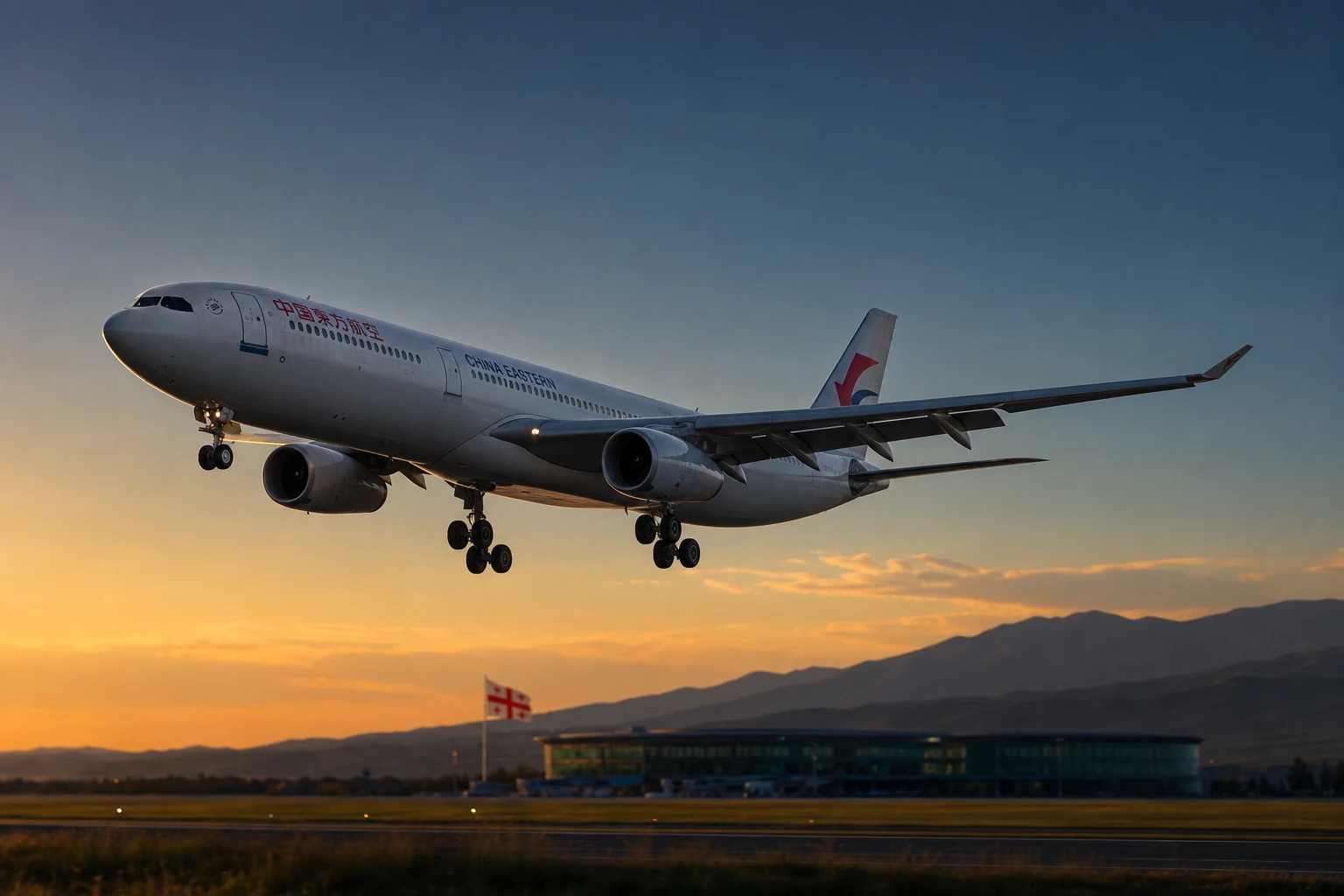
China Eastern Airlines’ first direct flight from Shanghai touched down in Tbilisi on July 15 with a 98% load factor, Georgia’s economy minister, Mariam Kvrivishvili, said, opening the country’s longest nonstop air route and a new front in its tilt toward Beijing. The Airbus A330 carried 274 passengers on the roughly 10 hour journey from Shanghai Pudong International Airport, China Eastern Airlines said.
Officials in Tbilisi are calling the launch proof that Georgia’s strategic partnership with China delivers results. Trade and investment figures tell a messier story underneath.
A Nearly Full Widebody Lands in Tbilisi
The inaugural flight, numbered MU285, landed in the Georgian capital at around 7 p.m. local time on Wednesday, July 15, after departing Shanghai Pudong at 12:50 p.m. Beijing time. China Eastern’s vice president confirmed the passenger count and flight time to Xinhua, the Chinese state news agency, at the arrival ceremony.
Kvrivishvili called the launch a milestone for Georgia’s aviation sector. “This is another important demonstration of what a strategic partnership means in practice,” she said. “It translates into economic activity, tourism and direct flights, strengthening our country’s economy.”
She said the route is now the longest direct flight currently operating out of Tbilisi International Airport, and said she expects frequencies to rise if demand holds. The route grew out of a meeting she held with China Eastern executives during an official visit to China in April.
Georgian Prime Minister Irakli Kobakhidze also spoke at the ceremony, telling attendees that Georgia-China relations have developed quickly in recent years and that he expects the flights to strengthen bilateral ties further. Chinese Ambassador to Georgia Zhou Qian and China Eastern Vice President He Xiaoxuan also attended, alongside representatives of Georgia’s aviation and airport sectors.
| Detail | Outbound MU285 | Return MU286 |
|---|---|---|
| Departure | Shanghai Pudong, 12:50 (Beijing time) | Tbilisi, 21:00 (local time) |
| Arrival | Tbilisi, 19:00 (local time) | Shanghai Pudong, 10:00 next day (Beijing time) |
| Aircraft | Airbus A330 widebody | Airbus A330 widebody |
| Frequency | Wednesdays, Fridays, Sundays | Wednesdays, Fridays, Sundays |
Aviation trade outlets describe it as the first widebody service ever flown directly between Georgia and China, and the first route linking Tbilisi to China’s Yangtze River Delta region, a manufacturing and finance hub. The distance covered is about 4,192 miles, or 6,746 kilometers, each way.
Beijing’s Travelers Are Already Showing Up
The flight lands on top of an existing visa waiver. Ordinary passport holders from China and Georgia can already enter each other’s country for stays of up to 30 days without a visa, a policy both governments credit with priming demand before a single direct flight existed.
The numbers back that up. Chinese arrivals to Georgia topped 20,000 in the first quarter of 2026, a 48.6% jump from the same period a year earlier. Georgia’s government has backed that growth with an annual tourism promotion budget in the Chinese market of GEL 7 million, roughly $2.6 million, according to Kvrivishvili.
Set against Georgia’s overall inbound numbers, the China trend looks even sharper. Total international visits to Georgia slipped 0.2% year on year in the same quarter, to 1.2 million, according to Civil Georgia’s reporting on national tourism data. China is growing fast off a small base while Georgia’s broader visitor count barely moved.
Georgia has also positioned itself as the official partner country at ITB China, a major Shanghai tourism trade show, a status Kvrivishvili’s ministry says is designed to keep building name recognition among Chinese travel agents and tour operators ahead of further route announcements.
Why Is Georgia Racing Toward Beijing Right Now?
Georgia upgraded its relationship with China to a “comprehensive strategic partnership” on June 9, 2026, one day after the U.S. House of Representatives advanced a bill demanding a formal assessment of Chinese and Russian influence inside the country. The timing lines up with a deepening rift between Tbilisi and its traditional Western partners as much as any new opening with Beijing.
The upgrade was announced through letters exchanged between Chinese President Xi Jinping and Georgian President Mikheil Kavelashvili, marking the 34th anniversary of diplomatic ties. Kobakhidze framed it as the next stage after the original 2023 strategic partnership.
Today is a very important day… We are now moving to a new stage of our relations, this is the stage of comprehensive strategic partnership.
Kobakhidze said that at a briefing marking the announcement. He pointed to visa-free travel, direct flights and expanding air connectivity as the concrete results of the first three years of the partnership, and said bilateral trade turnover jumped 45% between January and April 2026 alone, after rising 17% in 2024 and 21% in 2025. He also said China is now Georgia’s third largest trading partner overall and its second largest export destination.
The U.S. House bill followed Washington’s own suspension of its strategic partnership with Georgia in 2024 over democratic backsliding concerns, a rupture Georgian Dream, the governing party, has repeatedly cited as justification for leaning toward Beijing instead.
The Trade Ledger Doesn’t Match the Rhetoric
Independent researchers looking at the same relationship describe a different picture. Chinese foreign direct investment in Georgia fell from $98 million in 2023 to just $29 million in 2024, a drop of roughly 70%, according to an analysis published by The Diplomat examining two years of the strategic partnership. By the first quarter of 2026, Chinese FDI made up just 4.6% of all foreign investment in Georgia and China still does not rank among the country’s top ten investment sources.
A separate report from the Georgian research group Civic IDEA, titled From Promise to Disparity, reaches a similar conclusion about the gap between the partnership’s political messaging and its economic footprint.
The two sets of numbers are not strictly contradictory. One measures growth rate off a small base. The other measures scale against Georgia’s biggest trading partners. But they support very different conclusions about how much the partnership has actually changed.
- Georgian Dream officials – Kobakhidze says trade turnover with China is up 45% this year alone and calls China the country’s third largest trading partner and second largest export market.
- Independent analysts – The Diplomat and Civic IDEA say Chinese investment has collapsed since 2023 and that China does not appear among Georgia’s top five export destinations, still trailing Turkiye, the United States and Russia in overall trade.
Kvrivishvili has also said Georgia remains hopeful China will join the Anaklia Deep Sea Port project as one partner among several, a sign the two countries’ most ambitious joint infrastructure plan is still more aspiration than signed agreement.
The Airlines That Beat China Eastern to Tbilisi
China Eastern is not even the first Chinese carrier into Georgia. It is the third Chinese airline to operate direct scheduled flights on the route, following two carriers that opened service in earlier years as part of the same aviation push.
Chinese airlines are not the only ones arriving. Tbilisi has drawn a wave of new European entrants over the past two years, part of what Aviation Week describes as a strategy to build the capital into a Europe-Asia hub.
- British Airways – launched service to Tbilisi in 2025
- easyJet – entered the Georgian market in 2025
- Air Serbia and Edelweiss – both began flying to Tbilisi in 2025
- Transavia France – added service in 2025
- Norwegian – preparing to launch flights from Copenhagen in 2026
Kvrivishvili has been courting still more carriers on the same logic, including in talks with British Airlines about additional direct routes. The airport itself is being rebuilt to handle the traffic, with a $150 million concession extending infrastructure work to 2031. Georgia is making a parallel bet on sea transit, too, having begun construction on a second berth at Poti Port as it markets itself as a Belt and Road transit corridor between Europe and Asia.
Frequency Increases Hinge on Ticket Demand
For now, the route stays fixed at three flights a week. Kvrivishvili has said frequencies could grow later if bookings stay strong, but she has not put a date or a threshold on that decision.
A single full flight, however striking, is one data point. Inaugural flights on new international routes often draw diaspora travelers, journalists, officials and curious early adopters willing to fly on day one regardless of price. The real test is whether the Wednesday-Friday-Sunday pattern holds up once the novelty wears off.
Under that same rhythm, the second Shanghai-Tbilisi flight was due back into Georgia the very evening this story published, a quieter, unwatched rerun of the ceremony that greeted the first one.