A fresh marketing image leak shows the iQOO Z11 headed to India with a horizontal camera bar that looks straight off a Google Pixel. The redesign sits far from the Chinese and Malaysian versions and arrives with a curved OLED, big battery claims and a price near INR 35,000.
iQOO India CEO Nipun Marya has already teased the phone. Launch chatter points to August.
Skyline Camera Module Steals the Show
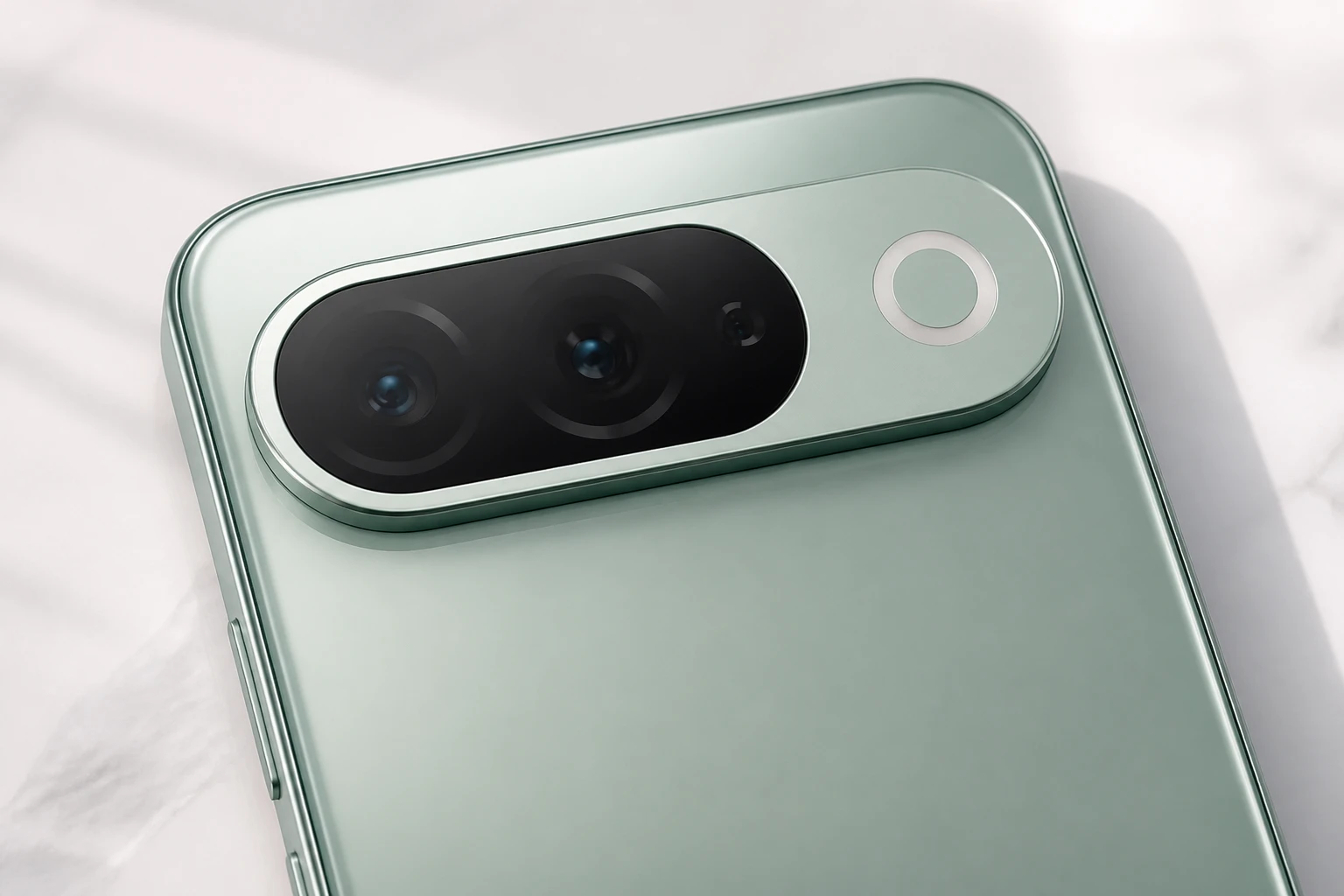
The leaked shot reveals a pill-shaped aluminium island running across the upper back. Two large camera rings sit beside a smaller third sensor and a circular LED. iQOO calls it the Skyline Camera Module. Polished chamfered edges catch light and the whole unit sits raised for grip and table stability.
That raised island does double duty. It keeps the glass off flat surfaces and gives fingers a natural stop when the phone is held one-handed. The aluminium machining also breaks up the rear panel so the phone reads as more expensive in hand than a plain plastic or glass slab.
Colors are Aurora Green, inspired by the northern lights, and Celestial Blue drawn from the night sky. Both finish options pair with a slim frame and curved rear panel that flows into a large 3D curved display with narrow bezels.
- Horizontal pill camera island with aluminium machining
- Nature-inspired Aurora Green and Celestial Blue finishes
- 3D curved OLED that meets a one-piece narrow frame
- Claimed slim, lightweight build despite the big screen
China’s Z11 uses a flat rear, flat frame, flat 6.83-inch panel and a squircle camera module with vertical lenses. India gets the more premium silhouette.
The horizontal bar is the clearest visual break. Vertical squircle modules still dominate much of the midrange. A full-width pill signals a different design brief and aligns the phone with the Pixel look that many buyers already recognize from across the aisle.
How the Specs Stack Against the China Model
Leaks put the Indian Z11 on a curved OLED with “1.5K” resolution and 144 Hz. Power comes from the MediaTek Dimensity 7500 Turbo with 8 GB or 12 GB of RAM. Battery capacity is floated between 7,000 mAh and 8,000 mAh with 90 W charging. The main camera is a 50 MP unit with OIS; the selfie shooter is 32 MP. An in-display fingerprint reader and dual IP68 plus IP69 ratings round out the package.
| Feature | India Z11 (leaked) | China Z11 (launched) |
|---|---|---|
| Chipset | Dimensity 7500 Turbo | Dimensity 8500 |
| Display | Curved 1.5K OLED, 144 Hz | 6.83-inch flat AMOLED, up to 165 Hz |
| Battery | 7,000-8,000 mAh, 90 W | 9,020 mAh, 90 W |
| Main camera | 50 MP OIS | 50 MP OIS + 2 MP depth |
| Selfie | 32 MP | 16 MP |
| Protection | IP68 + IP69 | Not highlighted at launch |
| Price target | ~INR 35,000 | Higher-end midrange China pricing |
Malaysia received a Snapdragon 7s Gen 4 version. India becomes the third market with its own silicon and design mix.
Read side by side, the sheet shows a clear swap. India trades peak refresh rate, multi-core headroom and some battery capacity for curve, sealing and a sharper front camera. The 90 W charge rate stays constant across both phones, so top-up speed is the one performance claim that does not move.
The Chipset Choice Carries Trade-Offs
The Dimensity 7500 Turbo is new to India. MediaTek positions the base Dimensity 7500 as a mainstream chip built on 4 nm with the first Arm C1 CPU cores in its class plus an NPU 850 for on-device generative AI. Official claims include stronger everyday performance and efficiency versus the prior generation.
Key MediaTek figures for the platform include:
- Up to 30% faster app switching and 11% faster cold launches versus previous Dimensity
- NPU 850 delivering more than double the AI performance for speech tools and summarization
- Support for 1.5K+ displays at high refresh and up to 200 MP camera sensors
- Wi-Fi 6E and Bluetooth 5.4 with long-range options
Those Arm C1 cores and NPU 850 AI features sound strong on paper. Yet Chinese buyers received the higher Dimensity 8500. Commenters on GSMArena immediately flagged the familiar China-versus-global SoC gap. The Indian phone looks flagship-adjacent on the outside while the processor stays firmly midrange.
For day-to-day work the gap may feel smaller than the model numbers suggest. App switching, cold launches and on-device speech tools are exactly the tasks MediaTek chose to highlight. Heavy multi-core loads and sustained gaming will still favor the China silicon. Buyers who live in browsers, chat apps and social cameras are the ones the Turbo configuration is built to serve.
Price Moves the Z Series Upmarket
At roughly INR 35,000 the Z11 sits well above the Z10, which opened near INR 21,999 for the base 8 GB + 128 GB model. The Z11x and Z11 Lite already sit at lower starting prices. The jump puts the standard Z11 against OnePlus Nord CE-class devices, Motorola Edge midrangers and upcoming Redmi Note models.
That is a full step up the ladder inside iQOO’s own range. The Z10 held the value lane. The standard Z11 now asks for money closer to phones that already carry curved glass and stronger brand heat in the same showrooms.
- Z10 base opened near INR 21,999
- Z11x and Z11 Lite hold the lower rungs
- Standard Z11 targets roughly INR 35,000
- Rivals include Nord CE-class, Motorola Edge midrangers and Redmi Note models
Buyers who want the curved glass and IP69 seal will pay more. Those chasing pure silicon value may look at the Lite or wait for sales. The redesign and durability package are the clear justifications for the higher sticker.
CEO Teases Confirm the India Push
Nipun Marya, CEO of iQOO India, has posted multiple hints. One early August message used first letters to spell ZELEVEN. Another shared a sketch with the line “Not every sketch belongs on paper.”
Not every sketch belongs on paper. Any guesses what this one is turning into?
Marya wrote that in the hand-drawn design sketch teaser that drew thousands of views. The earlier acrostic post spelling ZELEVEN left little doubt. Official iQOO India accounts have joined the binary-puzzle style teasers. Reports still point to an August debut, with some chatter of a late-month window.
The teaser sequence itself is short and deliberate:
- Early August – acrostic post spells ZELEVEN from first letters
- Follow-up post – hand-drawn sketch with the “not every sketch” line
- Official accounts – binary-puzzle style posts join the drip
- Launch window – August, with late-month chatter still active
Each step tightens the frame without giving the full sheet away. The sketch post in particular primed eyes for the horizontal bar that the marketing leak later confirmed.
Durability and Battery Aim at Real Use
IP68 and IP69 ratings are uncommon at this tier. Combined with a battery in the 7,000-plus mAh range and 90 W charging, the phone targets users who keep devices for years and want less top-up anxiety. The 50 MP OIS main sensor and 32 MP front camera look competent for social and travel shots, though the China model’s dual-rear setup is simpler yet paired with stronger silicon.
IP69 adds high-pressure hot-water resistance on top of the familiar dust and immersion cover of IP68. That pairing matters for buyers who take phones to wet kitchens, dusty commutes or outdoor work. Few rivals near the rumored price lead with both ratings at once.
Sister brand Vivo has also pushed curved screens and distinctive camera islands into the midrange recently, as seen in Vivo’s own recent midrange curved-screen push. iQOO’s Skyline move fits the same family playbook of adding flagship visual cues without full flagship silicon.
The shared playbook is easy to spot. Curve the glass, give the camera island a name, seal the body, and keep the chipset in the efficient midrange band. The result looks and feels richer than the bill of materials alone would suggest.
Three Markets Build Three Separate Phones
China, Malaysia and India now each carry a Z11 that shares a name and little else. The split goes beyond a single part swap. Silicon, camera layout, display shape and protection ratings all move with the market.
| Market | Silicon | Design notes |
|---|---|---|
| China | Dimensity 8500 | Flat body, squircle vertical cameras, 6.83-inch flat panel |
| Malaysia | Snapdragon 7s Gen 4 | Local tuning of the global mix |
| India | Dimensity 7500 Turbo | Skyline bar, curved OLED, IP68 + IP69 |
That approach lets iQOO match local price bands and taste without forcing one global mold. Indian buyers get the silhouette and sealing story. Chinese buyers keep the stronger multi-core chip and the larger 9,020 mAh cell. Malaysian stock takes a Qualcomm path instead.
The risk is confusion when reviewers or importers cross borders. A “Z11” benchmark from China will not describe the phone on Indian shelves. Shoppers will need to check the camera bar and the chipset name, not only the model number, before they compare scores or battery claims.
The Redesign Pushes the Line Toward Longer Ownership
The India Z11 package reads as a bet on keep time rather than peak charts. A sealed body, a battery floated in the 7,000 mAh to 8,000 mAh band, and 90 W charging all point at users who dislike frequent top-ups and who may hold a handset past the first two years.
Curved glass and the Skyline bar support that story in the shop. They give the phone a flagship first impression even though the Dimensity 7500 Turbo stays in mainstream territory. The higher selfie resolution adds another daily-use win for calls and social clips.
The cost of that tilt is clear from the China sheet. Less multi-core muscle, a smaller cell than 9,020 mAh, and a 144 Hz cap instead of 165 Hz. Buyers who chase synthetic scores or maximum endurance numbers still have reasons to look at the Lite, wait for discounts, or watch rival Nord CE-class and Edge models.
For everyone else the mix is coherent. Pay more than the Z10, receive the curve, the seal and the named camera island, and live with midrange silicon that MediaTek already tunes for app switching and on-device AI. That is a different pitch from pure speed per rupee, and it is the pitch the leak and the teasers both reinforce.
What Indian Buyers Get
The India Z11 is a different product from the China phone that shares its name. It gains a more modern camera bar, curved glass, stronger dust and water protection and a higher selfie resolution. It loses peak multi-core muscle and some battery capacity. At the rumored price it becomes a design-and-endurance play rather than a pure performance bargain.
Whether that mix lands will show once official specs and pricing lock in later this month. For now the leaked marketing image has done its job: the phone looks like nothing else currently in the iQOO Z lineup.