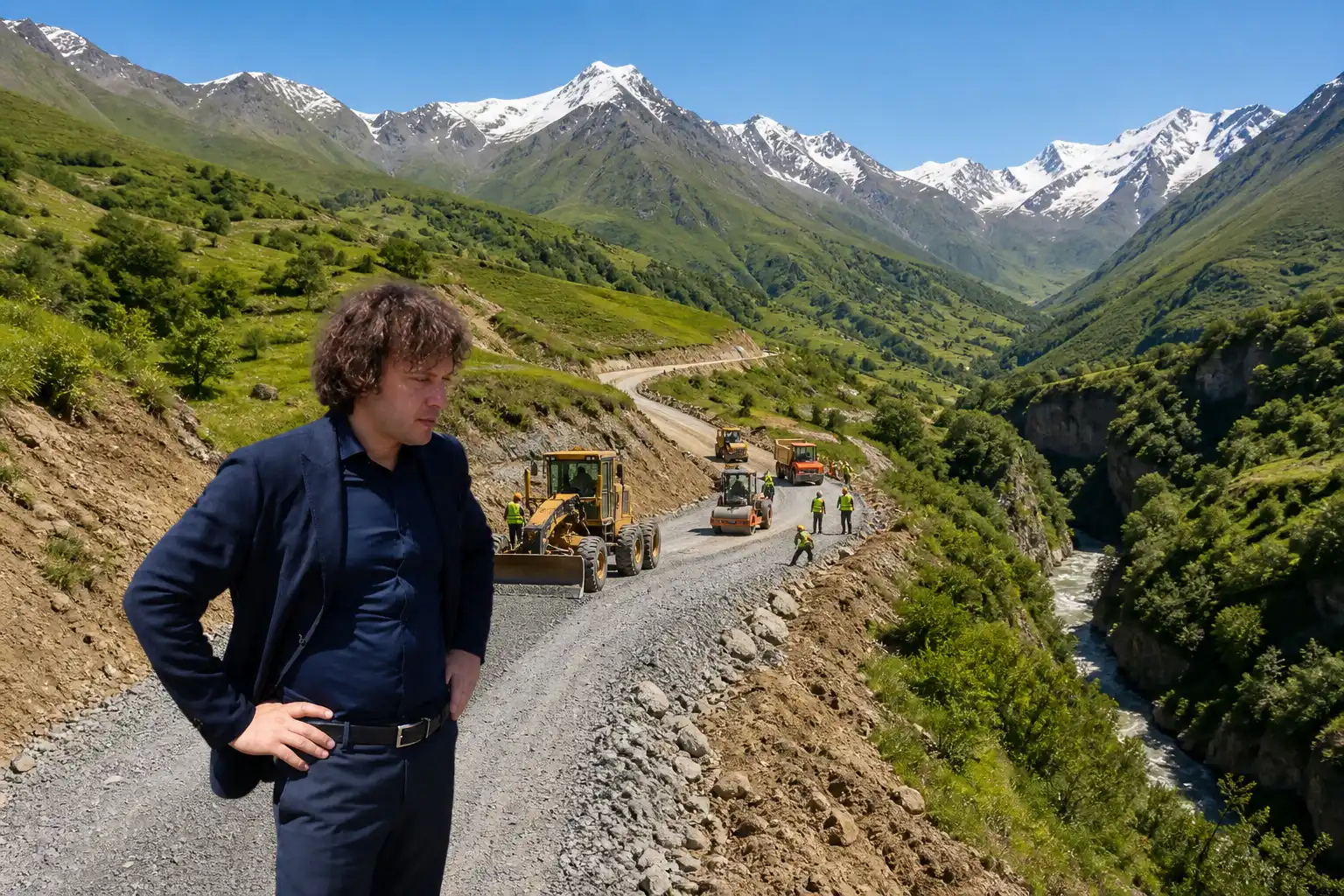
Construction has begun on the roughly 9- to 9.5-kilometer Shkmeri-Mravaldzali secondary road in Georgia’s Oni Municipality, a GEL 23 million project set for completion by the end of 2028. Prime Minister Irakli Kobakhidze inspected the site this week with Infrastructure Minister Revaz Sokhadze and tied the works directly to plans for a world-class mountain resort.
Preparatory and mobilisation work is already under way under the Roads Department of the Ministry of Regional Development and Infrastructure. Full-scale building follows. The upgrade replaces a badly deteriorated gravel track that turns dusty in dry weather and treacherous in rain.
Nine Kilometers, Nearly 23 Million Lari
The Roads Department framed the job as a key infrastructure push for the Racha region under a government decree. Length figures vary slightly across statements: the original announcement used nine kilometers while the prime minister spoke of a 9.5-kilometer section that will cut travel time between the two villages.
| Detail | Figure |
|---|---|
| Length | 9-9.5 km |
| Cost | Nearly GEL 23 million (about $8.8 million) |
| Target finish | End of 2028 |
| Current status | Prep and mobilisation |
| Implementer | Roads Department |
At recent official lari exchange rates near 2.62 GEL per dollar, the budget sits close to $8.8 million. That scale matches a secondary mountain road rather than a national highway yet still represents serious outlay for a remote valley.
Kobakhidze said the finished road will deliver safer, more comfortable travel for residents and visitors alike. He also noted completion is expected within about two years from the inspection, aligning with the end-2028 target.
The Resort Plan That Needs the Road
The prime minister went further than basic access. He described Mravaldzali as a unique location with potential to host a world-class resort. The Ministry of Economy is preparing a master plan in cooperation with Austrian partners.
The 9.5-kilometre section of the Shkmeri-Mravaldzali road will significantly reduce travel time between Shkmeri and Mravaldzali. We have ambitious plans for the development of Mravaldzali, which is a unique location with the potential to host a world-class resort. The Ministry of Economy is actively working on this initiative, and we are cooperating with Austrian partners to prepare a relevant master plan. Naturally, the construction of this road is of great importance for the successful implementation of these plans.
Irakli Kobakhidze made the remarks during the Oni inspection. Without reliable road access the master plan stays on paper. The secondary road therefore functions as the first physical link in a larger development sequence rather than an isolated comfort upgrade.
Racha already draws visitors for its highland scenery and heritage. A full resort could shift the scale from day trips and small guesthouses toward longer stays and higher-value tourism.
What Sits Behind the Current Gravel
Shkmeri and Mravaldzali sit in mountainous Racha and carry historical, cultural and natural weight. Centuries-old churches stand in both villages. Shkmeri adds a canyon, a karst cave and other draws that already pull domestic and international travelers.
- Shkmeri Canyon: 2,000 meters long, starts at 1,720 meters elevation, 450-meter drop, five waterfalls (highest 15 meters), a 200-meter cavern section, five-to-six-hour route best in summer.
- St. Giorgi hall church in Mravaldzali: 11th-century core with later cupola, surviving inscriptions and paintings.
- Hiking links via Khikhata mountain (2,239 meters) connecting the villages on an easy two-day, 18-kilometer track with ridge views and karst features.
- Broader Racha setting of Caucasus peaks, rivers and traditional highland life.
Official tourism material details a canyoning route through Shkmeri Canyon that requires no special skills yet still involves waterfalls and a cave passage. Guides supply suits, helmets and harnesses. The current gravel approach from Oni makes the start point harder to reach consistently, especially for groups or in bad weather.
Dust and mud have limited both resident mobility and visitor numbers. An upgraded surface removes that friction.
Locals First, Then the Visitor Economy
Daily life in the villages improves immediately once the road is reliable. School runs, medical trips, farm goods and winter access become less risky. That baseline gain underpins everything else.
Tourism sits next. Better access supports existing attractions and opens capacity for the planned resort. New guesthouses, guiding services, food suppliers and transport operators can follow. The government lists safer travel, improved access, tourism growth and fresh economic chances as the expected outcomes.
Georgia’s wider tourism numbers have recovered strongly since earlier shocks, with national ambitions measured in millions of arrivals and billions in revenue. Remote highland pockets such as upper Racha have lagged because of precisely the infrastructure gaps this project targets. Parallel experience from earlier regional road work shows isolation lifts when connections improve; one major past program rehabilitated hundreds of kilometers and linked agricultural zones to markets and borders.
The Austrian master-plan process itself signals foreign technical interest. If the resort concept advances, construction, operations and supply chains would spread benefits beyond the two villages into Oni Municipality and the wider Racha-Lechkhumi area.
Racha’s Long Isolation Pattern
Mountain valleys in western Georgia have always traded connectivity for drama of landscape. Centuries-old churches and defensive sites speak to communities that thrived despite hard travel. Modern gravel tracks improved matters but still left dust, ruts and seasonal closures.
National policy has shifted toward systematic secondary-road upgrades and strategic corridors. Projects elsewhere in Georgia have shown that reliable pavement multiplies both local commerce and visitor nights. The Shkmeri-Mravaldzali job fits that pattern at smaller scale while carrying an explicit resort multiplier.
Past earlier regional road rehabilitation results demonstrated measurable gains in trade access and municipal services once pavement replaced deteriorated surfaces. Racha’s version adds the tourism-resort layer on top of basic mobility.
What Changes by Late 2028
If the schedule holds, the paved link arrives just as the master plan should mature. Travel time between the villages drops. Dust and mud complaints fade. Tour operators can market reliable day and multi-day packages that combine the canyon, church, ridge hikes and any early resort facilities.
Economic paths open in several directions at once:
- Higher overnight capacity and longer average stays once a resort anchor exists.
- Year-round access that softens the strong summer seasonality of highland canyoning and hiking.
- Local employment in construction first, then hospitality, guiding and services.
- Secondary demand for food, transport and maintenance that keeps more spending inside the region.
Risks remain ordinary for mountain work: weather delays, cost pressures, and the gap between a master plan and actual investment. The road itself, however, is a concrete, budgeted commitment already under way. That physical step makes the larger ambition testable rather than theoretical.
For residents the difference will be felt first in ordinary trips. For the regional economy the same strip of pavement becomes the hinge that lets a remote valley step onto a bigger stage.