South Ossetia’s acting president Marat Kambolov has ordered two occupation-line crossing points to open more days each week and simplified entry for close relatives of residents in parts of Akhalgori and Java. The changes, if adopted, would mark the biggest relaxation of movement rules for ethnic Georgians in the district since limited monthly windows returned in 2022.
The announcement lands less than a month before the September 18 presidential election that Kambolov is expected to contest.
The order followed a Security Council meeting and still requires a formal government resolution before the new weekly schedule takes effect. Until that resolution appears, the monthly window remains the only lawful route across the line for the communities named in the plan.
Exact New Hours at Mosabruni and Perevi
Until now residents could cross only from the 20th to the 30th of each month. Under the plan published after a Security Council meeting, the schedule expands sharply.
| Crossing Point | New Days | Hours | Connects |
|---|---|---|---|
| Mosabruni / Odzisi / Razdakhan | Thursday-Sunday (4 days) | 08:00-18:00 | Akhalgori district to Mtskheta Municipality |
| Perevi / Pereu | Tuesday, Thursday, Saturday (3 days) | 08:00-18:00 | Java district to Sachkhere Municipality |
Close relatives of residents of certain settlements in those two districts will also face simplified entry and temporary stay rules. The new weekly schedule for Razdakhan and Pereu takes effect only after the de facto government issues a formal resolution. Security agencies were told to keep measures tight against provocations.
Kambolov framed the step as a response to repeated resident appeals. “People must be able to visit their relatives without unnecessary difficulties and at the same time feel protected,” he said after the meeting.
The shift from a ten-day monthly block to fixed weekday openings spreads access across the calendar. Residents who once had to compress medical trips, market runs and family visits into a single window would gain repeated chances inside the same month, still inside the 08:00-18:00 band and still at the two named points only.
| Measure | Until now | Under the plan |
|---|---|---|
| Akhalgori link (Mosabruni / Odzisi / Razdakhan) | 20th-30th only | Thursday-Sunday each week |
| Java link (Perevi / Pereu) | 20th-30th only | Tuesday, Thursday, Saturday |
| Daily hours | Inside the monthly window | 08:00-18:00 on open days |
| Close relatives | Standard crossing rules | Simplified entry and temporary stay |
Why the Timing Tracks the Election Calendar
Kambolov became prime minister on 16 June 2026 and acting president a week later when Alan Gagloev resigned to join Vladimir Putin’s staff. A North Ossetian native and longtime Russian official, he previously directed work at the Kurchatov Institute and held federal posts. Kambolov’s rapid rise from Russian institutes has been backed by major South Ossetian parties and former presidents, even though residency rules normally bar recent arrivals from the ballot.
The election is set for 18 September. Analysts and local reporting treat the crossing expansion as a visible goodwill gesture that can be claimed before voters go to the polls. Population decline ranks high among the problems Kambolov himself has named as the republic’s central challenge.
That sequence leaves little gap between the Security Council announcement and election day. A formal resolution issued in time would let the acting president point to concrete weekday openings rather than another promise of study. The same calendar also explains the care taken to keep security agencies on alert: any incident at the line could erase the political value of the gesture before ballots are cast.
Backing from major parties and former presidents already offsets the residency obstacle that would normally block a recent arrival. Delivering a movement concession aimed at Akhalgori and Java adds a local deliverable to that external support, aimed at voters who rank isolation and outflow among daily concerns.
What Life Looks Like for Akhalgori’s Remaining Georgians
Akhalgori (Leningor) is the South Ossetian district with the largest remaining ethnic Georgian community. A 2015 census counted 2,337 ethnic Georgians there, about 4.3 percent of the wider region’s population. Unofficial estimates now put the figure under 1,000, most of them elderly. Many left after the full closure of crossings in September 2019.
- Medical care, local facilities are limited; serious cases require travel to Georgian-controlled territory or Tskhinvali.
- Pensions and markets, Georgian social payments and cheaper goods sit on the other side of the line.
- Family ties, children, parents and property often lie across the occupation line.
- Documents, a local “propusk” pass plus South Ossetian papers remain standard for any crossing.
Tamara Mearakishvili, an ethnic Georgian journalist and activist from Akhalgori who was detained on espionage charges and released into Georgian-controlled territory in late 2025, told OC Media the road had been the single issue that defined every conversation with Tskhinvali officials. “All my speeches, even in public spaces in Tskhinvali, were about this,” she said. “People explained that we were not doing anything wrong by crossing, that we were just visiting our families, and [Kambolov] listened.”
The drop from the 2015 census figure to estimates under 1,000 shows how quickly a community ages and thins once regular passage stops. Elderly residents face the sharpest pressure: limited local care, pensions paid on the other side, and family networks split by the line all turn a closed gate into a practical barrier rather than a symbol.
Mearakishvili’s account places the appeals in public view inside Tskhinvali itself. The acting president’s later claim that the step answers repeated resident requests tracks that record of complaint, even as document checks and named crossing points stay in place.
How the 2019 Chorchana Dispute Shut the Gates
The current restrictions trace directly to a 2019 standoff.
- August 2019, Georgian police opened a checkpoint near Chorchana, on territory under Tbilisi control, citing local safety in a forested buffer zone opposite South Ossetian-held Tsnelisi.
- South Ossetian response, de facto authorities demanded removal, set up their own posts, and closed the main Akhalgori crossings indefinitely.
- September 2019 onward, ethnic Georgians in Akhalgori faced near-total isolation; roughly 400 people crossed into Georgian-controlled areas on the day of closure alone.
- August 2022, limited reopening: crossings allowed only on the 20th-30th of each month.
- August 2026, proposed multi-day weekly schedule plus relative simplifications.
South Ossetian leaders long tied any wider reopening to removal of the Chorchana post. Georgian Dream is investigating former prime minister Giorgi Gakharia over the original decision to place it. The post remains in place.
Each stage on that timeline narrowed or widened the same two corridors now named in Kambolov’s plan. The indefinite closure produced an immediate outflow; the 2022 monthly window restored partial contact without restoring predictability; the 2026 proposal multiplies open days while still leaving the Chorchana dispute unresolved.
Because the post itself has not moved, any goodwill reading of the new schedule sits alongside the older demand for its removal. That pairing keeps the crossing file open as both a humanitarian file and a leverage file.
How Weekly Openings Change Practical Trips
The existing pressures on Akhalgori residents map directly onto a calendar. Medical referrals, pension collection and family visits all require presence on the Georgian-controlled side. A single monthly block forced those errands into the same ten-day stretch, often against clinic schedules or family availability.
Weekday openings alter that arithmetic without altering the underlying rules. Four days at Mosabruni and three at Perevi, each running 08:00-18:00, create repeated slots inside one month. A resident who misses Thursday still has Friday, Saturday or Sunday at the Akhalgori link, or a later Tuesday and Thursday at the Java link.
- Serious medical cases gain more chances to match travel days with hospital appointments on the other side of the line.
- Pension and market trips no longer compete with every family visit inside one narrow window.
- Close relatives covered by simplified entry rules can time short stays to the new weekday pattern rather than a single monthly surge.
- Document checks, propusk passes and South Ossetian papers still apply on every open day.
The plan does not add new crossing points, extend hours past 18:00, or lift the ban on foreigners entering from Georgian-controlled territory. Relief comes from frequency, not from a wider map.
What Analysts See Beyond the Immediate Relief
Conflict analyst Zurab Bendianishvili described the move to OC Media as a goodwill step that improves the information climate. He suggested it could be followed by pressure for Georgia to dismantle the Chorchana post, giving Kambolov political credit that shows up in election results. Longer term he floated the possibility of reopening the main Ergneti road.
It’s possible that the next step will be the cancellation of the Chorchana post by the Georgian side, and this will already be reflected in the results of the planned elections.
Zurab Bendianishvili, conflict analyst, OC Media
The same report notes that any further opening would still leave movement under de facto control. For the full context of resident appeals and the Security Council discussion, see the full report on the Security Council decision.
Bendianishvili’s sequence runs from goodwill to reciprocal pressure to optional later infrastructure steps. Each stage still assumes Tskhinvali keeps the power to set days, hours and document rules. Electoral credit, in that reading, comes from being seen to ease daily strain while holding the larger levers unchanged.
Why the Outflow Still Hangs Over the Vote
Kambolov has named population decline among the republic’s central problems. The Akhalgori figures give that problem a local face: 2,337 ethnic Georgians in the 2015 census, unofficial estimates now under 1,000, most elderly, and roughly 400 people crossing out on the September 2019 closure day alone.
Movement rules shape whether remaining residents stay. When crossings shut, medical care, pensions and family contact push people toward Georgian-controlled territory. When limited windows return, some pressure eases, yet the community continues to age. A weekly schedule is the widest access offered since 2022, and it arrives while an acting president seeks a full mandate.
The gesture therefore works on two levels at once. It answers the road complaints that Mearakishvili said dominated talks with officials. It also supplies a measurable step Kambolov can cite against the decline he himself has flagged, three weeks before election day.
None of that guarantees the outflow slows. Implementation still waits on a government resolution, an exact list of settlements for simplified relative rules, and continued security clearance at the gate. The political claim can be made as soon as the days are published; the demographic effect would show only over later months and years.
Controls That Stay in Force
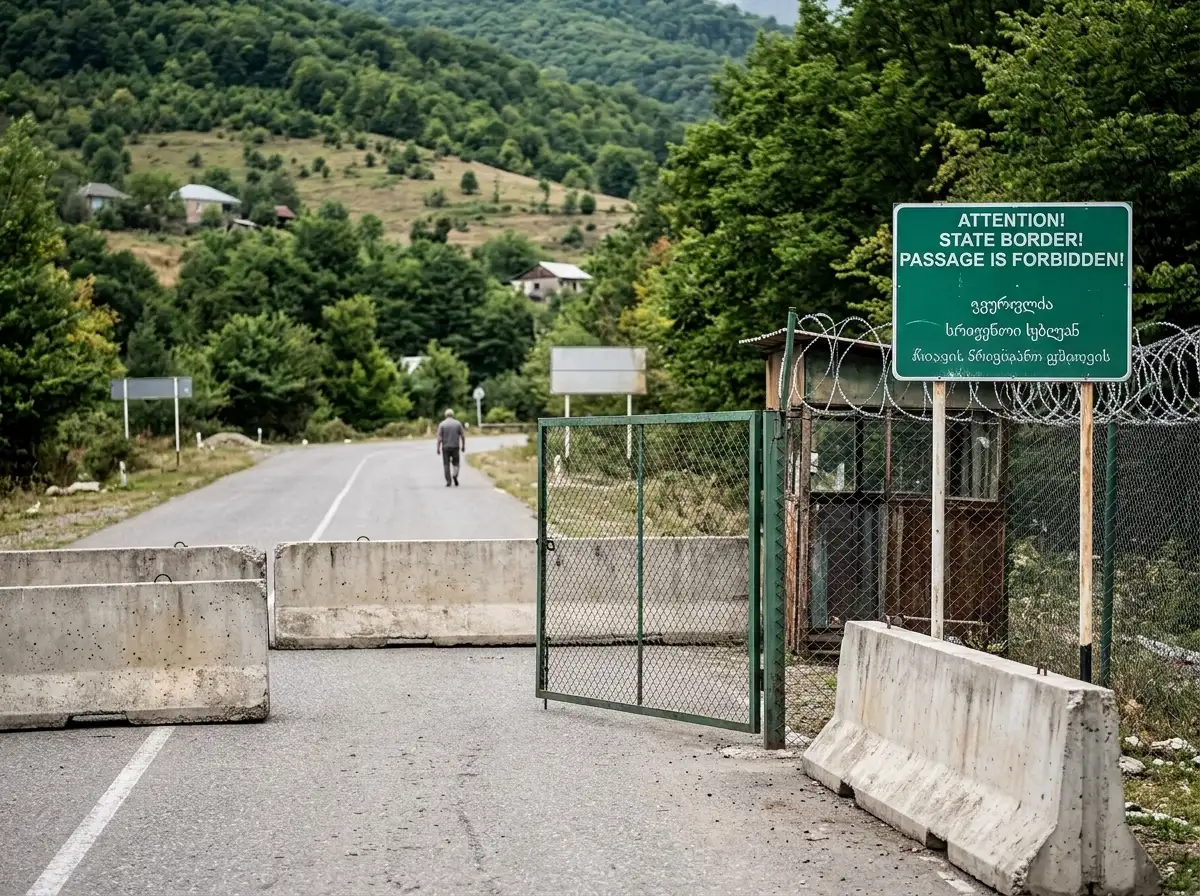
Even after the resolution, crossings remain limited to the two named points, foot or limited vehicle traffic as before, and subject to security checks. Foreigners still cannot enter South Ossetia from Georgian-controlled territory; the only open route for outsiders runs through Russia. Passes, local residence certificates and South Ossetian documents continue to gate entry. The de facto authorities retain full discretion to suspend the schedule.
Russia has occupied Abkhazia and the Tskhinvali region since the August 2008 war. Moscow recognizes both as independent; Georgia and most of the international community treat them as occupied Georgian territory. Humanitarian agencies have repeatedly flagged freedom-of-movement restrictions along the administrative boundary line as a source of medical, economic and family hardship.
Kambolov’s instruction to the security and interior bodies keeps “the security of residents of areas close to the occupation line” as an unconditional priority. Implementation details, the exact list of settlements covered by simplified relative rules, and the date of the government resolution have not yet been published.
For now the plan stands as an announced expansion that residents of Akhalgori and Java can point to when they next meet local officials, and that the acting president can cite three weeks before voters decide whether to keep him.
Until the resolution lists the covered settlements and locks in the first open weekdays, families still plan around the older monthly window. The announcement sets the direction; the unpublished paperwork sets the start date.