Georgia broke ground on a new berth at Poti Port on Thursday. The $25 million project is financed by the U.S. International Development Finance Corporation, the American development-finance agency. Prime Minister Irakli Kobakhidze framed the launch as proof that Georgia’s transit corridor is outgrowing its current capacity. He spoke at the ceremony alongside Economy Minister Mariam Kvrivishvili and representatives of PACE Group, the Georgian-American operator building the new terminal.
Poti’s Second Berth Breaks Ground
Construction of the second berth at the new Poti Sea Port launched Thursday under a fresh loan from the DFC. PACE Group, the Georgian-American transport and logistics company developing the terminal, signed the financing with the U.S. Embassy in Georgia acting as the formal counterparty. The deal lifts the agency’s direct exposure to the project to $75 million across two tranches.
The first tranche, a $50 million loan extended by the predecessor Overseas Private Investment Corporation in 2020, financed the construction of the first berth. That berth opened in late 2023 and reached an annual capacity of 600,000 TEU within months. The new loan will fund the second berth, which is set to lift the port’s throughput capacity by an additional one million tons per year. It also adds bulk-cargo handling capability the first berth could not cover. The U.S. Embassy said the project strengthens critical infrastructure along the Trans-Caspian Corridor, the overland route linking China to Türkiye through Central Asia and the South Caucasus.
These figures clearly show that demand for our transport corridor is growing at a very rapid pace. Our task is to meet this demand with modern infrastructure.
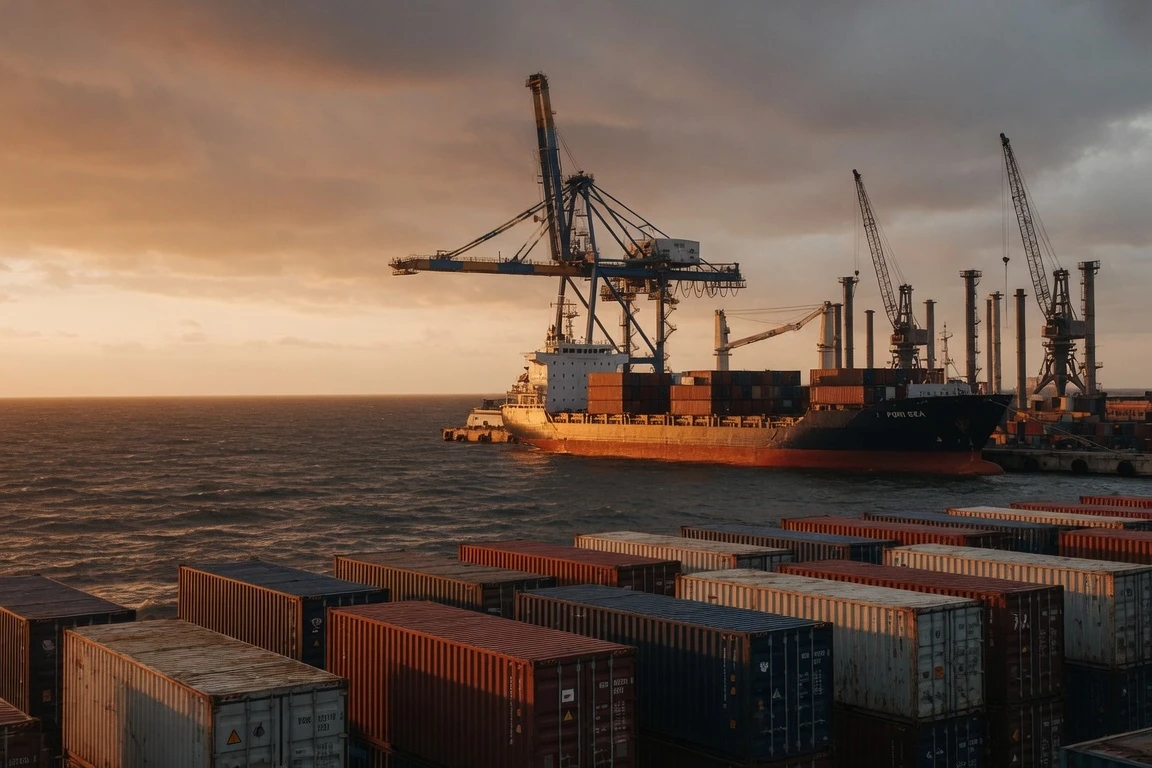
DFC Doubles Down With a $25 Million Loan
That is Prime Minister Irakli Kobakhidze, speaking at Thursday’s launch ceremony in Poti, per the Georgian government’s account of the launch event. The DFC’s $25 million loan is the second time the agency has financed PACE Group at the port. The first came in 2020, when the predecessor Overseas Private Investment Corporation extended a $50 million loan to build the new Poti Sea Port Terminal. The latest loan completes the financing for the second berth and adds bulk-cargo handling capability the first berth could not cover.
Economy Minister Mariam Kvrivishvili, who also spoke at the ceremony, said the second berth brings $40 million in additional investment on top of the $93 million already committed to the new Poti seaport, per her remarks on the $93 million Phase II build. Once Phase II is complete, the port’s annual throughput capacity is set to reach three million tons. The minister said the new berth will create roughly 50 jobs during the build. She also confirmed that cargo turnover at Georgian ports rose 21 percent in the first five months of 2026, with ship traffic across the country’s ports climbing 19 percent in the same window. Kvrivishvili framed the project as part of a coordinated plan to integrate Georgia’s ports, railways, international highways and logistics centres into a single system.
The new berth’s job is concrete. It will lift the port’s annual throughput by more than one million tons, add bulk-cargo handling the first berth cannot cover, and shore up what the U.S. Embassy described as critical infrastructure along the Trans-Caspian Corridor trade route the DFC financing targets. That wording mirrors the embassy’s framing of the 2020 deal, when it called the same corridor critical infrastructure.
PACE Group Anchors the $93 Million Build
PACE Group is the Georgian-American transport and logistics company that has operated the new Poti terminal since the first berth opened in late 2023. The company reached an annual capacity of 600,000 TEU at the terminal and handles maritime agency, brokerage and logistics work along Georgia’s Black Sea coast. With Phase II now in motion, PACE Group is positioning itself as the principal private operator at a port that the government wants to grow into a regional logistics hub. Kobakhidze, in his remarks, credited the company with showing that Georgian business has both the expertise and the resources to deliver large-scale infrastructure projects with international partners. The economics ministry separately confirmed that 50 jobs will be created during the build.
Kobakhidze called the project a partnership between the state, Georgian business and American financial institutions. Kvrivishvili said the same four-pillar modernization plan covers Poti, the planned Anaklia deep-sea port, railway upgrades and the East-West road corridor. Together, those projects are how the government says it will turn Georgia from a transit geography into an economic hub.
78% in Three Years: Where the Cargo Came From
The 78 percent throughput figure Kobakhidze cited covers the new Poti maritime terminal operated by PACE Group, not the older port complex next door. That distinction matters because the terminal reached 600,000 TEU annual capacity only in October 2023, so the three-year baseline starts near zero.
Still, the broader cargo data confirms the direction. Kvrivishvili said cargo turnover at Georgia’s ports rose 21 percent in the first five months of 2026, with growth recorded across all major cargo categories. Ship traffic across the country’s ports climbed 19 percent in the same window. Kobakhidze framed the figures as evidence that demand for the country’s transport corridor is rising rapidly. He tied that demand to the Middle Corridor trade route linking Europe and Asia, the overland alternative to the Northern Corridor through Russia. The government’s response, he said, is to expand ports and modernize rail and road infrastructure to match.
- 21%: Cargo turnover growth at Georgian ports, first five months of 2026.
- 78%: Throughput growth at the new Poti maritime terminal, past three years.
- 19%: Ship traffic growth at Georgian ports, first five months of 2026.
- 1 million tons/year: Additional throughput capacity the second berth will add.
- 3 million tons: Target Phase II annual capacity for Poti Sea Port.
- $93 million: Total invested in the new Poti Sea Port to date.
- $25 million: New DFC loan for the second berth.
- 50: New jobs expected during the build.
The Middle Corridor pitch has been Georgia’s central trade argument since 2022. The 78 percent three-year throughput figure and the 21 percent five-month cargo number now anchor the data the government presents to international lenders. Those figures are the basis for the new $25 million DFC loan and for follow-on financing requests still in the pipeline.
Together, the data line up with the government’s larger pitch. Georgia wants to be more than a transit corridor between Europe and Asia. Kobakhidze said the country has become an economic and logistics hub that creates additional value for international trade. The second berth is the concrete answer to that pitch, funded on a partner relationship that started with a $50 million loan during the 2020 pandemic. Kvrivishvili framed the new berth as a direct response to growing regional demand for cargo services.
Anaklia Sits on the Sideline as Poti Carries the Load
Kobakhidze listed Anaklia as part of the same modernization push. The deep-water port on Georgia’s northwestern Black Sea coast is the project designed to handle the large vessels that Poti and Batumi cannot accept. The World Bank and the EU’s Trans-European Transport Network have both flagged it as a central corridor priority. Yet, per an April 2026 analysis of Middle Corridor bottlenecks, the Georgian government has slashed Anaklia’s 2026 funding from 150 million lari ($56 million) to 50 million lari.
- The new Poti Sea Port (second berth under construction)
- The Anaklia deep-sea port (planned, with 2026 funding cut)
- Railway infrastructure modernization
- The East-West road corridor
Kvrivishvili listed the same four pillars in her remarks. With Anaklia’s deep-water capacity still years away, Poti’s expansion is the only piece of the port-modernization plan that can absorb additional cargo in the near term. The 50 jobs and the additional one million tons per year are real additions to a working port, not construction at a future one.
That is the strategic reality behind Thursday’s ceremony. Poti is a mid-sized port on a coast that, until Anaklia opens, has no facility able to receive Capesize-class vessels. The 78 percent throughput gain is genuine, and the second berth will lift annual capacity meaningfully. The Poti terminal’s 600,000 TEU capacity and growing bulk handling will continue to absorb cargo that Anaklia was designed to carry. The Middle Corridor’s rise as a true alternative to the Russia-routed Northern Corridor still depends on a deep-water facility that, for now, is not being built at the pace once planned. The second berth adds capacity without resolving the strategic gap, and Carnegie recorded 4.1 million tons crossing the Caspian in 2024, up more than 63 percent year on year, but that figure is still roughly 6 percent of the Northern Corridor’s 100 million tons.
How Poti Fits the Middle Corridor’s Bigger Map
The Middle Corridor is the land-and-sea route that links western China to Eastern Europe through Central Asia, the Caspian Sea, the South Caucasus, the Black Sea and Türkiye. A June 2026 explainer of the corridor’s strategic role put overland transit times at roughly two to three weeks, compared with a month and a half by sea. The route was built around the Baku-Tbilisi-Kars railway, which has connected the Caspian region to the European rail network since 2017. Until the planned TRIPP route through Armenia opens, Georgia remains the corridor’s sole gateway to Europe, with Poti and Batumi as its two Black Sea outlets.
The cargo data show the route is gaining share. The 4.1 million tons crossing the Caspian in 2024 was up more than 63 percent year on year, but still only about 6 percent of the Northern Corridor’s 100 million tons of annual capacity. Kazakhstan’s $30 million container terminal at Poti Sea Port is set to wrap up in April, adding another route into the port. The Poti-Baku express block train cutting Middle Corridor transit times is one of the rail upgrades Kvrivishvili named. The second berth is the second DFC-financed expansion at Poti in five years: a $25 million loan, signed on top of a $50 million 2020 loan, on a port whose three-year throughput gain now anchors Georgia’s transit pitch.