A $150 million Tbilisi airport expansion deal, signed on January 16, 2026 between TAV Airports and the Government of Georgia, will double annual passenger capacity to more than 10 million by 2028 and extend the operating concession through the end of 2031. Tbilisi International Airport finished 2025 with more than 5.4 million passengers, a 13.7% rise over 2024, running close to the 5 million design ceiling of the existing terminal. The signing at Tbilisi was attended by Prime Minister Irakli Kobakhidze, Economy Minister Mariam Kvrivishvili, Groupe ADP CEO Philippe Pascal, and TAV Airports CEO Serkan Kaptan. TAV has operated Tbilisi and Batumi airports under state concessions since 2005, a tenure the new deal extends by nearly five years.
The expansion pairs terminal infrastructure with commercial investment. Inside the building, the agreement adds a tripled lounge footprint, two food and beverage locations dedicated to Georgian cuisine, an expanded ATU Duty Free presence, and marketing funding meant to bring new international carriers onto Georgian routes.
What the $150 Million Buys
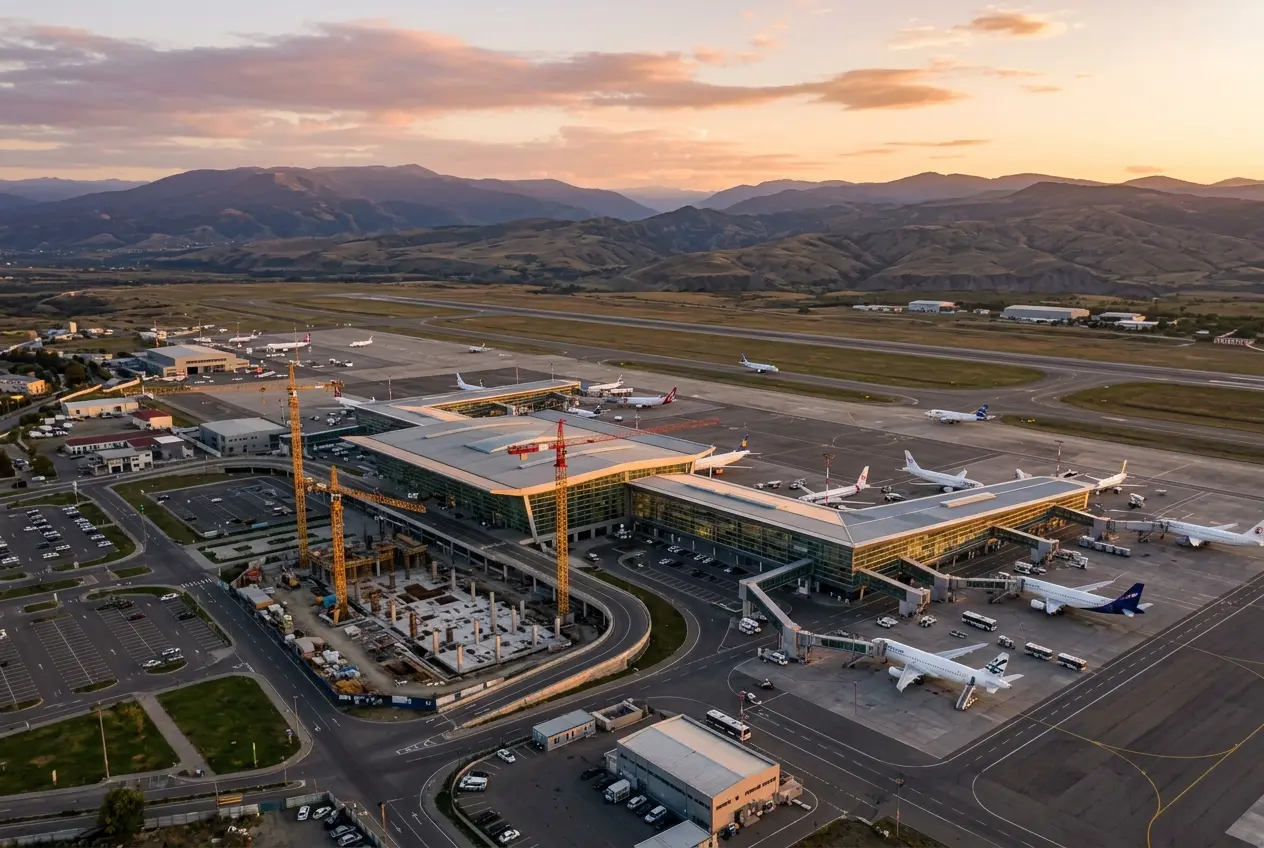
At the center of the plan is the terminal itself. The existing 37,500 square meter passenger building will grow by an added 19,500 square meters once construction completes, according to TAV Airports’ signed expansion agreement with Georgia. Crossing the 10 million annual passenger threshold is the headline target, one the airport has never come close to in any full year of operations. The project is scheduled for completion as early as 2028.
- 10 boarding bridges, double the existing count
- 7 remote aircraft parking stands, all new
- 10 check-in counters, added inside the terminal
- 24 passport control counters, expanded at the border point
- 2 baggage carousels, added at arrivals
- 500 parking spaces, added landside
- $150 million total TAV Airports investment
- 19,500 sq m of new terminal space added to existing 37,500 sq m
- More than 10 million annual passenger capacity target
- 2028 project completion target
- End of 2031 extended Tbilisi concession expiry
For travelers moving through the terminal on the day the new building opens, the most visible changes sit inside the existing structure rather than outside it. Ten new check-in counters, 24 passport control stations, and two baggage carousels are sized to relieve queues that built through 2025 as traffic crossed 5 million for the first time. Landside, the carpark expands by 500 vehicles and existing passenger areas are slated for refurbishment. Inside the commercial area, every concession space is scheduled to be redone, with new retail and dining locations created rather than simply added on. Modernization of operational and technological systems is included in the same budget, though the operator has not yet published a spending breakdown.
A Terminal Already Hit Its Wall
Passenger growth has outrun the building for several years. Tbilisi Airport handled 4.75 million passengers in 2024 and crossed 5.4 million in 2025, a 13.7% annual gain that put volumes above the design ceiling of the existing facility for parts of the year. The 20-year compound rate stands at 12.6% a year, a figure TAV’s CEO flagged at the signing ceremony.
Tourism flows have moved in the same direction. Georgia recorded 5.5 million tourist visits in 2025, a historic high that the country’s leadership has consistently cited to justify more terminal capacity. New airlines and routes opened across the same 12 months, a pattern Kobakhidze connected to broader gains in Georgia’s regional and global aviation connectivity. The combination matters because 5 million passengers is the upper limit on what the existing footprint absorbs without queueing and delays, not the actual ceiling the building was designed to handle. Around 63 airlines now connect Tbilisi to 71 destinations, and the marketing funding inside the new agreement is built to grow that count further.
The expansion is structured around that pressure. Kobakhidze, speaking at the signing, cast the deal as a foundational piece of national aviation strategy.
Tbilisi International Airport is one of the country’s most important strategic infrastructure facilities and plays a special role in the development of the economy and tourism. The significance of the airport’s expansion becomes even more evident given that 2025 was a record year for the development of tourism and aviation in Georgia.
Georgia’s Prime Minister Irakli Kobakhidze addressed the concession renewal signing in Tbilisi on January 16, 2026. He was joined by Economy Minister Mariam Kvrivishvili, Groupe ADP CEO Philippe Pascal, TAV Airports Chair of Executive Committee Franck Mereyde, and TAV Airports CEO Serkan Kaptan. TAV’s wider portfolio, which spans more than 100 airports across 30 countries and handled 113 million passengers in 2025, treats Georgia as the place where the company first became a global operator.
The Concession That Came With the Money
The longer concession is the structural core of the new agreement. TAV’s Tbilisi operations were set to expire in January 2027 under the original terms. The new deal extends the timeline until the end of 2031, adding nearly five years to a contract that began in 2005. The renewed mandate ties the operator to Tbilisi through the end of 2031.
According to the Georgian government’s statement on the deal, the Georgian Airports Association has received a one-time upfront payment of $25 million. The government’s revenue projection for the post-completion period has annual revenues at Tbilisi International Airport rising approximately threefold. The agreement also funds airline marketing support programs aimed at developing new air routes and attracting more international carriers. Existing passenger areas inside the terminal are scheduled for refurbishment under the same budget as the new commercial floor plate. The build schedule runs through 2028, with the renewed mandate covering operations from then through end of 2031.
TAV already has skin in the game beyond the new $150 million. Kaptan told the signing his company had invested more than $230 million in Georgian airports by the close of 2025, with Batumi Airport also operated by TAV and remaining Georgia’s third-busiest under the same umbrella concession.
Recent route additions give the marketing mandate a working baseline. The agreement’s broader marketing budget covers similar future openings, with airline marketing programs aimed at developing new air routes and attracting more international carriers. The agreement’s renewal ties those marketing budgets to the concession, which the Georgian government signed at the January 16, 2026 ceremony.
What Travelers Will See on Day One
Alongside the gate and apron work, the deal builds out a commercial layer inside the existing footprint. ATU Duty Free, the joint venture between TAV Airports Holding and Gebr. Heinemann/Unifree Duty Free, will take a strong presence in the new commercial area. The operator has identified increasing dwell time as the primary driver behind the retail and F&B expansion. Existing passenger areas will be refurbished as the new commercial floor plate goes in.
Food and beverage is the most visible upgrade in the plan. The new terminal will have two food and beverage locations dedicated to Georgian cuisine, run separately from the broader F&B mix. Two children’s play areas are planned at the same time. Landside, the carpark adds another 500 spaces to the existing footprint. The combined investment is sized to absorb passenger growth consistent with the terminal expansion’s doubled ceiling, set to be reached by 2028.
For higher-spending travelers, the lounge expansion is the most concrete change. Lounge capacity will be tripled under the agreement, with new premium services added in parallel. Skytrax ranked Tbilisi among the best airports in Eastern Europe in 2025, a positioning the commercial expansion is designed to lock in.
Behind the Tbilisi plan sits TAV Airports’ wider commercial platform. TAV Airports’ 2025 portfolio results show 113 million passengers served across more than 100 airports in 30 countries.
The 71 destinations TAV’s network reaches from Tbilisi today include a growing share of long-haul connections, where lounge and duty-free spend concentrates. Skytrax’s Eastern Europe ranking, which TAV cited at the signing, gives the lounge tripling a positioning anchor. The 5.5 million tourist visits Kobakhidze cited feed into the same commercial logic, with the agreement’s marketing budget designed to seed new international services and longer-haul routes. The combined ceiling ties the commercial floor plate to the new 10 million passenger threshold. Beyond the new lounges and duty-free areas, refurbishment of existing spaces sits inside the same budget line.
Twenty Years of Double-Digit Growth Behind It
Traffic grew steadily across TAV’s two decades at the gateway. Between 2005 and 2025, annual passenger numbers at Tbilisi moved from 540,000 to more than 5.4 million, roughly a tenfold rise over 20 years. The compound annual growth rate of 12.6% a year has held across recessions, regional conflicts, and pandemic-era troughs at roughly that pace throughout the period.
The wider route map gives the marketing funding real reference points. Norwegian’s first direct Copenhagen-Tbilisi service, run twice weekly, became the first capital-to-capital air link between Denmark and Georgia, per Riverdale Standard coverage of the new route. The reopened Baku-Tbilisi-Kars railway gives Tbilisi a parallel ground corridor across the South Caucasus, per Riverdale Standard coverage of the Middle Corridor reopening. The two openings fit the marketing mandate to develop new air routes, attract international carriers, and strengthen Georgia’s air connectivity. The 71 destinations TAV already operates form the base off which future routes will be added.
Frequently Asked Questions
How much is TAV Airports investing in Tbilisi Airport?
Through a January 16, 2026 agreement with the Government of Georgia, TAV Airports is investing approximately $150 million. The deal also extends the operating concession through the end of 2031, replacing the prior January 2027 expiry.
When will the Tbilisi Airport expansion be completed?
According to TAV Airports, the project is scheduled for completion as early as 2028. The work covers terminal expansion, airfield infrastructure, and operational technology upgrades across the existing facility.
What is the new passenger capacity?
The plan lifts annual terminal capacity from 5 million to more than 10 million passengers, a doubled ceiling over the prior design limit.
How long has TAV Airports operated Tbilisi Airport?
TAV Airports, through its subsidiary TAV Georgia, has operated Tbilisi and Batumi international airports since 2005. The renewed agreement extends the Tbilisi concession through the end of 2031, lengthening the original 22-year run by nearly five years.
What airline marketing support is in the deal?
The agreement includes funding for airline marketing programs aimed at developing new air routes, attracting international carriers, and strengthening Georgia’s air connectivity, per the Georgian government’s statement on the deal.