
The Baku-Tbilisi-Kars railway, the rail spine that links Azerbaijan, Georgia and Turkey, entered full service on June 2 after a reconstruction that raised its annual freight capacity from 1 million tons to five million. A signing ceremony at Georgia’s Akhalkalaki station marked the moment, almost nine years after the line first carried cargo.
Behind the ceremony sits a freight route that China and Europe have leaned on to move goods around Russia since 2022, and the upgrade clears its worst rail bottleneck. The line, known across the industry as the BTK (Baku-Tbilisi-Kars), is the western anchor of what planners call the Middle Corridor.
What Reopened at Akhalkalaki on June 2
The full launch followed a protocol signed by Mariam Kvrivishvili, Georgia’s Minister of Economy and Sustainable Development, and Rashad Nabiyev, Azerbaijan’s Minister of Digital Development and Transport, during Prime Minister Irakli Kobakhidze’s recent visit to Baku. The three governments treat the line as a joint strategic project, with Turkey holding the western end.
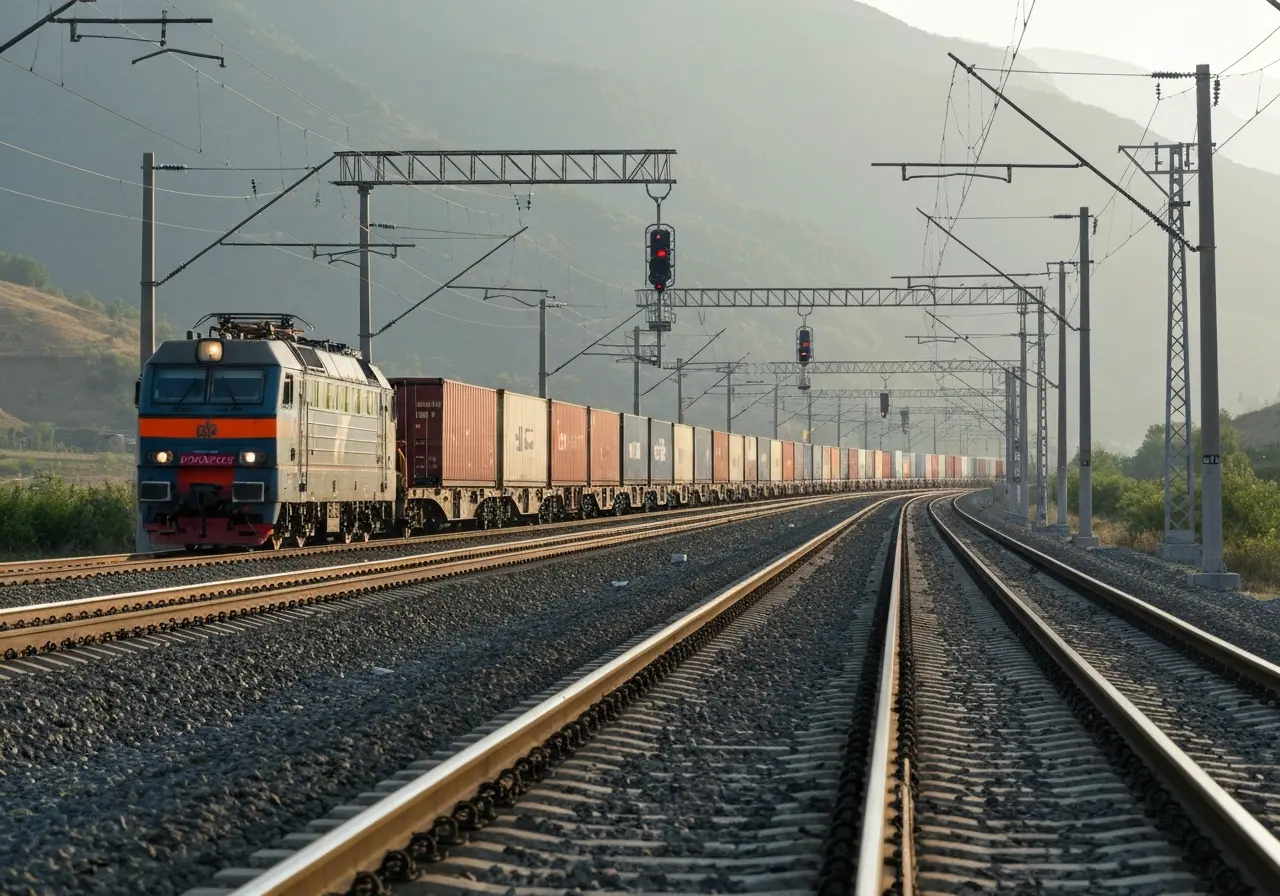
The work centered on the Georgian leg, the Marabda-Kartsakhi section. Of its 180 kilometers, crews rehabilitated 153 kilometers of existing track and laid a new 27-kilometer segment built to European standards. Azerbaijan Railways ran the job in five phases at a cost of about 250 million dollars, according to Azerbaijan’s transit council summary of the BTK modernisation, with new stations, bridges and traction substations along the route.
The headline change is throughput. Here is what the reopened line now carries on paper:
- 5 million tons of freight a year, up from roughly 1 million before the rebuild
- 826 kilometers of track across three countries, from Baku to Kars
- 27 kilometers of brand-new European-standard line through the Georgian mountains
Why the 2017 Line Never Carried What It Promised
The railway is not new. Leaders from Azerbaijan, Georgia and Turkey inaugurated it on October 30, 2017, at Alat Port near Baku, with a stated design capacity of 6.5 million tons of freight and a million passengers a year.
The Promise on Paper
Azerbaijan financed much of the Georgian construction, lending Tbilisi 220 million dollars at 1 percent interest over 25 years, then adding a further 575 million dollars on commercial terms. Records kept by Azerbaijan’s state oil fund financing the new railway show the project drew on Baku’s energy revenues for years before the first train ran.
The Georgian Bottleneck
For most of its first eight years, the line moved far less than its design allowed. The Georgian section ran on a single, non-electrified track through difficult terrain, and real throughput sat closer to a million tons a year. Trains queued, schedules slipped, and shippers kept defaulting to the established route through Russia.
The June rebuild goes straight at that constraint. Double-tracking and modern signaling on the reconstructed stretch are what take the line from a symbolic corridor to a working one.
The Middle Corridor Is Where the Freight Is Going
The route’s formal name is the Trans-Caspian International Transport Route (TITR, the multi-country rail and ferry chain that planners brand the Middle Corridor). It runs from China through Kazakhstan, across the Caspian Sea by ferry, then through Azerbaijan and Georgia to Turkey and onward into Europe, touching no Russian soil.
The Numbers Behind the Shift
That last point became the selling point after 2022, when sanctions and insurance risk pushed China-Europe cargo off the northern path through Russia. Container traffic on the corridor rose 37 percent to 63,300 TEU (twenty-foot equivalent units, the standard container measure) in the first ten months of 2025, with full-year volume near 77,000 and a target of 300,000 by 2029.
The bilateral data tells the same story. Georgia and Kazakhstan, two of the corridor’s anchor states, hit a record 2.74 million tons of rail freight between them in 2024, a sign of how fast the trade is thickening. The World Bank’s Middle Corridor freight assessment projects flows across the Caspian could triple to 11 million tonnes a year by 2030.
What Is Pulling Cargo Onto the Route
Several forces are converging at the same time:
- Sanctions and insurance risk pushed China-Europe cargo off the northern route through Russia after 2022
- Transit time fell to roughly two weeks, competitive with the older Russian rail path
- Kazakhstan, Azerbaijan and Georgia coordinated tariffs and set up a single operator to smooth border handoffs
- Demand for routes that do not depend on a single chokepoint rose across European importers
Where the Corridor Still Jams
The capacity win is real, and so are the limits it does not touch. The reopened BTK line removes the slowest link on its own stretch, but the broader corridor still hands cargo across two awkward seams before it reaches a European platform.
- The gauge break at Akhalkalaki, where Georgia’s 1,520-millimeter broad gauge meets Turkey’s 1,435-millimeter standard gauge, forcing a bogie change or container transfer
- The Caspian Sea crossing, where trains become ferries between Aktau or Kuryk and Baku, exposed to weather, vessel shortages and port queues
- The capacity gap, since the World Bank’s 11 million tonnes of projected 2030 demand sits well above the line’s new ceiling
So the chokepoint moves rather than disappears. With the Georgian track fixed, the next pressure points are the Caspian ferries and the gauge handoff, as Azerbaijan Railways’ Baku-Tbilisi-Kars project overview makes clear when it lists onward upgrades still planned.
Comparing the Routes China Now Has
For a shipper moving a container from inland China to Central Europe, three broad options compete. Speed, cost and political exposure pull in different directions, and the BTK upgrade changes the math on the middle one.
The rail crossing through the Caucasus now clears in roughly 13 to 17 days on a good run, against far longer for sea freight and a comparable window for the Russian path that many buyers no longer want to use.
| Route | Path | Crosses Russia | Typical transit | Status |
|---|---|---|---|---|
| Northern Corridor | China, Kazakhstan, Russia, Belarus, EU | Yes | About 16 days | Operating, volumes down since 2022 |
| Middle Corridor (BTK) | China, Kazakhstan, Caspian ferry, Azerbaijan, Georgia, Turkey, EU | No | 13 to 17 days | Operating since 2017, newly upgraded |
| Deep-sea route | China, Suez or Cape, European ports | No | 35 to 45 days | Cheapest per ton, slowest |
The trade-off is plain. The Caucasus rail line costs more per ton than the ocean and carries far less volume than either rival, but it offers a politically clean, two-week link that neither the sea nor the Russian route can match together.
Who Gains From the Akhalkalaki Junction
Georgia is the clearest winner. Every ton moving between the Caspian and Turkey now passes through its rebuilt track, turning transit fees and handling charges into a steadier revenue line and giving Tbilisi a strategic card it did not hold when the route ran light.
Azerbaijan and Turkey gain reach. Through the Marmaray tunnel beneath the Bosphorus, the corridor connects to the European network; the first freight train from China reached Prague this way in 2019 in 18 days. Each carries political weight as the broker between Asian cargo and European buyers.
Central Asia gains an exit that skips both Russia and Iran. Kazakhstan, already deepening ties with Georgia through new direct Shymkent to Tbilisi air links, treats the corridor as its main rail gateway west. Armenia, bypassed since the 1993 closure of the old Kars to Gyumri line, remains outside the project entirely.
If the rebuilt line holds its schedules through a full year of traffic, the Caspian ferries become the next thing the partners have to fix. If it cannot, the shippers who tried the corridor during the Russia squeeze will drift back to sea freight, and the new ceiling that looks ample today will start to look tight.
Frequently Asked Questions
What is the Baku-Tbilisi-Kars railway?
It is an 826-kilometer freight and passenger line connecting Baku in Azerbaijan, Tbilisi in Georgia and Kars in eastern Turkey. It opened to cargo in 2017 and forms the western leg of the Middle Corridor trade route between China and Europe.
When did the railway officially open after its upgrade?
The rebuilt line entered full service on June 2, marked by a ceremony at Georgia’s Akhalkalaki station. The launch followed a protocol signed by the Georgian and Azerbaijani transport and economy ministers.
What is the railway’s freight capacity?
The reconstruction lifted annual freight capacity from about 1 million tons to five million, with a longer-term target of 17 million tons once further upgrades are completed along the corridor.
Why does the railway bypass Armenia?
The route was built to connect Azerbaijan and Turkey through Georgia after the historical Kars to Gyumri to Tbilisi line was closed in 1993 during the first Nagorno-Karabakh war. Armenia has remained outside the project since.
What is the Middle Corridor?
Also called the Trans-Caspian International Transport Route, it runs from China through Kazakhstan, across the Caspian Sea by ferry, then through Azerbaijan and Georgia to Turkey and Europe, avoiding Russian territory entirely.
Does the Baku-Tbilisi-Kars railway carry passengers?
Passenger service on the line began in late May 2026, years after freight operations started in 2017. Freight, however, remains the corridor’s main commercial purpose.