A Cambridge-led team has produced the first direct experimental proof that inherited genetic background steers both cancer risk and the exact evolutionary path a tumour takes after the same DNA-damaging hit. In mice given one identical dose of a tobacco-smoke carcinogen, tumours still formed, but latency, driver mutations and genome stability diverged sharply by strain.
The work, published 22 July 2026 in Nature, sequenced nearly 600 tumours and shows why most smokers never develop lung cancer while some never-smokers do. Background genetics is no longer a footnote.
Four Strains, One Carcinogen Dose
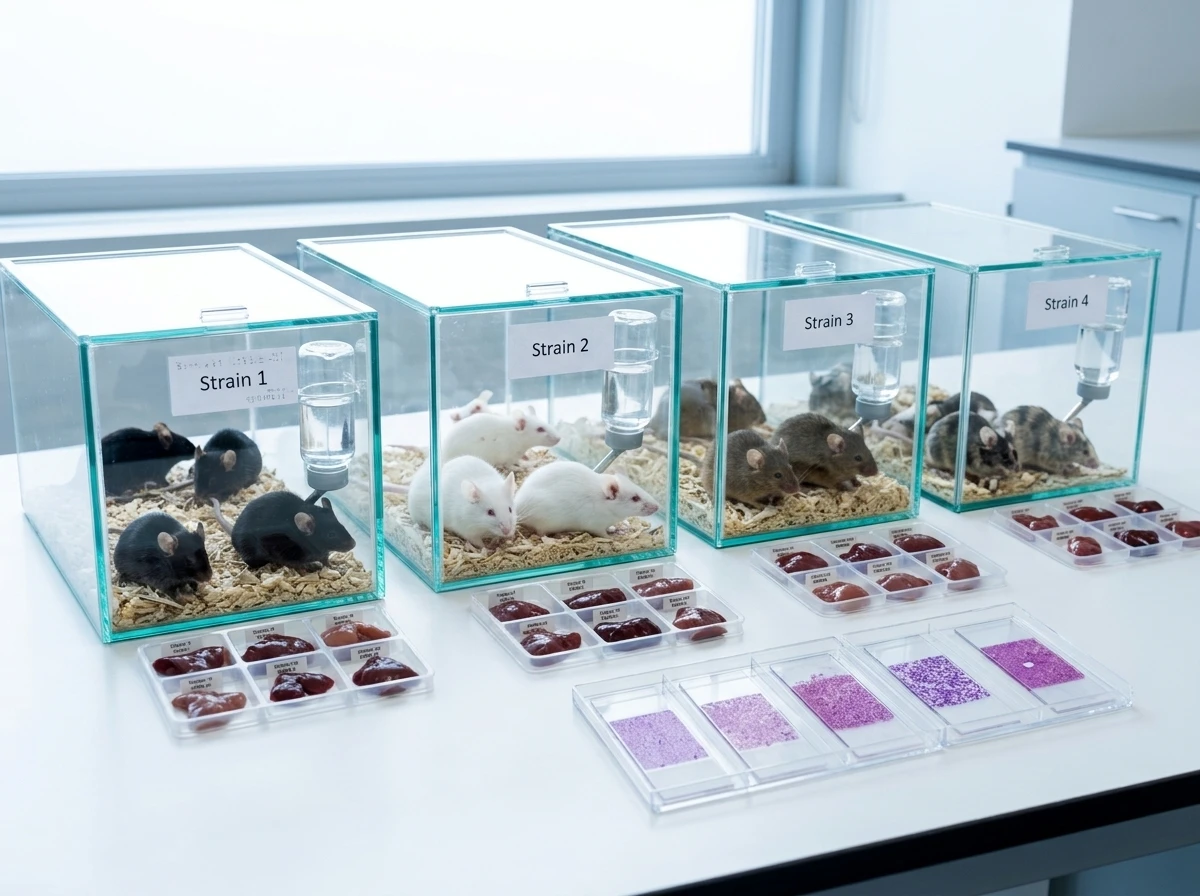
Researchers at the Cancer Research UK Cambridge Institute, with partners at Edinburgh, Yale, the German Cancer Research Centre (DKFZ) and labs across Europe and the US, bred four genetically divergent inbred mouse strains. The genetic spread matched or exceeded differences seen between major human ancestry groups.
Every male pup received a single intraperitoneal dose of diethylnitrosamine (DEN) at 15 days of age. DEN, present in tobacco smoke and some processed foods, creates well-characterised DNA adducts in liver cells. Housing, diet, age and dose were locked down. Environmental noise that confounds human cohort studies was removed.
That design isolates germline background as the only major variable left standing. Once the shared carcinogen hit lands, every later difference in timing, mutation spectrum and genome architecture has to be read through the inherited genome.
They then dissected and sequenced the genomes and transcriptomes of 581 DEN-induced liver tumours, plus spontaneous tumours from untreated controls, and reconstructed each tumour’s path from the first driver mutation. The University of Cambridge research release and the full Nature paper on genetic background detail the design.
Latencies Stretch From 25 Weeks to 78
Tumour appearance was not random. C3H mice reached 100 percent incidence by 25 weeks. C57BL/6J needed 36 weeks. CAST/EiJ took 38 weeks. Mus caroli stretched to 78 weeks. Spontaneous tumours in untreated animals followed the same order of susceptibility.
- 25 weeks: C3H/HeOuJ reaches full incidence
- 36 weeks: C57BL/6J reaches full incidence
- 38 weeks: CAST/EiJ reaches full incidence
- 78 weeks: Mus caroli reaches full incidence
Mutation burden did not explain the speed difference. CAST and BL6 tumours carried higher median base-substitution rates (17.6 and 16.6 per Mb) than the more susceptible C3H (13.5) or resistant CAROLI (13.3). Strain, not litter or individual animal environment, drove the rate variation.
| Strain | Latency to 100% tumours | Median substitutions/Mb | Notable features |
|---|---|---|---|
| C3H/HeOuJ | 25 weeks | 13.5 | Highest susceptibility; frequent DEN2 outliers |
| C57BL/6J | 36 weeks | 16.6 | High burden; some DEN2 outliers |
| CAST/EiJ | 38 weeks | 17.6 | Highest burden; strong lesion segregation |
| Mus caroli | 78 weeks | 13.3 | 37% mutationally symmetric (WGD-linked) |
The table compresses the core numerical contrast: same hit, different clocks and different mutational economies.
Mutation Load Does Not Explain Speed
Indels were rare across the board. The DEN mutational signatures shifted slightly by phylogeny, and Mgmt expression differences helped explain why some C3H and BL6 tumours flooded with the DEN2 signature. Still, raw mutation count failed to predict who got tumours first. Selection intensity and pathway choice mattered more.
The inverse pattern is hard to miss. The two strains with the highest median substitution rates were not the fastest to full incidence. The most susceptible strain sat near the bottom of the burden range. Clock speed and mutational economy are therefore separable traits under germline control.
Same MAPK Destination, Different On-Ramps
Almost every tumour, regardless of strain, acquired a gain-of-function mutation that activated the MAPK signalling cascade. That pathway controls cell growth and differentiation and is hijacked in many human cancers. Braf, Kras, Hras and Egfr appear repeatedly among the drivers.
Yet the specific driver chosen, the accompanying pathway activity, and the number of drivers per tumour varied by genetic background. Strain biases appeared in Hras-activating versus Egfr-activating mutations. Some backgrounds needed fewer driver events to lock in malignancy.
- Shared endpoint: MAPK cascade activation in nearly every tumour
- Recurrent drivers: Braf, Kras, Hras and Egfr gain-of-function events
- Strain-biased choices: Hras-activating versus Egfr-activating routes
- Variable driver count: some backgrounds lock in malignancy with fewer events
Cancer does not arise entirely by chance. Although tumours often reach the same biological endpoint, the path to that endpoint is determined by an individual’s genetic background.
Professor Duncan Odom, senior author who led the work at CRUK Cambridge Institute and is now at DKFZ, said those words in the study materials. He added that the team had shown for the first time the extent to which background influences both mutation processes and the pathways to tumour development. The peer-reviewed EurekAlert summary carries the full quotes.
Convergence on MAPK therefore hides divergence in the on-ramps. The endpoint looks familiar from human cancer catalogues. The route taken to reach it is background-specific, and that specificity begins before the first somatic driver is fixed.
Whole-Genome Doubling and Other Strain Signatures
One of the starkest differences was whole-genome duplication. In CAROLI, 37 percent of tumours lost the classic mutational asymmetry of lesion segregation. Those symmetric tumours carried higher mutational loads and lower variant allele frequencies, consistent with both daughter genomes of the original damaged duplex contributing to the final tumour. That pattern points to an early whole-genome doubling event.
Other strains stayed highly asymmetric. Aneuploidy rates also differed. Epistatic interactions between germline variants and the new somatic mutations produced population-specific progression, including subclonal selection that tracked both susceptibility and growth rate.
Even modest genetic divergence, on the scale of human ancestry groups, was enough to rewrite the selection pressures.
Lesion segregation normally leaves one daughter lineage heavily mutated and the other comparatively clean. When early whole-genome doubling intervenes, both copies of the damaged duplex can feed the expanding clone. The CAROLI symmetric class is the clearest experimental signature of that switch, and it co-occurs with the longest latency of the four strains.
Spontaneous Tumours Trace the Same Susceptibility Order
Untreated control animals still developed tumours, and those spontaneous cases lined up in the same susceptibility rank as the DEN-induced set. C3H remained the fastest, CAROLI the slowest, with BL6 and CAST in between.
That parallel matters. It shows the germline effect is not limited to how a cell handles one exogenous adduct load. Baseline risk, without the shared carcinogen pulse, already sorts by strain. DEN amplifies and timestamps a hierarchy that inherited genetics had already set.
For human epidemiology the implication is direct. Never-smokers who develop lung cancer and heavy smokers who never do need not be random outliers. Polygenic background can raise or lower the threshold at which ordinary DNA damage, from any source, tips a clone into malignancy.
The sequencing of spontaneous tumours alongside the 581 DEN-induced cases therefore serves as an internal control. Same order, two very different insult regimes, one germline ranking.
What This Means for Human Screening and Drugs
Dr Sarah Aitken, first author and now Assistant Professor at Yale School of Medicine, stated the practical stake plainly. If genetic background shapes both risk and the evolutionary trajectory of tumours, future prevention and screening will need to incorporate inherited genetics and population diversity. Responses to DNA-damaging cancer treatments are also likely to differ by background, so diagnostics and therapies may need tailoring.
Cancer Research UK’s Dr Sam Godfrey called the result a fascinating hint that inherited genes heavily influence how cancers develop after DNA damage. More human work is required, he noted, but the finding could change how cancer starts and how it is tackled with greater precision.
- Screening programmes that ignore polygenic background and ancestry will keep missing high-risk never-smokers and over-calling low-risk heavy smokers.
- DNA-damaging chemotherapies and radiation may show different efficacy and toxicity profiles once germline context is measured.
- Polygenic risk scores already exist for lung cancer; this work supplies a mechanistic reason they should be integrated earlier and calibrated by ancestry.
- Clinical-trial enrolment and biomarker cut-offs that treat “the mouse” or “the patient” as uniform will continue to produce noisy or non-replicable results.
The DKFZ account of strain differences underscores the same long-term push toward precise, personalised prevention and treatment.
In short, exposure history alone is an incomplete risk model. The same adduct burden can be cleared, tolerated or converted into a fast MAPK-driven clone depending on the germline chassis it lands in. Screening rules and adjuvant choices that omit that chassis will keep misfiring at the tails of the risk distribution.
Research Models That Ignore Ancestry Miss the Point
Most laboratory cancer work still relies on a narrow set of inbred strains. The new data show that choice is not neutral. Latency, driver spectrum and genome stability all move with background. A drug or prevention strategy validated in one strain can look different in another whose genetic distance is no larger than the distance between two human populations.
Odom and colleagues argue that genetic background must be treated as a designed variable when biomedical and translational studies are planned and interpreted. The old assumption that environment plus a few strong drivers tell the whole story is incomplete. The second-order effect is that the field’s own tool kit needs updating if results are to generalise.
On X, scientists quickly labelled the germline genome a hidden axis of cancer evolution and a potential shift for precision oncology. That reading matches the data: the same carcinogen, the same MAPK endpoint, yet routes, speeds and genomic catastrophes that are background-dependent.
How Trial Design Absorbs the Background Lesson
If strain is enough to flip latency by more than threefold and to switch whole-genome doubling rates from rare to 37 percent, then single-strain preclinical pipelines are sampling one slice of a wider response surface. A prevention agent or DNA-damaging combination that looks clean in C3H may behave differently in a CAST-like or CAROLI-like genetic neighbourhood.
The practical fix is not endless strain panels. It is deliberate diversity at the design stage: at least two backgrounds separated on the scale used here, with latency, driver spectrum and genome-stability readouts reported side by side. Biomarker thresholds and toxicity flags should be allowed to move with ancestry proxies rather than forced to a single cut-off.
Human trials face the same geometry. Enrolment that ignores polygenic risk and ancestry will keep averaging away the very interactions this mouse panel makes visible. The Cambridge data do not prescribe a new assay; they prescribe a design habit. Treat inherited background as a planned factor, not residual noise.
The mouse experiment does not yet hand clinicians a new blood test. It does hand them a clear mechanism and a warning. Inherited genetics sets the trajectory after DNA damage. Screening, treatment and research design that continue to treat that background as noise will keep leaving the same people unprotected.
Frequently Asked Questions
What carcinogen did the Cambridge team use and why?
They used a single dose of diethylnitrosamine (DEN), a DNA-damaging agent found in tobacco smoke and some processed foods. DEN is metabolically activated in liver cells, produces known adducts, and reliably drives hepatocellular carcinoma-like tumours in mice while allowing precise control of dose, timing and environment.
How many tumours and mouse strains were analysed?
Four strains (C3H/HeOuJ, C57BL/6J, CAST/EiJ and Mus caroli) produced 581 DEN-induced tumours that received whole-genome and transcriptome sequencing, plus spontaneous tumours from untreated controls and normal-tissue baselines, for a total exceeding 600 profiled samples.
Did every tumour activate the same cancer pathway?
Nearly all tumours acquired mutations that activated the MAPK pathway, a core growth-signalling cascade common in human cancers. The particular driver gene or allele, the accompanying pathway changes, and the frequency of whole-genome duplication still differed by genetic background.
Can these mouse results be applied directly to human smokers?
No. The authors and Cancer Research UK explicitly caution that the findings come from controlled mouse experiments. Parallel human studies are required before clinical guidelines change, although the genetic diversity of the strains was chosen to approximate human ancestry differences.
Who funded the study and where was it led?
Major funding came from Cancer Research UK, the Medical Research Council, the European Research Council and Wellcome. Experimental work was centred at the CRUK Cambridge Institute with co-leads at Edinburgh, Yale and DKFZ.
Disclaimer: This article summarises peer-reviewed research in mice and is not medical advice. Consult qualified clinicians for personal cancer risk or treatment decisions.