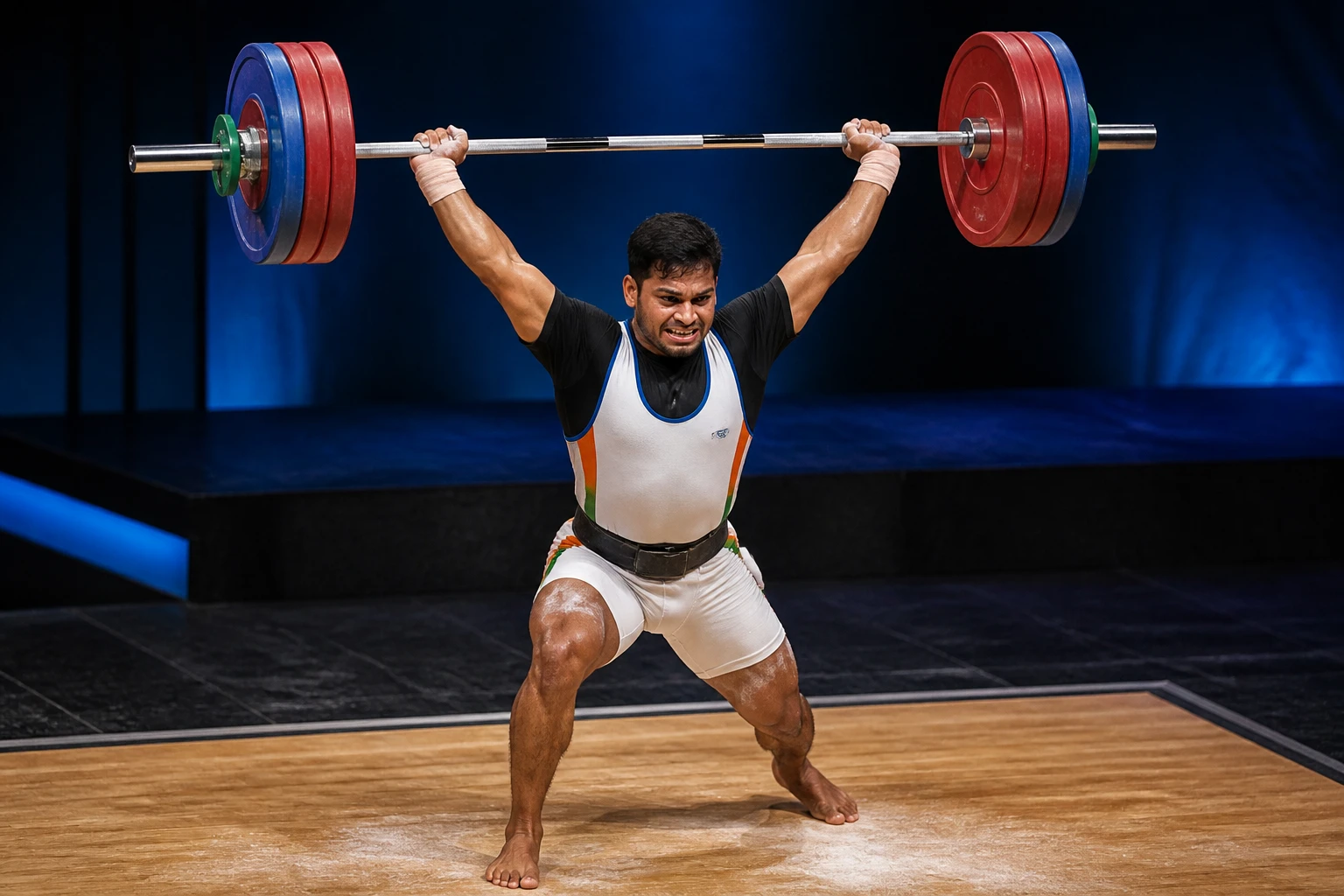
Valluri Ajaya Babu lifted a Commonwealth Games record 149kg snatch and 181kg clean and jerk for a 330kg total, taking men’s 79kg silver at Glasgow 2026 by a single kilogram. The 21-year-old from Kondavelagada finished behind Malaysia’s Erry Hidayat Muhammad (331kg) after a final that rewrote the Games record multiple times on Monday night.
England’s Chris Murray claimed bronze at 325kg. The silver is India’s sixth weightlifting medal of these Games and the clearest recent proof that one Andhra village’s old stone contests still feed the national podium.
The night turned on successive Games records and a final attempt that moved the gold by the smallest possible margin. Ajaya Babu left the platform with silver, a family legacy upgraded, and a clear technical ledger of what still needs fixing before the next major meet.
The Duel That Kept Breaking Records
Ajaya Babu opened the snatch with a clean 145kg. He missed 149kg on his second attempt, then nailed it on the third to set a new Commonwealth Games record and lead the field. Muhammad sat on 147kg and Murray on 148kg heading into the clean and jerk.
The second discipline turned into a direct duel. Muhammad posted 181kg and a provisional Games-record total. Ajaya Babu answered with the same 181kg on his final attempt, briefly reclaiming the lead at 330kg. Muhammad still had one lift left. He cleaned and jerked 184kg, also a Games record, for 331kg and gold.
| Lifter | Nation | Snatch | Clean & Jerk | Total | Place |
|---|---|---|---|---|---|
| Erry Hidayat Muhammad | Malaysia | 147kg | 184kg (GR) | 331kg (GR) | Gold |
| Valluri Ajaya Babu | India | 149kg (GR) | 181kg | 330kg | Silver |
| Chris Murray | England | 148kg | 177kg | 325kg | Bronze |
Ajaya Babu had beaten the same Malaysian rival earlier in 2025 at the Commonwealth Championships in Ahmedabad, posting a lifetime-best 335kg to Muhammad’s 333kg. The Glasgow result reversed that order by the slimmest margin.
The snatch record gave him the early cushion. The clean and jerk answers then cancelled that cushion and left the contest on Muhammad’s last bar. One successful extra kilo decided the colour of the medal.
record snatch then silver finish video captured the swing from early lead to final-kilogram heartbreak in real time.
Father’s Bronze, Son’s Silver Sixteen Years Later
In 2010 Valluri Srinivasa Rao won bronze in the men’s 56kg class at the Delhi Commonwealth Games. Ajaya Babu was a small boy watching at home in Kondavelagada. “Everyone was so excited. They were all clapping and telling me that was my father on the TV,” he later recalled.
The pair now form one of the rare father-son Commonwealth Games medallist pairs in the sport. Srinivasa Rao, a former Army man who spent 22 years in service and won twelve straight national titles, still works with flowers and runs a local gym after voluntary retirement.
This was my dream. He will perform even better than me.
Srinivasa Rao told ANI after the final. He has already begun looking toward the 2026 Asian Games and 2028 Olympics and asked the government for extra support so the next step is possible. Ajaya Babu’s own words after the competition struck the same note of unfinished business.
“It is a mix of happiness and sadness, as I missed out on the gold,” he said. “I feel that a mistake cost me the gold today. I will ensure I don’t repeat this error… I dedicate this medal to my coaches, my father, and the entire nation of India.” Before Glasgow he had said his father’s one regret was never winning gold and that he wanted to win one for him.
The weight classes differ and the gap in colour remains. Yet the family line now runs bronze to silver across sixteen years, with both men already treating Glasgow as a staging post rather than an end point.
Stones Before Bars in Kondavelagada
Kondavelagada is a village of roughly 3,000 people in Vizianagaram district. Flower fields still dominate the economy. For decades the local measure of strength was Sangidi Rallu, a Pongal-festival contest of lifting black-granite stones that weigh between 80kg and 220kg. The winner earned the title Ustad.
That folk test evolved into organised weightlifting. Villagers brought in proper bars and plates in the early 1990s. Srinivasa Rao and friends trained after the stone lifters finished, then cycled long distances to sell flowers before formal sessions. A district win opened the door to coaching under M.S. Sharma and later the SAI centre in Eluru.
- 1991-early 1990s, Children including young Srinivasa Rao watch and then enter Sangidi Rallu; first modern equipment arrives in the village.
- Late 1990s-2005, Rao becomes state and national contender; friend Challa Ramu opens a local gym after personal tragedy; medals and government jobs begin to follow.
- 2010, Srinivasa Rao takes CWG bronze in Delhi, putting Kondavelagada on the national map.
- 2024-2026, Ajaya Babu sweeps junior and senior Commonwealth Championship golds, then claims CWG silver; sisters Bellana Bhargavi and Harika add youth and junior Commonwealth golds from the same village.
The village has now produced 20 national and 13 international weightlifters. Neighbouring Amadalavalasa and Godalam tell parallel stories. Together the three hamlets function as a quiet production line: traditional strength culture plus low-cost gyms plus the promise of a government job for medallists.
Nutrition remains the bottleneck. A serious lifter needs Rs 50,000-60,000 a month for food and training. Most families still take loans. Rao and Ramu are building another gym so the next generation does not have to leave home as early as they did.
The same festival stones that once decided local bragging rights now sit beside calibrated bars. The pathway is no longer improvised. It is a known route from granite to national camps, and the village keeps feeding it.
India’s Six-Medal Weightlifting Haul in Glasgow
Ajaya Babu’s silver sits inside a broader Indian surge on the platform.
- Mirabai Chanu, Gold, women’s 48kg
- Valluri Ajaya Babu, Silver, men’s 79kg
- Gyaneshwari Yadav, Silver, women’s 53kg
- Chanambam Rishikanta Singh, Silver, men’s 60kg
- Muthupandi Raja, Silver, men’s 65kg
- Bindyarani Devi, Bronze, women’s 58kg
Every Indian weightlifter who has competed so far has left with a medal. The streak underlines how deep the talent pool has become, much of it still rooted in the same rural Andhra and Manipur pipelines that produced earlier stars.
Four of the six medals are silver. The pattern shows consistent podium reach even when the top step stays just out of range. Ajaya Babu’s one-kilogram deficit fits that larger picture of near-misses that still add to the tally.
Ahmedabad Gold Flipped to Glasgow Silver
The two meetings between Ajaya Babu and Muhammad now form a neat reverse pair. The numbers already on record make the swing plain.
| Meeting | Ajaya Babu Total | Muhammad Total | Winner | Margin |
|---|---|---|---|---|
| Ahmedabad 2025 | 335kg | 333kg | Ajaya Babu | 2kg |
| Glasgow 2026 | 330kg | 331kg | Muhammad | 1kg |
In Ahmedabad the Indian held a lifetime best and a two-kilo cushion. In Glasgow both men sat below that earlier ceiling, yet the Malaysian found the extra lift when it counted. The order changed by three kilos across the two contests if measured from Ajaya Babu’s side of the ledger.
The Glasgow snatch record could not protect the lead once the clean and jerk opened. Muhammad’s final 184kg rewrote the total and closed the chapter. For a 21-year-old already carrying Commonwealth title pedigree, the lesson is narrow and usable: the last attempt selection and the kilo that stayed on the platform.
Both athletes now know the other’s ceiling under Games pressure. The next meeting will start from that shared data rather than from surprise.
What the One-Kilogram Gap Leaves Open
Ajaya Babu entered Glasgow as the reigning Commonwealth champion and left with the silver that upgrades his father’s bronze. The this was my dream father reaction captures the family satisfaction. Yet both men have already shifted focus to the Asian Games later this year and the Los Angeles Olympics.
The technical lesson is clear. A Games-record snatch put him in front; the clean-and-jerk strategy and final attempt selection left one kilogram on the platform. At 21 he has time to close that gap. The village system that produced him is already turning out the next teenagers who watch the same stone contests and the same television footage of Glasgow.
For now the ledger is simple. Srinivasa Rao, bronze, Delhi 2010. Valluri Ajaya Babu, silver, Glasgow 2026. Kondavelagada keeps sending lifters.
The Next Targets Already Sit on the Calendar
Srinivasa Rao has named the 2026 Asian Games and the 2028 Olympics as the immediate horizons. He has also asked the government for extra support so those steps remain realistic. Ajaya Babu’s post-competition remarks matched that forward tilt: happiness mixed with the knowledge that a mistake cost gold, and a promise not to repeat the error.
The support request sits against the known cost of staying elite. Monthly food and training needs of Rs 50,000-60,000 already force most village families into loans. A further push toward Asian and Olympic standards will only raise that figure. The new gym Rao and Ramu are building aims to keep more of the next cohort at home longer, cutting one layer of early expense.
The medal itself already does part of the work. Government jobs have long followed successful lifters from Kondavelagada and its neighbouring hamlets. Each podium finish advertises the route to the teenagers still lifting stones at Pongal. Ajaya Babu’s silver, coming sixteen years after his father’s bronze, refreshes that advertisement in real time.
- Father’s stated aim: Asian Games 2026, Olympics 2028, and added government backing
- Son’s stated aim: correct the final-attempt error and convert the next major meet
- Village aim: another gym so later lifters train closer to home
The one-kilogram gap is therefore both a technical note and a calendar note. It marks what must improve before the Asian Games bar is loaded, and it keeps the family and the village pointed at the same unfinished list.
Frequently Asked Questions
How much did Valluri Ajaya Babu lift for silver at CWG 2026?
He totalled 330kg with a Games-record 149kg snatch and 181kg clean and jerk, one kilogram behind the gold-medal total of 331kg.
What medal did Ajaya Babu’s father win at the Commonwealth Games?
Valluri Srinivasa Rao won bronze in the men’s 56kg category at the 2010 Delhi Games and later coached his son in the early years.
Why is Kondavelagada known for weightlifting?
The village’s traditional Sangidi Rallu granite-stone lifting contests evolved into organised training that has produced 20 national and 13 international weightlifters and multiple government jobs through sport.
Did Ajaya Babu beat the gold medallist before Glasgow?
Yes. At the 2025 Commonwealth Championships in Ahmedabad he recorded 335kg to Erry Hidayat Muhammad’s 333kg before the Malaysian reversed the result by 1kg in Glasgow.
How many weightlifting medals has India won at Glasgow 2026 so far?
Six: one gold (Mirabai Chanu), four silvers including Ajaya Babu, and one bronze, with every Indian lifter medalling to date.