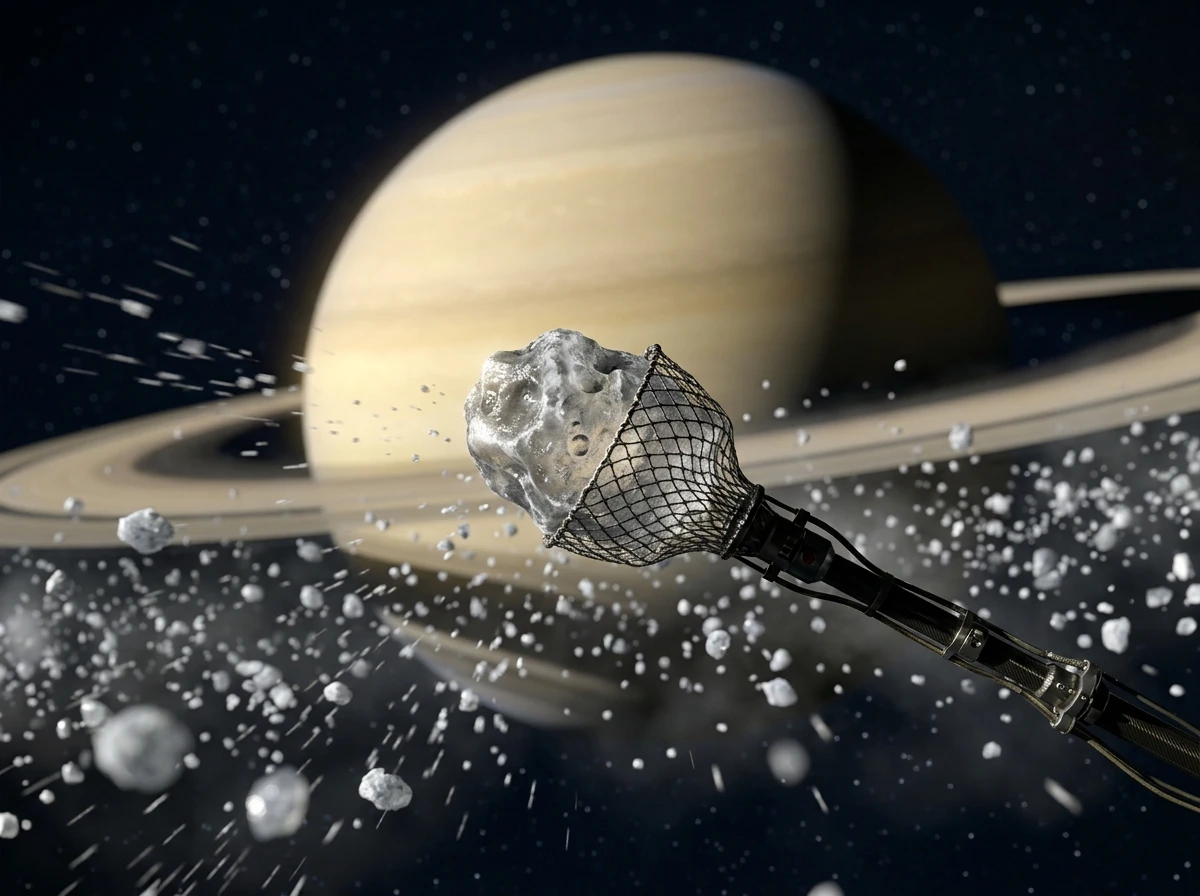
NASA has selected a mission concept designed to physically grab a piece of Saturn’s rings, something no spacecraft has ever done. The proposal, called PRAXIS, just won a nine-month feasibility grant for 2026, not a launch date or a rocket.
The bigger payoff may sit two planets further out. NASA’s own project description ties this autonomous sampling technology to the agency’s next flagship destination, a Uranus mission that is still waiting on a launch window of its own.
A Robotic Arm Built to Grab a Moving Target
PRAXIS stands for Planetary Rings Autonomous EXploration with In-situ Sampling. It is led by Marco Quadrelli at NASA’s Jet Propulsion Laboratory (JPL) and was chosen as part of the 2026 class of NASA Innovative Advanced Concepts (NIAC) awards, the agency’s program for early, speculative technology studies.
Saturn’s rings are mostly water ice, made of particles ranging from tiny grains to house-sized boulders that are constantly colliding, clumping and breaking apart. PRAXIS would identify a suitable target through imaging, then hold position at a safe distance while a boom reaches out to snag a moving sample with a soft deployable boom. It would then drift off to sample a different gap or region entirely, building a picture of how the rings vary from place to place.
The system leans on several pieces of technology working together:
- AI-driven collision avoidance that keeps the spacecraft clear of debris moving at orbital speed
- A long, soft, deployable boom that allows touch-and-go sampling without a full landing
- A bio-inspired capture mechanism, drawing on the flicking, line-and-net motion of casting sports to snag a free-floating particle without a hard impact
- Miniaturized onboard instruments that analyze size, porosity and composition in real time, rather than waiting to phone results home
The collision-avoidance problem is not unique to Saturn. China is preparing a kinetic impactor built to close faster than DART, NASA’s own asteroid-deflection test, a sign that autonomous precision near small, fast-moving bodies is becoming its own corner of spacecraft engineering.
PRAXIS Runs on a $175,000, Nine-Month Budget
NIAC Phase I awards are capped at up to $175,000 for nine months of work, and that work is simulation and system design, not hardware. Nothing about PRAXIS has flown, been built, or been assigned to a rocket.
A strong Phase I result can lead to Phase II, a bigger award of up to $600,000 spread across two more years, meant to fund an actual physical prototype. PRAXIS is not there yet. It shares this year’s full slate of advanced concepts with proposals covering resource surveys, exoplanet imaging and propulsion systems that have nothing to do with Saturn at all.
That is a modest bet for an agency to place on a technology this novel. It is also the honest scale of what got announced: a paper study, not a mission with a spacecraft already under construction.
Where Cassini Watched, PRAXIS Would Reach In
NASA’s Cassini spacecraft studied Saturn for 13 years before a deliberate plunge into the planet’s atmosphere in 2017. It reshaped what scientists know about the rings, but it never touched one.
| Capability | Cassini | PRAXIS (proposed) |
|---|---|---|
| Data-gathering method | Remote imaging, spectroscopy and radio occultations from orbit | Direct touch-and-go sampling with a deployable boom |
| Smallest particle studied directly | None sampled; bulk properties inferred from afar | Millimetre-to-centimetre particles captured and examined onboard |
| Physical sample analyzed on-site | No | Yes, real-time composition and porosity readings |
| Mission status | Ended with atmospheric entry in 2017 | Phase I feasibility study underway in 2026 |
That jump from watching to reaching in matters for reasons beyond Saturn. Understanding how individual ice particles form, collide and break apart could inform how scientists read the thinner rings around Uranus and Neptune, and even the disks of debris that eventually clump into planets and stars.
Saturn’s Rings Already Have Company on the 2026 Shortlist
PRAXIS was not the only ring-focused idea NASA funded this cycle. The same NIAC class includes a separate concept for steerable femtosat swarms threading the rings and magnetosphere, a swarm of tiny steerable satellites meant to sample Saturn’s rings, atmosphere and magnetic field all at once.
Two independent teams pitched two different ways to get hands-on data from the same planet in the same funding round. Neither is guaranteed to fly as designed. NASA’s appetite for speculative robotic-capture concepts extends past NIAC, too: the agency has floated a $30 million bid to grab its own falling telescope, the aging Swift Observatory, before it burns up in the atmosphere.
Taken together, it looks less like a single dramatic Saturn mission and more like a portfolio. NASA is placing several cheap, parallel bets on autonomous, hands-on space robotics, and letting the strongest results decide which one gets built.
The Idea NASA Shelved Two Decades Ago
PRAXIS is not the first attempt to get physically close to Saturn’s rings. It updates an idea NASA has circled since the early 2000s.
- 2000: Engineer Thomas Spilker first proposes the Saturn Ring Observer, a spacecraft that would hover directly above the rings rather than orbit at a distance.
- 2010: A NASA-commissioned engineering study, requested for the planetary science decadal survey process, examines hovering two to three kilometers off the ring plane in a non-Keplerian orbit to study particle interactions at a 1 to 10 centimeter scale.
- 2026: NASA selects PRAXIS for NIAC Phase I funding, trading the hover-and-watch design for a robotic arm that grabs samples directly.
- Early 2030s: NASA’s current earliest planning window for the Uranus Orbiter and Probe, the flagship mission PRAXIS’s own backers say this sampling technology is aimed at.
The throughline is two decades of the same basic goal, getting close enough to Saturn’s rings to measure individual particles, achieved first by hovering and now by reaching out and taking hold.
So Why Is Uranus the Real Payoff?
Because NASA’s own PRAXIS project description says so. It states plainly that the system’s versatility positions it for infusion into the upcoming Uranus Probe mission, the flagship trip that the 2023-2032 Planetary Science and Astrobiology Decadal Survey ranked as the field’s top priority, and one that has already slipped behind its original schedule.
The Uranus Orbiter and Probe was originally planned for a 2031 launch on an expendable Falcon Heavy rocket, using a Jupiter flyby to reach Uranus by 2044. A shortfall in the plutonium-238 that would power the spacecraft’s systems has already pushed that back. NASA is now planning around an atmospheric probe released right after orbit insertion, with a launch window in the early 2030s and arrival closer to 2045.
Only one spacecraft has ever seen Uranus up close. Voyager 2 flew past in 1986 and has not been followed since. Whatever autonomy and sampling tricks PRAXIS proves out at Saturn would have a decade or more to mature before an actual Uranus-bound spacecraft needs them.
Phase II funding decisions typically follow the completion of a Phase I study. If the simulations hold up, NASA could fund a physical PRAXIS prototype next, years before any spacecraft carrying the technology is scheduled to leave Earth.