China plans to slam a spacecraft into a 30-meter asteroid at nearly 9 kilometers per second before 2030, a speed that would make it the fastest planetary defense test ever attempted. The target is 2015 XF261, a faint near-Earth rock discovered eleven years ago and studied only in passing since.
The mission, built around two spacecraft and a peer-reviewed Chinese study, does more than test whether humanity can nudge a killer rock off course. It also doubles as a live demonstration of the exact hypervelocity guidance and orbital coordination that defense analysts already link to anti-satellite weapons.
The Target Is a Faint Rock Named 2015 XF261
The China National Space Administration, or CNSA, the country’s space agency, has built its first full-scale planetary defense mission around a small, obscure object. Asteroid 2015 XF261 measures roughly 30 meters across, about the length of a basketball court, and has barely been studied since its discovery.
Chinese scientists described the plan in a paper for the Journal of Deep Space Exploration, a Chinese-language academic journal, led by Li Mingtao, chief scientist for planetary defense at CNSA. Global Times reported this week that the asteroid has been identified as a potential target, with the encounter expected during a close pass of Earth sometime in 2029 or 2030, when the object comes within roughly seven million kilometers of the planet.
Earlier planning pointed to an even tighter runway. In 2024, Wu Weiren, director of China’s Deep Space Exploration Laboratory, indicated the spacecraft could launch around 2027, leaving two to three years of transit time before the encounter window opens.
Nine Kilometers a Second
Speed is the headline number. China’s impactor is expected to hit its target at about 9 kilometers per second, or roughly 5.6 miles per second, close to Mach 26 at sea level. That is noticeably faster than NASA’s Double Asteroid Redirection Test, or DART, which struck the asteroid moon Dimorphos at 6.1 kilometers per second in September 2022.
DART remains the baseline every planetary defense program measures itself against. NASA’s own investigation team found the impact shortened Dimorphos’s orbital period by 33 minutes, far beyond what mission planners expected. Johns Hopkins Applied Physics Laboratory, which built and ran DART, said the result beat NASA’s minimum success threshold by more than 25 times.
| Metric | NASA’s DART (2022) | China’s Planned Mission (2029 to 2030) |
|---|---|---|
| Target asteroid | Dimorphos, moon of Didymos | 2015 XF261 (potential target) |
| Target size | About 160 meters wide | About 30 meters wide |
| Impact speed | 6.1 km/s (3.8 miles/second) | About 9 km/s (5.6 miles/second, Mach 26) |
| Spacecraft flown | 1 impactor, plus a separate Hera follow-up mission | 2 spacecraft launched together: impactor and observer |
| Orbital effect | Period cut by 33 minutes | Path expected to shift 3 to 5 centimeters at impact |
A higher closing speed means more kinetic energy delivered into a much smaller target, which is why Chinese researchers say the test could weaken or break apart the asteroid’s structure entirely, not just push it off course.
Two Spacecraft, One Shot at the Rock
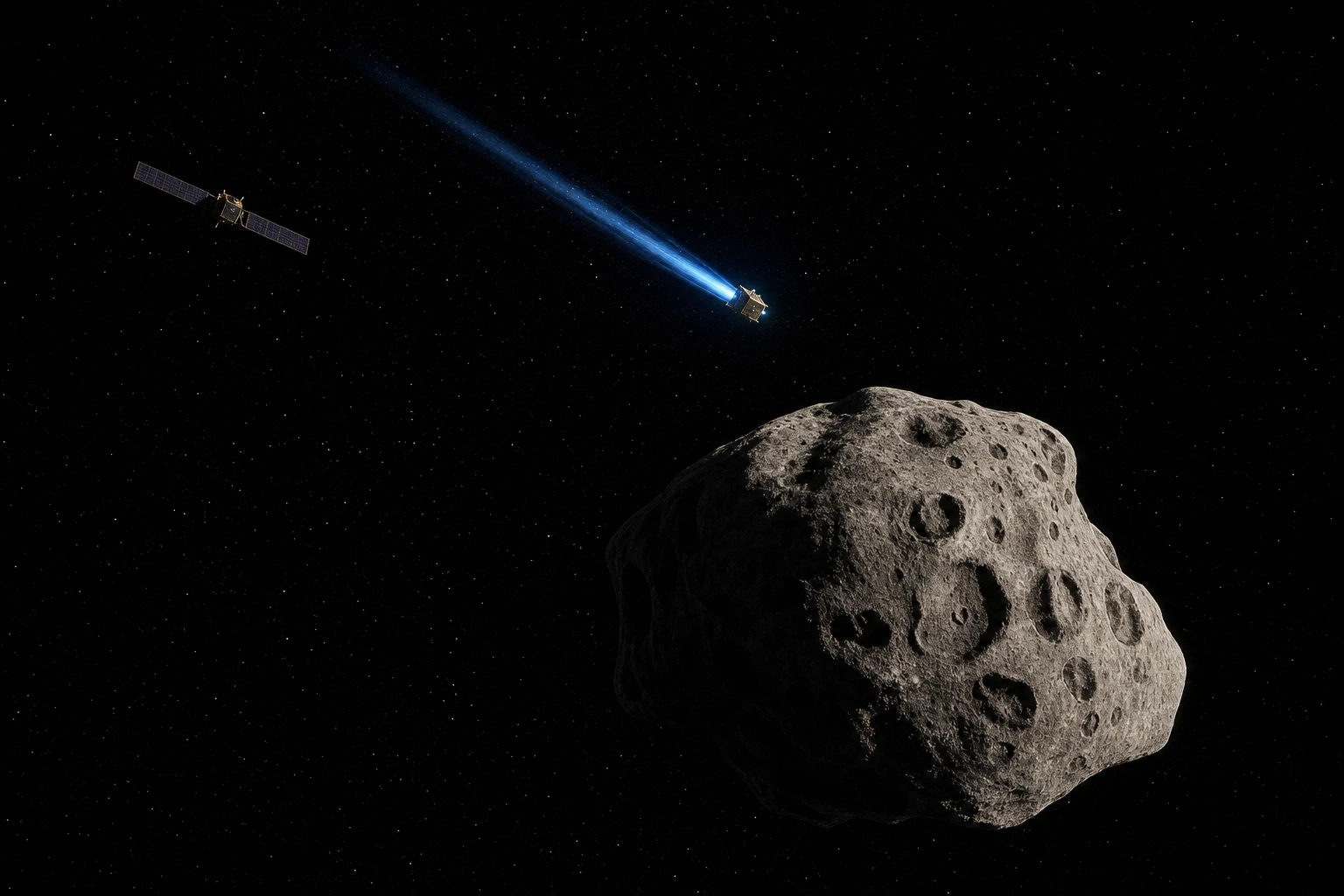
Where DART flew alone and relied on a separate European mission, Hera, to inspect the aftermath years later, China’s plan launches both roles together. One craft acts as the impactor. The other trails behind as an observer, watching before, during and after the collision to measure changes in the asteroid’s crater, debris field and orbit.
Engineers have described the sequence as fly-along, impact, fly-along: survey the target first, strike it, then stay to record what happened. Researchers have laid out four things the test needs to prove.
- Hit the asteroid accurately enough to confirm the guidance system works at extreme closing speed.
- Measure whether the strike actually changed the asteroid’s path.
- Capture enough data on the impact to refine future deflection models.
- Confirm the asteroid poses no new risk to Earth once the test is complete.
That last point matters because 2015 XF261 orbits the Sun on its own, unlike Dimorphos, which orbits a larger companion asteroid. A binary system makes deflection easy to measure from Earth, since the moon’s orbital period shifts in a way telescopes can time directly. A lone asteroid does not offer that shortcut, which is part of why China’s team is chasing a shift measured in centimeters rather than minutes.
A Smaller Target Mimics the Real Threat
Dimorphos was large, round and unusually well mapped before DART ever launched. Global Times reported that China’s planners deliberately went smaller and messier, arguing that a 30-meter object is a more realistic stand-in for the asteroids most likely to actually threaten Earth.
Objects under 10 meters typically burn up harmlessly in the atmosphere. Objects tens of meters across are common, hard to spot because they are faint, and often sit outside existing catalogs entirely, which is precisely the size range most likely to catch astronomers off guard. Kilometer-scale asteroids capable of global catastrophe are far rarer and, in most cases, already tracked.
Researchers studying DART’s aftermath found that ejecta blasted from the impact site added more momentum than the spacecraft itself carried, a detail that complicates predictions for smaller, less-studied bodies like 2015 XF261. A tinier asteroid with unknown internal structure could respond to a hit in ways no computer model has confirmed yet, which is part of the point of testing one.
The Same Impactor Doubles as a Weapon
Every part of the technology that makes this mission work, precision terminal guidance closing at hypervelocity on a small non-cooperative object, plus a second spacecraft tracking the result from nearby, has an obvious second application. Analysts have said as much in print for the better part of a year.
Asia Times reported that the same proximity-monitoring techniques China needs to watch its own asteroid impact could provide a foundation for tracking objects in orbit with precision, the same skill set used to shadow a satellite. The Eurasian Times went further, noting China’s 2007 test that destroyed one of its own weather satellites with a ground-launched missile, and arguing that mastering hypervelocity kinetic impact and dual-spacecraft coordination could hand China capabilities transferable to anti-satellite systems.
Asteroid detection, defense and resource utilization are directly linked to the survival and long-term development of humanity in space. The asteroid-colliding mission is highly complex, with significant economic and social benefits, and it is suitable for international cooperation.
Wu Weiren said that in September 2025 at the Tiandu Forum in Hefei, framing the mission as scientific and cooperative. Not everyone reads it that way.
- Chinese officials describe the mission as planetary protection, tied to future asteroid resource use and open to international partners.
- Western defense analysts, writing in outlets from Asia Times to the Eurasian Times, say the same guidance and impact hardware works as a rehearsal for anti-satellite operations.
- Independent planetary scientists mostly stay out of the weapons debate, focused instead on what the data will do for future deflection models.
A 2025 paper from the Center for Global Security Research at Lawrence Livermore National Laboratory documented that China maneuvered a satellite to drag a defunct BeiDou craft into a graveyard orbit in 2022, calling out the dual-use nature of that capability. The Pentagon has said publicly that Chinese military strategists treat the ability to deny adversaries the use of space as central to modern warfare.
Does China Have an Early Warning System for Asteroids Too?
Yes. China said in June 2026 that it is studying a round-the-clock network of ground-based telescopes and space-based satellites to spot hazardous near-Earth objects earlier, with software that would automatically calculate a new object’s orbit and its odds of striking Earth.
Part of that network already exists. The 2.5-meter Wide Field Survey Telescope in Lenghu, Qinghai Province, saw first light in 2023 and had already logged two new asteroid discoveries within its first few months of operation. China’s newest Five-Year Plan, covering 2026 through 2030, formally commits the country to its first planetary defense test and verification mission alongside other deep space goals.
The asteroid-strike mission is not China’s only current brush with a near-Earth object. Its Tianwen-2 spacecraft, launched in 2025, is already carrying out a separate encounter with the quasi-moon Kamoʻoalewa, part of a broader push to study and eventually redirect the small bodies that pass closest to Earth. If the impact mission goes ahead as planned, China would become only the second nation after the United States to demonstrate asteroid deflection in space.
Frequently Asked Questions
Is asteroid 2015 XF261 a threat to Earth?
No known asteroid, including 2015 XF261, is currently on a collision course with Earth. Experts say the value of a test like this comes from proving that even a small nudge, applied years ahead of a real threat, could be enough to steer a genuinely dangerous object clear of the planet.
When will China’s asteroid mission launch and hit its target?
Early proposals floated a launch around 2027 to allow transit time before the asteroid’s close approach. The impact itself is expected during a flyby window in 2029 or 2030, though CNSA has not locked in a final date.
How does China’s plan compare with Europe’s Hera mission?
The European Space Agency launched Hera in October 2024 to study the aftermath of DART’s impact up close, arriving at the Didymos system years after the actual collision. China’s design skips that gap by sending its observer spacecraft alongside the impactor from the start.
Could a deflection test push an asteroid toward Earth instead of away?
Mission planners choose targets and impact angles specifically so any nudge moves the object further from Earth’s path, following the same orbital mechanics NASA used to plan DART. The tiny scale of a test deflection, centimeters rather than kilometers, leaves essentially no realistic path to the opposite outcome.
How long will China watch the asteroid after impact?
Plans call for the observer spacecraft to study the target for several months before the strike and then remain on station for roughly six months to a year afterward, tracking changes in the asteroid’s orbit, shape and surface.