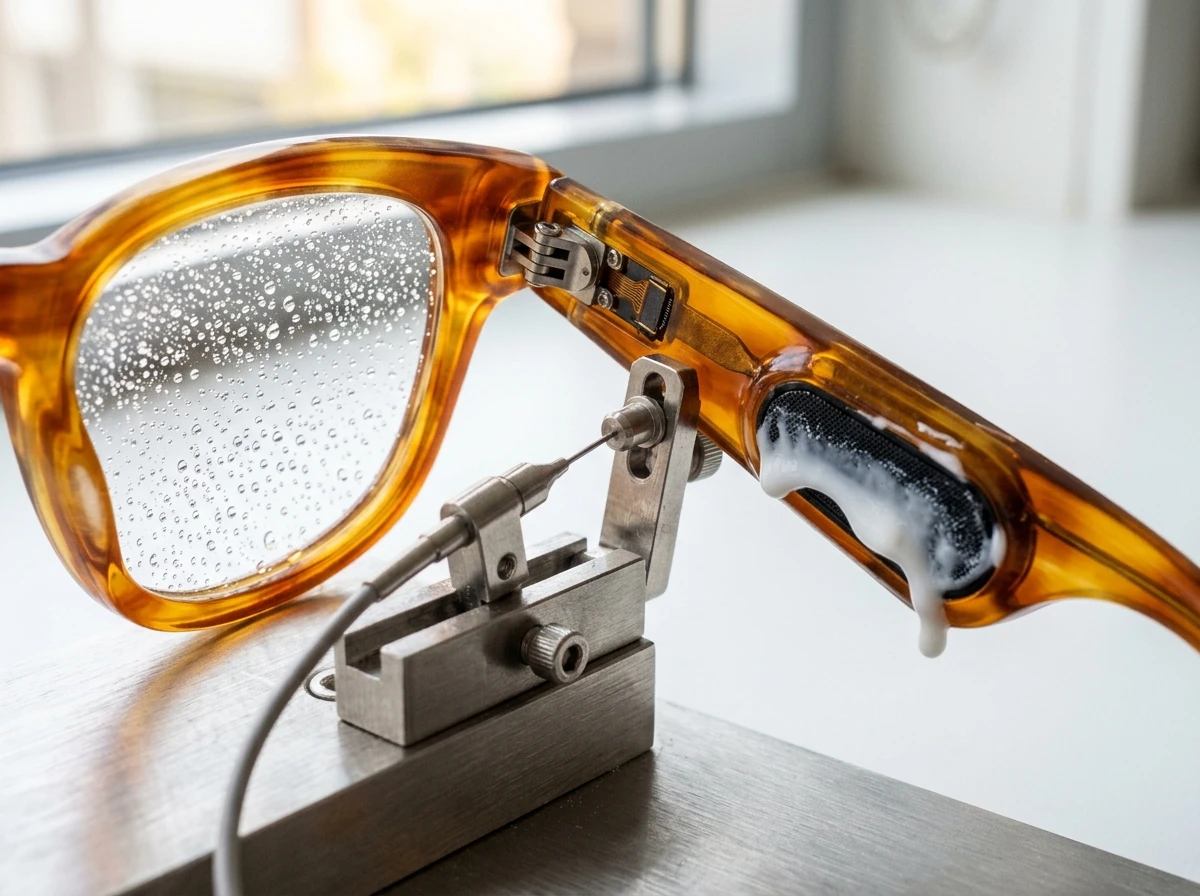
Samsung Electronics injected sunscreen into the speakers of its new AI glasses, baked them and shook them on a vibration rig, all to prove the lotion would not wreck the sound. That torture test sits behind two intelligent eyewear models Samsung built with Google and Qualcomm and unveiled at Galaxy Unpacked in London on July 22.
Samsung says the goal was comfort people would trust enough to wear all day. The chip running the glasses, Qualcomm’s Snapdragon AR1, already powers the market-leading Ray-Ban Meta glasses that Samsung is chasing into a category one rival still controls almost entirely.
Samsung’s Sunscreen Test for Everyday Glasses
Choi Jae-in, Samsung Electronics executive vice president and head of its XR development team within Mobile eXperience Business, said the company measured success by a simple standard.
“No matter what technology we put into the glasses, our goal was to create a pair that my parents and daughter would want to wear immediately,” Choi said at a press briefing in London on July 23, a day after the unveiling.
Glasses sit against the skin for hours at a stretch, which Choi said demanded a different ergonomic approach than phones or watches get. Weight came down to fractions of a gram per part. Sunscreen turned out to be the toughest problem of all, since the open-ear speakers sit right where lotion gets rubbed into the temple.
We injected alcohol-based, high-performance sunscreen into the open-ear speakers on the outside of the frames, raised the temperature and applied vibrations to make sure it seeped all the way in. We then tested the speakers’ performance more than 100 times.
Choi described that process at the briefing. The two models shown in London, designed with input from eyewear brands Gentle Monster and Warby Parker, build on unbranded prototypes Samsung and Google first showed at Google I/O 2026 in May. They shared Wednesday’s stage with Samsung’s foldable lineup, where the company split its Fold flagship into two separate tiers to fend off rival foldables.
One Chip, Two Rivals
Samsung’s new glasses and Meta’s market-leading Ray-Ban Meta glasses run on the same processor family. Qualcomm’s device pages confirm the Snapdragon AR1 chip inside Ray-Ban Meta, and Samsung has said its own glasses run on Snapdragon AR1 as well. The platform was built specifically for eyewear rather than shrunk down from a phone chip, handling on-device wake-word detection, camera processing and basic spatial tracking inside a tight power budget.
It would not be the first time Samsung leaned on Qualcomm over its own silicon. Samsung’s latest smartwatches also dropped Samsung’s own chip for Qualcomm’s earlier this year, a switch that landed across two separate Galaxy product lines within months of each other.
Whichever brand wins the smart glasses race, Qualcomm gets paid either way.
| Feature | Samsung Intelligent Eyewear | Ray-Ban Meta |
|---|---|---|
| Chip platform | Qualcomm Snapdragon AR1 | Qualcomm Snapdragon AR1 Gen 1 |
| Voice assistant | Google Gemini | Meta AI |
| Eyewear design partner | Gentle Monster and Warby Parker | EssilorLuxottica (Ray-Ban, Oakley) |
| Camera | Built-in camera, resolution undisclosed | 12-megapixel camera |
| 2025 to 2026 market position | Sales begin later in 2026 | 7.4 million units shipped in 2025 |
Meta’s 85 Percent Head Start
Samsung is entering a category Meta already dominates by a wide margin. Research firm Omdia tracks global smart glasses shipments, and its latest numbers show how far ahead the leader really is.
- 8.7 million units of AI glasses shipped worldwide in 2025, up 322 percent from the year before, according to Omdia.
- 85.2 percent of that market belonged to Meta Platforms alone.
- 7.4 million units is roughly what Meta shipped, powered by its Oakley and second-generation Ray-Ban models and new pushes into India, Mexico and Brazil.
- 15 million units is Omdia’s forecast for total 2026 shipments across every brand in the category, Samsung included.
That is the gap Samsung, Google and Qualcomm are trying to close, a little more than a year after their first prototypes appeared together.
Why Is Google Paying Warby Parker $150 Million?
Google committed up to $150 million to Warby Parker in May 2025 to jointly develop smart eyewear on its Android XR platform, split between upfront product development funding and payments tied to future milestones.
That deal turned into something bigger. Samsung, Google, Qualcomm, Gentle Monster and Warby Parker now function as one loose alliance chasing the smart glasses market together. Meta has the mirror image: Ray-Ban and Oakley maker EssilorLuxottica, already locked in as its manufacturing and design partner.
Google’s own account of its plans, detailing Android XR eyewear arriving this fall, lines up with the fall sales window Samsung has floated for its own glasses. The original announcement of the Warby Parker partnership made clear the eyewear brand was designing for Google’s operating system broadly, across more than one hardware partner. Gentle Monster brings a bolder, fashion-forward look to the lineup, while Warby Parker leans toward the everyday frames its optical customers already wear.
The Recording Light Users Cannot Disable
Cameras worn on the face invite a specific kind of worry: covert recording. Samsung built two hardware safeguards directly into the glasses to answer it.
A small LED lights up on the frame every time the camera is active, with no setting to switch it off. A separate on-body detection sensor senses when the glasses come off and are set down, and it automatically disables image capture the moment that happens.
Both features target the same ‘secret recording’ backlash that has followed camera-equipped eyewear since Google Glass drew public complaints more than a decade ago.
Samsung Still Wants You Holding Your Phone
“Our goal is not to replace the phone with AI glasses,” Choi said. “The AI era is advancing even faster than the internet and mobile revolutions did. We asked ourselves how we could extend the AI experience people already have on their phones.”
That extension runs through Samsung’s existing Galaxy ecosystem, the same phones, tablets and watches it already sells by the hundreds of millions. To stretch battery life inside a thin frame, Samsung, Google and Qualcomm formed what Samsung calls a Power Camp.
- A joint Power Camp task force of more than 50 hardware, software and chip engineers from Samsung, Google and Qualcomm, focused entirely on power efficiency.
- Up to nine hours of battery life under heavy use, in a frame thin enough to pass as ordinary eyewear.
- Automatic filing of whiteboards, documents and meeting photos into Samsung Notes on a paired Galaxy phone.
- Hands-free photos, video and music control surfaced through the phone’s Now Bar and Gallery app.
Samsung’s own account of the launch folds the glasses into its wider Galaxy ecosystem instead of treating them as a standalone gadget. Choi called the approach consistent with Samsung’s history. “Samsung Electronics has always excelled at creating new form factors and setting the standard for entirely new product categories,” he said. “We believe the benchmark we have established will become the industry’s new standard and help drive the growth of a new mobile AI ecosystem.”
Samsung has not set a price or a firm release date. It has said only that sales begin later this year.
Frequently Asked Questions
Do Samsung’s New AI Glasses Have a Display Screen?
No. Samsung’s first-generation intelligent eyewear is audio-only, built around open-ear speakers, an embedded camera and voice access to Google Gemini rather than a built-in screen, unlike Meta’s separate Ray-Ban Display glasses.
How Much Will Samsung’s AI Glasses Cost, and When Do They Go on Sale?
Samsung has not announced pricing or a specific release date. Executives have said only that sales begin later in 2026, following the Gentle Monster and Warby Parker versions shown in London.
How Are the London Glasses Different From the Prototypes Samsung Showed at Google I/O?
The Google I/O 2026 prototypes shown in May were unbranded engineering demos. The London versions add production-oriented designs from Gentle Monster and Warby Parker, plus months of additional durability and battery work through the Power Camp collaboration with Google and Qualcomm.
Which Other Companies Are Entering the AI Glasses Market Besides Samsung and Meta?
Omdia’s 2026 outlook lists smartphone maker Xiaomi and automaker Li Auto among new entrants to the category, even as Meta is expected to keep the largest share of the market.