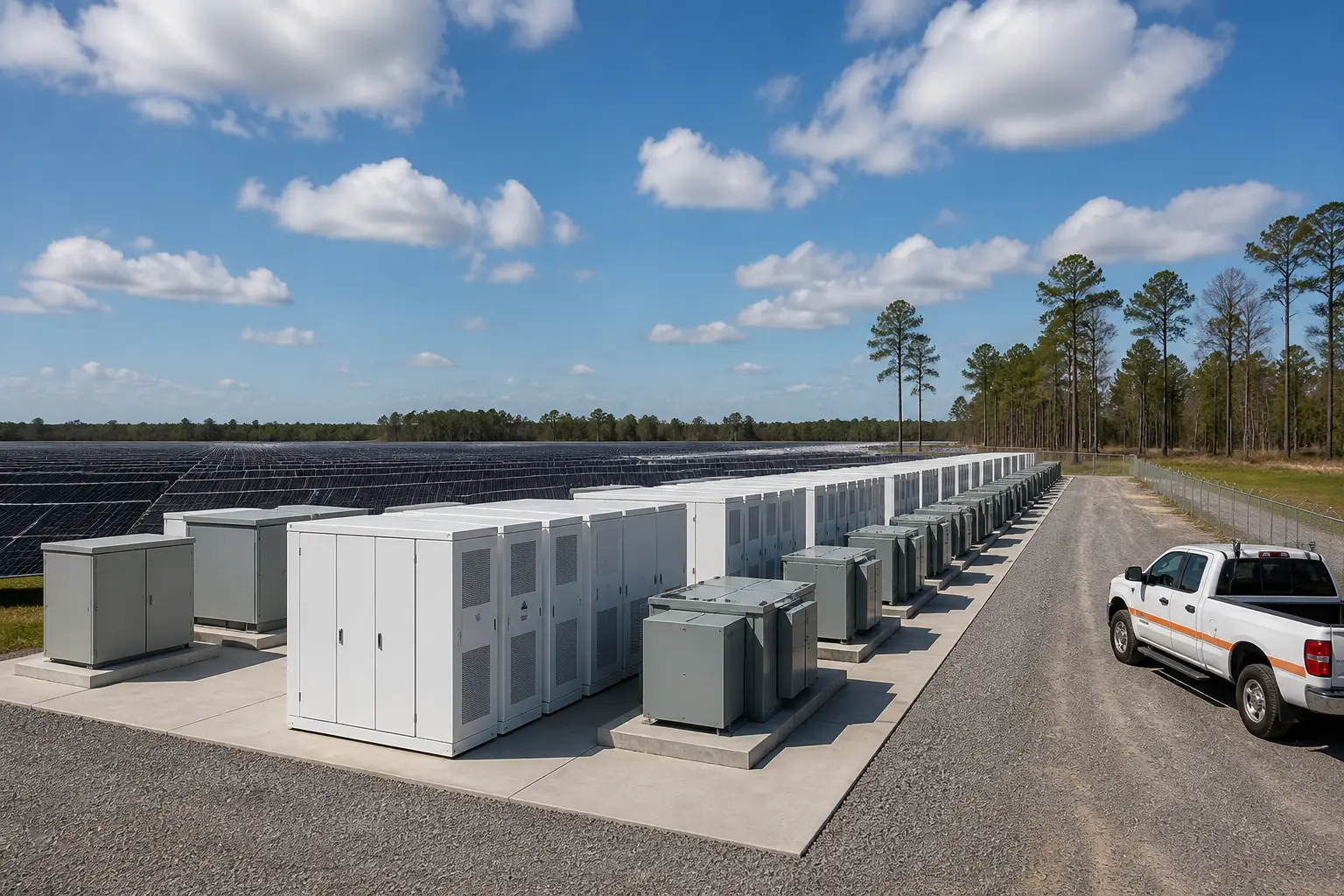
Georgia Power has cut the ribbon on the Moody Battery Facility outside Valdosta, a 49.5 megawatt storage plant that can push power back onto the grid for four straight hours. It is one of the utility’s first battery systems built directly beside a solar farm, storing sunshine the grid does not need at midday and releasing it when demand climbs later on.
The ceremony in Lowndes County was small and local. What it belongs to is not. Moody is one piece of a Georgia Power battery buildout that will eventually top 4,000 megawatts, approved because data centers are pulling more electricity out of the state’s grid than the company forecast even two years ago.
A Ribbon Cutting for 49.5 Megawatts
Georgia Public Service Commission (PSC, the state body that regulates utility rates and approves generation projects) Chairman Jason Shaw and Lowndes County Manager Paige Dukes joined the Lowndes County Board of Commissioners, the Valdosta City Council and Georgia Power leadership to mark the plant’s completion. The company credited Crowder Engineering, the contractor on the project, along with the surrounding community for supporting the new facility.
Rick Anderson, Georgia Power’s senior vice president and senior production officer, framed the timing as the headline.
The successful completion of the Moody Battery Energy Storage System, ahead of schedule, is great news for our customers and for reliable energy in our state. This project not only enhances grid resiliency but highlights our commitment to adding cost-effective resources to our diverse generation mix through programs reviewed and approved with the Georgia PSC.
Anderson made those remarks at the ribbon cutting, according to Georgia Power. The mechanics behind the applause are straightforward: batteries at Moody soak up output from the neighboring solar array during low-demand hours, then discharge it back onto the grid during higher-demand stretches, including cold winter mornings when solar panels produce little on their own.
Why Georgia Suddenly Needs More Power
Georgia Power’s own numbers explain the urgency better than any ribbon cutting can. The Georgia PSC approved the utility’s 2025 Integrated Resource Plan (IRP, the multiyear filing that sets how a utility will meet future electricity demand) on July 15, 2025, and it projects 8,500 megawatts of load growth through 2030, roughly 2,600 megawatts higher than what the company forecast in its 2023 update. The filing also cites 40,000 megawatts of industrial interest already expressed across the state, most of it tied to data centers.
Georgia Power executives have been showing up where that demand gets negotiated. The company took a briefing Governor Kemp held with OpenAI executives on data center siting earlier this year, a sign of how directly the utility is now involved in courting the load it will eventually have to power.
Parent company Southern Company’s most recent quarterly results show how fast that load is arriving. A few figures carry the story:
- 8,500 megawatts of load growth Georgia Power now expects by 2030, roughly a fifth larger than its prior forecast.
- 42% more power drawn by data centers across Southern Company’s utility footprint in the first quarter of 2026 compared with a year earlier.
- 11 gigawatts under contract across 28 large-load projects, mostly data centers, as of Southern Company’s first-quarter 2026 results.
- $81 billion is Southern Company’s five-year capital spending plan through 2030, raised to keep pace with that demand.
Georgia Power’s own capital spending tracks the same curve. The utility’s first-quarter 2026 capital expenditures rose to roughly $2 billion, up from about $1.6 billion a year earlier, and its net income for the quarter climbed to $628 million from $596 million, according to Southern Company’s results.
The Statewide Battery Math
Moody is the smallest entry on a list that keeps growing. Georgia Power has now built or won approval for battery projects stretching from the Florida line to the Tennessee border, most of them paired with new or existing solar.
| Project | Location | Capacity | Status |
|---|---|---|---|
| Moody Battery Facility | Lowndes County | 49.5 MW, four-hour discharge | Complete, paired with solar |
| Three 2023 IRP Update projects | Bibb, Cherokee and Floyd counties | 715 MW combined | Nearing completion |
| Nine new BESS facilities | Plants Bowen, Hammond, McIntosh, Wansley and Yates, plus Hall and McDuffie counties | More than 3,000 MW | PSC-approved |
| Two solar-plus-storage systems | Laurens and Dougherty counties | 350 MW combined | PSC-approved |
The pipeline is already moving past the approval stage. Georgia Power separately broke ground on a 260 megawatt system near Wadley in Jefferson County this year, evidence that projects are moving from PSC order to construction within a matter of months rather than years.
Not all of the company’s solar expansion runs through utility-owned plants like Moody. Georgia Power also runs a separate track for customers who want their own systems, having set aside 3,000 megawatts for customer-owned solar under a different enrollment program. The two efforts add capacity from opposite directions: one utility-built and rate-based, the other customer-financed.
Can Four-Hour Batteries Cover a Data Center’s Appetite
Not entirely, and Georgia Power’s own resource plan says so. A battery like Moody discharges for four hours at a stretch, long enough to smooth the evening ramp when solar output fades and household demand rises. A data center runs its servers continuously, drawing steady power around the clock, every day of the year.
That mismatch is why batteries are showing up in Georgia Power’s plan alongside new gas capacity rather than instead of it. The 2025 IRP pairs up to 4,000 megawatts of renewables and 1,500 megawatts of battery storage with a smaller but real addition of new gas turbines, the kind of generation that can run continuously regardless of sunlight or wind. Batteries shift when stored power gets used. They do not, on their own, add new generation capacity to a grid straining under data center load.
The Ghost of Vogtle in the Room
Anderson’s emphasis on Moody finishing ahead of schedule lands differently in Georgia than it might elsewhere. The state’s last major generation project, the expansion of Plant Vogtle’s nuclear reactors, became a byword for the opposite. The two new reactors came online seven years behind schedule and cost $35 billion, more than double the original $14 billion estimate, according to Inside Climate News reporting on the project.
Georgia regulators eventually let Georgia Power recover $7.56 billion of the roughly $10.2 billion the company said it spent finishing its share of the plant. Utility Dive has reported that residential and small commercial rates climbed more than 20% as a result, with the average customer’s monthly bill rising by about $35, more than double the $15 figure Georgia Power originally disclosed to regulators.
Battery projects carry none of Vogtle’s construction risk. They arrive prebuilt in shipping-container-style units, get installed on land the company often already owns near existing substations, and move from PSC approval to commercial operation far faster than a reactor ever could. That speed is precisely what Georgia Power is now selling to regulators as the safer bet against a demand forecast nobody wants to get wrong twice.
Who Pays for the Buildout
Georgia Power serves 2.8 million customers across all but four of Georgia’s 159 counties, and the battery buildout touches several distinct groups differently.
- Residential ratepayers – cost recovery for approved BESS projects flows through the same IRP process that let Vogtle costs land on customer bills, though batteries carry a far smaller price tag per megawatt than a nuclear reactor.
- Data center operators – the large-load customers driving the forecast typically sign long-term contracts, the 11 gigawatts already on the books, that are meant to insulate other ratepayers from picking up the tab for capacity built to serve them.
- The Georgia PSC – the five-member elected commission reviews and approves each BESS project individually, as it did with Moody and the eight other new sites.
- Host counties – Lowndes, Bibb, Cherokee, Floyd, Hall, McDuffie, Laurens and Dougherty counties gain construction jobs and an expanded property tax base from hosting the facilities.
Not every group is convinced the safeguards match the scale. The Southern Environmental Law Center warned regulators the plan lacked customer protections when the PSC approved Georgia Power’s data center framework, arguing that ordinary ratepayers still risk absorbing costs if projected data center load fails to materialize as forecast. Advocacy group Georgia Watch has separately tracked how much of Vogtle’s overrun landed on the public absorbing the bulk of Vogtle’s costs, a history that now shadows every new project Georgia Power brings to the commission.
Eight more BESS sites and two solar-plus-storage systems are still working through construction, at Plants Bowen, Hammond, McIntosh, Wansley and Yates, in Hall, McDuffie, Laurens and Dougherty counties. Moody was simply first through the gate.