Brian Kemp has six months left as Georgia’s governor, and he is not coasting to the finish. In a new interview on POLITICO’s Energy Podcast, the term-limited Republican said his push to land electric vehicle factories was never about the tax credits in Joe Biden’s 2022 climate law, and that losing them under President Trump hasn’t changed his thinking. At the same time, he is racing to lock in more AI data centers, even as the industry is projected to drain roughly $2.5 billion from Georgia’s treasury this year.
Both bets rest on the same power grid, one Georgia Power is now rebuilding at a pace that has already cost several Republicans their jobs. Kemp will hand that grid, and the political fallout from it, to whoever wins the governor’s race in November.
A Two-Track Bet, Six Months Left
“I still feel very strongly that EVs are going to have a place in the country along with a lot of the other great vehicles that we have, and you know, it really just needs to be customer choice,” Kemp told POLITICO. He opposed the Inflation Reduction Act (IRA) when Congress passed it in 2022, the law that showered tax credits on EV and battery makers and touched off a national building spree.
Trump’s rollback of those credits last year did not slow Kemp down. During his second inaugural address in 2023, he pledged to make Georgia the “electric mobility capital of America.” Since then the state has logged more than $27 billion in private and corporate investment tied to EVs and batteries.
Kemp was coy about what comes next. “I can’t really speak to exactly what is on the horizon, but I’ll just tell you, I’ve only got about six months left in office, but I’ve got a couple of really, really good economic development projects that the team and I are working on,” he said.
The EV Money Keeps Landing Anyway
The clearest test of Kemp’s claim is Rivian. The company paused its $5 billion plant near Social Circle in 2024, spooking economic development officials across the state. It broke ground again in 2025, and this year closed a $6.6 billion loan from the Department of Energy backing its Georgia campus, on top of a $1.5 billion state incentive package. The site is now planned 50% larger than first announced, with production of Rivian’s R2 and R3 models targeted for 2028.
Hyundai moved even faster. Just last week, the automaker and its battery partner, SK On, opened a $5 billion plant northwest of Atlanta capable of supplying batteries for 300,000 electric vehicles a year. That plant runs separately from Hyundai’s Metaplant assembly complex outside Savannah, which the company’s official announcement of its grand opening says can build up to 500,000 EVs and hybrids annually for the Hyundai, Kia and Genesis brands, a $12.6 billion slice of Kemp’s statewide total.
| Project | Investment | What It Produces | Status |
|---|---|---|---|
| Hyundai/SK battery plant, northwest of Atlanta | $5 billion | Batteries for 300,000 EVs a year | Opened this month |
| Hyundai Metaplant America, near Savannah | $12.6 billion (group total) | Up to 500,000 EVs and hybrids a year | Operating |
| Rivian, near Social Circle | $5 billion-plus, now 50% larger | R2 and R3 electric SUVs and crossovers | Construction resumed; production targeted for 2028 |
None of those projects needed the federal credits to keep moving this year, which is the record Kemp points to when he says his EV push was never about Washington’s incentives.
Three Million Homes’ Worth of Power, Near Savannah
Data centers are the other half of the bet, and the newest one dwarfs the EV numbers. OpenAI said this week it will spend $20 billion, and likely more than $30 billion at full build-out according to Bloomberg, on a campus called Project Camellia in Effingham County, part of the Savannah Gateway Industrial Hub, Axios reported. Georgia Power has contracted to deliver 3.2 gigawatts to the site in phases between 2028 and 2032, enough to power about 3 million homes. Georgia Power’s own role in shaping that deal was significant enough that the utility, not OpenAI, effectively held the central seat at Kemp’s briefing on the project.
OpenAI says it will spend $80 million on local schools, public safety, health care, workforce training and housing, and expects to become Effingham County’s largest taxpayer. That local windfall sits next to a statewide cost: the tax breaks Georgia hands data centers broadly are projected to cost the state about $2.5 billion this year alone, even as the state already hosts more than 150 data center facilities with more in the pipeline.
Who Pays for the Grid?
Georgia’s answer, on paper, is the data center operators themselves. Regulators created a rule in 2025 requiring any customer expected to draw 100 megawatts or more to accept contract terms beyond a standard utility tariff, including long-term minimum payments designed to stop big users from sticking around households if demand ever drops.
We’re making the hyperscalers pay. The bottom line is we’re not going to put that on the back of the ratepayers.
Kemp said that to POLITICO, describing the philosophy behind Georgia’s approach. Under the plan Georgia Power filed with the Public Service Commission’s new large-load rule, big customers are projected to generate $556 million in new annual revenue by 2028, revenue the company says will cut typical residential bills by at least $8.50 a month. Nationally, hyperscalers including Amazon, Google, Meta, Microsoft and Oracle have signed a ratepayer protection pledge at the White House, promising their expansion won’t land on ordinary customers’ bills. Georgia’s own regulators are not fully convinced yet: they opened a fresh investigation this month into whether Georgia Power’s cost formula for large users actually covers what those users cost to serve.
One Election Already Punished the Rate Hikes
Kemp’s hyperscaler-pays pitch arrives after voters already delivered a verdict on who was paying before. Georgia Power raised rates six times over three years, adding an average of $43 a month to residential bills before freezing them last year, even though Georgia’s rates remain below the national average. Kemp attributes much of that run-up to fuel cost recovery and to Plant Vogtle, the nuclear expansion that became the most expensive infrastructure project in U.S. history at roughly $35 billion, nearly double its original budget.
Voters responded anyway. Democratic candidates for the Public Service Commission beat Republican incumbents in a special election last year, flipping 22 counties that Trump had carried the year before. That result is now shaping how both parties talk about data centers heading into the fall.
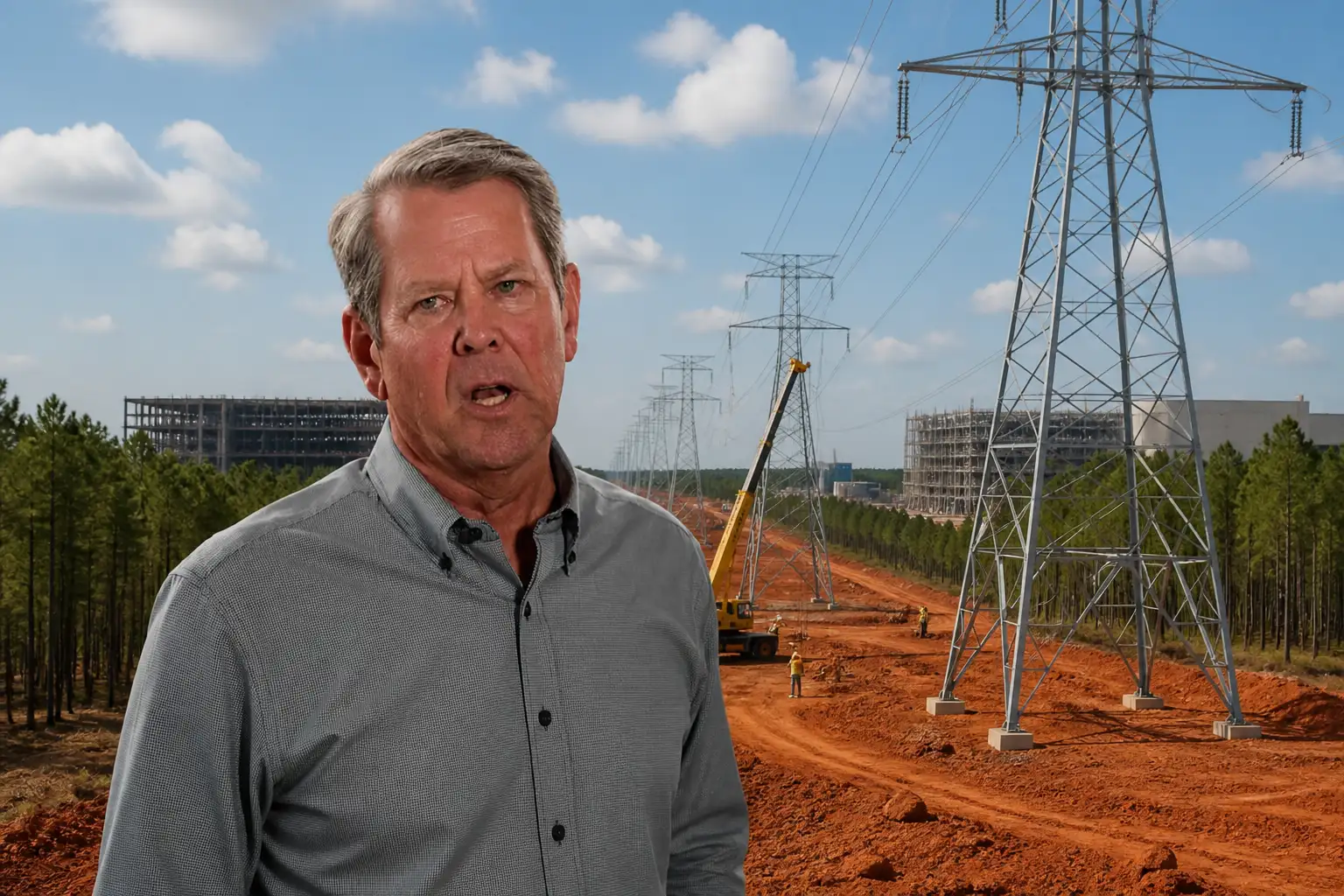
- Eminent domain fights – counties clearing land for transmission lines feeding new data center campuses
- Water use worries – residents questioning how much water massive server farms pull from local supplies
- Rate hikes – six increases in three years before last year’s freeze
- Local moratoriums – dozens of Georgia counties have paused new data center permits outright
The Fight Over Whether the Bet Is Working
Kemp insists he is not forcing the issue on anyone. “We’re not trying to go around and push a data center in somebody’s neighborhood that doesn’t want it,” he said. “But there’s a lot of communities that see the benefits of this and want these projects.” He points to Loudoun County, Virginia, part of the world’s densest cluster of data centers, where roughly 200 facilities are expected to generate about $1.3 billion in tax revenue this year.
Not everyone reads the ledger the same way.
- Kemp and Georgia Power say the new large-load rules and negotiated contracts guarantee hyperscalers, not residents, cover the cost of new power plants.
- The Southern Environmental Law Center says regulators approved Georgia Power’s data center plan without sufficient customer protections.
- Keisha Lance Bottoms says the state needs to slow down before more communities absorb the costs.
Kemp’s Successor Inherits the Wager
Kemp opposes a statewide moratorium on new data centers, the position New York Gov. Kathy Hochul adopted this month when she signed the nation’s first such pause. Bottoms, the Democratic nominee for governor and a former Atlanta mayor, has proposed something similar for Georgia. Kemp called that comparison “irresponsible.” Bottoms’ campaign says the state must “slow down and reassess the rapid expansion of data centers so families are not left with higher utility bills, strained water resources, and damage to surrounding communities,” a position she has repeated in venues including a recent podcast appearance with radio host Jay Walker.
On the Republican side, Kemp endorsed his lieutenant governor days before the primary runoff, and Burt Jones has generally embraced the build-everything approach Kemp is defending now. Jones has also faced attack ads over his father’s company reportedly pursuing its own data center development in the state, though Jones has told POLITICO that neither he nor his family holds a direct stake in any local data center project.
Georgians choose between those two paths in November.
Frequently Asked Questions
What is Georgia’s rule for large power users like data centers?
Georgia’s Public Service Commission adopted a rule effective February 2025 requiring any customer expected to draw 100 megawatts or more of peak demand to accept negotiated terms instead of a standard tariff, including contracts running up to 15 years with minimum-bill and termination-payment provisions meant to protect other ratepayers if a project shrinks or exits early.
Who is running to succeed Kemp as Georgia’s governor?
Republican Lt. Gov. Burt Jones, endorsed by both Trump and Kemp, faces Democrat Keisha Lance Bottoms, a former Atlanta mayor, in November’s general election. Jones has generally supported continued data center growth, while Bottoms has campaigned on slowing it down.
Are other states considering data center moratoriums too?
Yes. New York became the first state to enact a statewide pause this month under Gov. Kathy Hochul, and multiple 2026 governor candidates in other states have made data center moratoriums a campaign position, according to a Newsweek tracker of the issue, making it a live wedge issue well beyond Georgia.
Did Rivian’s Georgia plant survive losing federal EV tax credits?
It has kept moving. After pausing construction in 2024, Rivian broke ground again in 2025 and this year closed a $6.6 billion Department of Energy loan plus a $1.5 billion state incentive package, with the campus now planned 50% larger than originally announced and production targeted for 2028.