The European Union placed Inter RAO on its Russia sanctions list on July 23, folding one of the country’s largest energy companies into a record-setting 21st package. The listing reaches well past Moscow: Inter RAO indirectly owns 75% of Telasi, the company that keeps electricity flowing to Tbilisi.
Georgia is not an EU member, so nothing in the sanctions forces its government to act. That is not the interesting part of this story. The interesting part is that this exact ownership chain has collided with the Georgian state before, and the last collision cost Tbilisi $76 million.
A Kremlin-Linked Boardroom Lands on the Blacklist
The Council of the European Union added Inter RAO to its 21st sanctions package on July 23, a package it says hits Russian energy, financial services and crypto sectors hard, with a record number of new listings targeting Russia and those who help it dodge existing restrictions. Inter RAO reported revenue of roughly 1.36 trillion rubles (about $15 billion) in 2023 and serves more than 19 million customers, according to the Council’s own justification. Moscow controls the company, and state-owned Rosseti and Rosneftegaz sit among its shareholders.
Inter RAO’s board already includes people the EU had previously sanctioned. One is Igor Sechin, Rosneft’s chief executive. Another is Dmitry Shugaev, who runs Russia’s Federal Service for Military-Technical Cooperation, the agency that oversees the country’s arms exports.
The company therefore financially supports the government of the Russian Federation, which is responsible for the annexation of Crimea and the destabilization of Ukraine.
The Council wrote that line into its formal decision. It added that the Russian state collects income from Inter RAO in two ways: through taxes the company pays, and through dividends paid out by its owners.
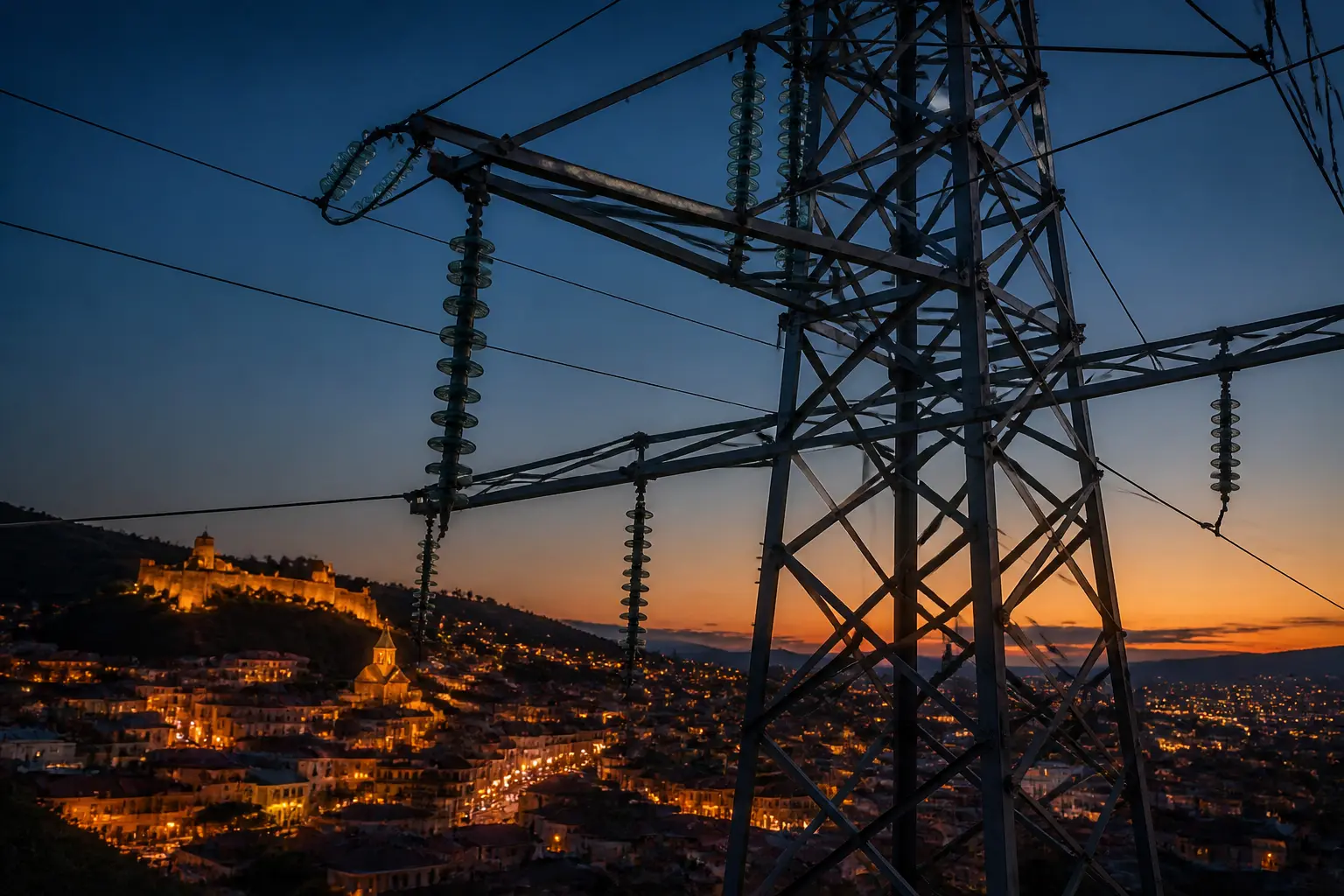
Two Dutch Shell Companies Run Tbilisi’s Grid
Inter RAO does not hold its Georgian assets directly. It works through two Netherlands-registered holding companies, a structure that predates Inter RAO’s own involvement in Georgia by years.
Silk Road Holdings B.V. goes back to 1998, when U.S. firm AES set it up to buy 75% of freshly privatized Telasi for $22.5 million. AES sold that stake to Inter RAO in 2003 for $26 million and separately cleared $60 million of Telasi’s debt as part of the deal. Inter RAO has controlled the Dutch shell, and Tbilisi’s grid, ever since.
Gardabani Holdings B.V. is the second vehicle. It bought full ownership of the Khrami 1 and Khrami 2 hydropower plants on the Khrami River in Georgia’s Kvemo Kartli region in 2011, one of the country’s largest hydropower complexes.
| Asset | What It Does | Dutch Holding Vehicle | Inter RAO’s Stake |
|---|---|---|---|
| Telasi JSC | Electricity distribution grid, Tbilisi | Silk Road Holdings B.V. | 75% |
| Telmico | Electricity supply and billing, Tbilisi | Routed through Telasi’s ownership chain | Indirect |
| Khrami 1 and Khrami 2 | Hydropower generation, Kvemo Kartli region | Gardabani Holdings B.V. | 100% |
The Council’s own sanctions text names Telasi and Telmico as separate Georgian firms under Inter RAO’s indirect control. Together they bill close to 700,000 accounts across the capital. Telasi alone supplied 2.81 billion kilowatt hours in 2021, the most recent year with published figures, split roughly between residential and business customers.
Georgia Never Signed Up for These Sanctions
Nothing obligates Tbilisi to freeze Inter RAO’s Georgian assets. Georgian Dream is Georgia’s governing party. Billionaire Bidzina Ivanishvili founded it and still shapes its direction, and it has declined to join a single round of Western sanctions on Russia since the 2022 invasion of Ukraine.
The relationship with Brussels has only cooled since. Georgian Dream suspended talks on EU candidate status until 2028 on November 28, 2025. More than 100,000 Georgians have taken to the streets since that announcement, protesting a decision that put the country’s EU path on ice.
Telasi and Telmico now sit in an odd spot because of it. Sanctioned by association in Brussels. Left alone by their own regulator in Tbilisi.
The Tariff Promise That Already Cost Georgia $76 Million
This is not the first time Inter RAO’s Dutch-registered vehicles have squared off against the Georgian state, and the history is expensive.
In 2011, the same year Gardabani Holdings bought the Khrami plants, Georgia signed a memorandum with Inter RAO guaranteeing that electricity tariffs tied to its Georgian assets would not be cut for 15 years. Georgia broke that promise. Gardabani Holdings B.V., Silk Road Holdings B.V. and Telasi JSC sued in 2017, invoking the bilateral investment treaty between Georgia and the Netherlands. A tribunal issued a redacted final award in September 2022, while a separate Stockholm-seated tribunal set total damages at $112 million.
- 1998: Telasi is privatized; AES Silk Road Holdings B.V. buys a 75% stake for $22.5 million.
- 2003: AES sells Telasi to Inter RAO for $26 million and clears $60 million of the utility’s debt.
- 2011: Georgia signs a 15-year tariff guarantee with Inter RAO; Gardabani Holdings B.V. buys the Khrami 1 and Khrami 2 hydropower plants outright.
- December 2016: Inter RAO’s ownership of the old Gardabani thermal power plant ends.
- 2017: Gardabani Holdings, Silk Road Holdings and Telasi JSC file arbitration claims against Georgia over the broken tariff promise.
- September 2022: An ICSID tribunal issues its final award on the treaty claim.
- July 2024: Sweden’s Svea Court of Appeal rules on Georgia’s parallel challenge to the Stockholm award.
- August 2025: An ICSID annulment committee rejects Georgia’s bid to overturn the $76 million treaty award.
- July 23, 2026: The EU adds Inter RAO to its 21st sanctions package.
Georgia fought the ruling on two fronts at once. Sweden’s Svea Court of Appeal weighed a parallel appeal over the Stockholm award in July 2024. An ICSID annulment committee rejected Georgia’s separate bid to overturn the treaty award in August 2025, the legal trade publication Global Arbitration Review reported. The tribunal has clarified that the $76 million figure sits inside the $112 million Stockholm number rather than on top of it. Either way, Georgia owes it.
What Brussels Sanctions Can and Cannot Touch
The EU did not name Telasi, Telmico or the Khrami plants individually in its listing. Sanctions law generally treats companies that a blacklisted entity owns or controls as covered too. Inter RAO holds 100% of both Dutch vehicles, so their accounts and any dealings with EU persons or firms could be frozen even though the Georgian operating companies themselves were left off the list by name.
- What we know: Inter RAO itself has been under EU sanctions since July 23, 2026.
- What we know: Telasi, Telmico and the Khrami plants are not individually named on the sanctions list.
- What we know: Georgian Dream has not joined a single Western sanctions round on Russia since 2022.
- Unconfirmed: Whether Dutch authorities will move to freeze Silk Road Holdings B.V. and Gardabani Holdings B.V. as Inter RAO subsidiaries.
- Unconfirmed: Whether Georgia’s energy regulator will revisit Telasi’s license now that the 2011 tariff guarantee has lapsed.
- Unconfirmed: Whether Inter RAO would ever be forced to sell its Georgian holdings.
The old Gardabani thermal power plant offers a small precedent here. Inter RAO owned it until December 2016, when its stake there ended, years before any of this sanctions activity began. Georgian authorities can, and have, unwound pieces of this portfolio before, just not the tariff clause that ended up costing the state $76 million.
Does This Change Tbilisi’s Electricity Bill?
Not immediately. Telasi and Telmico keep operating under Georgian law, regulated by Georgia’s own energy authorities, regardless of what Brussels decides. Tbilisi’s roughly 700,000 accounts will keep paying the same company under the same ownership for now. The sanctions reshape how Inter RAO operates across Europe. Telasi’s license to run Tbilisi’s grid still comes from Georgia’s own regulator.
What has changed is the calendar. The 15-year tariff guarantee that triggered Georgia’s $76 million arbitration loss dates to 2011, which means it runs out this year, the same year Brussels put Inter RAO on a blacklist. For the first time since that memorandum was signed, Georgia’s regulator can revisit Telasi’s tariffs without tripping the treaty clause that cost the state so dearly the last time it tried.