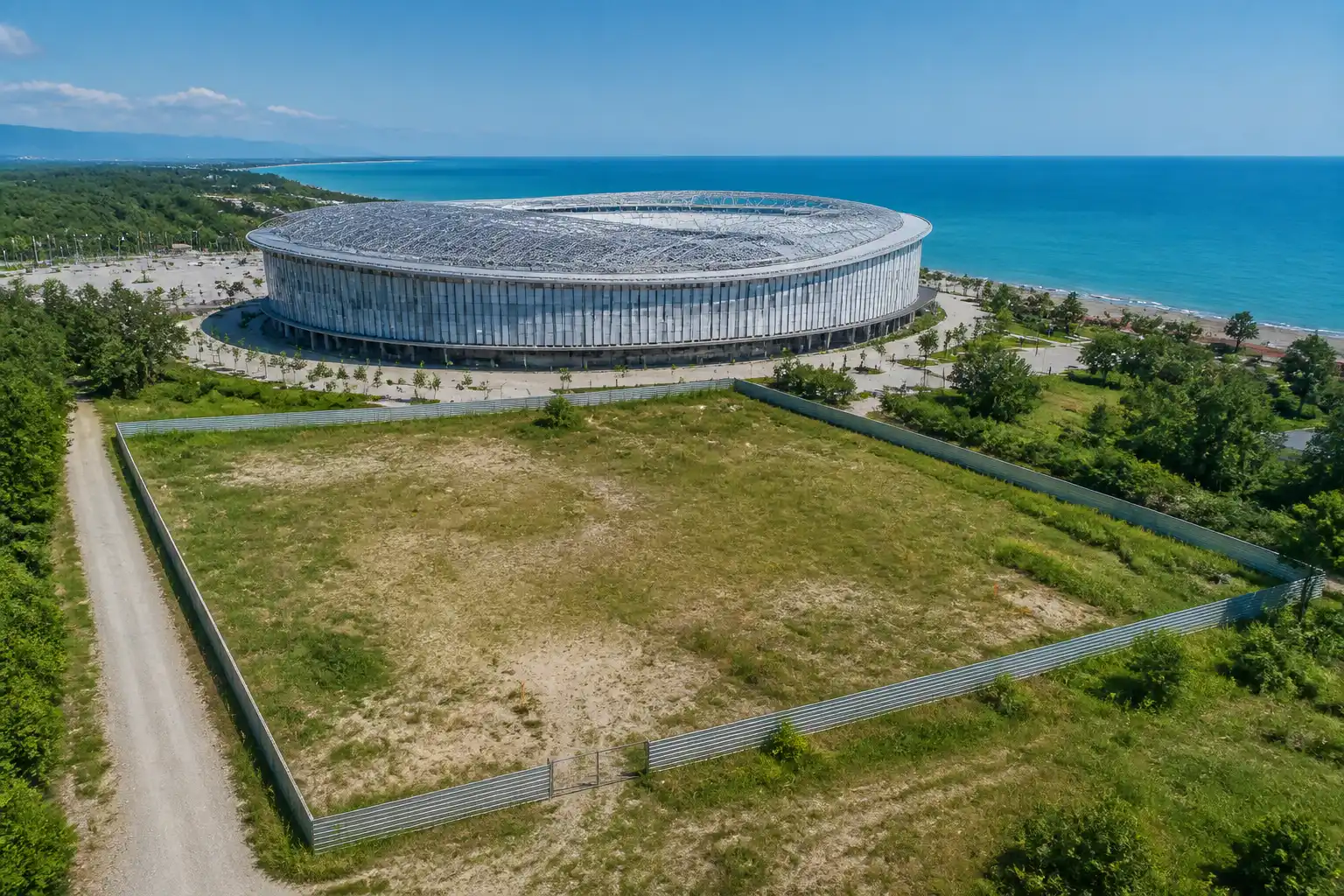
Georgia’s government is auctioning a 20,414-square-meter plot across the road from the Black Sea Arena in Shekvetili, and whoever wins has to build a hostel, dozens of apartments and hand part of it back to the state for free. A decree signed by Prime Minister Irakli Kobakhidze, Georgia’s head of government, authorizes the National Agency of State Property (NASP) to sell the land through what officials call a conditional auction: a sale where the buyer pays a price and also signs up to a construction contract with deadlines attached.
The opening bid is set at GEL 4,902,633, roughly $1.8 million at current exchange rates and just one lari below the independently assessed market value of GEL 4,902,634. That is the part every outlet covering the sale will report. The part worth sitting with is who signs off on what actually gets built there: not the municipality, not NASP, but Starring Georgia, the private company that already owns and runs the arena across the street.
A Beachfront Plot Comes With Fine Print
The terms read less like a land sale and more like a construction contract with a deed attached. Within three years of signing, the winning company must invest at least GEL 7.9 million to build a 65-apartment building, following a design that Starring Georgia has to approve first. Every unit needs its own bathroom and kitchenette. Six apartments must run at least 60 square meters, and one at least 40 square meters, each with a bathroom, kitchenette and reception area of its own.
The building also needs at least 800 square meters of shared space: a conference hall for 100 people, a cafeteria, a workspace for 50. Once it is finished, the developer has 12 months to renovate it and then hand the whole building to the state, free of charge.
A second, larger phase covers the rest of the parcel. Within six years of signing, the buyer must build a hostel with at least 100 rooms, sports and recreational facilities, food venues with outdoor seating, a children’s area and a pet-friendly zone, backed by a minimum GEL 3 million investment. Add the land price to both construction minimums and a buyer is committing to just over GEL 15.8 million before the first guest checks in.
| Term | Phase 1: Apartment Building | Phase 2: Hostel and Grounds |
|---|---|---|
| Deadline | 3 years from signing | 6 years from signing |
| Minimum investment | GEL 7.9 million | GEL 3 million |
| Core deliverable | 65 apartments, conference hall, cafeteria, workspace | 100+ room hostel, sports facilities, food venues, children’s area, pet zone |
| Who ends up owning it | Transferred to the state, free, after renovation | Retained by the winning company |
Design Approval Runs Through Starring Georgia
Georgia Today first reported the sale terms, and buried in them is a detail that says more about how this stretch of coast actually works than the price tag does: both the apartment building and, implicitly, the wider project have to clear a design review run by Starring Georgia, a private company, not a state planning body.
Starring Georgia is not a neutral reviewer. According to a company profile in LA Weekly, it was built to establish Georgia as a global cultural and entertainment destination, and it already controls a cluster of venues that shape how the country’s arts and events scene runs.
- Black Sea Arena – the 10,000-capacity venue the new project would sit directly across from
- Tbilisi Philharmonic – the capital’s classical concert hall
- Tsitsinatela Amusement Park – a family entertainment venue
- Musicians’ Park – an outdoor performance space
- The Social Space – an events and hospitality venue
That is the company a bidder now has to satisfy before pouring concrete on state land it does not own. Win the auction, pay close to GEL 5 million, commit GEL 10.9 million more in construction, and the blueprint still needs a stamp from the business next door.
Sixty-Five Apartments, One Handover
The apartment building is the strangest piece of the deal, because the state is not paying for it and will not have built it, yet it ends up owning it outright.
- 65 apartments minimum in the first building, each with a private bathroom and kitchenette
- Six units of at least 60 square meters, plus one of at least 40 square meters, each with its own reception area
- 800 square meters of shared space, including a 100-person conference hall and a cafeteria
- 12 months to renovate the completed building before it transfers to the state at no cost
Run the math and the state’s position looks close to ideal on paper: it collects roughly $1.8 million for the land, loses nothing on the discount (one lari is not a discount), and receives a finished, renovated apartment building worth at least GEL 7.9 million without laying out construction capital itself. The private investor carries all the build risk and the three-year deadline pressure.
The Hostel the Investor Gets to Keep
Phase two reads differently, and the contract terms make that difference explicit. Nothing in the sale requires the hostel, the sports facilities or the food venues to transfer to the state. Once the six-year window closes, the investor keeps what it built: a 100-plus room hostel with recreation space, dining and a children’s area, sitting on prime beachfront next to a venue that has hosted Aerosmith, Elton John and The Killers.
So the structure splits cleanly. The state gets a free building in year one through three. The investor gets a commercial hostel it owns outright by year six, built on land it also had to buy at full market price. Whether that trade favors the state or the developer depends entirely on how much a beachfront hostel next to a 10,000-capacity arena is worth to operate for the following decades, a number nobody in the public terms of this auction has put a figure on.
A Coastline Already Filling In
Shekvetili is not an empty bet. The 10,000-capacity arena that anchors the area opened in July 2016, funded by the Kartu Foundation and designed by the German firm Drei Architekten, which won Germany’s Design Award in 2020 for the building’s contemporary architecture. It is the largest open-air concert venue in the Caucasus, and its stage has carried acts from Elton John and Robert Plant to Black Eyed Peas and OneRepublic.
Private capital has followed the crowds. A long-pool beachfront hotel and separate residential developments have gone up along the same stretch of coast in recent years, and the official tourism profile of the Shekvetili resort area now markets it as a standalone Black Sea destination rather than a stop on the way to Batumi. The arena’s own design credentials sit in a public European architecture project archive, which is the kind of validation a state auction planner can point to when arguing this land is worth building on.
What Could Still Go Wrong?
A bidder has to clear roughly GEL 15.8 million in combined obligations, hit a three-year deadline for the apartment building and a six-year deadline for everything else, and get every design choice past a private company with its own commercial interests in the neighborhood. That is a narrow field of buyers: large hospitality groups or construction firms with the balance sheet to front years of spending before the hostel produces a dollar of revenue.
Miss the three-year deadline and the contract terms around penalties are not spelled out in the public decree summary. Georgia’s state asset sales have historically included clawback and fine provisions for missed construction milestones, and a buyer walking into this deal is betting that tourist traffic to a single-arena coastal town keeps growing long enough to justify a hostel and a commercial complex built to someone else’s design brief.
The Clock Starts the Day Someone Signs
None of the deadlines in this contract start counting until a winning bid is accepted and the paperwork is signed. From that date, the developer has three years to hand the state a finished, renovated 65-apartment building, and six years to finish a hostel and recreation complex it gets to keep. The state banks a building it never paid to construct. Starring Georgia keeps design leverage over the last undeveloped lot facing its own arena.