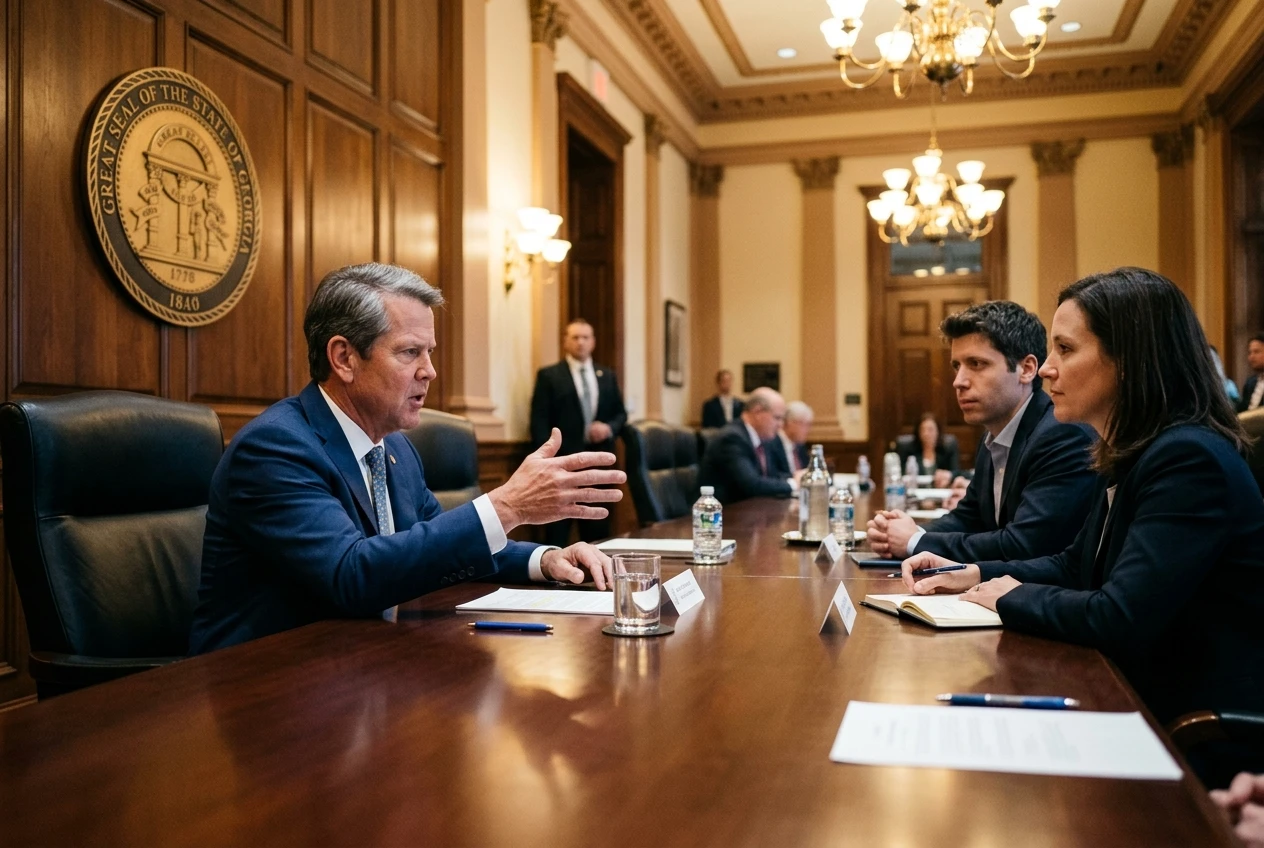
On a Tuesday in May, Georgia Gov. Brian Kemp sat down in Atlanta with senior OpenAI executives and representatives of Georgia Power to hear why one of the world’s most valuable artificial intelligence companies wants to build in his state. The meeting was added to Kemp’s schedule, then sat there, public but unexplained, as residents rallied at the polls and community meetings against the data centers already reshaping metro Atlanta.
A one-page briefing memo prepared by Kemp’s scheduling director set the agenda: site readiness and development, jobs and investment commitments, and OpenAI’s “current strategy and timeline” in Georgia. The governor’s office, the utility, and OpenAI would not say what was said. The memo, obtained by The Current GA through an open records request, is the most detailed public record of the encounter.
The Meeting on Kemp’s Calendar
The May 20 gathering in Atlanta was the kind of routine business sit-down that Kemp’s office says the governor holds frequently. It surfaced because The Current GA reviews Kemp’s meeting calendar and noticed the OpenAI name on it. The Current GA filed an open records request for any documents prepared before or after the meeting, and for any documents received from OpenAI. The memo was the sole document returned.
Listed among the OpenAI attendees were senior leaders in:
- Site readiness and development
- Economic development
- Power projects
None of the executives were named in the documents released by the governor’s office. The Current GA’s reporting indicates the company sent people whose job is to land data center campuses, not to discuss abstract policy. Georgia Power sent representatives of its own; the utility declined to discuss their roles in the meeting.
The One-Page Briefing Memo
The briefing memo, hosted on DocumentCloud, frames the encounter as a presentation, not a negotiation. It tells the governor to expect OpenAI to “provide an overview of why Georgia and any specific sites are of interest, jobs and investment commitments, and OpenAI’s current strategy and timeline.”
The purpose of the meeting is to brief the governor on OpenAI’s activity in the state of Georgia. They will provide an overview of why Georgia and any specific sites are of interest, jobs and investment commitments, and OpenAI’s current strategy and timeline.
It is also silent on whether Georgia is one of several states under consideration, whether OpenAI is courting incentives, and whether any site has been shortlisted. A Kemp spokesman said the governor cannot comment on his “private conversations and meetings,” and pointed to the meeting calendar as proof of transparency. An OpenAI spokesperson said the company does not comment on or confirm private meetings, and sent links to promotional material rather than answers.
Why Georgia Power Was at the Table
Georgia Power’s name on the briefing memo is the part that turns a sit-down between a governor and a tech company into something larger. Georgia Power is the state’s investor-owned electric utility, regulated by the Georgia Public Service Commission, and it controls the grid that any new data center will plug into. Without utility cooperation on transmission, generation, and rate design, a multi-billion-dollar campus does not get built.
Georgia Power declined to elaborate on its representatives’ role. The utility said in a statement that it “can’t discuss specific projects or potential customer agreements,” and that its job is to make sure businesses have access to “reliable and affordable electricity” when they locate or expand in the state. That phrasing mirrors the language used by utilities that are quietly negotiating with hyperscale customers while telling the public nothing.
The utility’s footprint in this story has grown since 2025. The Georgia Public Service Commission approved a plan to add 10 additional gigawatts of electricity in the coming years, the largest multi-year power request in the commission’s history. Bloomberg reported in June that Kemp called a proposal to halt new data centers “insane.” Georgia Power’s recent board addition of Beth Lowry, a construction executive, fits the same pattern of preparing the utility for a building cycle defined by data center demand. A coalition of faith leaders and environmental groups is now in court challenging the grid expansion plan.
Georgia’s Data Center Boom, by the Numbers
Whatever OpenAI decides, the wave is already here. Capital Analytics Associates reported in June 2026 that the state is home to 17 operating data centers and another 83 planned projects that would add more than 9,200 megawatts of capacity. Science for Georgia, an advocacy group, put the combined planned load for current and future sites at 25 gigawatts.
| Indicator | Figure | Source |
|---|---|---|
| Operating data centers in Georgia | 17 | Capital Analytics Associates, June 2026 |
| Planned data center projects | 83 | Capital Analytics Associates, June 2026 |
| Capacity added by planned projects | More than 9,200 MW | Capital Analytics Associates, June 2026 |
| Total planned load (all sites) | 25 GW | Science for Georgia |
| Energy needed for state data centers | Power for about 3.9 million homes | Science for Georgia, Feb 2025 estimate |
| PSC-approved additional capacity | 10 GW over multi-year plan | The Guardian, Jan 2026 |
Most of the planned capacity sits in metro Atlanta, with some projects owned by shell corporations whose end users cannot be identified from public records. OpenAI’s own footprint in the state, if any, is not disclosed. The Current GA reported that it is unclear whether OpenAI is an investor in any existing Georgia data center.
A Backlash Local Officials Are Trying to Manage
The meeting came during a season of organized resistance. In May, the Camden County Board of Commissioners adopted a six-month moratorium on data centers, becoming the first coastal Georgia county to do so. The vote followed the withdrawal of a rezoning request from a Florida businessman who had sought to put a data center on 700 acres near Interstate 95 in Kingsland, after pushback from residents and an unusual plea from the commander of the Naval Submarine Base Kings Bay.
Inside metro Atlanta, organizing has produced results and litigation. Politico reported in May that residents of an affluent subdivision in Fayetteville noticed low water pressure and discovered that a data center campus operated by Quality Technology Services had used nearly 30 million gallons of water through two unaccounted-for hookups, a sum equal to 44 Olympic-size swimming pools. The Fayette County water system billed QTS $147,474 in retroactive charges after a county resident obtained the 2025 letter through a public records request and posted it on Facebook. QTS, owned by private equity firm Blackstone, attributed the unmetered use to construction activity and said operational water use will be minimal.
DeKalb County extended its data center moratorium by six months. Atlanta’s Adair Park neighborhood helped block a citywide ordinance that would have allowed data centers in their community. At least 10 Georgia municipalities have passed their own moratoriums, according to The Guardian, with Atlanta suburb Roswell becoming the most recent. State Rep. Ruwa Romman, a Democrat running for governor, introduced HB 1012 to halt new data centers statewide until March of next year, with Republican co-sponsor Jordan Ridley. Kemp’s public posture, captured in his Bloomberg Television remarks in June, is that any moratorium is “insane.”
The Pentagon Contract That Traveled With the Executives
OpenAI executives arriving in Atlanta do not arrive from a purely commercial orbit. The company reached an agreement with the Department of War in February 2026 to deploy advanced AI systems in classified environments, an arrangement the company has described as carrying more guardrails than any prior classified AI contract. The agreement followed President Donald Trump’s order for the federal government to stop using Anthropic’s products and a separate Pentagon deal with xAI.
OpenAI also leads Stargate, the $500 billion AI infrastructure joint venture with Oracle, SoftBank, and MGX that Trump announced on January 21, 2025. Stargate is building across the country, with announced sites in Shackelford County and Milam County in Texas, Doña Ana County in New Mexico, Lordstown in Ohio, and a flagship campus in Abilene, Texas. OpenAI, Oracle, and SoftBank announced five new Stargate sites in late 2025, bringing the project to nearly 7 gigawatts of planned capacity and over $400 billion in investment over three years, on a path to the full $500 billion, 10-gigawatt commitment. The Midwest site, OpenAI later confirmed, is in Wisconsin, developed with Vantage Data Centers. Plans in Saline Township, Michigan, are moving forward despite local opposition.
Georgia is not on that announced list. That is one reason the Kemp meeting matters: a state that has cheap land, power, and water, and is already home to 17 operating data centers, would be a natural fit if Stargate expands further.
What the Kemp Office Won’t Say
Three months after the meeting, the public still has only the one-page memo. The governor’s office would not say who called the meeting. OpenAI would not say which sites it is evaluating, how many jobs it is contemplating, or whether the company is even investing in Georgia at all. Georgia Power would not discuss the utility’s role. The open records request returned a single page.
OpenAI has previously demonstrated a data center playbook in India, where the company announced a partnership with the Tata Group for an initial 100 megawatts of capacity. Kemp’s meeting calendar now includes a similar entry in Georgia, with the utility sitting on the same side of the table as the company considering the build. The next time a planned data center shows up at a county zoning hearing, the question of who knew what in May may move from the calendar to the courtroom.