JAXA’s Hayabusa2 spacecraft completed a flyby of asteroid 98943 Torifune on 5 July 2026, the first asteroid encounter of its decade-long extended mission, nicknamed Hayabusa2#. The close-approach images confirmed that the S-type asteroid is a contact binary, two lobes that once orbited a common center of mass before merging into a single body. JAXA framed the high-speed pass as a stepping stone for planetary defense, the practice of using spacecraft to alter the path of an asteroid that might otherwise hit Earth.
Hayabusa2 launched in December 2014, dropped a capsule of asteroid samples back to Earth in December 2020, and is on course to rendezvous with the 11-meter near-Earth asteroid 1998 KY26 in July 2031. Two Earth swingbys, in December 2027 and June 2028, are planned to set up the trajectory. The Torifune flyby is the first asteroid stop on the way, and the only one that does not end in a sample return. The remaining data from the encounter has not yet been transmitted to Earth.
Five Kilometers a Second, Eight Hundred Meters Apart
The 800 meters closest approach was logged at 18:30 Japan Standard Time, with an error margin of plus or minus one second, according to the spacecraft’s post-flyby status report. Ground controllers confirmed the spacecraft was operating normally at 18:35 JST, and a JAXA livestream showed the control room bursting into applause. The encounter was the first asteroid exploration of the Hayabusa2 Extended Mission.
A relative speed of 5 km/s left almost no margin for the navigation team. Asteroids are dark, their orbits are uncertain, and the closer a probe gets, the less time controllers have to react. JAXA’s solution was optical-radio hybrid navigation, using the spacecraft’s telescopic camera to image Torifune starting in mid-June and feeding those images into a navigation model. The first direct image arrived on 20 June, more than two weeks before closest approach, and the camera continued to track the asteroid daily as the geometry tightened.
About one hour before closest approach, three more instruments joined the observation.
Those instruments were the Near-Infrared Spectrometer (NIRS3), the Thermal InfraRed Imager (TIR), and the Light Detection And Ranging (LIDAR) altimeter. They measured the asteroid’s surface minerals, surface temperature, and shape from closer in than any ground-based telescope can reach. JAXA said only a fraction of the data they recorded has been transmitted to Earth so far, with the remainder to be downlinked during future operations.
Two Lobes, Confirmed
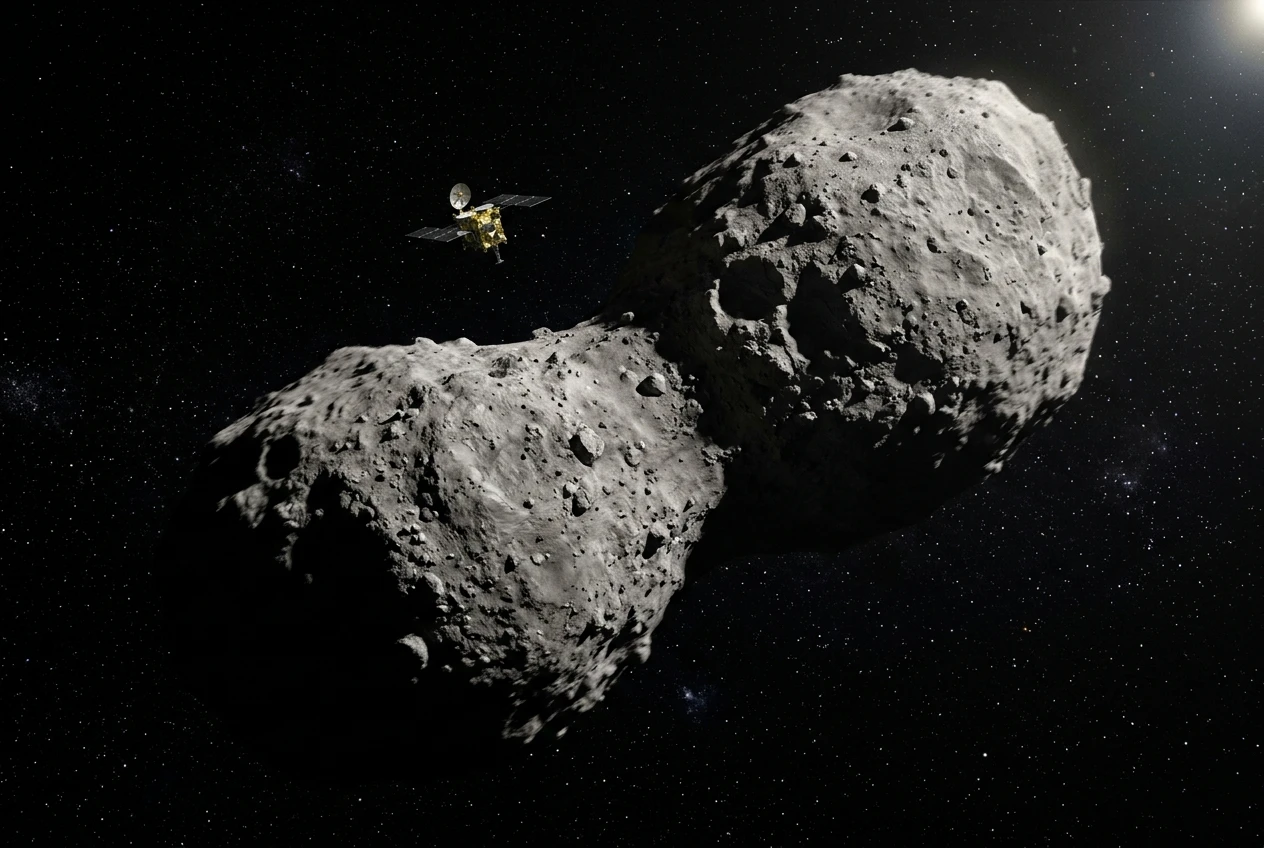
Telescope observations from Earth had long shown that Torifune was unusually elongated, with a brightness that varied by nearly a full magnitude as it rotated every 5.02 hours. That shape, roughly twice as long in one direction as the other, was consistent with a contact binary, an object formed when two separate asteroids spiraled inward and merged. Ground-based observers could not rule out other elongated shapes. Hayabusa2’s flyby images settled the question.
A contact binary, in plain terms, is two asteroids that once orbited a common center of mass before their mutual gravity pulled them together. The shape is not expected to be rare in the asteroid population. Torifune’s mean diameter is now placed at about 450 meters, with a recent measurement of 476 ± 9 m reported in April 2026 from NEOWISE and Spitzer data.
The asteroid was discovered on 3 February 2001 by the Lincoln Near-Earth Asteroid Research (LINEAR) survey at Socorro, New Mexico. It carried the provisional designation 2001 CC21 until the International Astronomical Union approved the name Torifune on 23 September 2024, after a Japanese god and his ship that “can travel safely at high speed like a bird and steady as a rock.” Torifune follows a 1.05-year orbit around the Sun, classified as an Apollo-type near-Earth asteroid because it crosses Earth’s orbit.
- Mean diameter: ~450 m (April 2026 measurement: 476 ± 9 m)
- Rotation period: 5.02 hours
- Orbital period: 1.05 years
- Spectral type: S (stony, silicate-rich)
- Orbital class: Apollo-type near-Earth asteroid
Four Instruments, One Pass
Hayabusa2 carried four instruments into the encounter, each tasked with a different slice of the asteroid’s character. The Optical Navigation Camera, Telescopic version (ONC-T), was the workhorse, doubling as the navigation sensor and the primary imager. It first locked onto Torifune on 20 June and continued to image the asteroid throughout the approach. TIR produced a separate image of the asteroid from about 10 km away, mapping surface temperatures in the 8 to 12 micrometer range.
NIRS3 recorded the asteroid’s reflectance spectrum from 1.8 to 3.2 micrometers, the band where silicate minerals leave their strongest signatures. The LIDAR altimeter measured the spacecraft’s distance to the surface, building a topographic profile. Both instruments, along with TIR, ran for roughly the final hour before closest approach before the geometry cut them off.
| Instrument | Role | When used |
|---|---|---|
| ONC-T (Optical Navigation Camera, Telescopic) | Navigation and high-resolution imaging | First imaged Torifune 20 June 2026 |
| TIR (Thermal InfraRed Imager) | Surface temperature mapping (8 to 12 µm) | Used from about one hour before closest approach; separate image from ~10 km |
| NIRS3 (Near-Infrared Spectrometer) | Surface mineral composition (1.8 to 3.2 µm) | Used from about one hour before closest approach |
| LIDAR (Light Detection And Ranging) | Topography and distance to surface | Used from about one hour before closest approach |
From Ryugu to 1998 KY26
Hayabusa2 launched from the Tanegashima Space Center in Japan and reached the carbonaceous near-Earth asteroid 162173 Ryugu, where it surveyed the body for a year and a half. It returned 5.4 grams of Ryugu material to Earth, the first successful delivery of asteroid subsurface samples. The full mission profile is laid out on the spacecraft’s launch-to-Ryugu timeline.
After dropping its sample capsule, the spacecraft turned away from Earth and started a second career as Hayabusa2#, with the symbol pronounced SHARP, for Small Hazardous Asteroid Reconnaissance Probe. Mission planners initially weighed two scenarios: an EVEEA path that would have used a Venus flyby to reach asteroid 2001 AV43, and an EAEEA path that would fly by Torifune, swing by Earth twice, and finally rendezvous with 1998 KY26. The Venus option would have driven the spacecraft too close to the Sun for its thermal design to handle. The Torifune path was approved, as detailed in the Torifune flyby planning study.
The 1998 KY26 destination is a small, fast-rotating near-Earth asteroid about 11 meters across. It is too small to have been visited before, and its size, rotation rate, and composition have only been characterized in the last few years.
Two Earth swingbys and a final asteroid encounter complete the extended mission plan. JAXA’s stated reason for the detour is that small, fast-rotating asteroids are scientifically interesting in their own right and also pose a real impact hazard on Earth. About half of Hayabusa2’s original 66 kg of xenon propellant remains, enough to make both asteroid encounters but not enough for unplanned maneuvers.
Torifune’s boulder-strewn surface, captured in the ONC-T images, sets a baseline for what 1998 KY26’s tiny body may look like up close. China’s Tianwen-2 is also closing in on a small body, having reached Earth’s quasi-moon Kamoʻoalewa in early July for its own sample return, as described in China’s Tianwen-2 sample return at a quasi-moon. Asteroids in this size class are estimated to strike Earth once every few hundred to a thousand years, which is part of why the two missions are of interest.
- 3 December 2014: Hayabusa2 launches from Tanegashima Space Center, Japan.
- 27 June 2018: Spacecraft arrives at asteroid 162173 Ryugu.
- 5 December 2020: Sample capsule returns to Earth with 5.4 grams of Ryugu material.
- 5 July 2026: Flyby of asteroid 98943 Torifune at 800 m and 5 km/s.
- December 2027: First Earth swingby of the extended mission.
- June 2028: Second Earth swingby of the extended mission.
- July 2031: Planned rendezvous with asteroid 1998 KY26.
A Test Run for Planetary Defense
JAXA framed the Torifune flyby as a stepping stone to planetary defense, the practice of deflecting asteroids that might otherwise strike Earth. The agency said it hoped to acquire the technology to control the probe precisely and maneuver it close to asteroids at high speed. NASA’s DART mission in 2022 rammed the moonlet Dimorphos and measurably changed its orbit, and Hayabusa2’s contribution is the navigation step, getting a probe to a small body in the first place. The full framing is laid out on the mission’s full extended mission plan.
Torifune made a useful target because its orbit was uncertain and the asteroid was dark, two facts that complicate optical navigation close in. JAXA’s approach was to start imaging from far out, refine the asteroid’s position, and update the spacecraft’s trajectory using both radio and optical data. The same recipe, run on a different asteroid with a different geometry, is the kind of autonomy that planetary defense eventually requires.
What has been received from the encounter already supports a new picture of a contact binary and a navigation approach that worked at 5 km/s. JAXA said the remaining data would be transmitted during future operations, with the next batch expected in the coming weeks. The flyby is the first asteroid stop on the extended mission’s path through the inner solar system, and a baseline for the harder encounters ahead. Junior engineers on the Hayabusa2 team are working through the operational design for the rendezvous and the swingbys, JAXA’s mission page notes.
Frequently Asked Questions
When did Hayabusa2 complete its flyby of asteroid Torifune?
5 July 2026, with closest approach at 18:30 Japan Standard Time. JAXA confirmed normal spacecraft status five minutes later, at 18:35 JST.
How close did Hayabusa2 get to Torifune?
About 800 meters from the asteroid’s center, at a relative speed of 5 km/s.
Is Torifune a contact binary?
Yes. Hayabusa2’s close-approach images settled the question that ground-based observations had only hinted at: the S-type asteroid is two lobes that once orbited each other before merging into a single body.
When is Hayabusa2’s next asteroid encounter?
A rendezvous with the 11-meter near-Earth asteroid 1998 KY26 in July 2031, with two Earth swingbys in December 2027 and June 2028 used to set up the trajectory.
How much propellant does Hayabusa2 have left?
About half of its original 66 kg of xenon remains, enough for the Torifune flyby and the 1998 KY26 rendezvous but not for additional maneuvers.