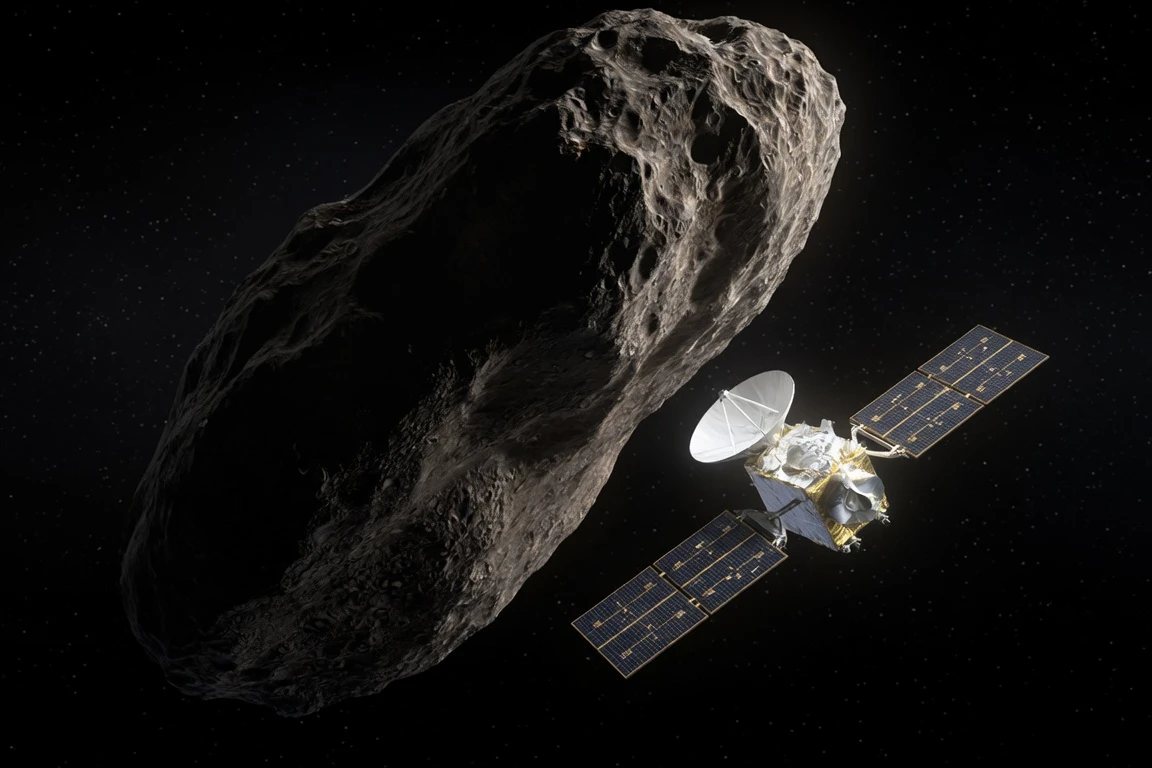
China’s Tianwen-2 spacecraft reached the asteroid 469219 Kamoʻoalewa on Saturday, July 4, 2026, after just over 13 months of interplanetary travel. The arrival marks the start of a roughly nine-month survey of a tiny, fast-spinning rock that may be a chunk of the Moon. A mission timeline published in scientific papers shows the spacecraft closing to within 20 kilometers of the surface to begin close-proximity science operations.
Tianwen-2 launched from the Xichang Satellite Launch Center on May 28, 2025, on a Long March 3B rocket, the first time that vehicle had been put directly on an escape trajectory from Earth orbit. The 2,100-kilogram probe used solar electric propulsion to chase the asteroid, and Doppler tracking from a German amateur-radio team picked up small adjustment burns in mid-June. Those burns followed a main engine firing on June 7 that brought Tianwen-2 into Kamoʻoalewa’s orbit. From this point, the mission descends in stages, from 20 kilometers down to 3 km, 600 meters and 300 m, looking for a place to grab at least 100 grams of surface material and send it home.
An Asteroid That Orbits the Sun but Follows Earth
Kamoʻoalewa is not a moon, even though, from a rotating frame of reference, it traces a slow loop around Earth every 45 years. It orbits the Sun on a path so similar to ours that the planet’s gravity continually nudges it back into sync. Astronomers call this configuration a quasi-satellite, a category of near-Earth objects that share Earth’s orbital neighborhood without being gravitationally bound to it.
Pan-STARRS 1 first spotted the asteroid on April 27, 2016, from Haleakalā Observatory in Hawaiʻi. Lightcurve work pinned its rotation period at about 28 minutes, and spectroscopic follow-up found a surface whose composition and color match weathered lunar soils more closely than any ordinary near-Earth asteroid. Yarkovsky-effect modeling suggests the orbit will stay stable for 0.3 to 0.5 million years, longer than most objects in this class. Its current distance from Earth varies between 38 and 100 times the distance of the Moon.
Kamoʻoalewa sits inside a small club of co-orbital companions, and is the second-smallest, closest, and most stable known member of that group, behind only 2023 FW13. Yet for all the attention it has drawn, no one has visited it up close, and no one has measured its mass, density, or detailed surface composition. That is the gap Tianwen-2 is now designed to close.
Kamoʻoalewa at a Glance
- Diameter: 40 to 100 meters (130 to 330 feet)
- Rotation period: 28.02 minutes
- Orbital period: 365.77 days
- Discovery: April 27, 2016, by Pan-STARRS at Haleakalā
- Quasi-satellite status: Stable for an estimated 0.3 to 0.5 million years
The Lunar Fragment Question
The most cited hypothesis about Kamoʻoalewa holds that it is lunar ejecta, a rock blasted off the Moon by a major impact and captured into an Earth-like orbit. The case was first laid out in detail in a 2021 paper in Communications Earth & Environment led by Ben Sharkey and Vishnu Reddy at the University of Arizona, working with collaborators including teams at the Large Binocular Telescope and Lowell Discovery Telescope. Their spectroscopic data showed a higher spectral reddening than typical asteroids and a striking similarity to space-weathered lunar materials.
The resemblance goes beyond color. The object’s spectral signature is most similar to weathered Apollo 14 and Luna 24 lunar mare soils, two of the few lunar sample collections on Earth. A follow-up study published in The Innovation in 2025 sharpened the picture, arguing that Kamoʻoalewa’s mineralogy is consistent with material from the lunar far-side highland crust. Neither paper claims certainty, but together they raise the stakes of any sample returned to Earth.
If Tianwen-2 confirms a lunar origin, scientists will have, for the first time, a fresh piece of the Moon delivered to laboratories without launching a lander. If the samples turn out to be ordinary chondritic or S-type material, the orbit itself becomes the puzzle, and the asteroid joins the long list of near-Earth objects whose capture into a quasi-satellite path still lacks a clean explanation. Either answer is publishable, and both are why planetary scientists who have spent a decade characterizing this rock from the ground are watching the descent altitude markers tick down.
The University of Hawaiʻi’s Institute for Astronomy, which operates the Pan-STARRS telescope that discovered the asteroid, has framed the mission as the payoff of years of follow-up work. In a statement, the institute said a team of researchers it collaborated with published findings in 2021 suggesting Kamoʻoalewa may have come from the Moon.
Sampling a Spinning Rock in Microgravity
The asteroid’s tiny size and 28-minute rotation make sampling harder than any previous asteroid mission has faced. The gravity field is minuscule, the surface is unknown, and a fast tumble means any contact must be precisely timed. To handle that, the spacecraft carries three redundant techniques and will try each one before settling on whichever produces material.
Tianwen-2’s earlier proposed design relied on anchor-and-attach and touch-and-go, the two methods used by NASA’s OSIRIS-REx and JAXA’s Hayabusa2. SpaceNews reporting from June 2026 confirmed the mission now also plans a hovering sampling mode, giving engineers three independent ways to grab regolith. The spacecraft will also carry explosives designed to expose subsurface volatiles for the onboard instruments to sniff, a first for an asteroid mission.
China’s Chang’e-5 and Chang’e-6 lunar sample returns used a drill-and-scoop approach on a body with real gravity. Kamoʻoalewa offers none of that margin. The mission design therefore descends in staged altitudes of 20 km, 3 km, 600 m and 300 m, with global mapping and sample site selection at each step before any attempt to grab material.
Three Ways Tianwen-2 Will Try to Grab a Sample
- Touch-and-go: A brief contact with the surface to collect loose regolith, the method NASA and JAXA used on Bennu and Ryugu.
- Anchor-and-attach: A first-ever method for an asteroid mission that grips the surface for longer, controlled sampling.
- Hovering sampling: A redundant mode that grabs material without full contact, added for the 2026 flight profile.
A Test Run for Mars Sample Return and a Comet in 2035
Getting the samples home will require a reentry capsule built to survive a far harder atmospheric hit than China’s lunar missions faced. The Planetary Society’s mission profile puts Tianwen-2’s return speed at 12.1 kilometers per second, compared with 10.7 km/s for Chang’e-5’s lunar return. That 1.4 km/s difference is what physicists call the second cosmic velocity, the speed at which an object can escape Earth’s gravity, and it is the regime any future Mars sample return must master.
Freelance space journalist Andrew Jones, who has covered China’s space program for years, told Planetary Radio that Tianwen-2 is, in his reading, an engineering-led mission. The science targets are real, he said, but the priorities are demonstrating particular capabilities and technologies that feed directly into the next flagship, Tianwen-3, which China plans to launch in late 2028 to return Martian samples. Tianwen-4, scheduled for around 2030, will head to the Jupiter system with an orbiter aimed at the Galilean moon Callisto, plus a Uranus flyby spacecraft riding along. Long-duration deep-space operation with ion propulsion is one of the technologies the asteroid leg is meant to mature.
After dropping its sample capsule toward Earth on November 29, 2027, the main Tianwen-2 bus will use the planet’s gravity as a slingshot toward its second target, the main-belt comet 311P/PANSTARRS. The arrival is set for January 24, 2035, after a transfer that takes the spacecraft out past 3.4 astronomical units from the Sun. 311P is roughly 480 meters across, orbits the Sun once every 1,180 days, and showed a tail during a close approach to Earth that hints at a volatile-rich composition. Eleven science payloads, including cameras, spectrometers, sounding radar, a magnetometer, and an Italian-built dust analyzer called DIANA, will work both targets in sequence.
The Tianwen Program at a Glance
| Mission | Target | Launch | Key Milestone |
|---|---|---|---|
| Tianwen-1 | Mars (orbiter, lander, rover) | July 2020 | Zhurong rover landed May 15, 2021 |
| Tianwen-2 | Kamoʻoalewa, then comet 311P | May 28, 2025 | Sample return late 2027, comet arrival January 24, 2035 |
| Tianwen-3 | Mars sample return | Late 2028 (planned) | First Mars samples delivered to Earth |
| Tianwen-4 | Jupiter system (Callisto orbiter) and Uranus flyby | Around 2030 (planned) | China’s first mission beyond the asteroid belt |
Haleakalā Discovered It. A Hawaiian Chant Named It.
The telescope that found Kamoʻoalewa sits atop Haleakalā on Maui, where the University of Hawaiʻi’s Institute for Astronomy operates Pan-STARRS 1 for NASAʻs Planetary Defense Coordination Office. The discovery made Kamoʻoalewa the first Hawaiian-named object ever visited by a spacecraft, a fact the Institute for Astronomy flagged in the run-up to the July 4 arrival.
The name came through A Hua He Inoa, a program at the UH Hilo ʻImiloa Astronomy Center in which Hawaiian-speaking students and educators work with Hawaiʻi-based astronomers to assign ʻōlelo Hawaiʻi names to objects found by Hawaiʻi observatories. The chosen name, Ka moʻo a lewa, draws on the Kumulipo, the Hawaiian creation chant, where it refers to an oscillating celestial object. The wordplay is precise: the asteroid’s Hawaiian rendering literally means something like an offspring fragment that oscillates in the sky, an apt description of a quasi-satellite whose path appears to dance around Earth.
This is a remarkable moment for planetary science. A target first identified through observations from Hawaiʻi is now being visited by a spacecraft, opening the door to discoveries that simply cannot be made from Earth alone. The mission has the potential to reveal how Kamoʻoalewa formed and whether it truly originated from the Moon.
That was Doug Simons, director of the University of Hawaiʻi Institute for Astronomy, in a release tied to the arrival. The framing matters as much as the engineering: the asteroid’s discovery and its naming are both products of a specific observatory and a specific community, and the spacecraft now closing in is the first probe to bring a Hawaiian name into deep space. Earlier Chinese Chang’e missions brought back lunar samples that researchers have begun cross-checking against the asteroid’s spectral fingerprint, a parallel thread of lunar science that could harden or weaken the ejecta case long before Tianwen-2’s capsule lands.
Frequently Asked Questions
What is asteroid Kamoʻoalewa?
Kamoʻoalewa, formally designated 469219 Kamoʻoalewa and also known as 2016 HO3, is a near-Earth asteroid roughly 40 to 100 meters across that orbits the Sun in sync with Earth, a configuration astronomers call a quasi-satellite. It was discovered by the Pan-STARRS 1 telescope at Haleakalā, Hawaiʻi, on April 27, 2016.
When did Tianwen-2 arrive at Kamoʻoalewa?
Tianwen-2’s close encounter with Kamoʻoalewa began on July 4, 2026, after a main engine burn on June 7 placed the spacecraft into the asteroid’s orbit. The probe launched from the Xichang Satellite Launch Center on May 28, 2025.
Is Kamoʻoalewa actually a piece of the Moon?
It is the leading hypothesis, not a confirmed fact. A 2021 spectroscopic study in Communications Earth & Environment and a 2025 follow-up in The Innovation found a spectral match between Kamoʻoalewa and weathered lunar soils, including samples returned by Apollo 14 and the Soviet Luna 24 mission. Tianwen-2’s samples are expected to settle the question.
How will Tianwen-2 collect samples from such a small asteroid?
The spacecraft carries three sampling techniques: touch-and-go sampling, the anchor-and-attach method, and a hovering sampling mode. Each is designed to work in the asteroid’s extremely weak gravity and on a body that rotates once every 28 minutes.
What happens after Tianwen-2 returns its samples to Earth?
The main spacecraft will use an Earth gravity assist to set course for the main-belt comet 311P/PANSTARRS, with arrival scheduled for January 24, 2035. The mission is planned to last around 10 years in total.