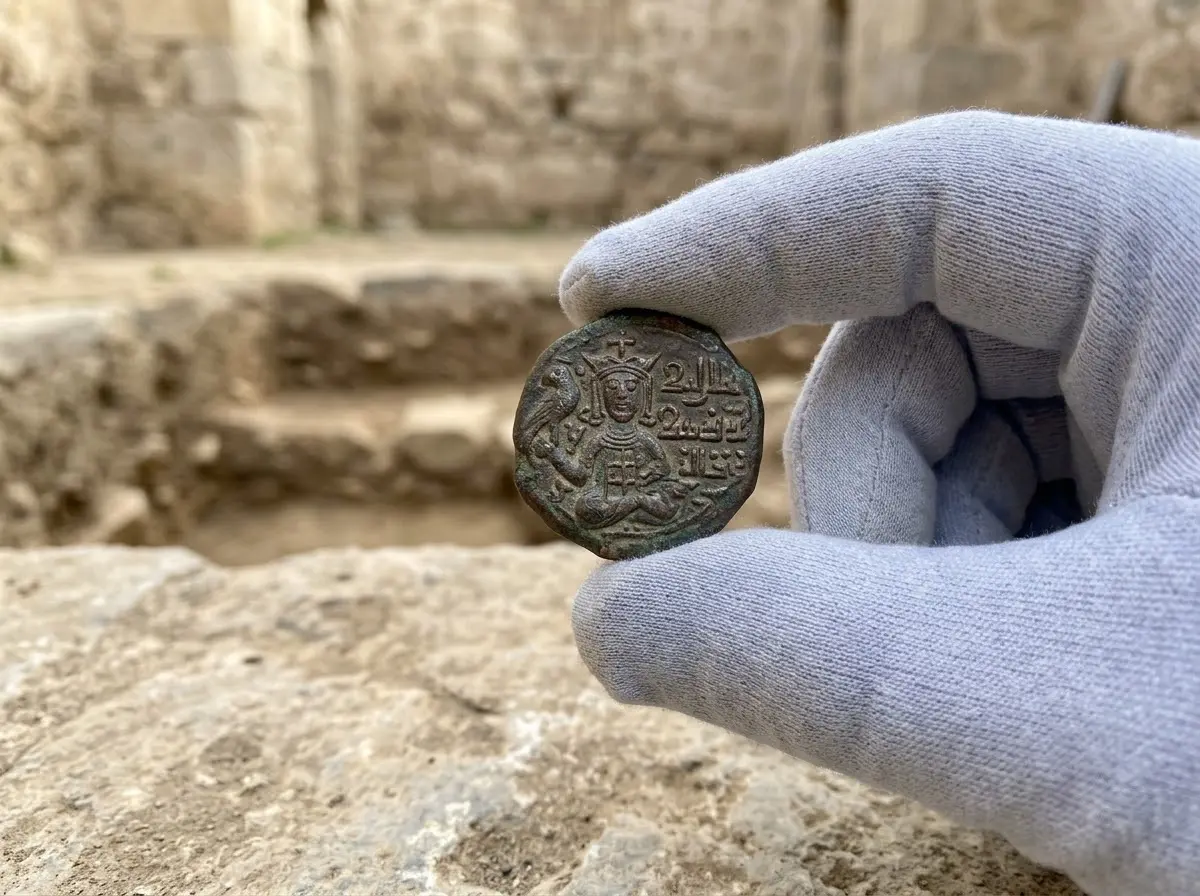
A unique 12th-century Georgian coin from the reign of King George III has been recovered by the Rustavi Historical Museum expedition inside the medieval palace at Rustavi Fortress. The copper piece shows the king with a falcon on his hand, carries his name in Mkhedruli letters, and bears the Asomtavruli date Chronicon 394.
Georgia Today reported the find on August 25, 2026, calling it the first Georgian coin yet discovered with both a Mkhedruli inscription and a date in the Georgian chronicle system. Excavations continue in the palace rooms this summer.
What the Falcon Coin Shows
The obverse presents a crowned king seated cross-legged in Eastern style, falcon perched on one raised hand, the other resting on his thigh. Beside him appear Mkhedruli characters giving the short name of George and the Asomtavruli legend Chronicon 394. That koroniкon year converts to AD 1174, squarely inside George III’s reign of 1156-1184.
The reverse carries a three-line Arabic inscription: “King of Kings George, son of Demetre, the sword of the Messiah.” The bilingual design matches a known rare type catalogued as a copper drachm or fals.
| Side | Design and Legend | Details |
|---|---|---|
| Obverse | Seated king with falcon, Mkhedruli name, Asomtavruli Chronicon 394 | Eastern dress, stemma crown |
| Reverse | Arabic three-line legend | “King of Kings George, son of Demetre, the sword of the Messiah” |
| Specs (known type) | Irregular round copper | Approx. 4.5 g copper drachm dated 394, diameter near 26 mm |
Numismatic literature already recorded specimens of this exact type, some sold at auction for several hundred dollars. The Rustavi example gains force from its stratified palace context rather than from private collections.
Rooms Already Cleared This Summer
The expedition finished work in the palace’s first, third, fourth and fifth rooms. Digging is still active in the fifth room. There the team uncovered a well-preserved wooden floor, large amounts of millet and grain, and a clay vessel still filled with millet.
- Third room: uniquely decorated pottery, locally made glass vessels, glazed and unglazed bowls, cooking pots, and additional coins of the 12th-13th centuries
- Fifth room: wooden flooring, bulk millet and grain stores, millet-filled clay vessel
- Lower layers across the complex: material dating to the ancient period
- Overall: evidence of continuous occupation through the high medieval centuries
These finds sit inside a fortress that has been under systematic study since July 2025.
George III and the Peak Years Before Tamar
George III ruled a Georgia that had already expanded under David the Builder and Demetre I. He took Ani, campaigned against the Shah-Armens, and faced coalitions of Muslim rulers from Ahlat and Diyarbekir. His daughter Tamar succeeded him in 1184 and pushed the kingdom to its greatest territorial and cultural reach.
Coins of this reign often mixed Christian royal titles with Arabic phrasing aimed at traders who moved between Christian and Muslim markets. The falcon image itself was new: a king shown as hunter in Persian-influenced dress while still wearing a Byzantine-style stemma and proclaiming himself sword of the Messiah.
One X post from a Georgian account noted the find in Hall IV “shedding new light on Rustavi’s role as a major royal center during Georgia’s Golden Age.” That reading matches the material coming out of the palace rooms.
Mkhedruli Arrives on Everyday Money
Mkhedruli, the secular script, first appears in inscriptions around the late 10th century and in royal charters of the 11th. Religious texts stayed with Asomtavruli and Nuskhuri. Putting Mkhedruli letters on a circulating coin in 1174 shows the civil alphabet moving into daily economic life during the very decades when the kingdom’s power peaked.
The same type already listed in catalogues carries both scripts, so the “first discovered” claim reported by Georgia Today may refer to the first example recovered under controlled excavation rather than the absolute earliest known piece. Either way, the stratified find locks the date and the place of use.
Readers can see the full development of the Mkhedruli script from the 10th century in standard reference pages that track its shift from military and legal use into the standard modern alphabet.
From Armor in 2025 to Coin in 2026
The current palace project is the largest archaeological effort in Rustavi’s modern history. It began in July 2025 with support from the municipality and the Ministry of Culture. More than 100 people, students, volunteers and professionals, have taken part.
In the sixth chamber that first season, the team led by Nazibrola Pachikashvili, director of the Rustavi Museum, recovered a complete 9th-10th century iron helmet and chain-mail shirt, the only such combat set known from the South Caucasus. Pachikashvili called it unprecedented for Georgia.
- July 2025: Major palace excavation launched inside Rustavi Fortress
- Autumn 2025: Helmet with muzzle guard and full chain-mail recovered from sixth chamber
- December 2025: Summary conference presents military and glass finds
- Summer 2026: Rooms 1, 3, 4 and 5 cleared; George III falcon coin and grain stores recovered
Earlier written sources had little to say about a royal residence at Rustavi before the 17th century. The digs are rewriting that picture room by room.
Rustavi’s Walls Guarded the Road to Tbilisi
The fortress sits about 25 km southeast of Tbilisi on the Kura River. It protected the southeastern approach to the capital and saw major rebuilds in the 5th-8th, 9th-11th and 12th-13th centuries. Fragments of frescoes still cling to some interior walls, a rare survival that points to ceremonial as well as military use.
Historical lists place Rustavi among the earliest urban sites of the Kingdom of Iberia alongside Mtskheta and Uplistsikhe. Seljuk occupation in the 11th century was reversed by David IV. Timur destroyed the place in the late 14th century. The modern industrial city rose only in the Soviet period. The surviving Rustavi Castle walls and reconstruction phases still show the successive circuits of towers and the outer tunnel wall added in the 12th-13th centuries.
Grain stores, glass vessels, glazed bowls and now a royal coin of 1174 inside the palace rooms argue that the site was more than a garrison in George III’s day. It handled food, trade goods and royal money at the same time the kingdom projected power into Armenia and the Muslim borderlands.
The Rustavi Historical Museum plans conservation and eventual display. The open-air museum concept already floated for the fortress would let visitors walk the same floors where millet was stored and the falcon coin was dropped or placed more than eight centuries ago.
Work in the fifth room continues. More coins, more pottery, and perhaps more dated inscriptions are still under the remaining floors.