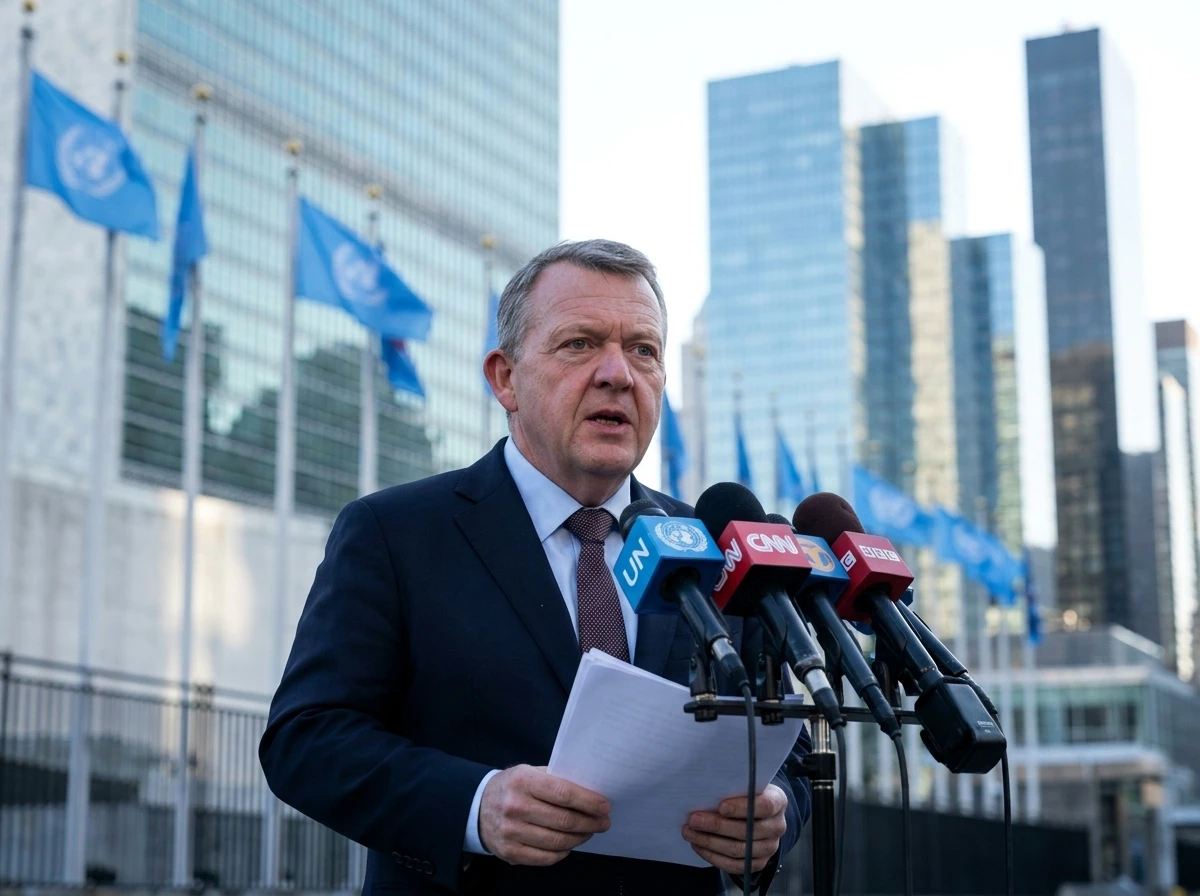
More than 50 UN member states, including Georgia, called on Russia on August 24 for a full, immediate and unconditional ceasefire in Ukraine. Danish Foreign Minister Lars Løkke Rasmussen delivered the joint statement at a UN stakeout as Ukraine marked 35 years of independence from the Soviet Union.
The appeal lands four and a half years into Russia’s full-scale invasion and days after the same European voices pressed Moscow over its unfulfilled 2008 ceasefire commitments in Georgia.
The timing binds two unresolved files. Independence Day supplies the public frame. The earlier Security Council push on Georgia supplies the continuity. Both center on the same core demand: an unconditional stop that Russia has so far refused.
What the Signatories Demanded on Independence Day
Rasmussen spoke for a broad group that included Albania, Australia, Canada, France, Germany, Japan, the United Kingdom, Ukraine, the European Union delegation and Georgia itself. The full joint statement text delivered opened by noting that Ukraine’s 1991 independence decision was recognized by the international community, including Russia.
Yet the day also marked the ongoing invasion, called a blatant violation of the UN Charter. Rasmussen said Russia’s actions had challenged the rules-based order and undermined regional and global peace.
Russia simply needs to accept the unconditional ceasefire that Ukraine and the international community has been calling for for over a year and a half now. Ukraine wants peace. We want peace.
Lars Løkke Rasmussen, Danish Foreign Minister, UN stakeout
The group urged Russia to resume negotiations for a comprehensive, just and lasting peace under international law. It reaffirmed support for Ukraine’s sovereignty and territorial integrity within its internationally recognized borders.
- Humanitarian steps: complete prisoner-of-war exchanges, release all unlawfully detained persons, and ensure safe return of forcibly transferred or deported civilians, including thousands of children.
- Accountability: full justice for crimes under international law to prevent future atrocities.
- Immediate end: a full, immediate and unconditional ceasefire as the first step.
Those three tracks are sequenced on purpose. The ceasefire comes first. Humanitarian returns and legal accountability follow as conditions of a durable settlement rather than substitutes for one.
The statement also flagged spillover risks. Several European countries have faced airspace violations and drone incidents that raise the chance of miscalculation. Russian attacks on Black Sea grain shipments and Ukrainian ports have disrupted operations with global food-security effects.
Diplomats treat those spillovers as evidence that the war’s costs no longer stop at Ukraine’s borders. Airspace incidents and grain-route hits give distant capitals a direct stake in an unconditional halt.
Georgia Signs While Its Own Ceasefire Stays Broken
Georgia’s presence on the list carries weight beyond a standard diplomatic alignment. Just three days earlier, on the 18th anniversary of the 2008 Russia-Georgia war, UN Security Council members including Denmark, France, the UK, Latvia and Greece again called on Russia to withdraw its forces from Georgian territory and fulfill the August 2008 ceasefire agreement.
Those countries condemned the continued military presence, militarization and steps toward annexation of Abkhazia and the Tskhinvali region. They demanded Russia reverse its recognition of the two regions, allow international monitors access, and enable the return of internally displaced persons.
Georgia has no diplomatic relations with Russia since 2008. Its government has faced Ukrainian accusations of helping Moscow circumvent sanctions, while Tbilisi has accused Kyiv of wanting to open a second front. Relations showed a tentative thaw when Prime Minister Irakli Kobakhidze met President Volodymyr Zelenskyy in May 2026, the first such encounter.
On Independence Day itself, Kobakhidze issued a congratulatory message wishing Ukraine peace, resilience and prosperity and citing historic friendship and shared values. In Tbilisi, protesters marked the day with a march from the Ukrainian embassy, many wearing blue-and-yellow colors and carrying signs linking the two occupations. Former President Salome Zourabichvili told the crowd that the struggles are the same.
By joining the UN statement, Georgia placed itself publicly with the demand for the kind of unconditional stop that remains unfinished at home.
- August 2008: Ceasefire agreement ends active fighting in the Russia-Georgia war; Russia’s full implementation remains contested for 18 years.
- May 2026: Kobakhidze meets Zelenskyy in a first encounter, signaling a tentative bilateral thaw even as sanctions disputes linger.
- May 2026: A similar joint UN statement on Ukraine also features Georgia among the signatories.
- Three days before August 24: Security Council members again urge Russian withdrawal from Georgian territory and reversal of recognition of Abkhazia and the Tskhinvali region.
- August 24: Georgia joins the 50-plus call for a full, immediate and unconditional ceasefire in Ukraine on Independence Day.
The sequence shows why Tbilisi’s signature is read as more than routine alignment. The same capitals pressing Moscow over Georgia’s unfinished 2008 terms are now joined by Georgia itself on Ukraine’s unfinished terms.
Moscow Calls the Appeal a Ceasefire Trap
Russia’s UN Ambassador Vasily Nebenzya rejected the approach the same day. In his Security Council remarks he said Nebenzya rejected any freeze as a trap designed only to let Ukraine regroup and rearm.
“There will be no agreements at the expense of Russia’s security interests,” Nebenzya said. He argued that as long as Moscow is addressed in the language of ultimatums, terror and threats, and the situation on the ground is ignored, there is no basis for meaningful dialogue.
Nebenzya accused Western states of arming Ukraine while claiming not to be parties to the conflict, and of turning the country into an instrument of pressure on Russia. He claimed Russian forces retain the initiative and are advancing, while listing Ukrainian strikes on Russian civilian targets as terror. The ambassador dismissed repeated Council meetings as unable to change Moscow’s position.
The United States did not join the joint statement. A U.S. envoy instead called on both sides to avoid strikes that risk civilian vessels, stopping short of the language used by the 50-plus group.
That split matters for leverage. The joint statement’s unconditional framing leaves little room for a freeze that locks in battlefield lines. Moscow’s trap argument treats any pause under that framing as a military concession rather than a diplomatic opening. The U.S. line on civilian vessels sits apart from both, narrower in scope and silent on the ceasefire formula itself.
July’s Civilian Toll Hit a Multi-Year High
The statement cited fresh UN figures to underline urgency. Last month the Office of the High Commissioner for Human Rights recorded the highest number of civilians killed and injured in a single month since March 2022.
According to the OHCHR recorded 437 civilians killed in July and 2,610 injured in Ukraine. That marked a 30 percent rise from June and a 70 percent rise from July 2025. Child casualties reached their highest level since April 2022.
| Period | Civilians killed | Civilians injured | Notes |
|---|---|---|---|
| July 2026 | 437 | 2,610 | Highest killed since May 2022 |
| June 2026 | 298 | 2,041 | Prior month baseline |
| July 2025 | 312 | 1,482 | Year-earlier comparison |
| Full-scale invasion to date (statement figure) | At least 68,000 killed or injured (almost 4,000 children) | Cumulative civilian toll cited | |
Long-range missiles and drones caused 38 percent of July casualties, mostly far from the front in cities. Glide bombs and short-range drones near the line also drove sharp rises. Kyiv, Kherson, Zaporizhzhia and Sumy recorded the highest city totals. Attacks on ports and vessels in Odesa and Mykolaiv regions damaged shipping and killed or injured port workers, compounding the grain-route disruption already noted by the diplomats.
The geography of the toll explains the diplomatic urgency. When long-range systems account for more than a third of civilian harm deep inside cities, a front-line pause alone would not address the pattern the OHCHR recorded. Port casualties link the human cost directly to the food-security spillovers already flagged at the stakeout.
How the Two Ceasefire Files Mirror Each Other
Place the Georgia and Ukraine demands side by side and the structure is nearly identical. Both call for an unconditional military stop. Both insist on withdrawal or non-recognition of territorial changes. Both tie monitoring access and displaced-person returns to any credible settlement.
- Stop first: full implementation of the 2008 ceasefire in Georgia; a full, immediate and unconditional ceasefire in Ukraine.
- Territory: reverse recognition of Abkhazia and the Tskhinvali region; restore Ukraine’s internationally recognized borders.
- Access and returns: international monitors and IDP returns in Georgia; prisoner exchanges, release of detainees and return of deported civilians, including children, in Ukraine.
- Legal frame: both packaged as obligations under international law and the UN Charter rather than discretionary bargains.
Russia’s reply pattern is also parallel. On Ukraine it calls the freeze a rearmament trap and rejects ultimatum language. On Georgia it has left the 2008 terms unfulfilled for 18 years while maintaining forces and moving toward annexation steps the Security Council members condemned. The signatories’ point is that accepting the same refusal twice hollows out the Charter standard they keep restating.
Why Spillover Risk Keeps the Pressure On
Beyond the battlefield figures, the joint statement’s spillover language gives the coalition a second rationale. European airspace violations and drone incidents raise miscalculation risk among states that are not parties to the fighting. Black Sea strikes on grain shipments and ports transmit the war into global food markets.
Those channels explain the breadth of the roster. Countries far from the front still face price and security externalities. The U.S. note on civilian vessels, even while skipping the ceasefire call, shows that shipping risk is recognized outside the 50-plus group as well.
For the diplomats, spillover is not a side theme. It is the mechanism that turns a regional war into a standing agenda item for capitals whose voters feel drone alerts or food-price swings. That is why the stakeout text pairs the unconditional ceasefire demand with explicit mention of airspace and grain-route harm.
A Familiar List and a Familiar Stalemate
The full roster ran to more than 50 members plus the EU: Andorra, Austria, Belgium, Bosnia and Herzegovina, Bulgaria, Costa Rica, Croatia, Cyprus, Czechia, Estonia, Finland, Greece, Honduras, Hungary, Iceland, Ireland, Italy, Latvia, Liechtenstein, Lithuania, Luxembourg, Malta, Monaco, Montenegro, the Netherlands, New Zealand, North Macedonia, Norway, Panama, Poland, Portugal, Republic of Korea, Moldova, Romania, San Marino, Slovakia, Slovenia, Spain, Sweden, Switzerland and others alongside the core European and Pacific partners.
Similar joint statements have appeared before, including one in May 2026 after heavy Russian strikes that also featured Georgia. The pattern is steady: large groups of UN members restate the same core demands for an unconditional stop, accountability and territorial integrity. Russia restates that it will not accept terms that ignore its security claims or the battlefield reality it describes.
European drone and airspace incidents continue to raise escalation fears. Global food markets still feel the pressure from Black Sea disruptions. For Georgia the signature adds a public line of continuity with its own long-running call for Russian withdrawal under a ceasefire that has stood unfulfilled for 18 years.
On Ukraine’s Independence Day the diplomats repeated that there is no alternative to a just and lasting peace in accordance with the UN Charter. Russia’s reply was that any freeze under the current framing is doomed.
Absent a shift in that exchange, the August text functions as another marker. It records the coalition’s terms, the civilian toll that justifies urgency, and Moscow’s rejection on security and initiative grounds. The next move still depends on whether either side alters the conditions the other calls non-negotiable.
Frequently Asked Questions
Which countries joined the August 2026 UN ceasefire call on Russia?
The statement was delivered on behalf of Albania, Andorra, Australia, Austria, Belgium, Bosnia and Herzegovina, Bulgaria, Canada, Costa Rica, Croatia, Cyprus, Czechia, Denmark, Estonia, Finland, France, Georgia, Germany, Greece, Honduras, Hungary, Iceland, Ireland, Italy, Japan, Latvia, Liechtenstein, Lithuania, Luxembourg, Malta, Monaco, Montenegro, the Netherlands, New Zealand, North Macedonia, Norway, Panama, Poland, Portugal, the Republic of Korea, Moldova, Romania, San Marino, Slovakia, Slovenia, Spain, Sweden, Switzerland, Ukraine, the United Kingdom and the European Union delegation, totaling more than 50 UN members.
What exact ceasefire language did the joint statement use?
It called for a “full, immediate and unconditional ceasefire” and for Russia to resume talks aimed at a comprehensive, just and lasting peace in accordance with international law and the UN Charter, while reaffirming Ukraine’s sovereignty and territorial integrity within its internationally recognized borders.
How many Ukrainian civilians has the UN recorded as killed or injured since the full-scale invasion?
The statement cited at least 68,000 Ukrainian civilians killed or injured, including almost 4,000 children; separate OHCHR monthly data for July 2026 alone verified 437 killed and 2,610 injured, the highest monthly killed total since May 2022.
How does the call relate to the 2008 Russia-Georgia ceasefire?
Three days before the Ukraine statement, UN Security Council members including several of the same European states again urged Russia to fully implement the 2008 ceasefire agreement, immediately withdraw troops from Georgian territory, reverse recognition of Abkhazia and South Ossetia, and allow international access and IDP returns, marking 18 years of non-compliance.