Apple refreshed its compact desktops on August 25 with the Mac mini powered by the new M6 chip and the Mac Studio carrying M5 Max or the flagship M5 Ultra, starting at $899 and $2,499 respectively. Both ship September 22 with macOS 27 and target on-device AI far harder than prior generations.
The machines keep the same tiny footprints while adding Neural Accelerators, higher memory bandwidth and the option to link multiple units over Thunderbolt 5. That combination turns everyday desks into private inference stations even as base prices rise with the ongoing memory shortage.
M6 Puts Apple’s First 2 Nm Silicon in the Mac Mini
The base Mac mini now skips a standard M5 and jumps straight to the M6, Apple’s first chip built on a 2-nanometer process. It carries a 12-core CPU made of two super cores, four performance cores and six efficiency cores, plus a 12-core GPU that puts a Neural Accelerator in every core and a Dual 16-core Neural Engine.
Apple says the CPU delivers the world’s fastest single-core performance and up to 1.2x multithreaded speed versus the M5, or 2.4x versus the M1. Memory bandwidth reaches 170 GB/s and unified memory starts at 16 GB, configurable to 32 GB. Storage begins at 256 GB and climbs to 2 TB. The company claims up to 4x faster AI performance and 2x faster graphics than the M4 Mac mini.
- CPU: 12-core (2 super + 4 performance + 6 efficiency)
- GPU: 12-core with Neural Accelerators
- Neural Engine: Dual 16-core
- Bandwidth: up to 170 GB/s
An M5 Pro option sits above it with a 15-core or 18-core CPU, up to 20-core GPU, 24 GB base memory rising to 64 GB, and 512 GB base storage expandable to 8 TB. Both models gain Wi-Fi 7, Bluetooth 6 and 2.5 Gb Ethernet (10 Gb optional). Front ports stay two USB-C plus headphone; the rear keeps three Thunderbolt ports (4 on M6, 5 on M5 Pro), HDMI and Ethernet.
Johny Srouji, Apple’s chief hardware officer, called the mini “the little Mac that can do it all,” now pushed further for agentic AI and pro work in the same 5-inch square.
M5 Ultra Links Four Dies for the Studio’s Peak
The Mac Studio arrives with the existing M5 Max or the new M5 Ultra. The Max keeps an 18-core CPU and up to 40-core GPU with Neural Accelerators, 32 GB or 36 GB base memory climbing to 128 GB, and 512 GB base storage to 8 TB. Bandwidth hits roughly 460-614 GB/s depending on configuration.
The Ultra is Apple’s first quad-die M-series design. It joins two dual-die M5 Max packages through next-generation UltraFusion at over 4.4 TB/s interconnect bandwidth. Default is a 30-core CPU and 64-core GPU; the top option is 36-core CPU (12 super + 24 performance) and 80-core GPU. Unified memory starts at 96 GB and reaches 512 GB (the 512 GB option ships late October). Bandwidth is 1.2 TB/s, 50 percent more than the M3 Ultra. Storage starts at 1 TB and goes to 16 TB.
Apple positions the Ultra as its most powerful chip ever for 3D, VFX, scientific work and frontier models kept entirely local. Media engines double versus the Max, allowing up to 33 simultaneous 8K ProRes 422 streams at 30 fps.
Today, we’re debuting the next giant leap in performance and AI compute for Apple silicon with the incredibly advanced M6 and the most powerful M-series chip yet, M5 Ultra.
Sri Santhanam, vice president of Silicon Engineering Group, Apple newsroom
The first 2 nm M6 and quad-die M5 Ultra form the hardware spine for both machines.
Base Prices Rise While Max Configs Hit Five Figures
The M6 Mac mini opens at $899 (education $799). The M5 Pro mini starts at $1,699 (education $1,599). That is $100 above the most recent M4 and M4 Pro street prices after earlier 2026 adjustments. The original 2024 M4 mini launched at $599 before memory pressure forced lifts.
Mac Studio with M5 Max holds at $2,499. The M5 Ultra begins at $5,499, $200 above the prior Ultra starting point after its own June hike. A fully loaded Ultra with 36-core CPU, 80-core GPU, 256 GB memory and 16 TB storage currently configures to $18,299. The 512 GB memory tier arrives later and will push the ceiling higher.
| Model | Base Chip | Starting Price | Base Memory / Storage | Max Memory |
|---|---|---|---|---|
| Mac mini | M6 | $899 | 16 GB / 256 GB | 32 GB |
| Mac mini | M5 Pro | $1,699 | 24 GB / 512 GB | 64 GB |
| Mac Studio | M5 Max | $2,499 | 32-36 GB / 512 GB | 128 GB |
| Mac Studio | M5 Ultra | $5,499 | 96 GB / 1 TB | 512 GB |
The same DRAM shortage that drove June increases across MacBooks and iPads is still biting. Apple previously said it could no longer shield customers after AI data-center demand sent memory prices soaring. That pressure also appears in the similar memory-driven price pressure on iPhone 18 and the pattern of scarce DRAM hitting premium Apple products first.
Mark Gurman of Bloomberg noted the “nice price hikes” and called the Ultra start “whopping.”
On-Device Models Become Everyday Desk Work
Apple’s performance claims focus almost entirely on local AI. The M6 Mac mini is said to deliver up to 13.5x faster LLM prompt processing in LM Studio versus an M1 mini and 4.8x versus M4. Excel spreadsheet work is 1.5x the M4. Gaming with ray tracing in Cyberpunk 2077 doubles.
On the Studio side the M5 Max reaches 3.9x faster AI than the prior Max generation. The Ultra hits 4.3x peak AI compute versus M3 Ultra and nearly 10x versus M1 Ultra. Text-to-image, Magic Mask in DaVinci Resolve and DNA basecalling all show multi-x gains in Apple’s published tests.
The practical second-order effect is that individuals and small teams can keep large open-weight models on the machine instead of metering cloud tokens. Reaction on X immediately listed concrete examples: a 32 GB M6 mini comfortably handling Qwen 3.6 27B or DeepSeek R1 32B-class reasoning; a 512 GB Ultra loading 70B-class models at higher quality or even larger frontier weights entirely in unified memory. Privacy stays local and the always-on agent use-case that drove M4 mini shortages now has headroom.
Core ML, the new Core AI framework, MLX and Xcode all route work across CPU, GPU Neural Accelerators and the Neural Engine automatically. Developers can fine-tune or run proprietary models without leaving the desk.
Four Studios Clustered Over Thunderbolt 5
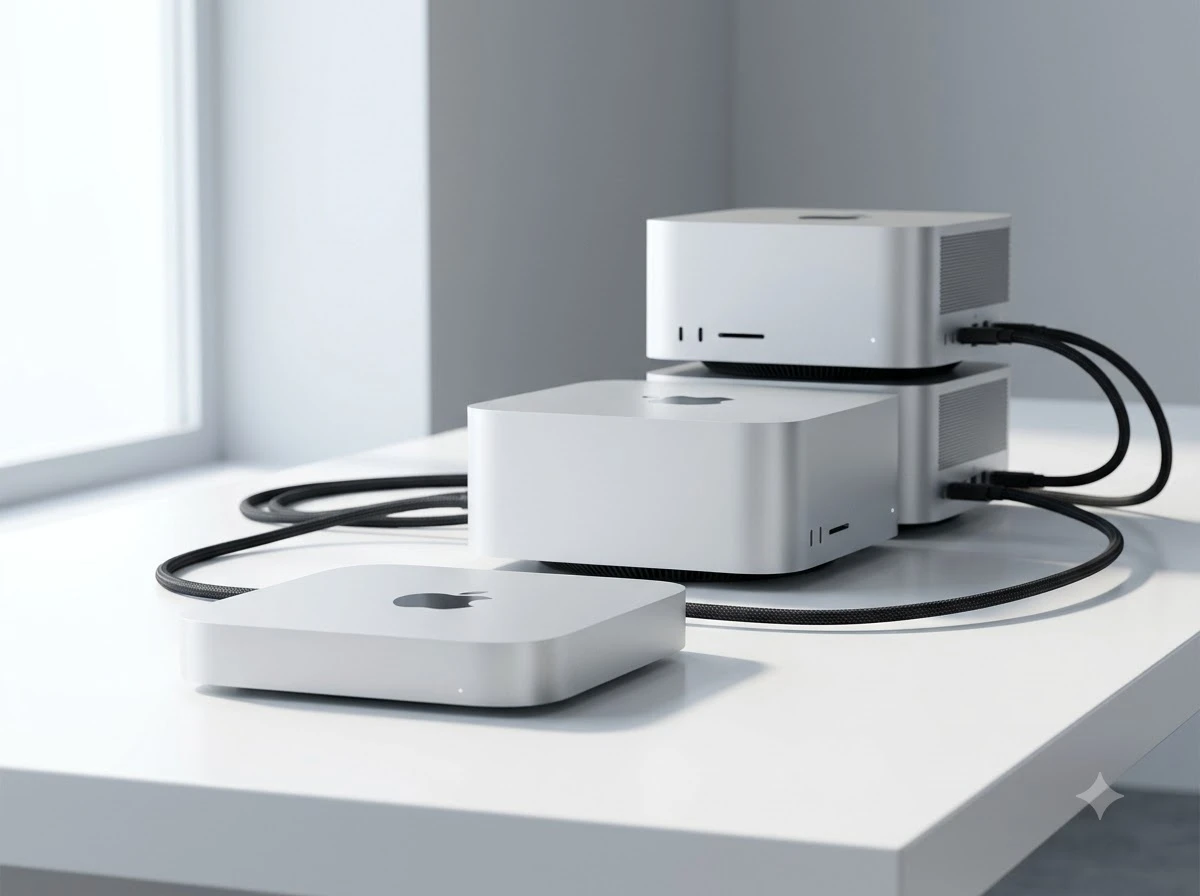
Thunderbolt 5 on the higher models (and clustering support on both lines) lets users link machines into a shared memory pool via RDMA. Apple states a four-Studio cluster delivers up to 3x faster AI inference than a single unit for distributed workloads. The same ports drive up to eight displays or four Studio Display XDRs at full 5K 120 Hz.
That multi-machine path is the clearest second-order move. Hobbyists who once daisy-chained older minis for agentic setups now have official bandwidth and software hooks. Small labs can scale inference without renting GPU time. Power draw stays modest enough that four Studios can share a standard wall circuit in some configurations, according to early coverage.
The up to 512GB unified memory and clustering is the feature set that turns the Studio into a building block rather than a single endpoint.
Wi-Fi 7, Faster Storage and macOS 27 Arrive Together
Both machines add Wi-Fi 7 and Bluetooth 6. Ethernet steps to 2.5 Gb standard. Storage controllers are up to twice as fast. The Studio gains six Thunderbolt 5 ports; the mini keeps three. Genlock over USB-C appears for camera-display sync, including with iPhone 17 Pro.
Everything ships with macOS 27 Golden Gate, which brings the next round of Apple Intelligence and Siri AI. Visual Intelligence, deeper Spotlight integration and system-wide writing tools land on the same hardware that can run the models locally.
Environmental notes stay consistent: high recycled aluminum and rare-earth content, renewable manufacturing energy, fiber packaging.
Preorders Open Now for September 22 Delivery
Preorders began August 25 on apple.com and the Apple Store app. Customer deliveries and store availability start September 22. The 512 GB M5 Ultra memory option follows in late October. Education pricing trims $100 off the mini bases and $400 off the Ultra.
The Mac mini M6 starts at $899 and the rest of the lineup follows the same schedule. Trade-in credits and Apple Card monthly installments remain available.
For buyers who already stretch older silicon for local agents, the new machines remove the previous memory and bandwidth ceilings. For everyone else the sticker is simply higher than last year’s equivalent.
Frequently Asked Questions
What chips power the new Mac mini and Mac Studio?
The Mac mini uses the all-new M6 (12-core CPU, 12-core GPU, Dual 16-core Neural Engine on 2 nm) or the M5 Pro (up to 18-core CPU and 20-core GPU). The Mac Studio uses the M5 Max (18-core CPU, up to 40-core GPU) or the new M5 Ultra (up to 36-core CPU and 80-core GPU formed from four dies).
How much do the new Mac mini and Mac Studio cost?
Mac mini with M6 starts at $899 and with M5 Pro at $1,699. Mac Studio with M5 Max starts at $2,499 and with M5 Ultra at $5,499. Fully loaded Ultra configurations currently reach $18,299 before the 512 GB memory option arrives.
When does the 512 GB memory option for Mac Studio ship?
The M5 Ultra Mac Studio with 512 GB of unified memory is scheduled for late October 2026. Configurations up to 256 GB are available for preorder now and ship September 22.
How much faster is AI performance on the new chips?
Apple claims up to 4x faster AI on the M6 Mac mini versus the M4 model and up to 4.3x peak AI compute on the M5 Ultra versus the M3 Ultra, driven by Neural Accelerators in every GPU core plus larger Neural Engines and higher memory bandwidth.
When do the new Mac mini and Mac Studio start shipping?
Preorders opened August 25, 2026. Units begin arriving to customers and stores on September 22, 2026, running macOS 27 Golden Gate.