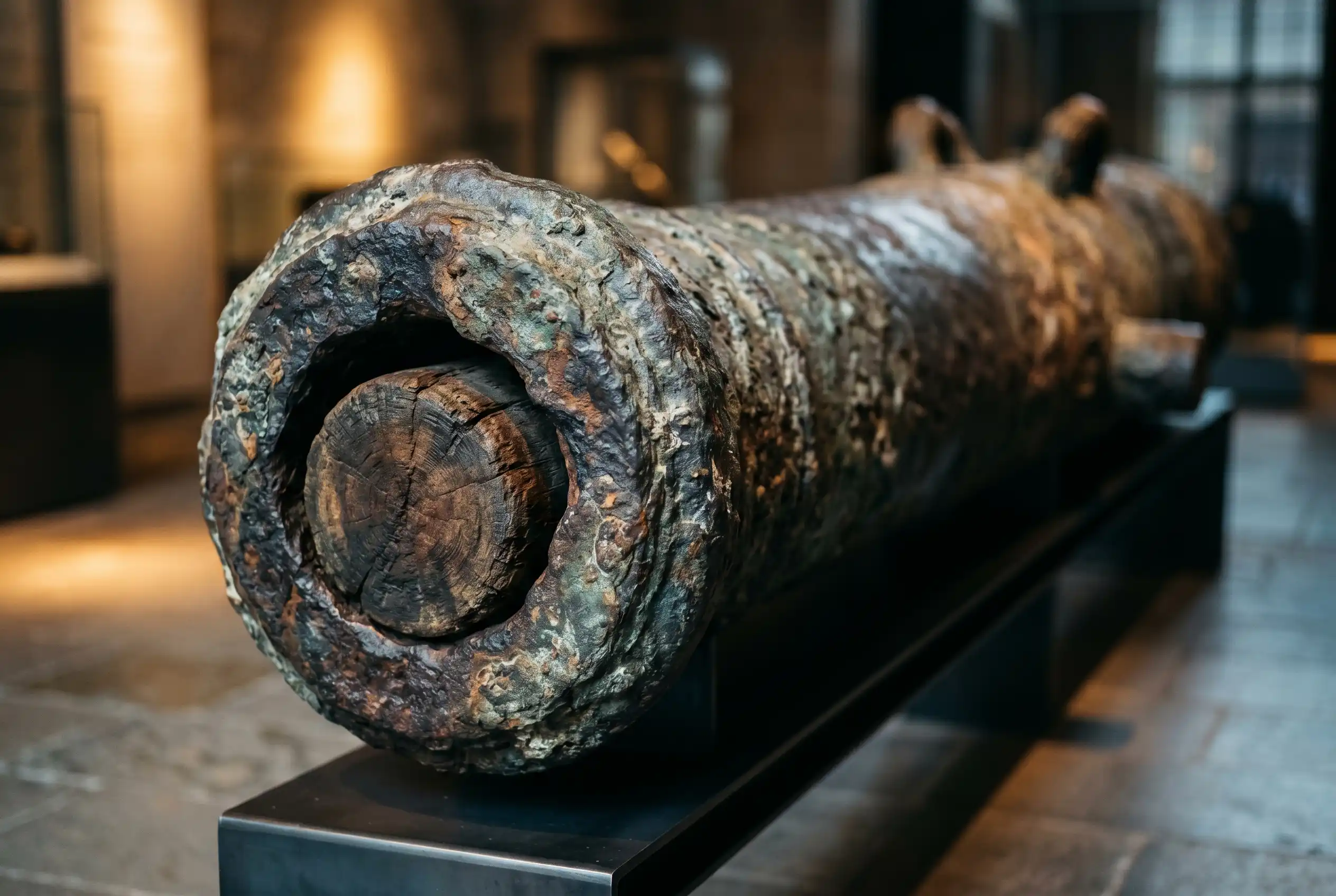
Seventeen restored American Revolution-era cannons arrived at the Savannah History Museum in Georgia on June 3, completing a five-year conservation journey from a muddy shipping channel to a July 4 weekend exhibit anchoring the city’s celebration of America’s 250th birthday. The guns were among 19 total pulled from Five Fathom Hole, a deep section of the Savannah River shipping channel, during a harbor-expansion project that ran from February 2021 into early 2022.
In the fall of 1779, British forces scuttled at least six ships in that same river to block a French fleet bringing reinforcements to colonial troops trying to retake the occupied city. The land battle that followed was one of the Revolution’s most costly defeats for the allied force. The new exhibit, Loyalists & Liberty: Savannah in the American Revolution, opens with a partner preview on July 2 before its public run over Fourth of July weekend.
Pulled From Five Fathom Hole
A Harbor Project Finds Something Older
The find began with a project designed to move cargo faster. The U.S. Army Corps of Engineers (USACE) was finishing the Savannah Harbor Expansion Project, deepening the main shipping channel from 42 feet to 47 feet at mean low water so that supertankers could transit without waiting for high tide. The Georgia Ports Authority marked the project complete in March 2022, noting the deeper channel lets container vessels load roughly 1,000 additional units per voyage. In late February 2021, with dredging ongoing just downstream from Savannah’s River Street, a clamshell dredge scooped up iron instead of silt.
Three cannons emerged within days. Archaeologists assumed a Civil War connection at first. A Confederate ironclad, the CSS Georgia, was scuttled in the same river stretch in 1864, and the Corps had previously recovered guns from that wreck during earlier phases of the channel work. Measurements of the new pieces and sonar surveys of the recovery site pushed the dating back nearly a century further. A total of 19 cannons came up between February 2021 and February 2022. Radiocarbon dating of wooden plugs still sealed inside the bores confirmed an origin in the late 18th century.
Racing the Clock in Zero Visibility
Getting the guns out required working under severe constraints. The channel carries heavy commercial traffic, and salvage divers with Commonwealth Heritage Group, the contractor that supervised sonar investigations and recovery operations, could work only at slack tide when the current briefly eased. Diver Richard Steele described the conditions in a U.S. Army Corps video: “You got zero vis. The current is ripping you, you are holding on for dear life half the time, trying to hike your way through down there. Every time you get in the water, you are racing the clock.” Crews used inflatable lift bags to free the guns from the sediment, then slung them for hoisting. The first three came up via clamshell dredge, 12 through lift bags, and the final four by dredge again in February 2022.
Sonar scanning during the operation turned up additional artifacts: anchors, bar shot (a munition type designed to shred ship rigging in naval combat), and a fragment of a ship’s bronze bell. None of the objects bore markings identifying any vessel.
What the British Sank to Win
Six Ships in the Channel
Savannah had been under British occupation for nearly a year when the French fleet appeared off the Georgia coast in September 1779. British forces had seized the city in December 1778 as the opening move of their southern campaign. Georgia became the only colony Britain successfully reconquered, and holding the port was central to the plan to push into South Carolina, where Loyalist support was believed to be substantial. When d’Estaing’s fleet appeared, British General Augustine Prevost ordered at least six ships scuttled in the river downstream from the city to block the channel.
Georgia’s colonial commerce depended on the waterway, carrying rice, timber, and indigo exports to Atlantic markets. A French naval force pushing upriver threatened British waterfront positions directly. Scuttling six ships in the channel was the fastest way to deny that route.
The cannons recovered from Five Fathom Hole are believed to have come from among those scuttled ships. British archives reviewed during the research process indicate the guns most likely belonged to two or more British troop transports. The more famous HMS Rose, initially suggested as a possible source, was sunk farther upriver, with its artillery removed beforehand.
One of the War’s Costliest Days
The Franco-American relief force assembled for the siege was substantial. D’Estaing arrived with roughly 25 ships of the line and 4,000 French troops; more than 500 Haitian volunteers from Saint-Domingue joined the campaign. General Benjamin Lincoln brought over 2,000 Continental soldiers from Charleston. Combined, the allied force numbered close to 7,000 against about 3,200 British defenders, per the American Battlefield Trust.
On October 9, the assault at Spring Hill Redoubt failed within the hour. The attack’s timing had been betrayed to Prevost, fog sent troops into the wrong swamps, and the planned pre-dawn strike launched near daylight into withering fire. Polish cavalry commander Count Casimir Pulaski was mortally wounded leading a charge. D’Estaing was wounded twice. He called off the assault an hour after ordering it. The French fleet sailed away within a week; Lincoln’s forces lifted the siege on October 18. British forces held Savannah until July 1782, and their push north seized Charleston in May 1780, capturing Lincoln’s entire army. The South would not see a decisive colonial victory until Yorktown in 1781.
- ~1,000 allied casualties in the October 9 assault at Spring Hill Redoubt
- ~150 British casualties across the entire six-week siege
- 6 ships scuttled by British forces in the Savannah River to block the French fleet
- 247 years between the British scuttling and the cannons’ July display in Savannah
Five Years Under Texas A&M’s Care
After being pulled from the river, the cannons were stored in protective wet vats at a secured location. Two were kept in their original encrusted state and put on early display at the museum. The other 17 left Georgia for Texas A&M University’s Conservation Research Laboratory (CRL), one of the oldest continuously operating conservation programs for underwater-recovered archaeological material in the world, founded in 1978 and now part of the university’s Center for Maritime Archaeology and Conservation (CMAC). Chris Dostal, a professor of nautical archaeology who directs the CRL, oversaw the work.
Each gun arrived caked in mud and minerals accumulated over more than two centuries on the riverbed. Cleaning took years. Dostal’s team stripped the deposits and coated the iron in paint and wax to prevent corrosion once the guns were no longer protected by the anaerobic conditions of the river bottom. Most arrived with original wooden plugs still in their bores, the bores packed with cannonballs and gunpowder charges unchanged since the original scuttling. The lab also had prior Savannah River experience; it previously conserved thousands of artifacts from the CSS Georgia, pulled from the same stretch of water.
They look brand new. They could pretty much be fired if someone wanted to.
Andrea Farmer, a U.S. Army Corps of Engineers archaeologist who led the research and preservation effort, made that assessment on June 3 as the 17 guns were unloaded at the museum.
| Cannon Group | Count | Treatment | Status |
|---|---|---|---|
| Cleaned and conserved at Texas A&M CRL | 17 | Multi-year cleaning; paint and wax coating applied | Returned June 3; at Savannah History Museum |
| Retained in original crusted state | 2 | No treatment; displayed as-recovered | Previously on display at the museum |
| Total recovered from Savannah River | 19 | February 2021 to February 2022 | All 19 in Savannah |
Most guns came through in good shape. Dostal described the marks: “A lot of them have scour marks on the side from anchors or dredging, so there’s some scarring on the cannons. But most of them look pretty exceptional.” Each weighs up to 1,500 pounds (680 kilograms), and museum staff installed them on custom display mounts that workers described as resembling giant wine racks.
Questions the River Won’t Answer
Three of the cannons carry dimensions consistent with British military manufacture, confirmed when Dostal’s team shared measurements with experts in London. The other 16 appear to match French artillery design but have no national markings. Dostal suspects those may have been cast in America around the time of the war; colonial foundries were producing artillery at scale by that point, and a French-patterned gun cast domestically would carry no foreign proof marks.
None of the 19 guns have engravings pointing to a specific vessel, and neither does the bronze bell fragment recovered at the same site. The commercial traffic constraints that made recovery difficult also limited underwater investigation. Divers working the channel could never conduct the systematic excavation that might have produced firmer answers. The river bottom holds Native American pottery, Civil War debris, and material from vessels lost across multiple centuries, all shifted and mixed by tidal current and successive dredging. Farmer put it plainly: “There is no telling what all is down there.”
What the five-year investigation established, and what remains open:
- Radiocarbon dating of wooden bore plugs places manufacture in the late 18th century, consistent with Revolutionary War-era origins
- Three cannons match British military manufacture specifications, confirmed against London records
- The Five Fathom Hole site sits directly downstream from Savannah, matching the scuttling location described in British archives
- None of the 19 guns carry ship-identifying markings or engravings of any kind
- Sixteen cannons carry French design characteristics but no national proof marks; their exact origin is unresolved
- The river holds additional artifacts from multiple eras; the full scope of what remains below is unknown
Across From the Battlefield, Just in Time
The Savannah History Museum, operated by the Coastal Heritage Society, sits inside the former passenger depot of the Central of Georgia Railway, a National Historic Landmark. Together with the Georgia State Railroad Museum and Savannah Children’s Museum, it is part of the Coastal Heritage Society’s Tricentennial Park complex in downtown Savannah. Battlefield Memorial Park, which commemorates the October 9, 1779 assault on the British works, is directly across the road. The museum holds over 10,000 artifacts spanning Savannah’s history from the colonial era forward. Alongside the 17 restored cannons, the Loyalists & Liberty exhibit displays the bronze bell fragment and other small artifacts from the river recovery.
Curator Samantha Moss described what her staff had been doing to prepare: “Our great team has been prepping for months, building mounts and planning how we can safely display these very large, very special artifacts.” Savannah is marking several American milestones this summer. The Budweiser Clydesdales’ visit to the city in early June was among the events drawing visitors ahead of what organizers expect to be a busy Fourth of July weekend.
Public access begins over Fourth of July weekend, with a partner preview on July 2. The museum sits one road crossing from the memorial ground where, 247 years ago, the colonials lost the battle those cannons were part of.