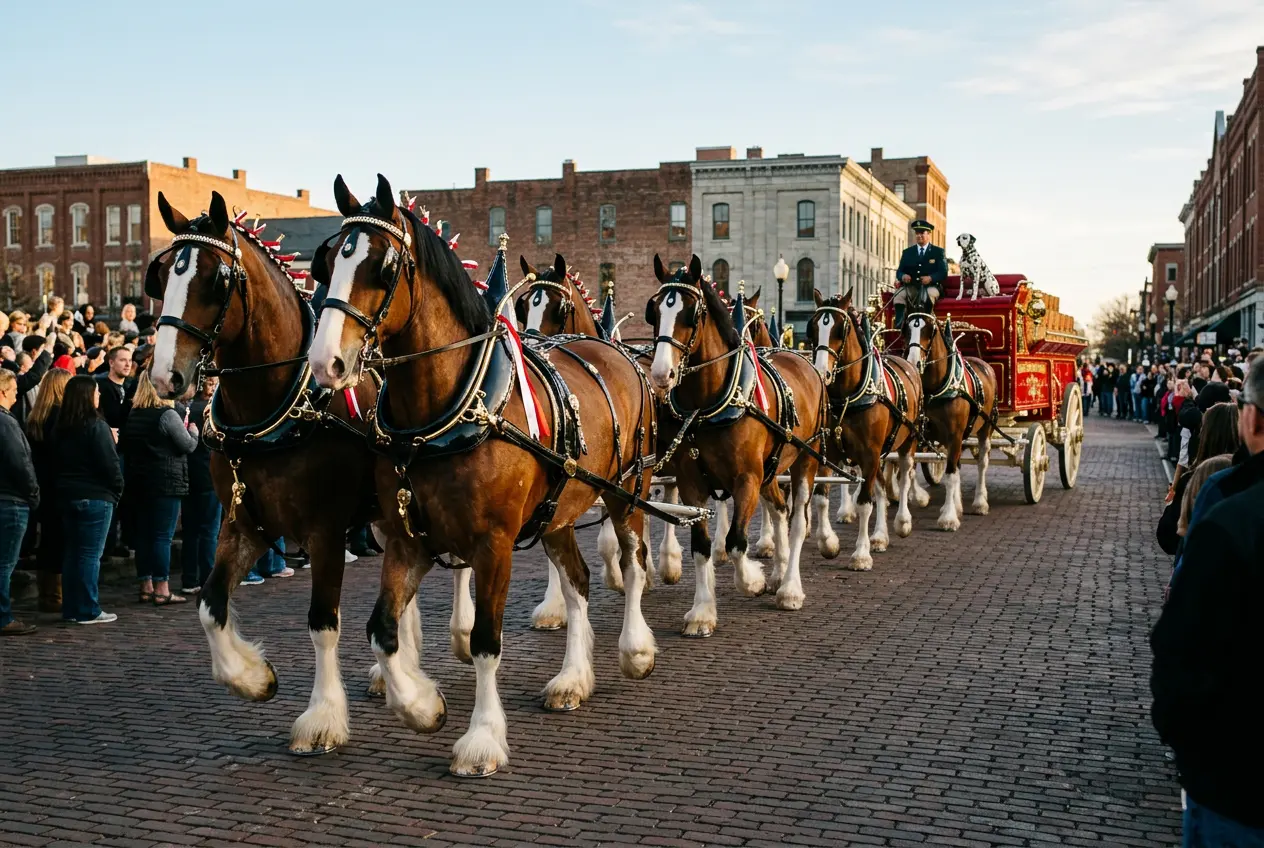
The Budweiser Clydesdales are in Savannah through June 6 for a three-day stop marking the brand’s 150th anniversary. The eight-horse hitch paraded from Daffin Park to Grayson Stadium on Thursday evening, which is itself celebrating its centennial year, and returns for a River Street parade Saturday at 11 a.m. Together, the visit layers three separate American milestones into one weekend.
Grayson Stadium opened in 1926 as Municipal Stadium. Franklin D. Roosevelt addressed a crowd there in 1933, the same year August A. Busch Jr. arranged the first Clydesdale hitch as a surprise gift for his father to mark the end of Prohibition.
From Daffin Park to River Street
Thursday’s sequence began at Daffin Park with the official hitching at 4 p.m. Fans who arrived early watched the horses groomed, manes braided with red and white ribbons, and each one fitted into the brass-trimmed harness before the formation took shape. The team then moved through city streets for a game between the Savannah Bananas and the Indianapolis Clowns, a historic barnstorming baseball team, at 5 p.m. The centennial banner on the stadium gates and the Budweiser wagon arrived at East Victory Drive at roughly the same moment.
All three American milestones converging in the same Savannah weekend:
| Milestone | Year Established | 2026 Mark |
|---|---|---|
| Budweiser | 1876 | 150th anniversary |
| Budweiser Clydesdales | 1933 | 93rd year of touring |
| Grayson Stadium | 1926 | Centennial year |
Saturday is the larger public event, and the stop is part of the Folds of Honor Tour, the formal name for the hitch’s traveling program in partnership with a military scholarship nonprofit. River Street ramps close to vehicles at 9 a.m.; cars already in River Street lots must remain until police reopen the road. The full Saturday sequence:
- 10:00 a.m.: Horses arrive at Morrell Park; hitching process begins.
- 11:00 a.m.: Parade begins along River Street. The wagon stops four to five times to deliver special anniversary Budweiser to restaurants along the route.
- 12:30 p.m.: Parade ends at Plant Riverside District; public photos begin.
- 1:00 p.m.: Unhitching begins at Plant Riverside, across from the Montgomery Street Stairs.
- 2:00 p.m.: Clydesdales depart.
Organizers are recommending early arrival at all stops. Friday includes additional public appearances and anniversary events across the city, with specific locations released throughout the day.
The 1933 Prank That Launched a Tradition
April 7, 1933 had a kinetic quality across the country. The Cullen-Harrison Act took effect that day, legalizing the sale of low-alcohol beer in most states after 13 years of Prohibition. Throngs gathered outside breweries and taverns for their first legal drink in over a decade. In St. Louis, August A. Busch Jr. and his brother Adolphus Busch III found something more theatrical to do with the occasion.
They told their father, August A. Busch Sr., head of Anheuser-Busch, that a new car was waiting outside the St. Louis brewery. It wasn’t a car. Six Clydesdale horses in red, white, and gold harness pulled a beer wagon down Pestalozzi Street, carrying the first post-Prohibition Budweiser out of the facility. Busch Sr. recognized the promotional power almost immediately. A second team went by rail to New York City and presented a case of Budweiser to former New York governor Al Smith, who had been central to the campaign against Prohibition. The hitch continued through New England and the Mid-Atlantic states before reaching the White House and delivering beer to President Franklin D. Roosevelt. The tour drew large crowds at every stop.
During the dry years, Anheuser-Busch had kept the St. Louis operation alive by pivoting to non-alcoholic products: soft drinks, ice cream, and car bodies. Robert Thomas Jr., writing in Busch Jr.’s 1989 New York Times obituary and cited in Smithsonian Magazine’s account of the Clydesdales’ first appearance, described the man behind the stunt as “a master showman and irrepressible salesman.”
The original six horses were purchased from Patrick Shea, owner of Shea’s Brewery in Winnipeg, Canada. The hitch expanded to eight horses shortly after the debut. A Dalmatian joined the traveling team in 1950, when one was introduced at the opening of the Newark Brewery, and one has ridden with every hitch since. The breed traces to 19th-century Scotland, where farmers along the banks of the River Clyde in Lanarkshire developed draft horses capable of hauling loads heavier than a ton at a five-mile-per-hour walking pace.
What It Takes to Enter the Hitch
Qualification standards for the traveling hitch are strict on size, color, and temperament, and have changed little since the first six horses were selected in 1933.
- 18 hands (6 feet) minimum height at the shoulder
- 1,600 to 2,300 pounds per horse
- Bay coat with a white blaze on the face
- Four white stocking feet; black mane and tail
- Geldings only; even temperament required
Each horse wears a hand-crafted harness of patent leather and solid brass hardware weighing 130 pounds. The 3.5-ton red, white, and gold wagon, built from wood and steel and hand-detailed, travels in one of the three tractor-trailers that accompany each hitch team. Harnessing all eight horses takes about 45 minutes on performance days. Handlers work outward from the wagon: wheel horses, those closest to the wagon and typically the strongest, are fitted first, then the body, swing, and lead teams in sequence.
Horses in the traveling hitches carry short names chosen so drivers can call commands quickly during parades. Duke, Captain, Mark, and Bud are among the common names in use. Three hitch teams currently operate, based in St. Louis, Fort Collins, Colorado, and previously Merrimack, New Hampshire. Each team carries 10 horses, two held as alternates. They are on the road at least 10 months each year.
Grooming on a performance day runs roughly five hours: washing and braiding red and white ribbons into the manes, inserting red and white bows into the tails, and polishing the brass hardware before the hitch goes out. Anheuser-Busch breeds more than 40 horses annually at its Grant’s Farm operation near St. Louis, working to produce the males that will meet hitch standards; the others are sold. The hitch has appeared in Super Bowl commercials in most years since 1986, a run that was nearly interrupted in 2010 when Anheuser-Busch InBev, the Belgian-Brazilian company that acquired Anheuser-Busch in 2008, initially planned to skip the game before fan pressure reversed the decision.
Grayson Stadium Turns One Hundred
The city of Savannah built Municipal Stadium in 1925-26 with a $100,000 project. Within a year, the facility hosted an exhibition between the New York Yankees and the St. Louis Cardinals, a rematch of the 1926 World Series. An estimated 15,000 fans packed the stands to watch Babe Ruth and Lou Gehrig play. The Yankees lost 20-10. The Boston Red Sox also held spring training there in 1932.
FDR spoke at the field in 1933. The wooden bleachers succumbed to hurricane damage and the stadium was rebuilt in 1940 at a cost of $150,000, only the concrete outfield wall surviving intact. The rebuilt structure opened in 1941 and was renamed Grayson Stadium in honor of William L. Grayson, credited with shaping the city’s sports culture.
The stadium has dense historical layering. Hank Aaron played there as a 19-year-old minor-league infielder in 1953, the same spring Grayson Stadium hosted the first integrated game in the South Atlantic League, on April 14 of that year. Mickey Mantle hit a home run there in a 1957 Yankees exhibition. Jackie Robinson, barred from the same field in 1946 when segregation laws prompted the cancellation of a scheduled game, came back to play in front of a Savannah crowd five years later.
The Savannah Bananas took over Grayson Stadium in 2016, initially as a collegiate summer league team before their Banana Ball format turned them into a national touring act. Between 2023 and 2024, the team oversaw a renovation that expanded seating to 5,000, replaced old bleacher seating with stadium-style bucket seats, and prepared the grandstands for the centennial. The park is now among the oldest active baseball stadiums in the United States.
Budweiser at 150, America at 250
Adolphus Busch and his partner Carl Conrad developed the Budweiser lager in 1876 at the Anheuser-Busch brewery in St. Louis, a National Historic Landmark. Inspired by Bohemian brewing traditions Busch encountered in Europe, Budweiser became the first nationally distributed beer in the United States, made possible by Busch’s early adoption of pasteurization and refrigerated railcars. By 1901, the company had become the country’s largest brewery.
This summer Budweiser runs the anniversary alongside America’s 250th birthday under the American Summer campaign name. The national kickoff was a May 17 daylong party at the St. Louis brewery, detailed in the official 150th Anniversary Celebration announcement, featuring a Clydesdales parade through the brewery campus, tours, and a live concert. Limited-edition Patriotic Cans, part of a series of milestone packaging released throughout the year, are in distribution nationwide. The Savannah stop follows earlier visits to El Paso, Texas and other communities, with the tour continuing to state fairs and sporting events through autumn.
The charitable thread running through the tour is a 16-year partnership with Folds of Honor, a nonprofit founded in 2007 by Lt. Col. Dan Rooney, an F-16 fighter pilot, to provide educational scholarships to the spouses and children of fallen or disabled U.S. service members and first responders. Since inception, the organization has awarded nearly 73,000 scholarships totaling over $340 million. Anheuser-Busch and its wholesaler partners have donated more than $37 million over the course of the partnership, helping underwrite more than 7,400 scholarships.
At the Savannah stop, Budweiser and Southern Crown Partners, the local distributor, are presenting a donation check to Folds of Honor during the weekend’s events. Budweiser’s American Beers for American Heroes program also donates a portion of all Budweiser sold at restaurants and bars across the country throughout 2026, up to $1.5 million, to the scholarship fund.
After the 2 p.m. unhitching Saturday at Plant Riverside District, the three tractor-trailers carrying the horses and their harnesses will move on, continuing a summer tour that doesn’t wrap until late autumn.