Oil prices climbed again on Wednesday after U.S. forces disabled an Iran-bound tanker and shot down Iranian drones over the Strait of Hormuz, with Brent crude up 1.09% at $97.05 a barrel and West Texas Intermediate (WTI, the U.S. benchmark grade) 1.19% higher at $94.88. Both benchmarks sat at one-week highs after strong gains the session before, according to OilPrice.com.
A 1% move sounds modest for a night that involved missiles aimed at two Gulf capitals and a Hellfire round punched into a tanker’s engine room. The tick is small because the thing pushing crude right now is older and quieter than the overnight headlines: a U.S. naval cordon that has been bleeding Iranian barrels out of the market for seven weeks straight.
The Lexie Took a Hellfire to the Engine Room
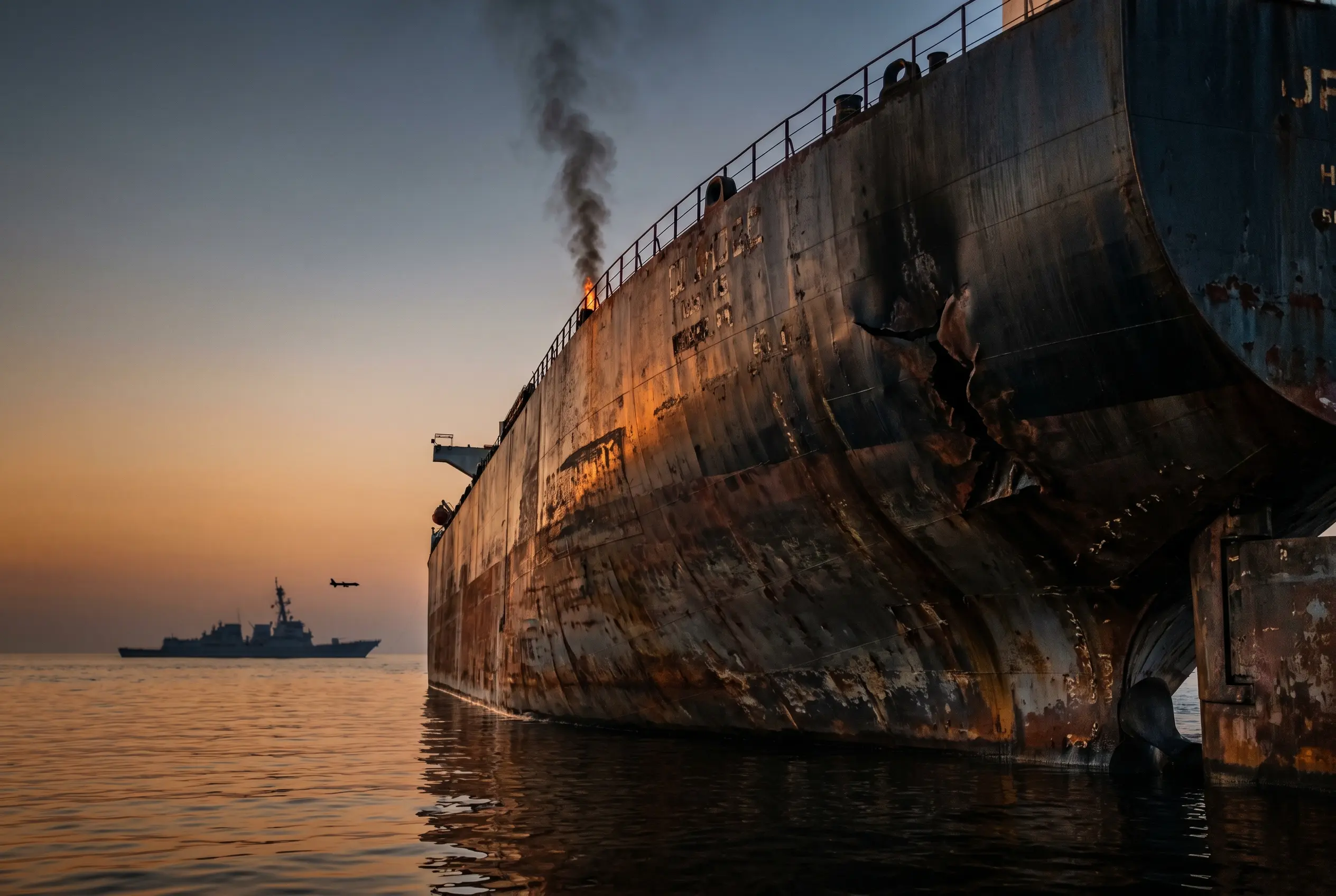
The headline incident was a single ship. U.S. forces fired on and disabled the M/T Lexie, an unladen, Botswana-flagged oil tanker steaming toward Iran’s main export terminal at Kharg Island. By the account of U.S. Central Command (CENTCOM, the military body running operations across the Middle East), the vessel ignored repeated orders over a 24-hour window before an American aircraft put a Hellfire missile into its engine room, leaving it unable to continue.
That made the Lexie the sixth commercial vessel U.S. forces have physically stopped since April 13. The night also carried a wider exchange of fire that CENTCOM laid out in sequence:
- Iran fired two missiles toward Kuwait, which fell short or broke apart before reaching their targets.
- Three more missiles were launched at Bahrain and intercepted by U.S. and Bahraini air defenses.
- Three one-way attack drones aimed at civilian mariners crossing the waterway were shot down.
None of that hit oil infrastructure. The crude that flows through this corridor accounts for roughly a fifth of the world’s seaborne supply, a dependency mapped in detail by a Congressional Research Service review of Hormuz oil flows, so even a near miss keeps a risk premium baked into the price.
Why 122 Redirected Tankers Move the Market More Than a 1% Tick
Strip the missiles away and the durable pressure on crude is a blockade. Since April 13, U.S. forces have not only disabled six ships; they have turned back another 122 attempting to reach Iranian ports. Each vessel sent away is a load of crude that does not clear, and the cumulative removal is what keeps a floor under prices when the day’s news is otherwise quiet.
The U.S. Department of Defense put an early dollar figure on the damage. Here is the scale of the cordon:
- 122 tankers redirected away from Iranian ports since mid-April.
- $4.8 billion in lost Iranian oil revenue between April 13 and May 1, by the Pentagon’s own estimate.
- 31 laden tankers holding around 53 million barrels of Iranian crude stuck in the Gulf during that window.
Trump announced an end to the formal blockade on May 29 after a round of negotiations. The latest tanker strikes show the cordon is back in operation in all but name, which is why traders are treating Iranian supply as effectively offline rather than recovering. A few cents on Brent does not capture barrels that simply cannot move.
Kharg Island Carries 96% of Iran’s Crude
The Lexie was not headed anywhere random. Around 96% of Iran’s crude exports leave from one terminal, and that single point of failure is why a counter-blockade works. Choke the loading jetties and you choke the national economy.
The terminal normally ships between 1.5 million and 2 million barrels a day, a concentration that the Council on Foreign Relations describes in its breakdown of Kharg’s role as Iran’s oil lifeline. Tehran has no real way to route around it. The Jask pipeline and port on the Gulf of Oman, built to dodge the strait entirely, managed one test cargo in late 2024 and has shipped nothing since, leaving it out of service as a crude export option by the International Energy Agency’s chokepoint assessment.
The wider waterway carries roughly 20 million barrels a day, and commercial traffic has thinned to a trickle. Earlier in the conflict, tanker traffic through the corridor collapsed as owners refused passage, with more than 150 ships anchoring outside rather than risk the crossing. Gulf producers in Saudi Arabia, Iraq, the UAE and Kuwait can lean on spare capacity, but not enough to paper over a fifth of global flow if the strait stays contested.
Seven Weeks of Falling U.S. Crude Stocks
Geopolitics is only half the bid. The other half is sitting in American storage tanks. American Petroleum Institute (API, the U.S. oil industry trade body) figures showed crude inventories fell by 6.8 million barrels in the week ending May 29, the seventh straight weekly draw.
Seven consecutive draws tell you domestic demand is outrunning supply even before a single missile flies. Traders were waiting on official confirmation from the Energy Information Administration, whose weekly petroleum status report was due later Wednesday. A matching drawdown in the federal data would hand the rally a second engine that has nothing to do with the Gulf, which is part of why both benchmarks have ground higher rather than spiking and fading.
Rystad’s $180 Bull Case for August
So how high can this go? Jorge León, Head of Geopolitical Analysis at the consultancy Rystad Energy, told CNBC’s Squawk Box Europe that an acute re-escalation paired with a prolonged closure of the strait could carry crude to $180 a barrel by August. That outcome assumes sustained military strikes, physical damage to infrastructure or a full shutdown of the chokepoint.
León also sketched the way down. A successful 30-day peace framework, a gradual reopening of shipping lanes and the return of Iranian crude would drag prices into the $70 to $80 range. The spread between those two calls is the entire story of where oil trades this summer.
| Scenario | Source | Price call |
|---|---|---|
| Acute re-escalation, prolonged strait closure | Rystad Energy (Jorge León) | up to $180/bbl by August |
| Effective closure of the chokepoint | Saudi Arabia (March warning) | up to $180/bbl |
| Prolonged disruption, no deal | BNP Paribas and other Wall Street desks | $170 to $200/bbl |
| 30-day peace framework, lanes reopen | Rystad bear case | $70 to $80/bbl |
The bull case is not a fringe view. Saudi Arabia floated the same triple-digit figure in March, and several Wall Street desks have penciled in $170 to $200. The pain travels well beyond the oil pits, too; importers have already absorbed the shock, with the Indian rupee sliding to record lows against the dollar as the crude bill climbs.
Tehran and Washington Have Stopped Talking
Everything above hinges on diplomacy that may not exist. Iranian state media reported that Tehran has not communicated with Washington for several days, a claim Trump dismissed as “false and erroneous” while insisting talks remain active. The two accounts cannot both be true, and the market is pricing the gap.
The pattern is familiar to anyone who watched the spring. Weeks ago Trump described the ceasefire as being on life support even as Brent pushed toward $110, and the same on-again, off-again signaling is driving the tape today. A signed agreement would reopen Kharg’s jetties and send crude back toward the bear case; continued silence keeps the cordon in place and the barrels stranded. For now the deal does not exist, and until it does, both Brent and WTI have a reason to keep grinding higher.