Microsoft has built a mini PC most people will never be allowed to buy. The Surface RTX Spark Dev Box, shown at the company’s Build 2026 developer conference on June 2, is a small aluminum desktop running an Nvidia RTX Spark chip with 128GB of unified memory, sold only to developers in the United States and only through Microsoft.com later this year. No consumer version, no retail shelves, no price.
That last detail matters more than the memory. Microsoft is putting a desktop on developers’ desks now so that native apps exist by the time its consumer flagship, the Surface Laptop Ultra, ships on the same chip family.
128GB of Memory in a Heatsink Chassis
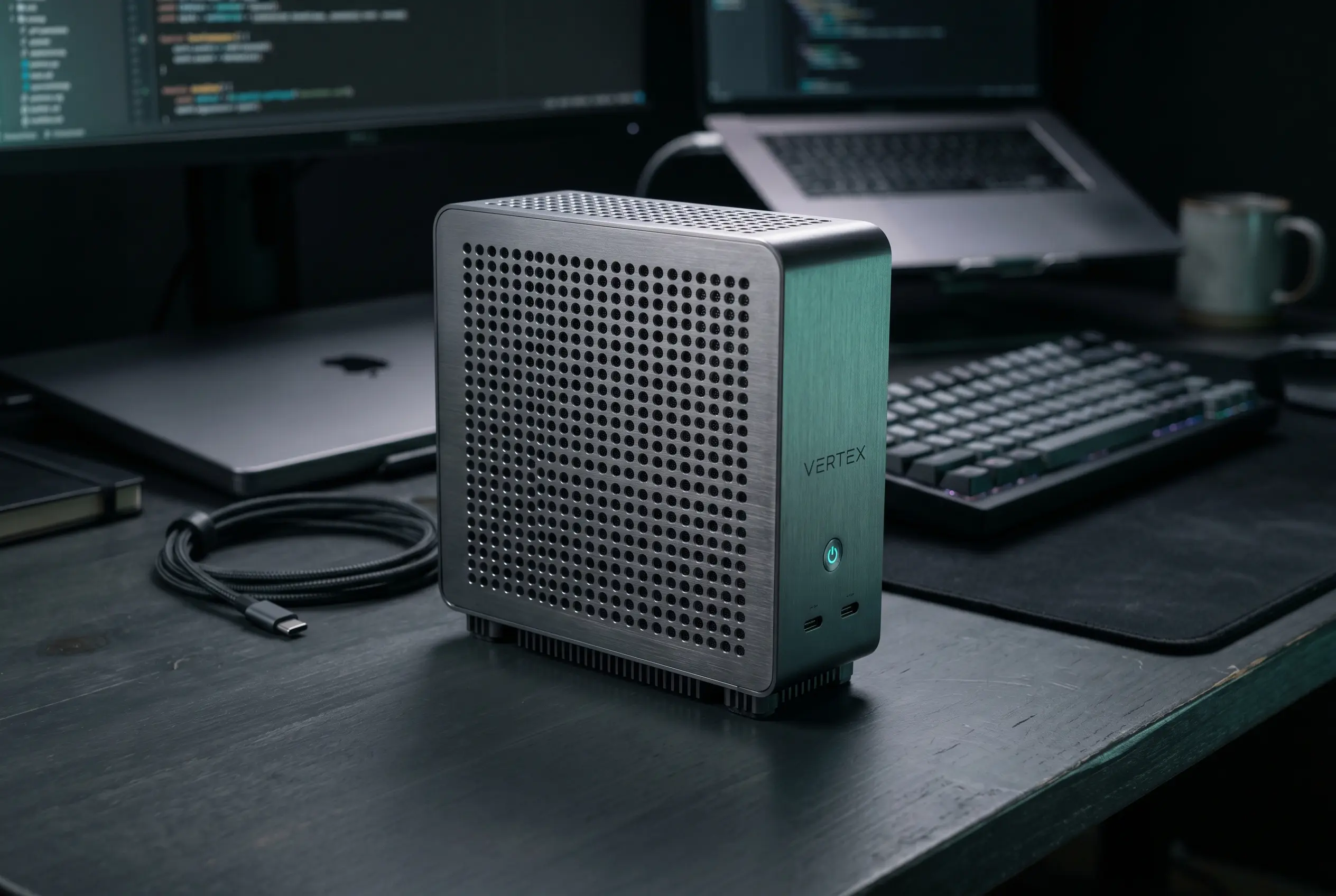
The hardware is the easy part to describe. The box is a compact slab of machined aluminum that doubles as its own heatsink, drilled with roughly a thousand air vents arranged in a grid so the whole shell sheds heat. Connectivity covers two USB Type-C ports, HDMI, USB-A, Ethernet and a headphone jack. Microsoft’s developer-device announcement on the Surface blog frames it as a machine engineered to run sustained local AI work, not a laptop pretending to.
The Silicon
The chip is Nvidia’s RTX Spark, the same GB10-class Grace Blackwell platform the company sells on its own as a desktop AI box. It pairs a 20-core Arm-based processor with a Blackwell GPU carrying 6,144 CUDA (Compute Unified Device Architecture, Nvidia’s parallel-computing cores) cores, and Microsoft rates the package at up to 1 petaflop of AI compute. The 128GB of memory is unified, allocated dynamically between processor and graphics, which is what lets the box hold large models in one pool. Microsoft says it can run 120-billion-parameter models with a one-million-token context window locally, at interactive speed.
The Pre-Loaded Stack
What sets the Dev Box apart from a generic mini PC is how it arrives configured. It ships with Windows 11 Pro tuned at the image level for developers, with a deliberate set of defaults rather than the consumer setup:
- WSL 2 (Windows Subsystem for Linux, which runs a real Linux kernel inside Windows) configured with GPU passthrough and CUDA support out of the box
- Visual Studio Code, GitHub Copilot, Git, Python and Node.js preinstalled
- PowerShell 7 as the default shell, Developer Mode on, dark theme enabled, Do Not Disturb active and the Widgets panel removed
- Secured-core PC protections, BitLocker encryption and Microsoft Defender, with Entra ID and Intune hooks for fleet management
A developer can pull it out of the box and start fine-tuning a model without spending a day wiring up drivers. That convenience is the tell.
Why the Developers Get It First
Microsoft is not trying to sell a few thousand desktops. It is trying to fix a software problem before it becomes a sales problem. The Surface Laptop Ultra, announced May 31, runs the same RTX Spark silicon and aims squarely at consumers and creative professionals, with a 15-inch mini-LED display and up to 128GB of memory. For that machine to land, the apps people open every day need to run well on an Arm chip with Nvidia graphics, a combination that has never shipped in volume on Windows.
So the Dev Box goes out months ahead, cheap to no one but valuable to the people who write the code. Get the developers building and testing now, and the consumer launch arrives into a software library that already works.
Surface RTX Spark Dev Box is engineered for developers who want to prototype, fine-tune and run capable models on their desk.
That line came from Andrew Hill, Corporate Vice President for Surface Product at Microsoft, in the company’s announcement. The pitch lines up with the agentic-Windows theme that ran through Build 2026, where Microsoft pushed local AI agents as the next layer of the operating system. Nvidia’s chip is the engine, and the strategy of aiming it at coders first echoes how the silicon itself was positioned, a point laid out in earlier coverage of how the RTX Spark superchip targets developers rather than just laptops.
The App Gap That Sank Earlier Arm Laptops
This is where the second-order story lives. Microsoft has tried to move Windows onto Arm chips twice before, and both times the hardware was fine and the software was the problem.
From Windows RT to Surface Pro X
The first Surface, Windows RT in 2012, could not run standard x86 desktop programs at all. Developers never showed up, buyers found a tablet that opened almost nothing they owned, and Microsoft wrote off close to a billion dollars in unsold inventory. The Surface Pro X in 2019 tried again with a custom Arm chip and software emulation, and again the emulation was slow and patchy enough that the device stayed a niche curiosity.
What Copilot+ Improved, and Didn’t
The 2024 Copilot+ PCs, built on Qualcomm’s Snapdragon X chips, were the first real progress. The Prism emulation layer ran most x64 apps acceptably, and big titles got native Arm builds. But gaps stayed: anti-cheat drivers, some creative tools, plenty of niche professional software. The lesson across all three attempts is blunt. On Windows, the chip is never the bottleneck; the apps are. A desktop seeded to developers a year early is Microsoft trying not to learn that lesson a fourth time.
Where This Leaves Qualcomm and Apple
For Qualcomm, Nvidia’s arrival is a direct hit. Qualcomm had an effective lock on Windows on Arm during the Copilot+ launch window, and that exclusivity has lapsed, opening the platform to Nvidia and others. The competitive shape of that shift was clear even before the Dev Box, when Nvidia’s N1X specs leaked and cracked Qualcomm’s Arm monopoly. Now Microsoft is building first-party hardware around a rival’s silicon.
Apple is the other reference point. The Dev Box is being read as a challenger to the Mac Studio, the desktop many AI developers buy precisely because its unified memory lets large models sit in one pool. Microsoft is offering the same trick on Windows, with CUDA, the toolkit most AI code is already written against. Here is how the new desktop sits next to its siblings.
| Spec | Surface RTX Spark Dev Box | Surface Laptop Ultra | Nvidia DGX Spark |
|---|---|---|---|
| Form factor | Compact aluminum desktop | 15-inch laptop | Desktop mini PC |
| Chip | RTX Spark (GB10-class) | RTX Spark (GB10-class) | GB10 Grace Blackwell |
| Memory | 128GB unified | Up to 128GB unified | 128GB LPDDR5x |
| AI compute | Up to 1 petaflop | Up to 1 petaflop | Up to 1 petaflop FP4 |
| Display | None | 15-inch mini-LED, up to 2,000 nits | None |
| Target user | Developers (US only) | Consumers, creators | AI researchers, developers |
| Price | Not announced | Not announced | About $4,000 (MSRP $4,699) |
The three machines run the same silicon family for different jobs. Nvidia sells its version as a personal AI box; Microsoft is splitting the platform into a tool for builders and a product for buyers.
The Price and the Pieces Microsoft Skipped
Microsoft left out the number that decides everything. There is no price for the Dev Box, no firm date beyond “later this year,” and the listing carries the usual pre-release caveat about regulatory approval. It will sell in the United States only, through Microsoft’s own store, which keeps it out of the hands of most developers worldwide at launch.
The closest read on cost comes from the silicon. Nvidia’s own desktop on the same GB10 platform, sold through the DGX Spark personal AI supercomputer page, launched at $3,999 and has since moved to a $4,699 MSRP. A Microsoft-built, fully configured Windows version is unlikely to come in cheaper. That puts the Dev Box well outside impulse-buy territory and squarely in the budget line of a working studio or an enterprise dev team, which is exactly who Microsoft wants writing code on it.
The bet is coherent. Seed the builders, fix the app library, then ship the consumer machine, the Surface Laptop Ultra, into a software ecosystem that already runs. Whether enough developers buy a roughly $4,000 US-only desktop to make that happen is the open question, and Microsoft has set no date and no price to answer it.
Frequently Asked Questions
What is the Surface RTX Spark Dev Box?
It is a compact Microsoft desktop aimed at software developers, built around Nvidia’s RTX Spark chip and 128GB of unified memory. It ships with Windows 11 Pro pre-configured for coding and local AI work, and it is sold only to developers in the United States through Microsoft.com.
How much will the Surface RTX Spark Dev Box cost?
Microsoft has not announced a price. The closest guide is Nvidia’s own DGX Spark, which uses the same GB10 platform and currently carries a $4,699 MSRP after launching at $3,999, so the Microsoft version is likely to land in a similar range rather than at a consumer price.
When and where can I buy it?
Microsoft says the Dev Box arrives later in 2026, sold exclusively in the United States through Microsoft.com. The product listing notes it is pre-release and subject to regulatory approval, so timing could shift.
What chip and storage does it use?
The RTX Spark is a GB10-class Grace Blackwell platform pairing a 20-core Arm processor with a Blackwell GPU carrying 6,144 CUDA cores, rated up to 1 petaflop of AI compute. Nvidia’s matching DGX Spark configuration includes a 4TB NVMe solid-state drive, an indication of the storage tier this class of machine targets.
Can it run large AI models locally?
Yes. Microsoft states the device can run models of 120 billion parameters or more with a one-million-token context window locally at interactive speeds, thanks to the 128GB of unified memory and WSL 2 configured with GPU passthrough and CUDA support.
Is it the same as the Surface Laptop Ultra?
No. The two share the RTX Spark chip family, but the Laptop Ultra is a consumer 15-inch laptop with a mini-LED display, while the Dev Box is a developer-only desktop with no screen, a heatsink chassis for sustained workloads, and secured-core protections with Entra ID and Intune management for organizations.