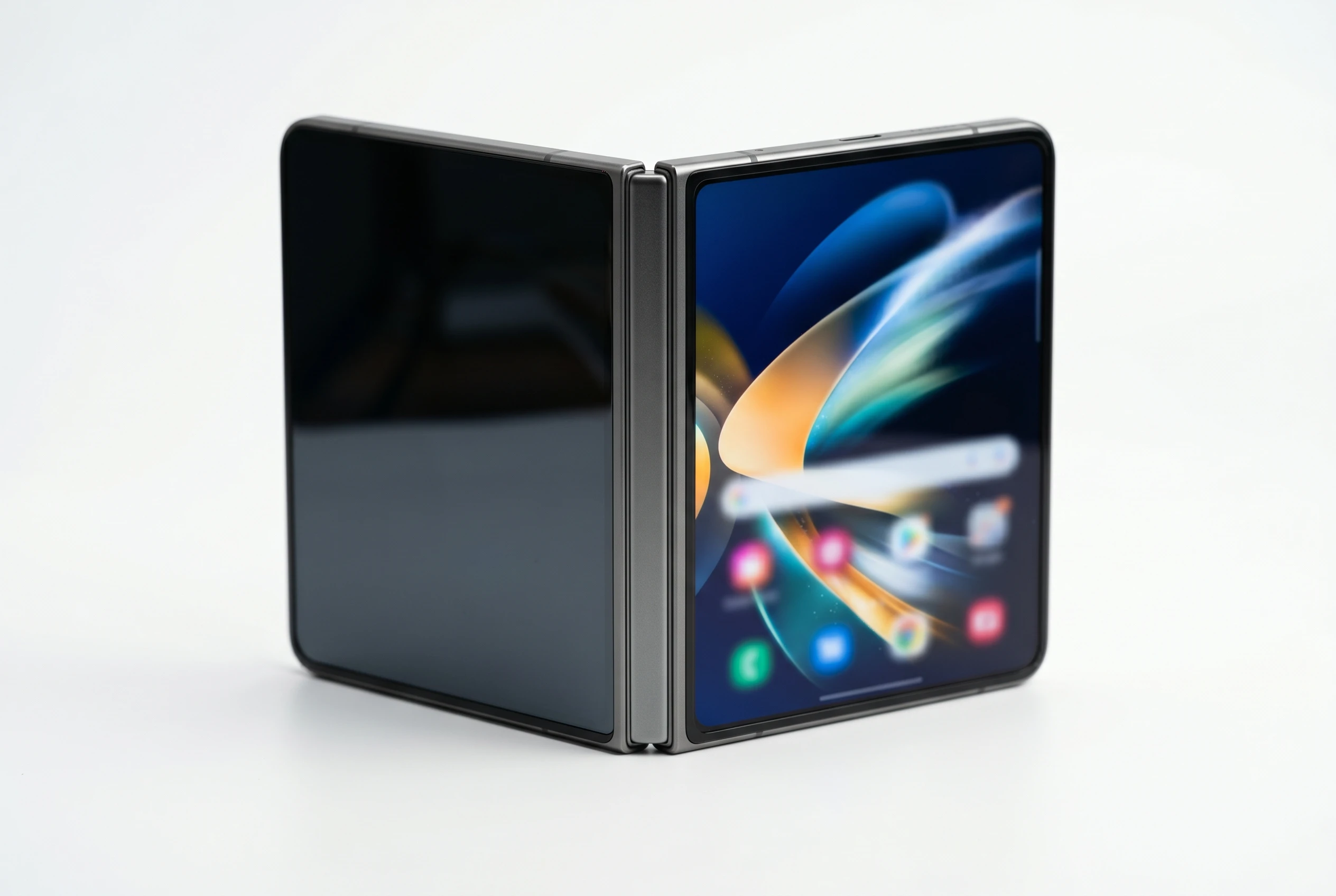
Samsung has quadrupled its Galaxy Z Fold 8 Wide production target, pushing it from an initial 500,000 units to 1.5-2 million, while cutting the Galaxy Z Flip 8’s allocation roughly in half and trimming the three-phone combined total, according to supply chain data reported by ZDNet Korea. The revision shows exactly where Samsung is placing its manufacturing bet heading into the most competitive foldable year the category has seen.
The Flip 7 delivered below expectations last year while the Fold 7 exceeded them, and the revised allocations reflect that performance gap. With Huawei already selling a wide fold in China and Apple’s first foldable iPhone targeting a September launch, Samsung has committed manufacturing capacity to the wide-body form factor at a scale that goes well beyond a cautious new-category test.
From 500,000 to 2 Million Units
The full picture from ZDNet Korea’s supply chain reporting shows a deliberate rebalancing across Samsung’s three-phone summer slate. An initial combined target of around 6.5 million units for all three phones has been trimmed to a 5-6 million range; the Wide Fold’s share of that total was the only allocation that grew. Samsung is expected to officially call the wide model simply the Galaxy Z Fold 8 at launch, while the tall-narrow Fold 7 successor takes the Galaxy Z Fold 8 Ultra designation.
| Phone | Original Target | Revised Target |
|---|---|---|
| Galaxy Z Fold 8 Wide | 500,000 | 1.5-2 million |
| Galaxy Z Flip 8 | 3 million | 1.5-2 million |
| Galaxy Z Fold 8 Ultra | approx. 3 million | 2.0-2.5 million |
An earlier signal came in May, when Korean outlet ETNews reported Samsung raised the Wide Fold’s three-month initial production allocation from roughly 100,000 units to 300,000, with components entering mass production as of March or April. The overall combined reduction has been attributed in part to persistent memory-crisis cost pressure that pushed up Samsung device prices across the premium lineup. 1.5 to 2 million is the annual number Samsung now has on order for the Wide Fold alone, and it is the only number in the three-phone slate that moved upward.
The Flip 8’s Shrinking Role
The Flip 8 revision tracks directly to the Flip 7’s 2025 performance. Samsung had set a combined target of around 6 million units for the Fold 7 and Flip 7 that year. The Flip 7 came in short; the Fold 7 beat its goal. Hana Securities, a Korean brokerage that monitors Samsung’s device volumes, reported that the Flip 6 and Fold 6 together reached roughly 4.9 million units over their first five months on sale, already a step down from the generation before them.
The clamshell category’s structural difficulties won’t resolve with a chip upgrade on the Flip 8. Motorola’s Razr line has been picking up ground on style and pricing, and Samsung’s Flip models haven’t carried a meaningful redesign across several cycles. Reports tracking the Fold 7’s outperformance against the Flip 7 and Flip 7 FE built steadily through the second half of 2025, and Samsung’s production decisions for 2026 confirm the direction. Industry reporting has suggested Samsung executives were internally reviewing the clamshell lineup’s long-term future. Nothing has been confirmed publicly, but cutting the Flip 8’s annual target from 3 million to the same 1.5-2 million range as the brand-new Wide Fold is not a number that signals confidence in the smaller phone.
The two phones target entirely different buyers. A wide-body fold that opens to a near-tablet display answers a different need than a clamshell that snaps shut into a jacket pocket. Their only shared resource is Samsung’s manufacturing bandwidth, and the revised targets show which side of that equation gets loaded first.
201 Grams and What Samsung Traded Away
How Samsung Built a Lighter Wide Fold
The 201-gram figure, posted on X by tipster Ice Universe with the full leaked spec set, is the weight Samsung wants in every comparison. At that weight, the Wide Fold undercuts the Galaxy S26 Ultra at 214 grams, the Galaxy Z Fold 7 at 215 grams, the Huawei Pura X Max at 229 grams, and Google’s Pixel 10 Pro XL at 232 grams, all on a chassis carrying two display panels and a mechanical hinge. The Galaxy Z Fold 8 Wide’s leaked spec sheet shows a phone unfolding at 4.5mm, with a 7.6-inch 4:3 inner display described in multiple leaks as near-crease-free, approaching the nearly invisible fold line Oppo achieved on the Find N6.
The 4,800mAh battery, 400mAh larger than the Fold 7’s cell and packed into a lighter frame, points to silicon-carbon battery chemistry as the most likely enabling factor. That chemistry delivers higher energy density than the conventional graphite-anode cells Samsung has used in most previous Fold models, allowing a bigger battery without a proportional weight penalty. Samsung hasn’t confirmed the chemistry. Achieving 201 grams on a wide-body foldable also likely required a titanium frame component, a redesigned hinge assembly, or thinner glass stacking on the inner panel; Samsung hasn’t detailed those engineering choices yet.
45W at Last, Minus Two Features
45W wired charging arrives after four consecutive Fold generations at 25W. Samsung held the Fold series at that ceiling through the Fold 4, 5, 6, and 7; at 25W, a 4,400mAh battery takes over 80 minutes to fill. On a 4,800mAh cell at 45W, Samsung’s comparable Galaxy S25 Ultra typically completes a full charge in 55-70 minutes, putting the Wide Fold in that performance window. The 45W spec extends to the Fold 8 Ultra as well, making it the first wired charging upgrade across the Fold lineup in four generations.
The camera setup: a new 50MP main sensor with native 24MP output mode, paired with an ultra-wide. The native 24MP mode matters practically. On current Fold devices, accessing that resolution requires downloading Samsung’s Camera Assistant module through Good Lock, the company’s modular customisation platform. The Wide Fold builds it in natively. The telephoto lens is absent.
Three features are off the Wide Fold’s current spec record:
- S Pen support is absent. The stylus that positioned previous Folds as productivity tools won’t ship with the Wide model.
- A privacy screen is not in the current leak record, a notable gap for a phone expected to see heavy commute and office use.
- A telephoto lens is gone, leaving a dual rear camera against the Fold 8 Ultra’s three-sensor arrangement.
Each cut helps compress weight and component cost while removing a differentiator that helped justify the Fold’s price premium over standard flagships.
Huawei Proved the Category First
Samsung enters a market Huawei opened. The Pura X Max, Huawei’s wide book-style foldable, launched in China in late April with a 7.6-inch 4:3 inner display at a starting price around $1,600. In its first five weeks on sale, it outsold the Mate X7 (Huawei’s prior flagship fold) according to Counterpoint Research, a data point analysts took as early category validation.
The early sales indicate that consumers are starting to find more practical uses for a wider inner display, especially for video, reading, document viewing, AI-assisted creation and multi-app tasks. For foldables, the next stage of competition will be less about whether the device folds and more about whether the larger screen creates daily value.
Liz Lee, Associate Director at Counterpoint Research, on the Pura X Max’s first-month commercial performance.
Samsung arrives with a weight advantage: 201 grams against the Pura X Max’s 229 grams, plus seven completed Fold-series generations of hinge and software refinement behind it. Huawei’s device is geographically limited to China and select markets where its hardware can reach retail. Samsung’s Wide Fold targets global distribution from launch, which is why the category’s broader trajectory matters directly to the bet: Counterpoint Research’s projection of 20 percent year-over-year foldable market growth in 2026 is a market Samsung is growing into, not just competing for share within.
Apple’s Calendar and Samsung’s Head Start
Apple’s first foldable iPhone, referred to in leaks as both the iPhone Fold and the iPhone Ultra, is targeting a September launch alongside the iPhone 18 Pro models. MacRumors’ comprehensive tracking of iPhone Fold supply chain reports has logged a production timeline slip from DigiTimes in April, which pushed the mass-production start from June to August. Bloomberg’s Mark Gurman maintained the device remains on schedule for a September reveal, though limited supply at launch is widely expected regardless of exact timing.
The competitive projections are pointed. Counterpoint Research estimated Apple will capture roughly 22 percent of global foldable shipments in its first full year and an estimated 46 percent of the North American regional market. North America has historically been among Samsung’s strongest Fold territories, and an Apple product backed by the iPhone brand represents a fundamentally different share threat than Huawei’s China-distributed phone. IDC’s separate forecast puts overall 2026 foldable category growth at roughly 30 percent, meaning the category is expanding precisely in the year both companies are releasing wide-body devices.
Samsung’s structural head start is calendar arithmetic. A July 22 Unpacked reveal in London and early-August retail availability puts the Wide Fold on shelves roughly six to eight weeks before Apple’s device, based on Apple’s supplier production timeline as it stands in June. That window covers first-party accessory availability, long-form review cycles, app optimization for the 4:3 inner display, and the retail shelf space a category’s first broadly available device tends to establish before the second one arrives.
July 22 Puts a Price on the Bet
One number is still absent from every spec sheet: the retail price. Samsung’s flagship pricing has been in active motion across the lineup. The Fold 7 launched at $1,799 in the US; the Fold 8 Ultra is expected to come in above that, partly because of memory-crisis cost increases running through the premium tier. Where the Wide Fold lands relative to the Ultra, and how that compares to Apple’s rumored starting point north of $2,000, is the arithmetic that determines whether Samsung’s production commitment fills on schedule or builds up in inventory.
There is a recent precedent worth keeping in mind. Samsung launched the Galaxy S25 Edge months ahead of Apple’s ultra-thin iPhone Air as a preemptive form-factor response to an anticipated competitor. Both phones reportedly generated weak sustained demand, and Samsung eventually cancelled the Galaxy S26 Edge. The Wide Fold has material engineering differences: its battery and charging specs are considerably stronger than the S25 Edge’s compromised design, and the 201-gram target suggests a longer development runway than the Edge reportedly had. The strategy of launching a competing form factor before Apple announces its version, however, carries a visible track record of its own that the production commitment alone cannot rewrite.
Samsung has reserved capacity for up to 2 million Wide Fold units; the price it prints in London on July 22 is the number that will tell us whether those slots fill.