France, Germany, Italy and the United Kingdom issued a joint statement on 7 August 2026 marking the 18th anniversary of Russia’s 2008 military action against Georgia, reaffirming full support for the country’s sovereignty and territorial integrity inside its internationally recognised borders while warning that recent steps in South Ossetia raise the risk of full-scale annexation that “will not go unanswered.”
The four foreign ministries described 7 August as another reminder of the grave consequences of Russian imperialism and noted that Russia continues to occupy Abkhazia and South Ossetia in violation of international law and the six-point ceasefire of 12 August 2008. The anniversary text binds four major European capitals to a single set of formulations on borders, militarisation and legal non-compliance, leaving little room for divergent national readings.
What the Four Capitals Said
The text, released simultaneously by the Italian, German, French and British foreign ministries, welcomes the Republic of Nauru’s decision to withdraw recognition of the self-proclaimed independence of Abkhazia and South Ossetia. It urges the remaining states that still maintain diplomatic ties with the two regions to follow that example.
August 7th is a date when we remember the grave consequences of Russian imperialism. On this day in 2008 the Russian Federation took military action against Georgia, further damaging Georgia’s territorial integrity by occupying the Georgian regions of Abkhazia and South Ossetia.
The spokespersons for the four governments issued the wording. They condemned Russia’s ongoing military presence and militarisation as a serious threat to Georgia’s security and to regional and European stability. The full joint statement text from Italy and the matching German Foreign Office release of the four-power text make the same points without variation.
- Reaffirmation of Georgia’s internationally recognised borders
- Welcome for Nauru’s withdrawal and call for others to follow
- Condemnation of Russian forces and militarisation
- Reference to the October 2025 European Court of Human Rights findings
- Explicit concern over the May 2026 alliance agreement and a Russian citizen heading South Ossetia
- Continued backing for the Geneva International Discussions and the EUMM
After Nauru’s step only four UN member states still recognise the two regions. The simultaneous release format itself signals coordination: each capital published identical language on the same day, underscoring that the warning on annexation is collective rather than a unilateral national position.
| Country | Status after July 2026 |
|---|---|
| Russia | Recognises both |
| Nicaragua | Recognises both |
| Venezuela | Recognises both |
| Syria | Recognises both |
| Nauru | Withdrew recognition and ended diplomatic ties |
Vanuatu and Tuvalu had already reversed earlier recognitions years before. The shrinking list leaves the two regions dependent on a narrow circle of patrons whose own international standing is limited, a fact the four powers highlight by urging the holdouts to reverse course.
The May Treaty and a Russian Acting President
The statement singles out the “Agreement on Deepening Alliance and Cooperation” signed in Moscow on 9 May 2026 between Vladimir Putin and then-de facto South Ossetian leader Alan Gagloev. The four governments call it a further violation of Georgia’s sovereignty and a clear breach of international law.
That document opened government and municipal posts in the region to Russian citizens. In June Gagloev resigned and took a post as adviser to Putin. Russian citizen Marat Kambolov, previously installed as prime minister, became acting president under local succession rules. Extraordinary presidential elections are set for 18 September 2026, with Kambolov among the candidates.
- 9 May 2026, Putin and Gagloev sign the deepening alliance treaty in the Kremlin.
- Late May-mid June 2026, Kambolov arrives as adviser then is named prime minister.
- 23 June 2026, Gagloev resigns; Kambolov becomes acting president and speaks of reunification with North Ossetia and Russia.
- 18 September 2026, Extraordinary presidential election scheduled.
Georgian officials and Western analysts have described the sequence as de-facto annexation steps. Opening administrative posts to Russian citizens creates a legal pathway for personnel integration that goes beyond earlier basing arrangements. Gagloev’s move from de facto leadership in Tskhinvali to an advisory role with Putin compresses the political distance between the two capitals. Kambolov’s dual status as Russian citizen and acting president, combined with public talk of reunification, supplies the personnel layer that matches the May treaty’s institutional opening.
The four powers state that a full-scale annexation would not go unanswered, though they give no concrete measures. The absence of listed sanctions or timelines leaves the deterrent effect dependent on how Moscow and Tskhinvali read the phrase when the September vote or any further integration step arrives.
Court Findings Russia Has Not Paid
The statement recalls the October 2025 European Court of Human Rights ruling in Georgia v. Russia (IV). The Court found Russia responsible for a pattern of violations in the occupied regions after the 2008 war, including excessive use of force, ill-treatment, unlawful detention and unlawful restrictions on movement across the administrative boundary lines.
- 253,018,000 euros awarded in non-pecuniary damages
- More than 29,000 individual victims covered
- Earlier 2024 merits judgment had already established the administrative practices
- Russia has stated it will not comply; enforcement remains with the Council of Europe Committee of Ministers for pre-2022 events
The four countries urge Russia to implement the judgments and to fulfil the commitments it made on 12 August and 8 September 2008. Payment has not occurred. The 2024 merits judgment first locked in the finding of administrative practices; the 2025 award translated that finding into a concrete sum covering more than 29,000 victims. Non-payment therefore sits against both a liability ruling and a quantified remedy, leaving the Committee of Ministers with an open enforcement file for the pre-2022 period while the underlying restrictions on movement continue on the ground.
Linking the ECHR record to the ceasefire dates of 2008 ties legal non-compliance to the original political undertakings. The joint statement treats the unpaid award and the unmet ceasefire points as parallel failures rather than separate tracks.
How Much Territory Remains Occupied
Russia recognised Abkhazia and South Ossetia as independent days after the five-day war ended in August 2008. It has maintained military bases and forces there ever since. Roughly one-fifth of Georgia’s internationally recognised territory stays under effective Russian control. The war itself killed more than 400 Georgian service members and civilians and displaced tens of thousands, many of whom have never returned.
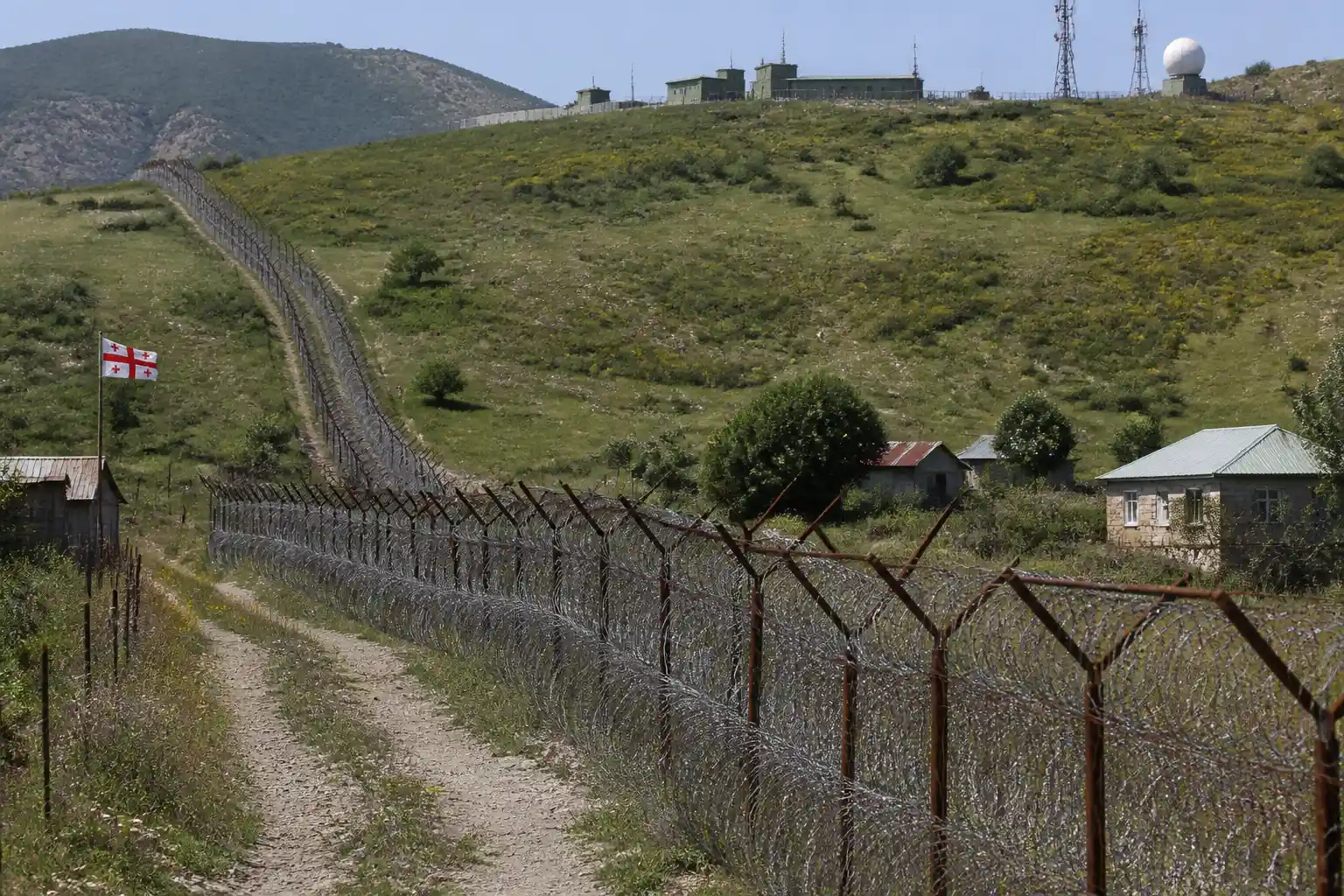
“Borderisation”, the progressive fencing and restriction of the administrative boundary lines, has continued for years, cutting farmers from land, families from relatives and children from Georgian-language schools. The ECHR judgments document that pattern in detail. Crowds on X this week repeatedly cast the 2008 occupation as an early warning that later appeared in Crimea and the full-scale invasion of Ukraine; the same principle of territorial integrity is at stake.
The one-fifth figure is not static in daily experience. Each new fence segment or crossing restriction converts a line on a map into a barrier that separates people from fields, relatives and schools. The Court’s findings on unlawful restrictions on movement give legal weight to what local communities have described for years. The parallel drawn on social media to later seizures elsewhere rests on that continuity of method: recognition of breakaway entities, permanent basing, and incremental hardening of administrative boundaries.
Geneva Talks and the Monitors Still on the Line
The four governments reaffirm support for the Geneva International Discussions, the only format that brings the parties together under EU, OSCE and UN co-chairs. They also praise the work of the European Union Monitoring Mission in Georgia and pledge continued backing for its role.
The unarmed civilian mission has patrolled areas adjacent to the administrative boundary lines since late 2008. Its priorities remain preventing a return to hostilities, helping local communities resume normal life, building confidence and reporting to Brussels. Regular Incident Prevention and Response Mechanism meetings continue; the 133rd took place in Ergneti in July 2026. Monitors still lack access inside the occupied regions themselves. The European Union Monitoring Mission patrols and mandate remain the sole international presence on the ground.
That access gap shapes what the mission can verify. Patrols and the Ergneti meetings cover the adjacent areas and incident reporting, yet the interior of Abkhazia and South Ossetia stays outside direct observation. The four powers’ continued backing therefore sustains the only standing international mechanism while acknowledging its geographic limit. Geneva remains the sole multilateral table; the EUMM remains the sole continuous presence. Both depend on political will that the anniversary statement seeks to renew.
Georgia’s Internal Pressure Adds Weight
The anniversary arrives while Tbilisi’s own politics complicate the Western message. Critics inside Georgia note that some domestic media downplayed the four-power language that named Russia the aggressor. At the same time, Russian legislative and influence tools continue to shape the environment for Georgian organisations and civil society. One recent example is the set of Russian legislative pressure on Georgian organizations that took effect earlier and tightened reporting and operational rules.
Western capitals keep issuing the same territorial-integrity formula they have used since 2008. Russia keeps adding legal and personnel layers that bring South Ossetia closer to direct incorporation. The new warning that annexation will not go unanswered is the sharpest phrase in this year’s text, yet it remains inside a familiar pattern of statements that have not reversed the occupation or forced compliance with the 2008 ceasefire or the ECHR awards.
Domestic downplaying of the aggressor language and external legislative pressure on Georgian organisations pull in the same direction: they soften the clarity the four powers try to project. The result is a dual track in which international statements harden in wording while the local information and civic space grows more constrained.
Nauru’s Exit Shrinks the Diplomatic Circle
Nauru’s withdrawal of recognition and the end of its diplomatic ties cut the list of UN member states that still treat Abkhazia and South Ossetia as independent to four: Russia, Nicaragua, Venezuela and Syria. Vanuatu and Tuvalu had already reversed course years earlier. The four-power statement treats each reversal as a precedent others should copy.
The remaining recognitions cluster among states already closely aligned with Moscow on other files. That concentration reduces the diplomatic utility of recognition itself. A claim of independence backed by four capitals, three of them under heavy sanctions or isolation, carries less weight than a broader roster would. The joint text’s call for the holdouts to follow Nauru therefore aims at the last thin layer of external validation.
- Russia remains the recognising power that also stations forces and signs alliance treaties
- Nicaragua, Venezuela and Syria supply the residual diplomatic cover
- Nauru’s exit, after earlier reversals by Vanuatu and Tuvalu, leaves no Pacific small-state recognisers
Without new recognitions, the legal and political case for separate statehood rests almost entirely on Russian sponsorship. The anniversary statement uses that narrowing to reinforce the message that the two regions lack genuine international standing.
September’s Vote Will Test the Warning
Extraordinary presidential elections in South Ossetia are set for 18 September 2026. Acting president Marat Kambolov, a Russian citizen installed after the May alliance treaty and Gagloev’s resignation, is among the candidates. His earlier public references to reunification with North Ossetia and Russia frame the ballot as more than a local leadership contest.
The four powers have already stated that full-scale annexation will not go unanswered. They have not listed the measures that would follow. The gap between the warning and any announced response leaves the next move to events on the ground and to whatever interpretation Moscow and Tskhinvali place on European resolve.
| Element | Status ahead of 18 September |
|---|---|
| Acting president | Russian citizen Marat Kambolov |
| Legal pathway | May 2026 alliance treaty opens posts to Russian citizens |
| Public framing | Reunification language already used |
| Four-power position | Annexation “will not go unanswered,” no measures named |
If the election consolidates a leadership openly committed to deeper integration, the statement’s sharpest phrase will face its first practical test. If further legal or administrative steps follow the vote, the same test sharpens. The historical cycle the closing lines invoke turns on whether words issued on an anniversary translate into costs when the calendar reaches mid-September.
The four powers have drawn a line in words. Whether that line holds when the September election in Tskhinvali or any further integration move arrives will test whether the historical cycle finally breaks.