The global red light therapy market hit $533.8 million in 2025, per the 2026-2033 red light therapy market forecast, and is on track to cross $1.13 billion by 2033. Cosmetic uses drive nearly 60% of that demand, and Asia-Pacific is the fastest-growing regional market. In India, the same treatment now lives in luxury hotel spas, premium gyms, dermatology chains, and the bathroom vanities of working makeup artists. The category has broken into settings that didn’t exist a decade ago, and the technology inside the box varies more than the marketing admits.
- $533.8 million: global red light therapy market value in 2025
- $1.13 billion: projected global value by 2033
- Nearly 60%: share of demand from cosmetic uses
- Asia-Pacific: fastest-growing regional market
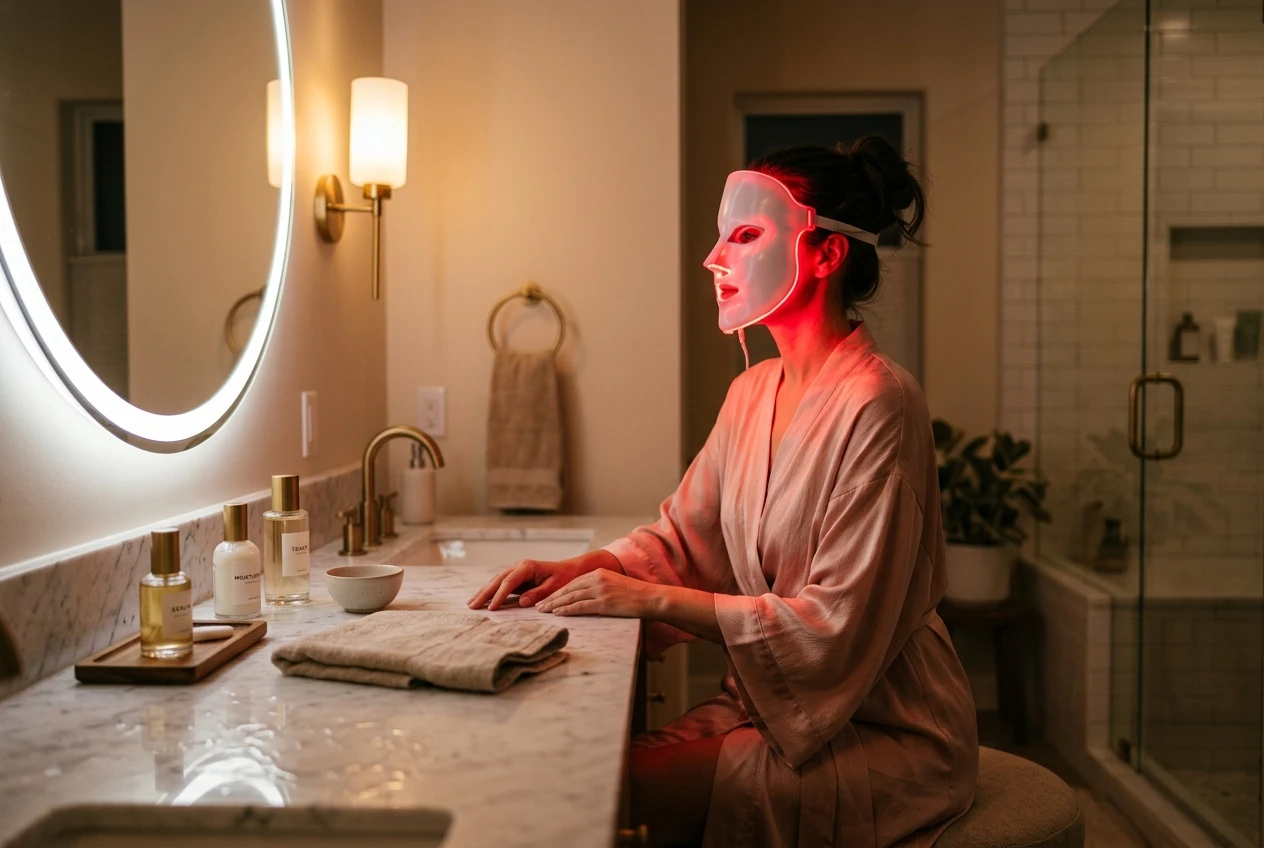
Indore-based makeup artist Shruti Sharma, 35, owns three red light devices at home: a Medicube AGE-R Booster for Rs 28,000, an LED eye mask for Rs 12,000, and a Numour smart gua sha for Rs 5,000. She started the search after months of seeing the sci-fi-looking masks on Instagram. She did not buy one. She bought three.
What Red and Near-Infrared Light Do to a Cell
At its core, red light therapy is a matter of wavelength, not mystique. The treatment uses red light at 630-700 nanometres and near-infrared light at 700-1,100 nm, neither of which tans or burns the way ultraviolet light does. Cells absorb those wavelengths through a process called photobiomodulation. Inside the cell, the light is taken up by the mitochondria, the organelle often called the cell’s powerhouse, where it appears to boost production of adenosine triphosphate, the molecule the body runs on for energy. The hypothesis is that those wavelengths raise cellular energy output enough to support collagen synthesis, calm inflammation, and speed tissue repair.
Research has linked red light therapy to collagen production, inflammation control, wound healing, and post-exercise muscle recovery, with the strongest case in skin ageing, mild inflammatory acne, and post-procedure wound healing. Plastic and cosmetic surgeon Dr Vashisht Dikshit of Gleneagles Hospital, Parel, Mumbai, notes that the science predates the social media buzz. NASA-sponsored research from the 1990s found specific wavelengths of red and near-infrared light stimulating cell growth and tissue repair, as detailed in the 2001 NASA-backed LED wound-healing study. A peer-reviewed paper at PubMed confirmed the underlying finding, reporting that LEDs developed for NASA plant growth in space also raised cell growth in animal and human tissue cultures.
Inside a clinical setting, those parameters (wavelength, dose, irradiance) are calibrated to a level a home device rarely matches. Dr Srishti Mohapatra, internal medicine consultant and head of research and development at The Wellness Co, ties the recent acceleration to clinical research, elite sports, the biohacking community and celebrity endorsements. Dr Jamuna Pai, founder of SkinLab, frames the surge as a perfect storm: the longevity and biohacking movement that has made consumers obsessed with cellular health, the post-pandemic habit of running clinical work at home, and the way celebrity and social media endorsements have demystified the technology. None of those forces, however, says anything about whether the device in your bathroom is delivering a clinically validated dose.
Hotels, Gyms and the New Wellness Stack
The category has escaped the clinic in three directions. At the top end, luxury hotels are folding red light into their wellness floors. Fairmont Mumbai introduced the therapy at Blu Xone, its longevity-focused wellness hub, last year, and a 25-minute session runs Rs 4,500 there.
The Wellness Co, a chain of wellness clinics, charges Rs 7,000 to Rs 10,000 a session depending on the treatment plan. Its clientele ranges from office-goers dealing with stress and fatigue to athletes, rehabilitation patients, and those focused on healthy ageing. Premium gyms have begun folding red light into the recovery offering. Drive FITT, a sports and fitness club in Gurgaon, has built a recovery layer onto its cricket and fitness programming. Cofounder Vikram Aditya Bhatia frames the shift as the wellness industry moving from training harder to sustaining peak performance.
Recovery has moved from the fringe to the mainstream of wellness and performance.
Bhatia, who cofounded Drive FITT, offered the framing in an interview. At Fairmont, hotel director of spa, wellness and recreation Dr Rashmi Ambastha has watched red light therapy become one of the property’s most sought-after treatments.
Ambastha described guests using red light therapy as part of a preventive routine, before skin concerns surface, a pattern she ties to longevity-focused healthcare. With clinics, gyms and hotel spas now legitimate delivery channels, the calibration behind the dose is what separates one setting from another. The at-home segment is the price spread, where devices sit on a spectrum from a Numour gua sha at Rs 5,000 to a Medicube AGE-R Booster at Rs 28,000.
What an At-Home Buyer Should Actually Check
Mumbai-based Bhawani Jha has already added a Noctix mask worth Rs 19,000 to her shopping cart. She had been using Numour’s collagen cream, which comes with a small red light device built in, and felt her skin looked better after. That was enough for her to start researching how much irradiance her next device should deliver so that the light could actually penetrate her skin. Her instinct is the right one, several dermatologists say, because the strength of the at-home market rests on whether the device on your counter has been built to clinical parameters or simply resembles one. The same cosmeceuticals trend is now rubbing up against the medical-grade device market, and doctors’ advice is to keep the two separate.
Dr Ankur Sarin, dermatologist and founder of Sarin Skin Clinic in Delhi, has watched enquiry numbers climb sharply in his practice. Patients arrive carrying online shopping links and asking which device to buy. His checklist for choosing a home device has three lines he repeats each time (per Dr Ankur Sarin’s clinic and checklist):
- Specific wavelengths listed in the spec sheet, including 630-660 nm for red light and 810-880 nm for near-infrared light.
- FDA clearance for the device as sold, not just for the component LEDs.
- A CE mark, the European conformity certification.
Sarin’s view on the new generation of hybrid products is blunt: there is little evidence that creams with built-in lights are as effective as medical-grade devices. Dr Varshini Reddy, chief dermatologist and founder of Glow Clinic, broadens the point: a gadget cannot be mistaken for the treatment, and medical-grade devices win because they deliver clinically validated parameters.
Where the Evidence Stops, and Who Should Sit Out
The strongest case for red light therapy has been documented in skin ageing, mild inflammatory acne, and post-procedure wound healing. Sarin is direct: there are no studies to validate the claim that red light therapy helps with pigmentation, ageing, or rosacea. That is the ceiling of what a consumer should expect, several doctors said.
Hair growth is the second well-documented application. Reddy routinely uses red light therapy alongside microneedling and mesotherapy to stimulate hair follicles, and credits consistency for the results she sees in her practice. Recovery from exercise is another area where the evidence has built up, though clinical and home devices again differ on calibrated dose. For everything outside those lanes, the marketing is louder than the published research.
- People with photosensitive conditions such as lupus
- Those taking photosensitising medications
- Individuals with suspicious skin lesions or skin cancer
- Those prone to heat-induced hyperpigmentation
- Anyone pregnant (use is not recommended)
- Direct eye exposure without proper protection
Sarin laid out the at-risk list in his clinic, citing each contraindication without nuance. Use during pregnancy is also not recommended, he said. Direct eye exposure should be avoided. Beyond the safety list, the bigger issue for Sarin is expectation rather than risk; patients arrive believing the therapy can replace proven medical treatments. Dikshit has watched the same pattern at his Gleneagles practice in Parel, Mumbai: patients ask about red light therapy in growing numbers, which makes it important to separate evidence-based benefits from exaggerated marketing claims.
SkinLab founder Dr Jamuna Pai treats the trend the same way: her advice to anyone arriving with a link to a shopping cart is that red light works as a supportive tool for maintenance, alongside a proper skincare routine and clinical treatments. Across clinic, hotel, gym and home, the prices diverge sharply.
What a Session Costs in India
Pricing for red light therapy in India runs from Rs 4,500 for a hotel spa session to Rs 28,000 for a top-of-line home mask, with clinical plans in the middle. At the top of the clinical range, The Wellness Co charges Rs 7,000 to Rs 10,000 per treatment, depending on the plan. A 25-minute session at Fairmont Mumbai’s Blu Xone runs Rs 4,500. Home devices, by contrast, are one-time purchases that can sit below the spa price or above the clinical plan, depending on the model.
| Setting | Product / Session | Price |
|---|---|---|
| Clinic | The Wellness Co (treatment plan) | Rs 7,000 to Rs 10,000 |
| Hotel spa | Fairmont Mumbai Blu Xone (25-minute session) | Rs 4,500 |
| Home | Medicube AGE-R Booster | Rs 28,000 |
| Home | Noctix mask | Rs 19,000 |
| Home | LED eye mask | Rs 12,000 |
| Home | Numour smart gua sha | Rs 5,000 |
For home buyers in that band, the checklist from the previous section reads directly off this table. For doctors, the same spread shows up in the consultation queue. Pai and Sarin both report an influx of patients arriving with the same artefact: an online shopping link saved on their phone. Pai’s standing advice to those patients is that red light works as a supportive tool for maintenance, alongside a proper skincare routine and clinical treatments. Grand View Research forecasts the category to cross $1.13 billion by 2033, with cosmetic uses driving the demand.
Frequently Asked Questions
What is red light therapy, in plain terms?
Red light therapy shines two wavelengths of light on the skin: red light at 630-700 nanometres and near-infrared at 700-1,100 nm. Cells take up those wavelengths via mitochondria in a process called photobiomodulation, where light energy appears to raise production of adenosine triphosphate, the molecule the body uses for fuel. Unlike ultraviolet light, the therapy does not tan or burn the skin. It now shows up in dermatology clinics, hotel spas, gyms, and home LED masks.
How much does red light therapy cost in India?
A 25-minute session at Fairmont Mumbai’s Blu Xone hotel spa costs Rs 4,500, and clinical plans at The Wellness Co run Rs 7,000 to Rs 10,000. Home devices sit on a wider band: a Numour smart gua sha at Rs 5,000, an LED eye mask at Rs 12,000, a Noctix mask at Rs 19,000, and a Medicube AGE-R Booster at Rs 28,000.
What should I look for in a home red light device?
Wavelengths, FDA clearance, and a CE mark are the three checkpoints Dr Sarin of Sarin Skin Clinic in Delhi asks home buyers to verify before any purchase, looking for 630-660 nm for red light and 810-880 nm for near-infrared light in the spec sheet, FDA clearance for the device as sold, and a CE mark. Buyers should also confirm irradiance (the measure of how much light energy actually reaches the skin) and steer away from creams with small built-in lights, which Dr Sarin says have little evidence behind them.
Is red light therapy safe for everyone?
No. Red light therapy is not safe for everyone. The contraindications spelled out by Dr Sarin include lupus, photosensitising medications, suspicious skin lesions or skin cancer, and a tendency toward heat-induced hyperpigmentation. Pregnant people are also advised to avoid the treatment, and direct eye exposure should be prevented as well.
Is red light therapy actually proven to work?
On the proven side, red light therapy helps with skin ageing, mild inflammatory acne, wound healing, and post-procedure recovery. It is also used alongside microneedling and mesotherapy to stimulate hair growth. Dr Sarin is direct that there are no published studies supporting claims for pigmentation, ageing, or rosacea. Most dermatologists interviewed treat the modality as supportive maintenance rather than a substitute for clinical care.
Does red light therapy actually have NASA backing?
Yes. Whelan and colleagues at NASA’s Marshall Space Flight Center published a study in the Journal of Clinical Laser Medicine & Surgery in 2001 reporting that LEDs developed for plant growth in space stimulated cell growth and tissue repair in animal and human tissue cultures. That work predates the current social-media-fueled wellness boom by decades.
Disclaimer: This article is for informational purposes only and is not a substitute for professional medical advice. Always consult a qualified dermatologist or healthcare provider before starting red light therapy, especially if you are pregnant, take medication, or have a medical condition. Figures and product prices are accurate as of publication.