A Bengaluru-based yoga guru outlines a daily routine of five yoga poses for immunity during malaria season, with the five asanas and one breathing drill folded into a sequence a beginner can complete at home. The routine comes from Himalayan Siddhaa Akshar, founder of Akshar Yoga Kendraa, and was published in an interview with TheHealthSite.
Akshar’s recommendations are layered on top of standard prevention, not in place of them. The World Health Organization reported in the World Malaria Report 2024 that 83 malaria-endemic countries remained in its global count, and standard travel-medicine guidance still points to repellents, treated nets and prophylactic drugs as the frontline defenses.
A Bengaluru Yoga Guru’s Five Poses for Malaria Season
A short, named routine is on the table as a complementary practice during malaria season rather than a medical intervention. Akshar’s recommendations center on standing and floor-based asanas plus a single pranayama drill, all drawn from classical yoga and folded into a sequence a beginner can complete at home. The recommendations stop short of any claim about preventing malaria.
In the routine Akshar laid out for malaria-season immunity, the routine is presented as a daily support for circulation, lung expansion and stress reduction, with each pose carrying its own explicit cautions. It is not pitched as a barrier against malaria. Akshar closes the published interview by summarizing the case in plain terms: people can make a good step toward their own health and inner balance by spending a few conscious minutes a day on the routine. Each pose in the published interview carries specific foot placement, breath timing and a ‘what to keep in mind’ note for the practitioner.
Medical care and hygiene is important, but yoga provides a natural and supportive means of strengthening the body internally.
Meet the Guru Behind the Routine
Akshar is the founder and chairman of Akshar Yoga Kendraa, headquartered in Bengaluru. The institution is accredited by India’s Ministry of Ayush under the Yoga Certification Board in the yoga institution category, a credential that places it inside India’s formal regulatory framework for yoga training.
Akshar’s organization has set multiple Guinness World Records for mass participation in yoga asanas. The August 2022 record was for the most people performing Dhanurasana (Bow Pose) simultaneously, and the February 2023 Mandala Yoga Festival in Bengaluru produced three further records for synchronized Vashishtasana (Side Plank), Ushtrasana (Camel Pose) and Halasana.
According to his biography and the Bengaluru institution he leads, Akshar also serves as president of the World Yoga Organisation and the International Siddha Foundation, organizations he established to promote yoga and Siddha practices globally. He has published two books, The Science of Mudras (2022) and Yoga Namaskar (2019), and has spoken at TEDx events on themes including thought patterns and decision making. His TEDx talk, titled ‘Your Thoughts Are Your Leader,’ was delivered in March 2021. His published work on TheHealthSite spans immunity, thyroid, sleep, hypertension and liver health, and his name has been linked in coverage to training sessions with Indian cricketer Sunil Gavaskar and Australian cricketer Matthew Hayden. Five more records followed in June 2024 during International Yoga Day celebrations, covering Naukasana, Koundinyasana, Chakrasana, Natarajasana and Surya Namaskar.
How Tadasana and Vrikshasana Open the Practice
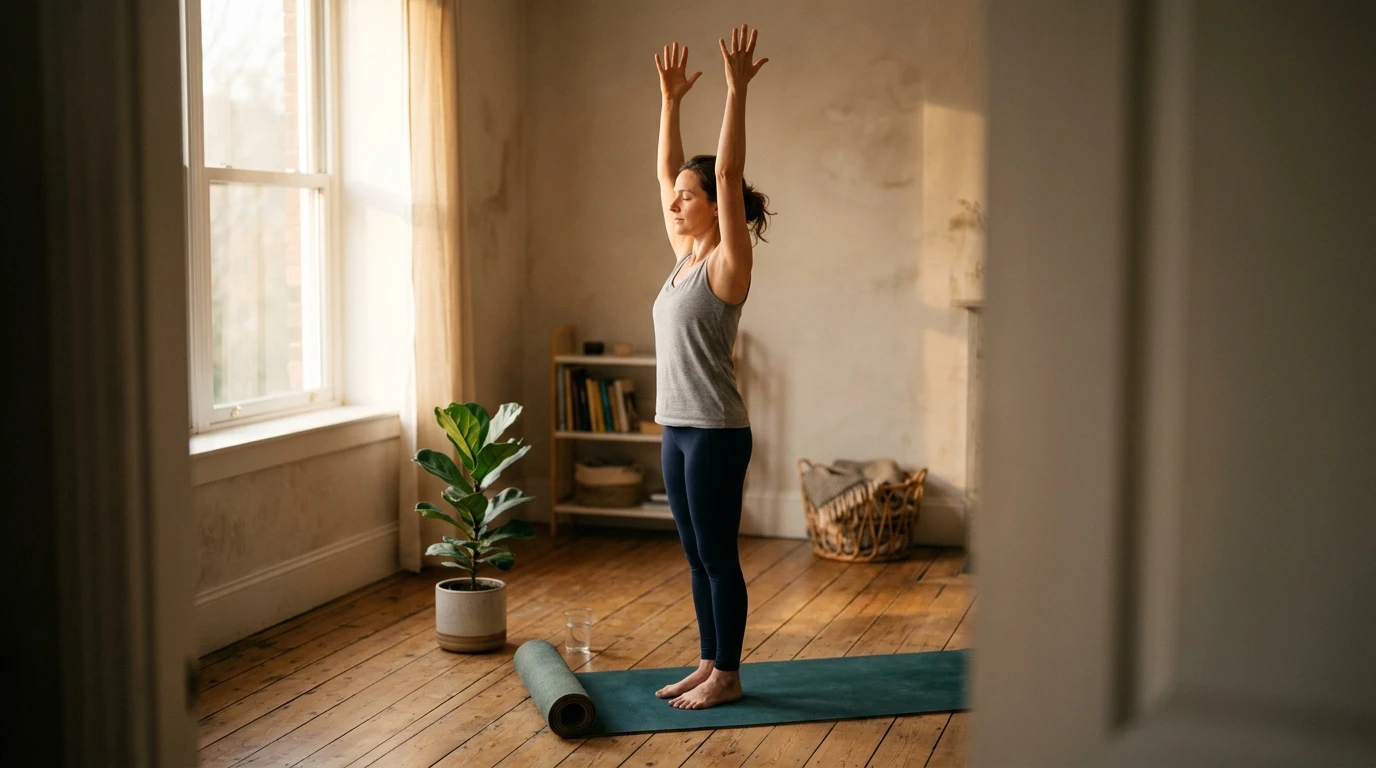
The sequence begins standing with Tadasana and Vrikshasana, two poses built around balance, alignment and breath. In Tadasana (Mountain Pose), the practitioner stands with feet together and arms at the side, then lifts the arms overhead on the inhale while lengthening the spine. Akshar ties the pose to improved blood flow, expanded lung capacity and a sense of stability that, in his framing, supports overall immunity.
Vrikshasana (Tree Pose) follows: one foot rests against the inner thigh or calf (never on the knee joint itself), with the hands meeting at the chest or rising overhead. Akshar credits the pose with stronger legs, sharper focus and a calmer mind, three changes he presents as preconditions for the body to handle seasonal infection. The cautions are the same as for Tadasana: balance the pose steadily without pushing, breathe continuously, and reach for support when needed. Both standing poses share the same downstream claim: their target is stability and circulation, and they sit at the start of a sequence that progresses from balance work to chest opening and finally to the breath. Beginners can use a wall for support in either pose, which is part of why Akshar’s interview specifies them as entry-level asanas.
| Pose | What Akshar Says It Targets | What to Watch |
|---|---|---|
| Tadasana (Mountain Pose) | Balance, posture, blood flow, lung expansion | Do not lock the knees; beginners can use a wall |
| Vrikshasana (Tree Pose) | Leg strength, focus, mental calm | Foot off the knee joint; do not push past a steady hold |
| Bhujangasana (Cobra Pose) | Chest opening, lung capacity, circulation | No strain in the lower back; elbows slightly bent |
| Setu Bandhasana (Bridge Pose) | Circulation, back strength, organ activation | Lift hips without strain; do not rotate the neck |
| Anulom Vilom (Alternate Nostril Breathing) | Nervous system balance, oxygen flow, stress reduction | Breathe slowly; keep the spine straight; choose a quiet place |
Bhujangasana and Setu Bandhasana Move the Sequence to the Floor
From standing, the practice moves to the mat. In Bhujangasana (Cobra Pose), the practitioner lies prone with palms at chest level and lifts the chest on the inhale while the lower body stays grounded. Akshar ties this directly to seasonal illness, writing that the pose opens the chest and expands lung capacity in ways that are significant during seasonal infections.
Setu Bandhasana (Bridge Pose) is the next step: lie on the back, draw the knees up, plant the feet near the hips and lift into a bridge shape on the inhale. Akshar lists enhanced blood circulation, stronger back muscles, internal organ activation and reduced stress and fatigue among the effects, alongside immune support. The cautions for both floor poses are largely the same and are spelled out in the published interview.
In Bridge Pose, lift the hips without difficulty, do not rotate the head once in position, and people with neck issues should approach the pose carefully or skip it. The shift from standing to the floor is the central hinge of the sequence. The floor work is where the lung-and-chest claims become most direct.
The Breathing Practice That Closes the Sequence
The routine finishes with Anulom Vilom pranayama, or alternate nostril breathing. The practitioner sits upright with a straight spine, closes one nostril at a time and breathes slowly through the other in a measured rhythm. Akshar describes the effect as harmonizing the nervous system, raising oxygen circulation and reducing stress, three mechanisms he ties to immune support. The cautions are simple and explicit: breathe naturally without hurrying, keep the spine straight, keep the mind steady and find a quiet, stress-free place.
Anulom Vilom is also the most-researched piece of the routine, with multiple studies of alternate nostril breathing in adjacent peer-reviewed journals pointing to measurable physiological effects over multi-week practice periods. Even where direct trials on malaria outcomes do not exist, the breathing work is the best-evidenced part of the sequence. There is no equipment needed for any of it, which is part of why the drill fits into a routine of a few conscious minutes a day.
What Standard Malaria Prevention Already Covers
Akshar’s framing is explicit on this point. Yoga is offered as a complement to medical care and hygiene, not a substitute. The standard reference for travel-medicine malaria guidance lists the frontline defenses: applying topical repellent, sleeping under an insecticide-treated mosquito net and wearing protective clothing such as long pants, socks and long-sleeve shirts. These measures are aimed at keeping the mosquito bite from happening in the first place.
For travelers to endemic areas, the same source outlines prophylaxis options whose choice depends on destination, length of trip and the resistance profile of local Plasmodium species. None of those frontline measures appear in Akshar’s yoga routine. What the routine adds, in Akshar’s framing, is a quiet daily support layer that sits on top of standard prevention.
- 83 malaria-endemic countries reported by WHO in the World Malaria Report 2024.
- 5 asanas and 1 breathing drill in Akshar’s recommended routine.
- 3 mechanisms most often cited for yoga’s immune effect: reduced cortisol, better sleep, and improved circulation.
What the Evidence on Yoga and Immunity Actually Says
The case for yoga rests on indirect effects. According to the NIH-cited summary of yoga’s evidence base, scientific evidence supports yoga for stress management, mental health, mindfulness, healthy eating, weight loss and quality sleep. Sleep and stress are themselves variables in how the immune system functions day to day.
A separate practitioner-focused summary walks through the proposed mechanisms: reduced cortisol, better circulation, improved lymph flow, stronger lung function through pranayama and increased oxygen supply. Both mechanisms are documented in adjacent research, even where direct trials on yoga and malaria outcomes do not exist.
The strongest evidence sits at the breathing end of the routine. Multiple studies of alternate nostril breathing in adjacent peer-reviewed journals have reported measurable physiological effects on cardiovascular and nervous system markers over multi-week practice periods. Those studies support Anulom Vilom’s place in the routine without ever claiming that the breath, on its own, prevents malaria. The same is true of the four asanas: the published mechanisms are stress reduction, lung expansion and circulation, each a known contributor to general immune resilience, with no direct antimalarial claim attached.
The honest framing is that yoga supports the body’s terrain. It does not repel the mosquito, kill the parasite or replace prophylaxis in endemic regions, yet it offers a daily routine with plausible effects on the stress, sleep and circulation pathways mainstream immunity research also flags. Standard travel-medicine guidance does not list yoga as a prevention tool, which leaves readers to weigh the routine on its own terms.
- Cortisol reduction through breathwork and slow movement
- Improved lymphatic circulation through gentle movement and position changes
- Better sleep onset and quality through evening practice
- Stronger respiratory muscle tone through pranayama
- Lower systemic inflammation through regular, low-intensity practice
Frequently Asked Questions
Can yoga actually prevent malaria?
No. Yoga does not prevent malaria. Standard prevention relies on repellent, treated bed nets, protective clothing and, where prescribed, antimalarial prophylaxis, the same measures the CDC Yellow Book lists as frontline. Akshar’s routine is presented as a complementary practice that supports general immunity, not as a substitute.
How long does Akshar’s routine take each day?
In the original interview, Akshar says readers can spend a few conscious minutes a day on the routine. The five poses and one breathing drill are designed to fold into a morning or evening routine at the reader’s own pace, with no equipment required.
Are these poses safe for beginners?
Yes for most healthy adults, with the cautions Akshar lists in the published interview. Use a wall for balance work in Tadasana and Vrikshasana, keep a slight bend in the elbows for Cobra, and skip Bridge if you have neck problems. A short consultation with a clinician is a sensible first step for anyone with an existing medical condition.
Who is Himalayan Siddhaa Akshar?
Akshar is an Indian yoga guru, author and columnist who founded Akshar Yoga Kendraa in Bengaluru. The institution is accredited by India’s Ministry of Ayush, and Akshar’s organization has set multiple Guinness World Records for mass participation in yoga asanas. He also serves as president of the World Yoga Organisation and the International Siddha Foundation.
Where does this advice sit next to vaccines and prophylaxis?
Yoga is layered on top, not below. Malaria vaccines, where available, and standard prophylactic drugs remain the medical tools that target the parasite. Akshar’s routine is a daily practice with no such claim, a quiet support layer rather than a replacement for the medical standard of care.
Disclaimer: This article is for informational purposes only and does not constitute medical advice. Yoga is not a substitute for malaria prophylaxis, vaccination or standard prevention measures in endemic regions. Figures and recommendations are accurate as of publication. Consult a qualified healthcare professional before beginning any new exercise routine, especially during illness, pregnancy or recovery.