Saudi Arabia has granted Acwa an exclusive mandate to export the kingdom’s green hydrogen and its derivatives to international markets, in a move that places a single state-backed developer at the centre of Riyadh’s clean-energy export push. The approval, confirmed through a Saudi bourse filing, gives Acwa the exclusive right to ship green hydrogen, green ammonia, green methanol, green methane and other green fuels produced in the Kingdom to buyers in Europe, Asia and beyond.
The same approval also tasks Acwa with developing projects to produce, transmit and export electricity generated from renewable sources to European and Arab markets, opening a parallel electron-export track alongside the molecule trade. The mandate is framed by the company and the government as a cornerstone of Saudi Arabia’s Vision 2030 diversification plan, designed to convert the kingdom’s solar irradiance and land mass into a new line of low-carbon exports.
Saudi Arabia Grants Acwa Exclusive Mandate to Export Green Hydrogen
The scope of the approval is broader than a simple export licence. According to the filing, the exclusivity covers every derivative that can be made from green hydrogen, and it pairs with a separate mandate to develop renewable-power export corridors. Acwa is now the only Saudi entity licensed to ship these products overseas, a position the company says reflects “the Kingdom’s confidence in Acwa’s ability to deliver strategic infrastructure at scale.”
Acwa’s footprint that the mandate sits on top of is already sizeable. The company lists 111 assets across 16 countries, $125.0 billion of assets under management, 98.0 GW of generation capacity and roughly 53% of that capacity drawn from renewables on its current homepage. The mandate turns that platform into a sovereign export channel rather than a portfolio of bilateral projects. The most recent quarterly snapshot, the company Q1 2026 results release, put assets under management at SAR 455 billion against SAR 381 billion a year earlier.
The Two Plants That Have to Deliver
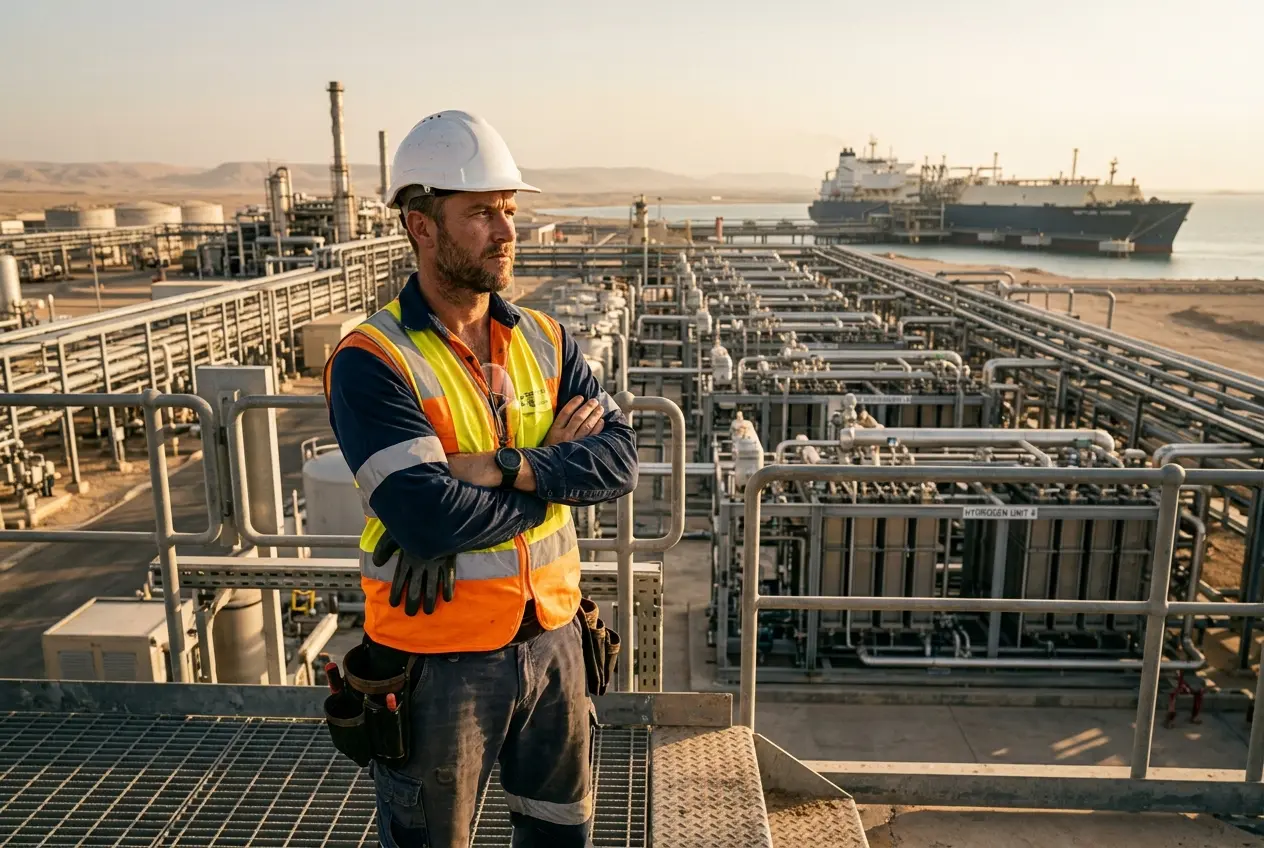
Production for the new export channel rests on two flagship schemes, both developed by Acwa. The first is the NEOM Green Hydrogen Company, an equal joint venture between Acwa, Air Products and NEOM. As described on the NEOM project page, the facility will draw on a combined 4 GW of renewable power, 2.2 GW of solar and 1.6 GW from 257 wind turbines, to produce up to 600 tonnes of carbon-free hydrogen a day, equivalent to roughly 1.2 million tonnes of green ammonia a year for export through a dedicated jetty at Oxagon.
The project’s economics are anchored by an $8.4 billion project cost, financed in 2023 through $6.1 billion of non-recourse debt from 23 banks and equal equity contributions from the three partners. Air Products is the exclusive off-taker of the green ammonia and acts as primary EPC contractor, meaning the offtake structure is locked before the first molecule ships. As of this year, construction is in final completion and commissioning has started with energization, per Air Products’ description of the NEOM complex, with first product now expected in 2027 rather than the 2026 timeline floated in earlier guidance.
The second scheme is the Yanbu Green Hydrogen Hub, a co-development with Germany’s EnBW that Acwa announced alongside the July 2025 India-Middle East-Europe Economic Corridor workshop. The Yanbu facility is planned as a fully integrated site with captive renewable generation, desalination, electrolysis and ammonia conversion, plus a dedicated export terminal, with commercial operations targeted for 2030.
How the Two Saudi Flagship Hydrogen Schemes Compare
| Project | NEOM Green Hydrogen Company | Yanbu Green Hydrogen Hub |
|---|---|---|
| Partners | Acwa, Air Products, NEOM (equal JV) | Acwa, EnBW (Energie Baden-Württemberg) |
| Target output | Up to 600 tonnes/day hydrogen; up to 1.2 million tonnes/year green ammonia | Captive renewables, desalination, electrolysis, export terminal |
| Renewable input | 4 GW (2.2 GW solar, 1.6 GW wind) | Captive renewable generation at the site |
| Project cost | US$8,500 million | Not stated in the announcement |
| Commercial operations | First product 2027 | Targeted 2030 |
Why One Company Got the Keys
The choice of Acwa reflects two decades of project delivery rather than a fresh political appointment. The company was founded in 2004 as a Saudi private-sector utility, was reorganised in 2008, and built an international portfolio that includes concentrated solar plants in Morocco and South Africa, the world’s largest reverse osmosis desalination facility in Abu Dhabi, and utility-scale wind and solar projects from Uzbekistan to Egypt. The Public Investment Fund has progressively lifted its stake in the company to 44.2% since 2018, making Acwa a PIF-controlled vehicle for the kingdom’s energy bets.
The desalination track record matters specifically for green hydrogen. Electrolysers need large volumes of deionised water, and scaling hydrogen output in an arid climate is inseparable from scaling water treatment capacity. Acwa already runs the world’s largest private water desalination operation. CEO Dr. Samir J. Serhan, in the bourse filing, framed the mandate as a trust placed in that execution track record.
This government approval reflects the Kingdom’s confidence in Acwa’s ability to deliver strategic infrastructure at scale and reinforces our responsibility to help position Saudi Arabia as a leading global exporter of clean energy.
Serhan added that “green hydrogen and renewable electricity exports represent the next chapter in the Kingdom’s energy leadership, creating new opportunities for economic growth while contributing to global energy security and the energy transition,” according to the company’s bourse filing. Acwa also said it would disclose any material developments and the financial impact of the approval in accordance with Saudi listing rules.
The Export Corridors Already Wired Up
The mandate does not arrive into an empty commercial pipeline. Acwa has spent the past 12 months signing the European end of the corridor that the new licence is designed to feed. The fastest read on that groundwork is the sequence of agreements already on the company’s books.
The list now runs as follows:
- July 2025: At a workshop in Riyadh chaired by Energy Minister Prince Abdulaziz bin Salman, Acwa signed a multi-party MoU with Italy’s Edison, France’s TotalEnergies Renewables, Italy’s Zhero Europe and Germany’s EnBW to assess demand and feasibility for large-scale renewable energy projects dedicated for export from Saudi Arabia to Europe. That same workshop produced a Joint Development Agreement with EnBW on the first phase of the Yanbu hub, per the IMEC workshop announcement.
- February 2026: Acwa signed a Green Ammonia Corridor MoU with EnBW to formalise export pathways from Saudi Arabia to Germany, building on the Yanbu collaboration.
- May 2026: Acwa reported Q1 2026 results, with AUM at SAR 455 billion, 95.7 GW of gross power capacity, 52.3 GW of renewable capacity and net profit of SAR 345 million. The company also improved its MSCI ESG rating to A on 13 May 2026.
- July 2026: The Saudi government granted Acwa exclusive export rights for green hydrogen, its derivatives, and renewable electricity to European and Arab markets.
Acwa’s $125 Billion Balance Sheet and Q1 Numbers
The licence lands on top of a balance sheet that has roughly doubled in five years. The company’s homepage now lists $125.0 billion of assets under management, 111 assets, 16 countries and 53% of generation capacity from renewables. Generation capacity has reached 98.0 GW across the portfolio, water desalination capacity stands at 9.7 million cubic metres per day, and the company employs more than 4,000 people in 13 offices.
The Q1 2026 numbers give a cleaner read on the operating engine. Assets under management rose to SAR 455 billion from SAR 381 billion a year earlier, gross power capacity climbed to 95.7 GW including 52.3 GW of renewable capacity, and water desalination capacity reached 9.7 million cubic metres per day. Net profit attributable to shareholders was SAR 345 million, down from SAR 427 million in Q1 2025; chief financial officer Abdulhameed Al Muhaidib attributed the drop to “cyclical fluctuation” from a slower start to development activities.
Operationally, power plant availability ran at 89% and water desalination availability at 99%, with year-to-date 38.5 million man-hours across operations and construction and a lost-time injury rate of 0.01. Two commercial operation dates were achieved in the quarter, adding 0.77 GWh of battery storage and 0.6 million cubic metres per day of desalination capacity. Acwa also secured its first greenfield project in Kuwait during the quarter, with 2.7 GW of power generation and 0.6 million cubic metres per day of desalinated water, and reached financial close on the Nukus 2 wind project in Uzbekistan at SAR 1 billion.
What the Mandate Does Not Solve
An export licence is a permission, not a molecule. The mandate gives Acwa the right to be the sole Saudi shipper of green hydrogen, derivatives and renewable electricity, but the molecules still have to clear three bottlenecks that sit outside the company’s control. The first is execution at the production sites. NEOM Green Hydrogen has already slipped from earlier 2026 commissioning targets to a 2027 first-product timeline, with Air Products reporting construction is in final completion and commissioning has started with energization. The Yanbu hub still targets 2030. Any further slippage narrows the window in which Saudi exports arrive while European offtakers are still building out demand.
The second is cost. Green hydrogen production economics are dominated by the cost of renewable electricity, and water treatment in an arid climate adds a premium Saudi producers do not face. The third is certification: under EU Renewable Energy Directive III rules, Saudi volumes must clear additionality and temporal correlation tests before they count toward European compliance quotas. The mandate does not address those tests; it only guarantees that, if the molecules qualify, Acwa is the channel. Saudi Arabia’s National Hydrogen Strategy targets 2.9 million tonnes of clean hydrogen a year by 2030, and the country is not yet producing at that scale.
Frequently Asked Questions
What does Acwa’s exclusive mandate cover exactly?
Acwa has exclusive rights to export Saudi-produced green hydrogen plus its derivatives, including green ammonia, green methanol, green methane and other green fuels. It also has a separate mandate to develop renewable-electricity export projects serving European and Arab markets.
How much green hydrogen will Saudi Arabia actually produce?
The NEOM Green Hydrogen Company is designed to produce up to 600 tonnes of carbon-free hydrogen a day, equivalent to up to 1.2 million tonnes of green ammonia a year, with first product expected in 2027. Saudi Arabia’s National Hydrogen Strategy targets 2.9 million tonnes of clean hydrogen a year by 2030 and 4 million tonnes by 2035.
Who owns Acwa and who runs it?
Acwa is a Saudi-listed company rebranded from ACWA Power in January 2026, with the Public Investment Fund as its largest shareholder. Dr. Samir J. Serhan is the chief executive officer; Mohammad Abdullah Abunayyan chairs the board.
When will the first commercial cargoes leave Saudi Arabia?
The NEOM facility targets first product in 2027, with Air Products as the exclusive off-taker of the green ammonia. The Yanbu Green Hydrogen Hub, developed with Germany’s EnBW, is targeted for commercial operations by 2030.