Georgia Power broke ground Tuesday on two new natural gas turbines and a 500-megawatt battery installation at Plant Bowen, the largest coal-fired power plant in the United States, betting big on the state’s data center-driven growth. The 1,485 megawatts of new gas capacity is expected online within three to four years, one piece of a roughly $15 billion push across three Georgia Power sites.
The timing matters less than what is happening at the same time in Atlanta. State regulators voted three weeks earlier to investigate whether the same data centers fueling this construction boom are quietly shifting fuel cost risk onto ordinary residential bills.
Two Gas Units and a Battery Field Rise Beside Bowen’s Cooling Towers
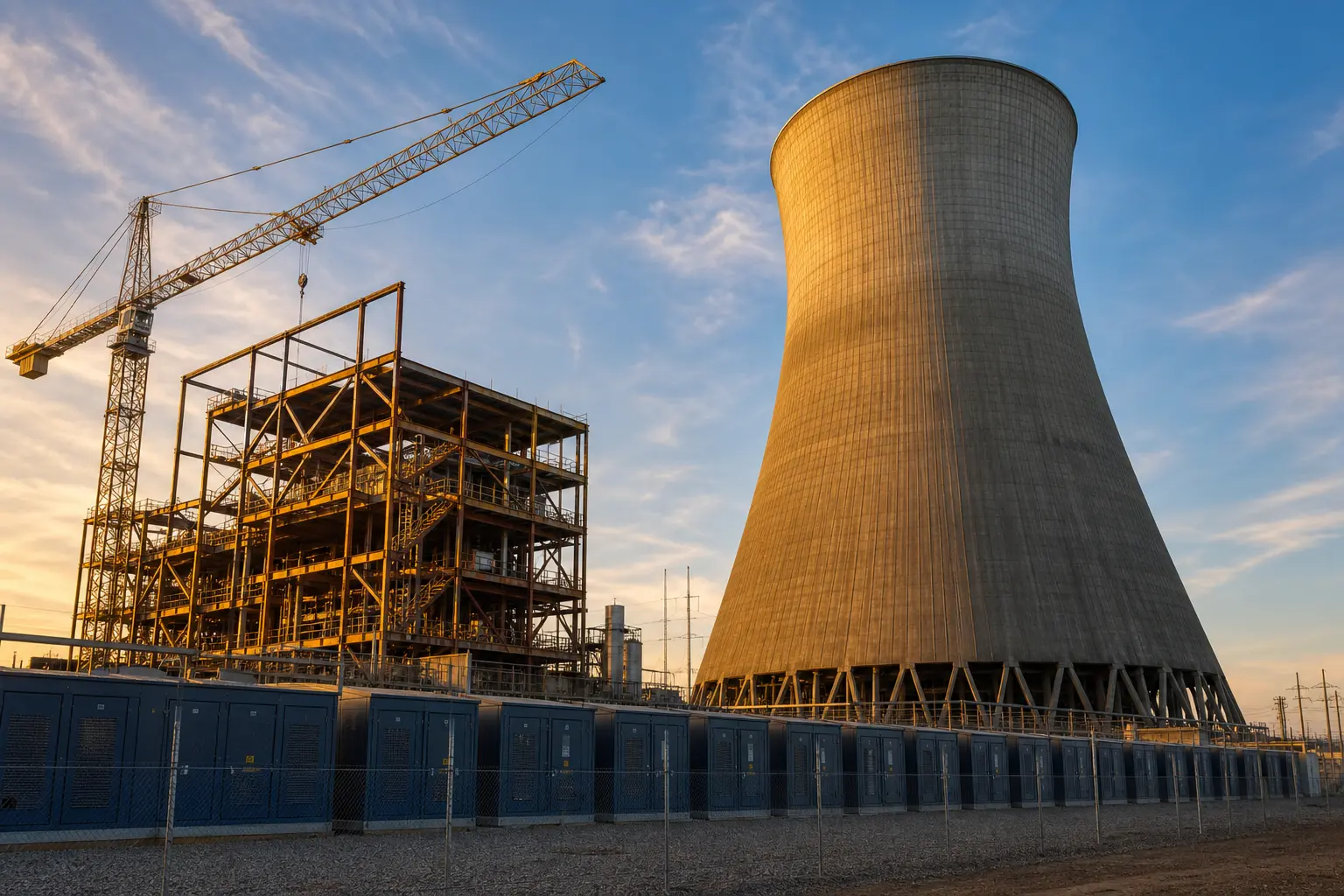
The expansion at Plant Bowen, just outside Euharlee in Bartow County, pairs two combined-cycle natural gas units with a battery storage field built around Tesla Megapack units. Combined, the gas turbines are expected to generate about 1,485 megawatts once construction finishes, alongside the separate 500-megawatt battery bank.
Bowen is not the only Georgia Power site getting this treatment. The utility has told regulators the Bowen work is one piece of a three-plant buildout expected to add roughly 8,000 megawatts of new gas and battery capacity between 2028 and 2031, at a cost the company puts at about $15 billion. A separate filing asks the Georgia Public Service Commission (PSC), the state’s utility regulator, to certify nearly 9,900 megawatts of new resources statewide.
Batteries have become a recurring piece of that puzzle. Georgia Power’s battery storage facility that opened earlier this year as data center demand climbed gave the company an early template for pairing storage with new generation, and Bowen’s battery field extends that approach to the state’s biggest power complex.
A Demand Forecast That Blew Past Its Own Numbers
Georgia Power’s 2025 integrated resource plan (IRP), the long-term blueprint utilities file with regulators, forecast about 8,500 megawatts of load growth over six years when the commission approved the plan that July. That figure alone revised the company’s own 2023 estimate of peak demand upward by roughly 2,600 megawatts by 2030.
Even that forecast looks conservative next to what Georgia Power says is knocking on its door. The company has cited as much as 40,000 megawatts of industrial interest statewide, expressions of interest from prospective customers rather than signed commitments, but a pipeline several times larger than anything currently under construction.
Since that 2025 approval, the company has gone back to regulators for more. Its request to certify nearly 9,900 megawatts of new resources came after the original plan, a sign the initial numbers did not hold for long. A commission fact sheet on data center demand lays out just how much of that growth traces to server farms rather than population or ordinary business expansion.
Who Pays for Powering the Data Centers?
Georgia Power says large customers, including data centers, sign contracts running as long as 25 years, with minimum monthly bills and collateral requirements, designed so those customers cover their own new capacity rather than passing the cost to households. Regulators are currently testing whether that promise holds up in practice.
The Georgia Public Service Commission voted unanimously on July 7 to open an investigation into Real-Time Pricing (RTP), a rate historically offered to large industrial customers that ties bills to hourly wholesale power costs. RTP has increasingly become a data center rate in practice, and commission staff have estimated the current structure could push fuel costs up 5 percent to 11 percent a month for everyone else as data center demand keeps growing.
That investigation followed a bruising fight over Georgia Power’s 27th fuel cost recovery case. The company’s initial proposal would have cut the typical residential bill by $5.78 a month, even as the underlying filing revealed a 25 percent jump in projected fuel costs tied to commercial and industrial load.
| Filing Stage | Residential Bill Impact | Key Detail |
|---|---|---|
| Initial fuel cost proposal | Down $5.78 a month | Filed as the 27th fuel cost recovery case; masked a 25 percent rise in projected fuel costs |
| Final stipulated agreement | Down about $4 a month ($50 a year) | Effective June 1, 2026; about $285 million in total customer savings |
| PSC staff RTP estimate | Up 5 percent to 11 percent a month | Risk to non-data-center customers if RTP cost-shifting continues |
Consumer advocates have already flagged the imbalance. Georgia Watch, a consumer advocacy group, has argued the state’s data center-driven expansion leans heavily on new gas rather than cheaper alternatives, a choice that carries its own long-term cost exposure for the customers ultimately backstopping the fuel account.
The Nation’s Biggest Coal Plant Was Supposed to Be Winding Down
Plant Bowen has carried the title of the country’s largest coal-fired power station for years, with four coal units producing more than 3,200 megawatts. Southern Company, Georgia Power’s Atlanta-based parent, had signaled it expected to retire those units by 2035. Rising data center demand has since put that closure date under review rather than treating it as settled.
The pattern is not unique to Bowen. Across Georgia, AI-driven data center demand has revived coal plants once headed for retirement, with environmental costs that regulators are only beginning to weigh against the reliability case.
- 1971 to 1975: Plant Bowen’s four coal units enter commercial service, eventually reaching more than 3,200 megawatts of combined capacity, tracked among the largest coal fleets in the country by energy researchers logging U.S. coal capacity.
- July 2025: The Georgia Public Service Commission approves Georgia Power’s integrated resource plan, keeping existing coal units online to meet anticipated data center load.
- May 2026: Regulators approve a stipulated fuel cost agreement after hearings expose a 25 percent jump in projected fuel costs tied to commercial and industrial growth.
- July 7, 2026: The commission votes unanimously to investigate whether the Real-Time Pricing rate lets data centers shift fuel costs onto other customers.
- July 28, 2026: Georgia Power breaks ground on Plant Bowen’s new gas turbines and battery field.
- 2029 to 2030 (expected): The new gas units and battery storage enter service, roughly three to four years after groundbreaking.
- 2035 (under review): Southern Company’s earlier target date for retiring Bowen’s coal units, no longer treated as fixed.
What Comes Next for Bowen’s Permits and Rates
Construction crews now have three to four years to finish Bowen’s gas units while the company works through permitting on its other two expansion sites. Georgia Power is separately fighting an air permit challenge over a planned expansion near Atlanta, a reminder that gas buildouts of this size rarely clear regulatory review without a fight somewhere in the state.
The RTP investigation is the piece with the most direct bearing on household bills. If commission staff’s cost-shifting estimate holds, residential and small business customers could see fuel costs climb even as Georgia Power points to 25-year data center contracts as proof that large users are covering their own weight.
The commission’s findings are expected later this year, around the time Georgia Power is due to break ground on the other two plants in its three-site expansion.
Frequently Asked Questions
Is Plant Bowen still burning coal?
Yes. All four of Plant Bowen’s coal units, generating more than 3,200 megawatts and now more than 50 years old, remain in service. Southern Company had signaled an expected 2035 retirement, but rising data center demand has put that date under review rather than confirmed.
What is Real-Time Pricing and why is it under investigation?
Real-Time Pricing (RTP) is a Georgia Power rate historically offered to large industrial customers that ties bills to hourly wholesale power costs. Regulators voted unanimously on July 7 to investigate whether data centers using RTP are shifting fuel cost risk onto residential and small business customers instead of covering their own share.
When will Plant Bowen’s new gas units start generating electricity?
Georgia Power expects the two new combined-cycle units to enter service within three to four years of Tuesday’s groundbreaking, putting a realistic start date around 2029 or 2030.
Do data centers pay extra to cover the cost of new power plants?
Large customers sign contracts running as long as 25 years, with minimum monthly bills and collateral requirements, meant to ensure they cover their own share of new capacity. Commission staff’s estimate that other customers could still see fuel costs climb 5 percent to 11 percent a month suggests that protection is not yet airtight.
How big is Georgia’s data center demand compared to what’s already approved?
Georgia Power’s 2025 plan forecasts about 8,500 megawatts of firm load growth over six years, but the company has also cited as much as 40,000 megawatts of expressed industrial interest, a speculative pipeline roughly four times larger than what is currently funded for construction.