Google Research and the University of California San Diego are turning 2,000 retired Pixel phones into a working data center, slated to go live in Fall 2026 with enough throughput for about 50 conventional servers. The pilot, outlined in a June 12 post on a low-carbon cluster built from retired phones by visiting postdoctoral researcher Jennifer Switzer and Turing Award winner David Patterson, treats the motherboard of a discarded smartphone as a generic compute node and stacks hundreds of them into a Kubernetes-managed fleet. The setup puts consumer silicon, stripped from retired phones, into tight, parallelizable workloads such as classroom grading and research compute, the workload class where the embodied carbon of cloud computing has to be cut first, before the AI build-out runs out of room.
The pitch lands against a backdrop the researchers are blunt about. Smartphones are typically replaced every four years, and a phone’s motherboard is responsible for roughly 50% of the device’s manufacturing carbon, the largest single share of the device.
The Benchmark That Flipped the Assumption
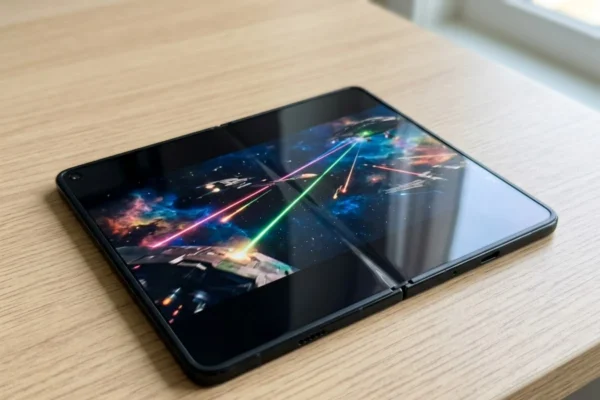
The starting number comes from SPEC CPU 2017, the same suite the server industry uses to size up new chips. Google Research reports that the single-threaded performance of modern smartphone performance cores lands on-par with or better than those of modern multicore servers on a per-core basis, even for devices that are three years old. A 2023-era Pixel Fold’s performance cores, scored against an AMD EPYC-equipped dual-socket server, run ahead of the server’s per-thread throughput. The framing matters: servers win on aggregate, with dozens of cores, hundreds of gigabytes of memory, and accelerators a phone cannot match.
A single Pixel will not replace a single EPYC. What it does, in the researchers’ framing, is turn compute from a unit problem into a fleet problem.
SPEC benchmarking results, the same blog post notes, indicate that 25-50 phones equate to a modern server, and that ratio is the number that drives the rest of the design. At 2,000 phones, Google says the cluster will give the campus the equivalent of about 50 server-class machines. That figure is the load-bearing number for the entire project.
How a Pixel Becomes a Server Node
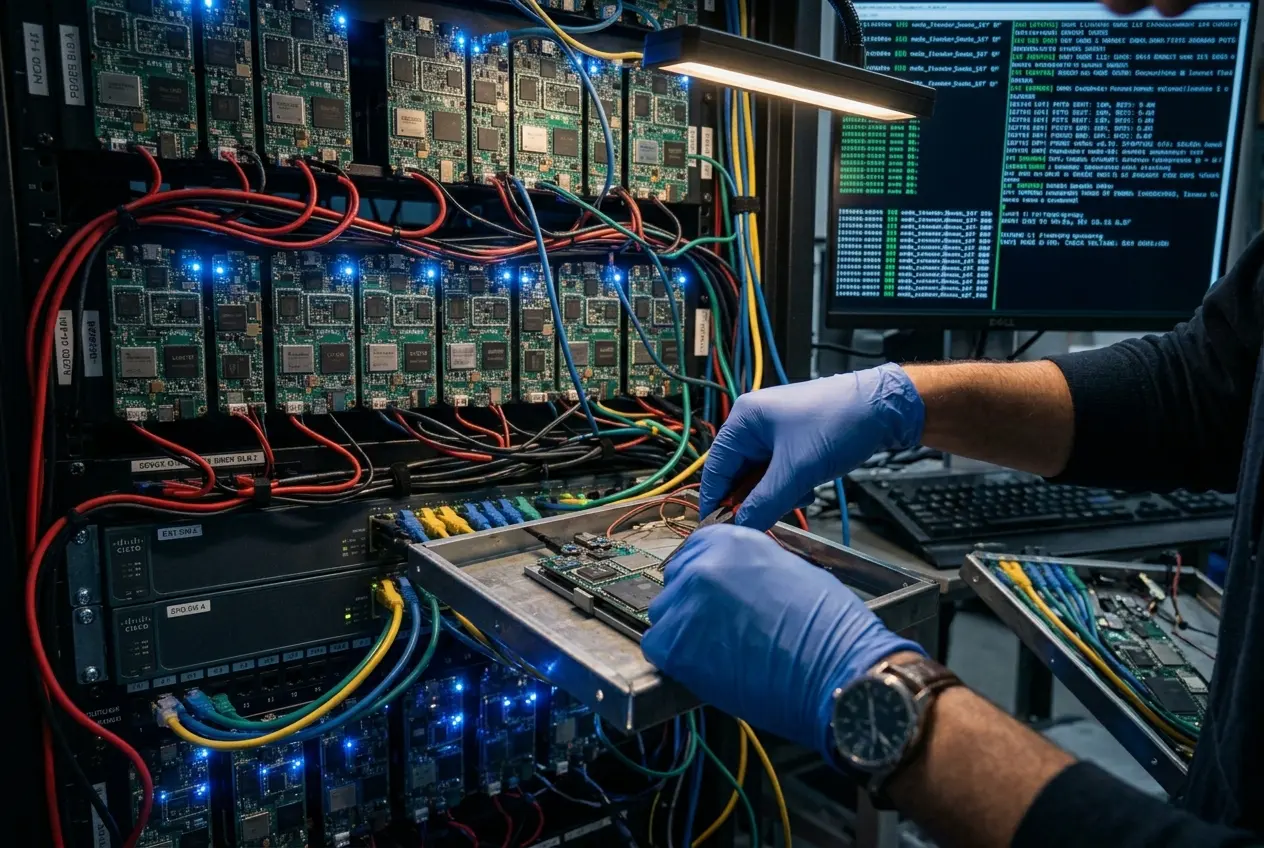
The transformation is a deliberate teardown, not a recycling. Each phone is stripped to the board, with the display, battery, cameras, speakers, and chassis removed and the motherboard, the system-on-chip, RAM, and storage, kept. Google Research flags two reasons the teardown is required. Components stripped from the phone take up space that a server rack does not have to spare. Some, notably the lithium-ion battery, contain materials not rated for a datacenter environment.
Stripped phones are then mounted, powered from a centralized supply, and networked like any other node in a Kubernetes cluster. To a workload, the cluster looks like a Linux cluster, and the fact that the workers used to take selfies is invisible. The choice of Kubernetes is not incidental, since it is the same orchestration layer Google and other cloud operators use to schedule containers across thousands of commodity nodes. The phone cluster is, in software terms, the same shape as a hyperscale cluster, just with smaller workers and more of them.
- Display, battery, cameras, speakers, and chassis are removed
- The motherboard, with its SoC, RAM, and storage, is the only part kept
- The Android user-space is replaced with a general-purpose Linux distribution
- Containerized workloads are scheduled with Kubernetes, in clusters of 25 to 50 boards
The 20-Phone Classroom Test
The case the researchers make for the model is not theoretical. Early experiments at UC San Diego ran a 20-phone micro-cluster against the peak grading load of a parallel-programming class with more than 75 students. The trial finished the job with grading latencies below the default AWS backend used for the comparison.
The comparison matters more than the absolute speed. A 20-phone cluster is a fleet of small machines, and the 75-student test shows the orchestration layer can absorb a real classroom spike faster than a small cloud instance can. At full scale, the 2,000-phone deployment is sized to support about 100 such classes at once, with about 50 server-equivalents of compute for the campus, all on hardware the team did not have to manufacture. For the procurement math, that is the line that has to land, since a university buys a single 2,000-phone cluster once, runs it for years, and skips buying the equivalent cloud capacity, paying the difference between a one-time capital build and a recurring bill.
| Cluster | Size | Workload | Result |
|---|---|---|---|
| 20-phone micro-cluster | 20 Pixel motherboards | Parallel programming class, 75+ students, peak submission | Grading latencies below the default AWS backend |
| Full 2,000-phone cluster | 2,000 Pixel motherboards | Computer science courses at UCSD, including Parallel Computation and Systems Programming | Support for about 100 classes at once, about 50 server-equivalents of compute |
| Per-server equivalence (SPEC CPU 2017) | 25 to 50 Pixel motherboards | CPU throughput benchmark, per dual-socket server | Match for a modern dual-socket server |
Procurement math aside, the cluster is also a live experiment in how consumer hardware holds up under continuous duty. Phones were built for mobility and intermittent use, not rack life, and the deployment is partly a stress test of that assumption. The UCSD announcement on the smartphone waste problem puts the volume behind the project: roughly 1.5 billion devices a year enter retirement, against a global compute build-out straining fresh silicon supply.
Why the Motherboard Matters Most
The carbon math runs through one component. Google’s internal carbon footprinting work puts the motherboard at approximately 50% of a smartphone’s embodied carbon, with the rest scattered across display, battery, and chassis, a ratio the UCSD Junkyard Computing project page echoes in its own manufacturing analysis.
A 2023 paper from the same group, presented at the 2023 Architectural Support for Programming Languages and Operating Systems (ASPLOS) conference, makes the case in harder terms. Phones are typically decommissioned about 2.5 years after purchase, even though their processors could run faultlessly for more than a decade, leaving roughly 75% of the device’s useful life on the table. The paper, by PhD student Jennifer Switzer with professors Ryan Kastner and Pat Pannuto and PhD student Gabriel Marcano, won a Distinguished Paper Award. It became the most-downloaded paper in the conference’s 28-year history, the UCSD announcement on the project notes.
The volume behind the project is hard to overstate. With 1.5 billion smartphones sold globally per year, the same source notes, the annual retirement flow is roughly the same size. The typical phone is replaced every 2.5 years, even though its processor could run for more than 10 years without failure. Pannuto, the UCSD computer science professor, has put the broader ratio plainly: for devices with shorter lifespans, such as smartphones, 80% or more of the lifetime carbon footprint comes from the energy expended to make the device, not the energy it used while it ran. The stat frames the cluster as a single experiment in a much larger reclaim program.
- 1.5 billion smartphones sold globally per year
- 2.5 years average use before a phone is decommissioned
- ~10 years of faultless processor life left at decommissioning
- 80% of a smartphone’s lifetime carbon footprint comes from manufacturing
- ~50% of a phone’s embodied carbon sits in the motherboard
Every phone the cluster keeps productive is one fewer chip that needs to be fabbed for the same workload. The full UCSD deployment, running at scale in Fall 2026, will also stress-test whether consumer silicon can hold up under rack life. That second question matters more for the long term than the carbon math alone, and the same earlier write-up of the UCSD 2,000-phone plan is worth reading for the cluster’s build sequence.
The Limits the Project Names
The Google Research post names a few limits of the model. The orchestration problem is harder at thousands of nodes, since data centers are usually standardized, and managing tens of thousands of heterogeneous phone boards runs against that pattern. Reliability under continuous server duty is the bigger open question. Phones were built for mobility and intermittent use, not 24/7 rack life, and the deployment is partly that long-running test.
The application mix is bounded by what fits on a phone’s hardware: small cloud instances, auto-graders, Jupyter notebook hosts, parallel programming backends. The researchers are explicit that hyperscale AI training, the workload driving the data center build-out, is not on the table. The bounding is also the design space, since universities, research labs, and smaller institutions running parallelizable workloads at a fraction of usual server cost fit the model cleanly.
Third-party coverage of the SPEC per-core comparison is candid on the same point. AI hyperscalers are not switching to refurbished motherboards, the write-up notes, because they want fewer parts, not more, and the reliability of specialized server hardware. A campus that can keep hardware productive for the long tail of its coursework, without buying new servers or renting more cloud capacity, pays less for compute and skips the carbon associated with building a new machine for the job. The contrast with regional data center build-outs, like the strain the Ocmulgee River is taking from 30 queued data centers, makes the same point in water and grid terms. Universities, research labs, and smaller institutions running parallelizable workloads at a fraction of usual server cost fit the model cleanly.
Procurement Math for the Second-Life Tier
A working 2,000-phone cluster leaves Google Cloud’s roadmap untouched. The shift runs through the assumption baked into how smaller institutions think about compute. The campus that runs it pays less for compute and skips the carbon associated with building a new machine for the job.
Procurement teams elsewhere will watch the Fall 2026 launch the way they watched early Kubernetes rollouts: as a sign that the second-life compute tier is ready to leave the lab. The wider test runs through the analogy Patterson’s work is built on.
Dave Patterson, a Turing Award winner who co-authored the original RAID paper, coined the name Redundant Array of Inexpensive Smartphones (RAIS) for the cloud repurposing effort, a deliberate echo of the storage idea that turned commodity disks into enterprise storage. The analogy runs through Patterson’s decades of work: aggregating many small, cheap, replaceable parts can beat a few large, expensive ones for a defined class of work, exactly the bet RAID made for disk in the 1980s. The investor-facing launch coverage reaches the same conclusion, noting that refurbishable-device computing could extend into edge computing, research infrastructure, and small-scale enterprise workloads. The cluster looks less like a data center and more like a storage array that happens to run Kubernetes.
If the Fall 2026 launch holds and consumer-grade hardware survives the rack, the second-life tier stops being a research project. The same logic reaches beyond education into the wider AI’s hidden water and land footprint in data centers conversation, where embodied carbon is now a planning constraint alongside power and water. The cluster doubles as a long-running test of whether consumer hardware holds up under sustained server duty.
It takes a spectacular amount of energy to manufacture modern, high-performance computer technology. The paper explores how to make computing more sustainable by finding new uses for devices society has already paid the carbon cost to manufacture.
Pat Pannuto, computer science professor at UC San Diego, made the point in the 2023 ASPLOS paper on junkyard computing that framed the work.
Frequently Asked Questions
How many Pixel phones is Google Research using for the UCSD cluster?
The cluster is sized at 2,000 retired Pixel smartphones, with motherboards extracted and the rest of each device stripped out. The project, supported by Google and run at the University of California San Diego, is expected to launch in Fall 2026.
How many phones equal one server?
Google Research’s blog post, drawing on SPEC CPU 2017 results, says 25 to 50 phone motherboards deliver the CPU throughput of a modern dual-socket server. At 2,000 phones, the cluster is sized to deliver the equivalent of about 50 server-class machines.
What workloads is the cluster actually running?
The 2,000-phone build is targeted at academic and research workloads, including parallel programming courses and systems programming classes. A 20-phone early test handled auto-grading for a 75+ student class with lower latency than a default AWS backend. The project is not aimed at hyperscale AI training.
What fraction of a phone’s carbon sits in the motherboard?
Google’s internal carbon footprinting puts the motherboard at approximately 50% of a smartphone’s embodied carbon, the largest single share of the device. The broader Junkyard Computing paper from the same UCSD group cites a figure of about 80% of a smartphone’s lifetime carbon footprint tied to manufacturing.
When will the cluster go live?
The full 2,000-phone system is expected to launch in Fall 2026. Early 20-phone experiments at UC San Diego have already run classroom workloads; the full deployment is also intended as a long-running test of how consumer hardware holds up under continuous server duty.