Rain has finally broken the back of Middle Georgia’s drought, the driest stretch the region has lived through in more than a decade, and the relief is real but partial. The latest US Drought Monitor, the federal and academic tracker run by the National Drought Mitigation Center, moved parts of central Georgia from “extreme drought” down to “severe drought” on Thursday after weeks of soaking storms. Soil at the root zone is still dry, the rivers are still thin, and forecasters say it will take months of steady rain to undo eight dry months.
The bigger question sits in the riverbed. The Ocmulgee River, which carried farms, cities and factories through the dry spell, fell this spring to a point where the water legally promised to users nearly matched the water actually flowing past. And roughly 30 data centers now want to draw from that same river, by the millions of gallons every day.
How Bad the Dry Spell Got
Georgia just came through one of its driest September-through-April periods on record, a span that runs back to 1895, according to Chris Ferman of the Southeast Regional Climate Center. Many parts of the state took in only about half their normal rain across those eight months.
Macon shows the gap plainly. The city has logged about 11 inches of rain so far this year against a normal of more than 17. Climbing out is a tall order. Projections presented at a May drought webinar hosted by the National Oceanic and Atmospheric Administration (NOAA) put the bar at 14 to 20 inches of rain over the next three months just to reach a milder drought category, never mind getting back to normal.
- 11 inches of rain in Macon so far this year, against a normal above 17.
- Driest September-to-April on the books since records began in 1895.
- 14 to 20 inches needed over three months to ease the drought one category.
Pam Knox, Georgia’s state climatologist at the University of Georgia, says the timing is what made this one strange. “This drought is somewhat different because it got so bad early in the spring, which is unusual since drought often grows worse over the summer,” she wrote in her climate newsletter. By mid-May, close to 99% of the state sat under some level of drought, according to the federal drought tracker’s Georgia readings.
A Split Verdict on the Farm
For Russ Elliott, a Bibb County livestock and strawberry grower of 30 years, the drought handed down two opposite rulings on the same farm.
Strawberries Loved the Dry April
His three acres of strawberries had their best season ever. A dry April kept fungus pressure almost nonexistent and pushed yields up. The pick-your-own rows priced out just above the grocery stores, the way they usually do, so for that side of the operation the dry weather read as a gift.
The Cattle Paid for It
From Christmas through March, the winter grass Elliott plants for grazing never germinated; the soil was too dry to wake it up. With nothing green in the pasture, his herd leaned entirely on stored hay through what should have been grazing season. “In March and April it was serious. Every day it got worse,” he said. “When you’re in a drought, every day is worse than it was yesterday.”
Knox says a warming climate is making droughts harder on crops and livestock, with higher temperatures pulling more moisture out of soil and plants, and rainfall shifting toward harder, less frequent storms with longer dry gaps between them. That swing has cut both ways across the state recently, the same volatile pattern that sent floodwater across Atlanta’s downtown connector even as fields farther south went bone dry. Crops generally need about an inch of rain a week to thrive. “There is no doubt that damage occurred, such as poor germination of newly planted crops and loss of pollination of corn due to the dry weather,” the climatologist told reporters. As for the grocery bill, Elliott said the link is real but hard to trace; beef prices are “just out of sight,” which he tied partly to the national cattle herd sitting at an all-time low.
The River Ran Close to Its Limit
At its lowest this spring, the river fell to roughly 260 million gallons a day, by the count of Fletcher Sams, executive director of the Altamaha Riverkeeper, the watchdog group that monitors the Ocmulgee and its tributaries. The combined amount that cities, farms and industries are legally permitted to pull from it nearly matched that flow.
For people who use the water, the strain was easy to see and harder to fish in.
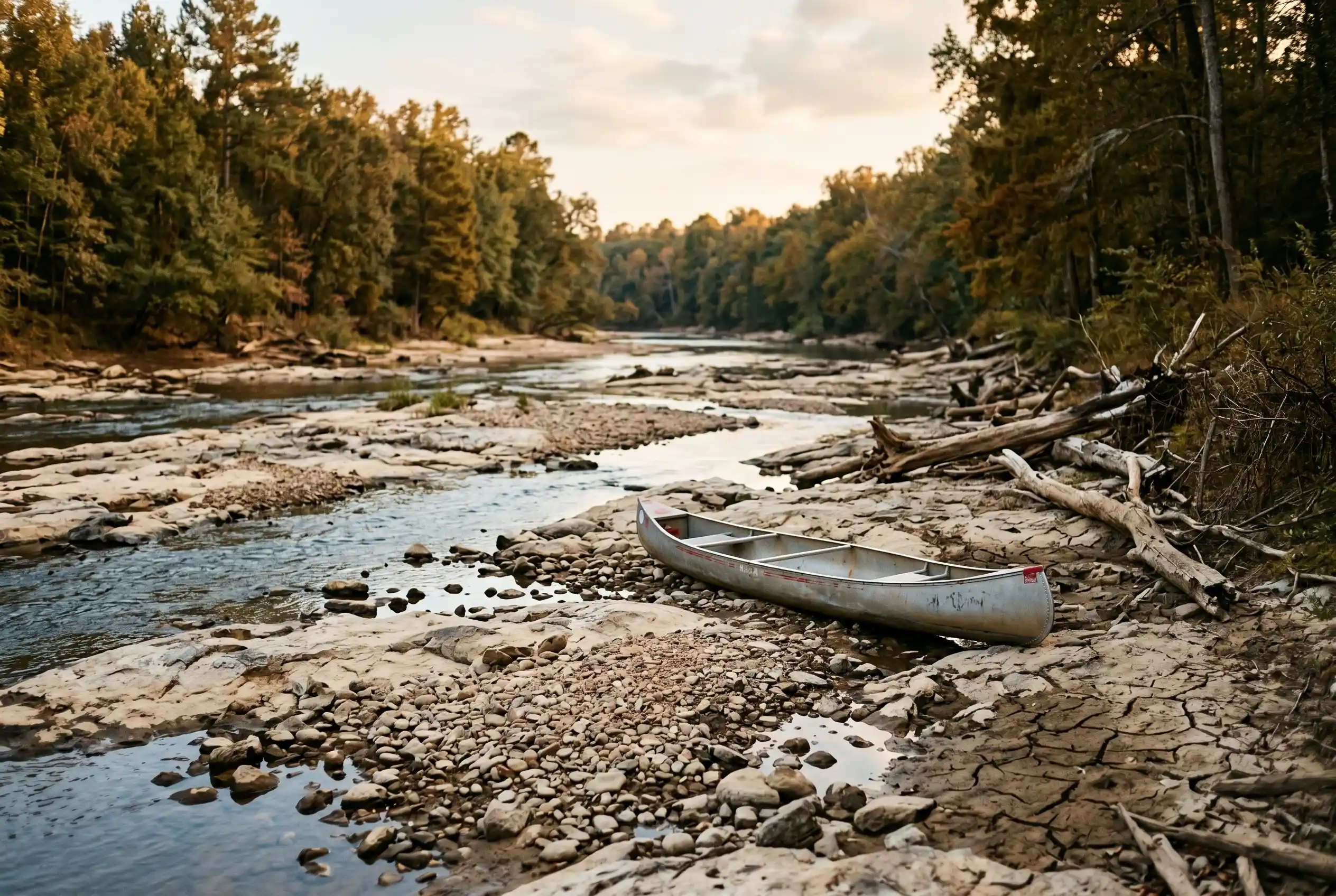
- Recreation: low levels turned navigable upper stretches into fields of exposed rock, where even canoes and kayaks struggled to pass.
- Oxygen: warmer water held less dissolved oxygen, putting stress on fish.
- Movement: “aquatic connectivity issues,” in Sams’s words, left fish unable to move freely through the system.
I’ve never seen conditions like this during the spring. The Ocmulgee and Oconee were improved with the rain, but we need more.
That was Sams, who is careful not to oversell the recovery even after the storms. Both rivers have come up since the rain, and you can watch the rebound on the real-time streamflow gauge at Macon, but a few good weeks do not refill a depleted basin.
Thirty Data Centers Want the Same Water
Here is where the relief gets complicated. The same river that nearly ran out of spare capacity this spring is the one a wave of computing projects has lined up to tap. Roughly 30 data centers are planned across the river basin, and they would draw water by the millions of gallons a day, much of it to cool racks of servers.
State tracking covers about 25 of those projects. The nine with public state impact reviews are projected to pull close to 10 million gallons a day on top of withdrawals already on the books, by figures compiled by river advocates. One project alone, an 11-million-square-foot complex planned near Interstate 75 in Butts County, is expected to use more than 4.5 million gallons a day, more than tripling that county’s current water use.
| Water source or draw | Daily volume | Status |
|---|---|---|
| River flow at its spring low | ~260 million gallons | Lowest point measured |
| Existing permitted withdrawals | Nearly the full flow | Already approved |
| Nine reviewed data centers | Close to 10 million gallons | In planning |
| Single Butts County complex | More than 4.5 million gallons | Proposed |
The Macon Water Authority holds a permit from Georgia’s Environmental Protection Division (EPD, the state’s water and pollution regulator) to draw from the river, and it could become a supplier to some of these projects. River advocates worry the state is approving withdrawal permits faster than a thin river can back them, with no cushion left for the next dry spring. The conservation group American Rivers has flagged the same squeeze nationwide, where data center cooling demand collides with stressed water supplies in basin after basin.
Macon’s Tap Stayed Safe
Through all of it, Macon’s drinking water never wobbled. The Macon Water Authority pumps from the river into Lucas Lake, a reservoir holding about 5.8 billion gallons, enough to supply the city for 90 to 120 days on its own.
At the height of the drought, Lucas Lake sat less than two feet below full pool, well above any warning line. The authority asked customers to trim use voluntarily by 10% and never moved to mandatory restrictions. The buffer that protected taps, though, is exactly the kind of margin that new industrial draws would eat into.
Where the Drought Stands Now
May finished wetter than normal across most of the state, and Knox said the rain “has put a dent in the drought.” One good month does not erase eight bad ones. Soil moisture down at the root zone is still low, and she warns that another dry stretch could stress crops all over again. The longer-range Georgia drought and precipitation outlook still leans dry into summer.
For Elliott, the turnaround was almost overnight. The pastures he had watched go barren came back, his cattle finally had grass instead of fence lines to walk, and hay that ran weeks behind is now ready to cut. “That rain was a blessing,” he said. To hold through a hot Georgia summer, he added, “you really need a shower or two every week.”
The pastures are green again and the river is up. After eight dry months, that is about as far as anyone in Middle Georgia is willing to commit.