AI data centers consumed an estimated 448 terawatt-hours of electricity in 2025, more than Saudi Arabia’s entire national grid, and a new report from the United Nations University Institute for Water, Environment and Health (UNU-INWEH) projects that figure will hit 945 TWh by 2030. What the study adds to that count is the rest of the environmental ledger: water, land, and the communities absorbing both without running a single workload.
Published June 3 on World Environment Day, the study Environmental Cost of AI’s Energy Use: Carbon, Water and Land Footprints finds AI’s water footprint could match the basic domestic water needs of 1.3 billion people in Sub-Saharan Africa by 2030, with a land footprint exceeding 14,500 square kilometres, roughly twice the area of the Jakarta metropolitan area. The distribution of those costs, concentrated in communities with no say in how AI infrastructure gets sited, is the report’s central argument.
The Carbon Blind Spot
Most existing environmental assessments of AI concentrate on greenhouse gas emissions tied to training and running large models. The AI environmental cost report covering carbon, water and land footprints argues that this approach misses two equally consequential dimensions: the water withdrawn to cool data centers and generate their electricity, and the land consumed by energy infrastructure and supply chains. Chasing lower carbon emissions without accounting for water and land can push infrastructure choices that intensify stress in regions already short on both.
The underlying problem is that the three footprints don’t move together. Switching the electricity supply for a data center from coal to bioenergy cuts the carbon footprint by roughly 70 percent. It also raises the water footprint more than 30-fold and the land footprint by up to a hundredfold. Hydropower creates a similar bind in a different direction: Brazil’s electricity system carries a carbon intensity 77 percent below the global average, but consumes roughly 29 litres of water per kilowatt-hour, far above the global norm.
The report makes a practical point absent from most industry assessments: when data centers shift to certain renewable sources, the carbon indicator improves while the water and land indicators can move the other way. Evaluating AI infrastructure through a single metric can shift substantial environmental burdens onto regions already under scarcity pressure, without the metric registering the shift at all.
| Electricity Source | Carbon Impact (vs. Coal) | Water Footprint Impact | Land Footprint Impact |
|---|---|---|---|
| Coal | Baseline | Baseline | Baseline |
| Bioenergy | Up to 70% lower | Up to 30x higher | Up to 100x higher |
| Hydropower (Brazil) | 77% lower | ~29 litres per kWh | Varies by site |
Source: UNU-INWEH, Environmental Cost of AI’s Energy Use, June 2026.
Inference Is the Power Bill
Public debate about AI’s energy use has concentrated on training: the massive compute runs that produce frontier models. The report finds training is a fraction of the total load. Day-to-day inference, the continuous stream of user queries, image generations, and video clips processed around the clock, accounts for 80 to 90 percent of AI’s total energy demand. MIT Technology Review confirmed the same range in a 2025 analysis, noting that inference has become the dominant and ongoing draw as AI features embed into daily products.
The volume is documented in the EurekAlert release of the UNU-INWEH AI energy findings: one widely used AI service is estimated to process around 2.5 billion prompts per day. The energy cost of those prompts varies by orders of magnitude depending on what they ask for.
- 2.5 billion prompts processed daily by a single widely used AI service
- 415+ Wh consumed by a single high-resolution AI video clip
- 1,000 times more energy for generating one AI image than running a simple text classification
- 80 to 90 percent of total AI energy demand comes from daily inference, not model training runs
Video compounds the problem quickly. When resolution doubles, energy requirements quadruple. A single high-resolution clip can already require more energy than the creation of hundreds of AI images. As video gets embedded in mainstream AI products and consumer feeds, that relationship becomes an infrastructure-scale issue with no obvious ceiling.
Communities Carrying the Grid
The Electricity Crunch
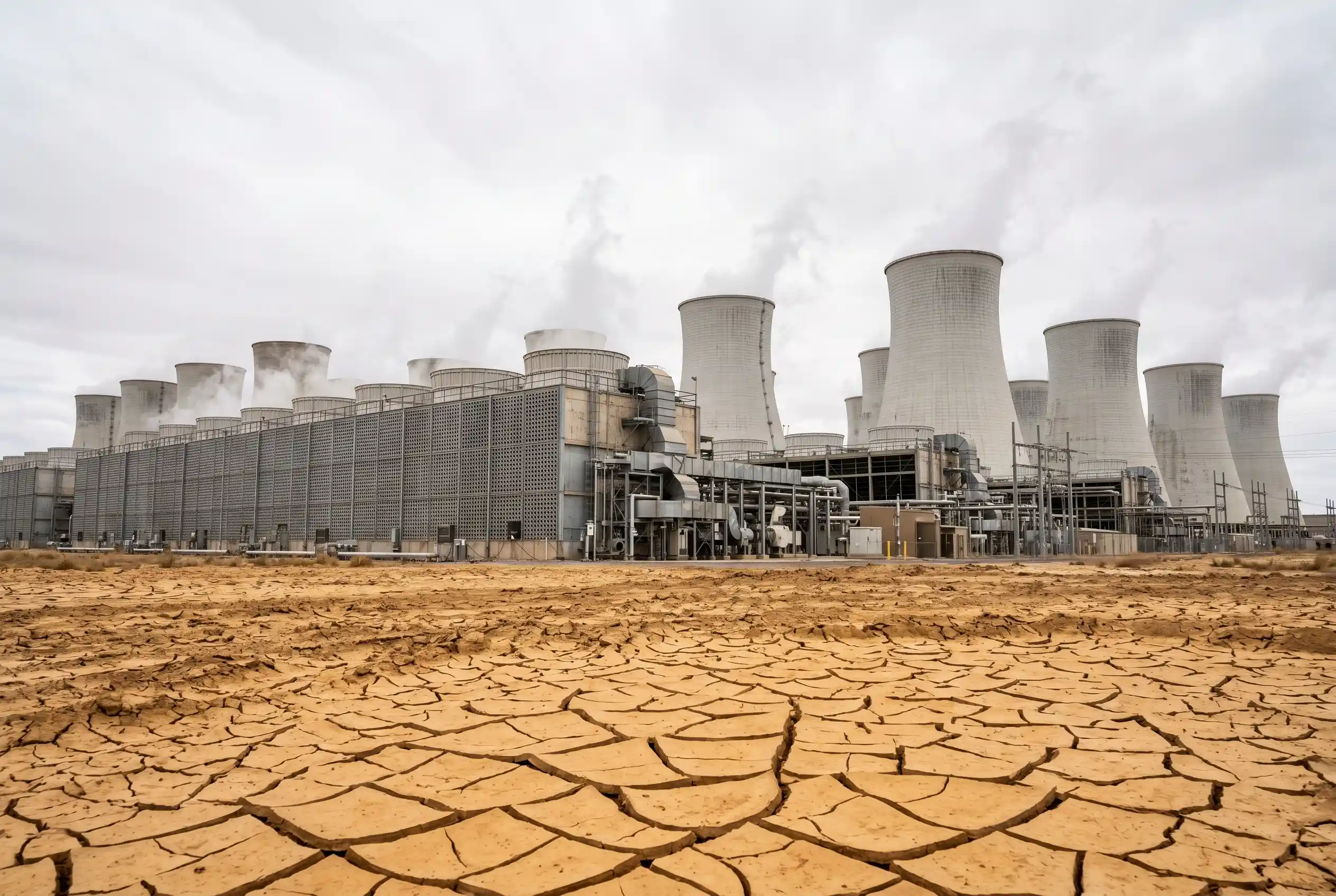
In Ireland, data centers accounted for 21 percent of total metered electricity in 2023, exceeding the electricity consumed by urban households across the entire country. The strain pushed Ireland’s national grid operator to pause new data center approvals around Dublin until 2028. Ireland is an extreme case, but the pattern has parallels elsewhere. A 2026 AGU Advances study on data center water transparency found that two-thirds of new U.S. data centers built since 2022 have been sited in high water-stress areas: California, Arizona, and Texas.
Scale explains part of the pressure. According to the International Energy Agency (IEA), the average large data center consumes electricity equivalent to what 100,000 households use. The largest facilities currently under construction would match the consumption of 2 million households, making them effectively small cities dropped into local grids with no prior planning for the load.
Water Stress Below the Surface
The water strain arrives more quietly. In Querétaro, Mexico, plans for fast-tracked data centers have threatened local water supplies during prolonged droughts. In Uruguay in 2023, proposals to build a water-intensive facility came as a drought had already depleted freshwater reserves in Montevideo, making tap water unsafe to drink and sparking public protests over industrial water priorities. Large data centers can consume up to 5 million gallons per day for cooling alone.
MSCI’s analysis of more than 13,500 global data center assets found that roughly 30 percent of facilities currently under construction are in regions where water scarcity is projected to intensify through 2050. The next wave of AI infrastructure looks set to deepen rather than redistribute these pressures.
If you map where data centres are getting built against where water stress is worst, you tend to see the same regions in some instances. And the communities living near these sites are not necessarily the ones using the AI being run there. That asymmetry is the issue. Without fixing it, we’ll just be repeating older patterns, where some places carry the costs and other places capture the benefits.
Dr. Mir Matin, Manager of UNU-INWEH’s Geospatial, Climate and Infrastructure Analytics Programme and co-author of the report, said this in the study’s press materials.
Why Efficiency Gains Won’t Save Water
The standard response to environmental pressure in the technology sector is to trust the efficiency curve. Chips improve per watt, cooling systems get smarter, renewable procurement grows. The report invokes the Jevons Paradox, the economic principle that as a resource becomes cheaper to use per unit, total consumption tends to rise because demand expands faster than per-unit efficiency improves.
For AI, the paradox has a product-design layer that’s largely invisible to users. Model choice, prompt length, output format, and resolution all materially shape the energy and water footprint of a session. Most of these variables are set by product defaults the user never sees or adjusts. Without explicit limits on token length, output resolution, or generation defaults built into those products, per-query efficiency gains get absorbed by volume growth.
Disclosure is the missing link. As of May 2025, 84 percent of usage on leading large language models (LLMs) occurred on models with no environmental reporting of any kind. Without measurement, there is no feedback loop and no external pressure on the gap.
The Hardware Lifecycle Burden
The environmental costs of AI infrastructure don’t end when the query completes. The report identifies three layers of physical impact extending beyond data center operations, each concentrated in communities that capture little of the benefit.
- Critical minerals: Lithium, cobalt, and rare earths required for AI chips and memory hardware are predominantly sourced from regions with weak environmental oversight, concentrated in sub-Saharan Africa and parts of South America, where extraction communities bear disproportionate health and ecological risk.
- Electronic waste: AI infrastructure could generate up to 2.5 million metric tonnes of e-waste per year by 2030, equivalent to discarding 250 Eiffel Towers annually. Most of that waste will be processed in low-income economies with limited safeguards for hazardous materials.
- Semiconductor fabrication: Chip manufacturing facilities withdraw millions of litres of water daily and release toxic byproducts, adding a pressure point absent from most AI sustainability frameworks.
The geography of who captures the benefit sharpens the imbalance. Over 90 percent of AI-specialized computing capacity is concentrated in two countries: the United States and China. More than 150 nations have no sovereign AI computing infrastructure. Those excluded countries frequently host the mineral extraction zones and e-waste processing sites that sustain the systems they can’t access.
What Accountability Would Require
Professor Kaveh Madani, Director of the institute who led the investigation, described the study’s purpose in the UNU-INWEH announcement of the June 3 report as a call to use AI responsibly and address its unintended impacts proactively. The framework the report proposes has six named principles: transparency, efficiency by design, equity and environmental justice, lifecycle responsibility, global cooperation, and sustainable use.
Translated into practical terms, the framework would require mandatory reporting of carbon, water, and land impacts across AI systems and data centers. Governments would need to integrate AI infrastructure into national energy, water, and land-use planning. Financial institutions would treat water and land footprints as material risks in AI infrastructure due diligence. The report identifies investors as one of the fastest available levers, positioned to act before any regulatory mandate forces the issue.
The disclosure gap is the immediate constraint. As of May 2025, 84 percent of leading AI model usage left no environmental trace in any public reporting. The six principles are sound in design. Mandatory water accounting, lifecycle tracking, and usage-limit defaults don’t yet exist anywhere at scale.
At 448 terawatt-hours in 2025, data centers already rank as the world’s 11th largest electricity consumer. The 2030 projection is 945. Nothing in the current disclosure landscape, no mandatory water accounting, no lifecycle governance, no usage limits built into product defaults, was designed for what happens when that number doubles.