Georgia lost power nationwide for nearly an hour on the evening of August 5, 2026, the third major blackout in two weeks, after tests at the Enguri Hydropower Plant forced the grid into an isolated mode. Lights began returning after about 60 minutes, but metro passengers had already walked darkened tunnels and traffic lights had failed across cities.
Georgian State Electrosystem said the work studied equipment linked to the July 24 and 25 failures. The fresh outage, coming so soon after those events and a leadership change at the transmission operator, has sharpened questions about how the system handles isolation and concentrated generation.
The Hour the Lights Went Out
The blackout started around 8 p.m. local time. Outages spread quickly through Tbilisi and the regions. Trains and the Tbilisi Metro halted. Footage and reports showed passengers leaving carriages on foot inside tunnels. Elevators trapped people. Traffic lights went dark, contributing to crashes. Water services and other utilities felt the interruption.
Abkhazia, which draws heavily from the same plant, also lost power. Restoration began gradually near 9 p.m. and finished later that evening. Internet traffic measured by Cloudflare Radar fell by as much as 55 percent during the window, confirming the scale of the disruption.
- Metro and railway services stopped; passengers evacuated tunnels on foot.
- Traffic signals failed, raising accident risk in major cities.
- Elevators and water systems were interrupted.
- Abkhazia experienced a parallel outage tied to Enguri.
Giorgi Pangani of the Georgian National Energy and Water Supply Regulatory Commission said the event coincided with scheduled tests of Enguri generating units. Those tests aimed to identify weak points left by the July accidents.
Why the Tests Produced a Full Shutdown
GSE stated that specialists tested equipment at Enguri after the July system failures. The work required the electricity system to run temporarily in isolated mode and at frequencies outside the normal operating range. That configuration produced the temporary nationwide outage. Emergency measures restored supply across the country.
Pangani described the tests as planned and intended to assess vulnerabilities exposed on July 24 and 25. Officials have not released a detailed technical chronology of how the isolated-mode run cascaded into a total blackout. The admission that a complete shutdown risk was known in advance drew immediate criticism.
Opposition MP Giorgi Sharashidze of the Gakharia for Georgia party asked why the public received no warning and why preventative steps were not taken. He said citizens forced to walk through darkened metro tunnels deserved clearer answers and suggested the underlying problem might be more serious than officials have acknowledged.
After the third nationwide electricity outage, the statement by the Georgian State Electrosystem and later comments by a member of the Georgian National Energy and Water Supply Regulatory Commission, saying that the blackout was caused by planned testing of Enguri HPP units and that the risk of a complete system shutdown was known in advance, raise even more questions about what is really happening in Georgia’s electricity system.
Sharashidze made the remarks in response to the official explanations.
July Cascade That Set the Stage
The August event followed two consecutive nationwide blackouts on July 24 and 25. Those earlier cuts also reached Abkhazia. GNERC’s preliminary assessment of the first outage pointed to the disconnection of the 110-kilovolt Geguti transmission line connected to the Kutaisi 220 substation. At the time Georgia’s system was synchronized with Azerbaijan’s network.
The line trip separated Georgia from the Azerbaijani system. The grid then operated in isolation. Frequency and voltage dropped. A chain reaction shut down power plants and consumers across the country. The regulator said existing protection and automation systems should have been recalculated to improve reliability rather than waiting for full modernization of high-speed protections.
Energo-Pro Georgia rejected the line-failure claim. Company chairman Mikheil Botsvadze said the disconnection of any single distribution line should not have forced the country into isolated operation, severed the neighbour link, and produced a nationwide blackout. GNERC and the State Security Service are running separate investigations. The security service is examining possible sabotage. No final conclusions have been published.
| Date | Duration / Notes | Official Trigger Cited |
|---|---|---|
| July 24, 2026 | Overnight into morning; full national | Geguti 110 kV line; loss of Azerbaijan sync; cascade |
| July 25, 2026 | Second consecutive day | Related system stress after first isolation event |
| August 5, 2026 | ~1 hour from ~20:00 | Enguri unit testing in isolated / non-standard frequency mode |
The July failures already prompted personnel movement at GSE. Director General Vano Zardiashvili is expected to leave after returning from leave. Deputy Davit Vardiashvili has been carrying out duties. GSE has described the departure as a resignation rather than a dismissal tied directly to the regulator’s findings.
- July 24, ~00:10, Georgia disconnects from Azerbaijan; cascade blackout begins.
- July 25, Second nationwide outage follows.
- July 30, GNERC releases preliminary Geguti-line assessment and calls for better protection settings.
- Early August, Reports confirm Zardiashvili departure process; Vardiashvili acting.
- August 5, ~20:00, Third blackout during Enguri diagnostic tests.
These twin blackouts that first exposed the grid vulnerabilities left the system under active scrutiny when the August tests began.
Enguri Hub and the Shared Western Load
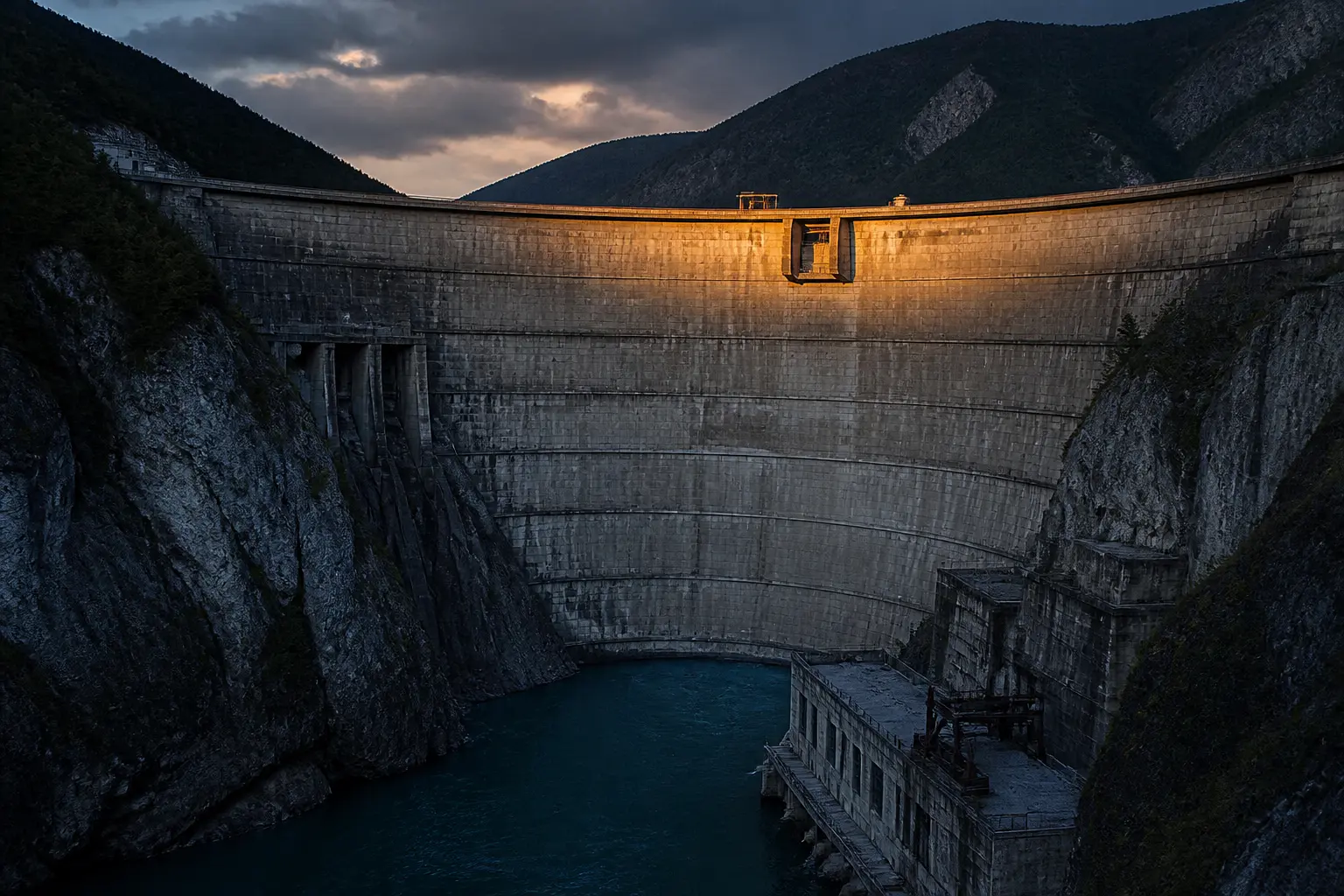
Georgia’s electricity mix is dominated by hydropower. In recent baseline years HPPs supplied roughly 80 percent of generation. The 1,300 MW Enguri facility is the single largest unit and functions as the backbone of the system. It typically accounts for a large share of output, often cited near 40 percent of the country’s electricity. The dam and intake sit on territory controlled by Tbilisi while the powerhouse lies in Abkhazia; the plant is jointly operated and its output is shared.
Much of the country’s hydropower capacity is concentrated in western Georgia. When the western complex or the high-voltage corridors that move its power are stressed, the whole system feels it. Georgia maintains interconnections with Azerbaijan Russia and neighbours, including Armenia and Türkiye. Those links normally provide balancing. When the Azerbaijan connection is lost and the grid must run islanded, the protection settings and frequency control become critical. GNERC said those settings had not been fully recalculated for the new risks.
The International Energy Agency notes that the Enguri hydro facility is the backbone of generation and that the system has improved reliability through rehabilitation, yet SAIDI and SAIFI figures for distribution companies remain elevated in some years. Structural concentration and the political geography of Enguri add layers that pure technical upgrades cannot erase overnight.
- Hydro share: ~75-80% of electricity generation in recent profiles.
- Enguri capacity: 1,300 MW, largest single plant, shared with Abkhazia.
- Western concentration: bulk of hydro resources and major corridors sit in the west.
- Isolation risk: loss of neighbour sync has twice produced cascade conditions.
Energy expert Gia Arabidze told Radio Free Europe/Radio Liberty that preliminary findings gave some information but the exact reasons for the outages remained unclear. Other specialists argued that changing directors alone would not fix deeper system problems.
Leadership Exit and the Open Probes
Zardiashvili, a former Georgian Dream MP who took the GSE helm in 2025, had earlier roles at the company. Supervisory board member Giorgi Abramishvili confirmed the planned exit after leave and called him an effective manager who brought order. The Economy Ministry confirmed the deputy was performing duties while Zardiashvili was on leave. Timing after the GNERC working-group findings has fuelled the link in public discussion even as GSE rejects a direct causal dismissal narrative.
Two investigations continue. GNERC is examining the technical sequence, the Azerbaijan disconnection, and islanded-mode performance. The State Security Service is treating the July events under a sabotage statute. No public evidence has tied the August testing outage to external interference. Officials have urged media to rely on primary statements and have warned against disinformation that could harm tourism or economic perceptions.
The combination of unfinished technical diagnosis, an open security probe, and a leadership transition leaves the grid under dual pressure: restore confidence in daily operations while completing the root-cause work that the Enguri tests were supposed to advance.
Public Trust Frays Faster Than the Grid
Social media and opposition voices focused less on the technical necessity of testing and more on the absence of public notice. If the risk of a full shutdown was known, the decision to proceed without warning left metro riders, elevator passengers and drivers unprepared. That gap between official planning language and lived experience has become the political story layered on top of the engineering one.
Earlier July commentary from President Salome Zourabichvili treated the sabotage framing with scepticism, warning that such accusations could be used to name new internal or foreign foes while avoiding harder scrutiny of system management. The August testing blackout, which officials themselves link to diagnostic work, has made purely external explanations harder to sustain as the sole narrative. Crowd discussion on platforms noted the repeated pattern and the shared pain with Abkhazia, underscoring that Enguri’s joint status turns every major plant event into a cross-boundary reliability issue.
GSE and the regulator continue analysis of the August incident. Specialists are examining why the isolated-mode test produced a complete outage rather than a contained frequency excursion. Until those results and the July final reports appear, the country is left with three data points in two weeks and a transmission operator in transition.
The lights came back on August 5. The structural questions about western concentration, isolation readiness and advance public communication remain on the table.