Georgia’s power grid collapsed twice in thirty-six hours this weekend, and both times the explanations offered trace back to the same Soviet-era dam. Its control room sits in Abkhazia, a Russian-backed breakaway region Tbilisi has not governed since the 1990s. The first outage hit at 00:10 local time on Friday, July 24, plunging the entire country dark; a second nationwide-scale failure followed at roughly 08:00 on Saturday, July 25, stopping Tbilisi’s metro and forcing airports onto backup power.
Georgian State Electrosystem (GSE), the state grid operator, has confirmed neither outage’s root cause. What it has confirmed is that competing versions of events are already circulating, and that some of them, in the company’s own words, are disinformation.
A Second Blackout in Thirty-Six Hours
The first blackout knocked out power nationwide within minutes, according to GSE’s own statement, and automatically shut down pumping stations run by Georgian Water and Power (GWP). Crews worked in stages through the night, and GSE said full nationwide power was back by about 09:30, roughly nine hours after the initial trip.
Less than a full day later, the lights went out again. The second failure struck around 08:00 on Saturday, hitting Tbilisi, Batumi, Kutaisi and a string of smaller towns. Some Tbilisi districts saw power return within about half an hour, but operators gave no immediate account of how long full restoration took this time, or whether the two failures shared a cause.
| Detail | Friday, July 24 Outage | Saturday, July 25 Outage |
|---|---|---|
| Reported start | Around 00:10 local time | Around 08:00 local time |
| Areas hit | Nationwide, including Abkhazia | Tbilisi, Batumi, Kutaisi and other towns |
| Documented disruption | GWP pumping stations shut down automatically | Metro halted, trains disrupted, water pumps down, mobile data issues, airports on generators |
| Restoration | Full nationwide power by about 09:30, roughly nine hours later | Some Tbilisi districts back in about 30 minutes; full timeline undisclosed |
| Cause cited | None confirmed at the time; GSE said it was still investigating | Enguri HPP’s director later pointed to a trip on the 500 kilovolt Imereti line |
Both events also cut power across the administrative line in Abkhazia, tying Georgia’s domestic grid trouble directly to territory Tbilisi does not control.
What Caused Georgia’s Blackout?
No single confirmed cause exists yet. GSE says specialists are still working to establish one, while a plant director and a foreign ministry have already offered two different explanations, and the state utility is asking reporters not to run with either until it says so.
GSE’s statement, issued hours after the first outage, was blunt about the risk of getting ahead of the facts.
Today, at approximately 00:10, an emergency power outage occurred across the entire country. We urge the media to rely exclusively on official information and to refrain from spreading unverified reports.
The company added that the exact cause was still being established and that findings would be shared publicly once confirmed. That has not stopped others from naming one. Levan Mebonia, director of the Enguri Hydroelectric Power Plant (HPP), told broadcaster TV Pirveli that the failure traced to a trip on the 500 kilovolt Imereti transmission line, the corridor that carries Enguri’s output as far as the town of Zestafoni. A very large share of the country’s power moves through that single line, he said, and losing it collapsed the grid’s operating mode entirely. Separately, Abkhazia’s energy ministry blamed a fault tied to the Enguri plant itself for cutting its own power, an explanation GSE has not endorsed. Georgia’s transmission company, JSC Sakrusenergo, which manages the Imereti corridor, posted an update on rehabilitation work underway on that same line, without assigning blame for either outage.
What is confirmed:
- Two separate nationwide-scale outages hit within thirty-six hours, on July 24 and July 25.
- Enguri HPP’s director has publicly blamed a trip on the 500 kilovolt Imereti transmission line.
- Abkhazia’s energy ministry has pointed instead to a fault tied to the Enguri plant itself.
- GSE restored power nationwide after both incidents.
What remains unconfirmed:
- GSE has not issued its own final determination of the root cause for either event.
- Whether the two outages share one underlying fault or two unrelated ones.
- Whether sabotage played any role, a line of inquiry DFWatch reported investigators are examining.
The Dam Tbilisi Shares With a Border It Doesn’t Recognize
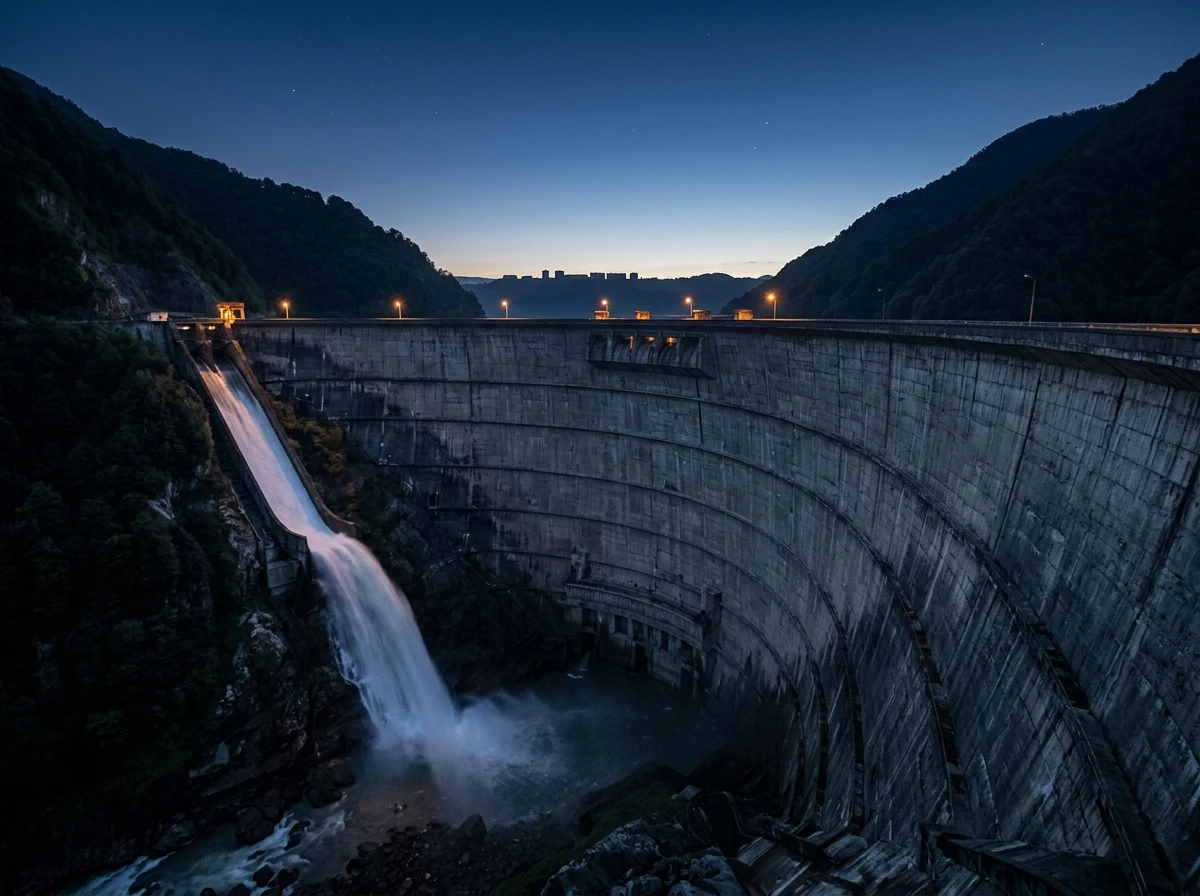
Every explanation offered so far points back toward the same facility: Enguri, a 1,325 megawatt hydropower plant built during the Soviet period on the river separating Georgia from Abkhazia. The dam itself sits on Georgian-administered ground. Its control center sits across the line, inside Abkhazia.
That split is not new. Under an informal arrangement dating to 1997, the power-sharing deal behind the dam guarantees Abkhazia roughly 40 percent of Enguri’s output, with Georgia taking the remaining 60 percent. Enguri alone supplies effectively all of Abkhazia’s electricity and more than a third of the power used across Georgian-controlled territory. Georgian officials have long acknowledged the national grid cannot function without it, or can only do so at high cost, since replacing that capacity has historically meant buying power from Russia during Enguri outages.
That dependency is what turns a transmission-line trip into a cross-border story. When the Imereti line failed, it did not just black out Georgian cities; it knocked out the plant that keeps Abkhazia’s lights on too, giving an unrecognized administration’s energy ministry its own stake in how the cause gets defined, and its own incentive to name one before Tbilisi does.
Who Felt the Dark
The second outage did more than dim streetlights. It reached directly into the infrastructure people rely on to get to work and stay connected.
- Tbilisi’s metro system stopped running, stranding riders on platforms and between stations.
- Train movements across the network were disrupted.
- Water supply was interrupted in several areas after pumping stations lost power, again.
- Mobile internet service degraded in parts of the country.
- Airports switched to backup generators and ran in emergency mode.
The timing lands in the middle of Georgia’s peak travel season. The country recently posted a record run of EU and UK visitors even as overall tourism revenue slipped, leaving an economy already leaning on summer arrivals exposed to back-to-back grid failures at the exact moment airports and hotels needed reliable power most.
A Sabotage Question Lands in a Tense Summer
DFWatch reported that Georgian authorities are examining whether sabotage contributed to the outages, alongside the technical explanations already in circulation. Neither GSE nor the government has confirmed that theory publicly, and it remains one thread among several rather than an established finding.
Whatever investigators conclude, they are working in a country where trust in official accounts is already strained. Amnesty International said in a June 2026 report that Georgian authorities have built a coordinated system to suppress dissent, including the use of disinformation against critics, during a political crisis that has run since late 2024. That backdrop helps explain why GSE moved so fast to draw a line around unverified claims after the first blackout, and why an unresolved cause, paired with a foreign energy ministry’s competing account, is landing on such receptive ground for rumor.
Grid Bets Placed Before the Lights Went Out
The irony is that Georgia’s grid ambitions were already in motion before either outage. The Asian Development Bank has agreed to back a $104 million battery storage plant, the country’s first, aimed at smoothing exactly the kind of supply shocks that hit this weekend. Tbilisi has also proposed a green hydrogen pipeline along its Black Sea corridor, part of a broader pitch to become a regional energy transit hub.
Neither project addresses the specific vulnerability exposed this weekend: a single 500 kilovolt line carrying enough of the country’s power that losing it can collapse the whole system, anchored to a plant whose control room Tbilisi does not operate. GSE has not set a date for its final report on either outage. Until it lands, the two blackouts stand as the clearest test yet of a grid still built around a dam Georgia shares with a border it does not govern.