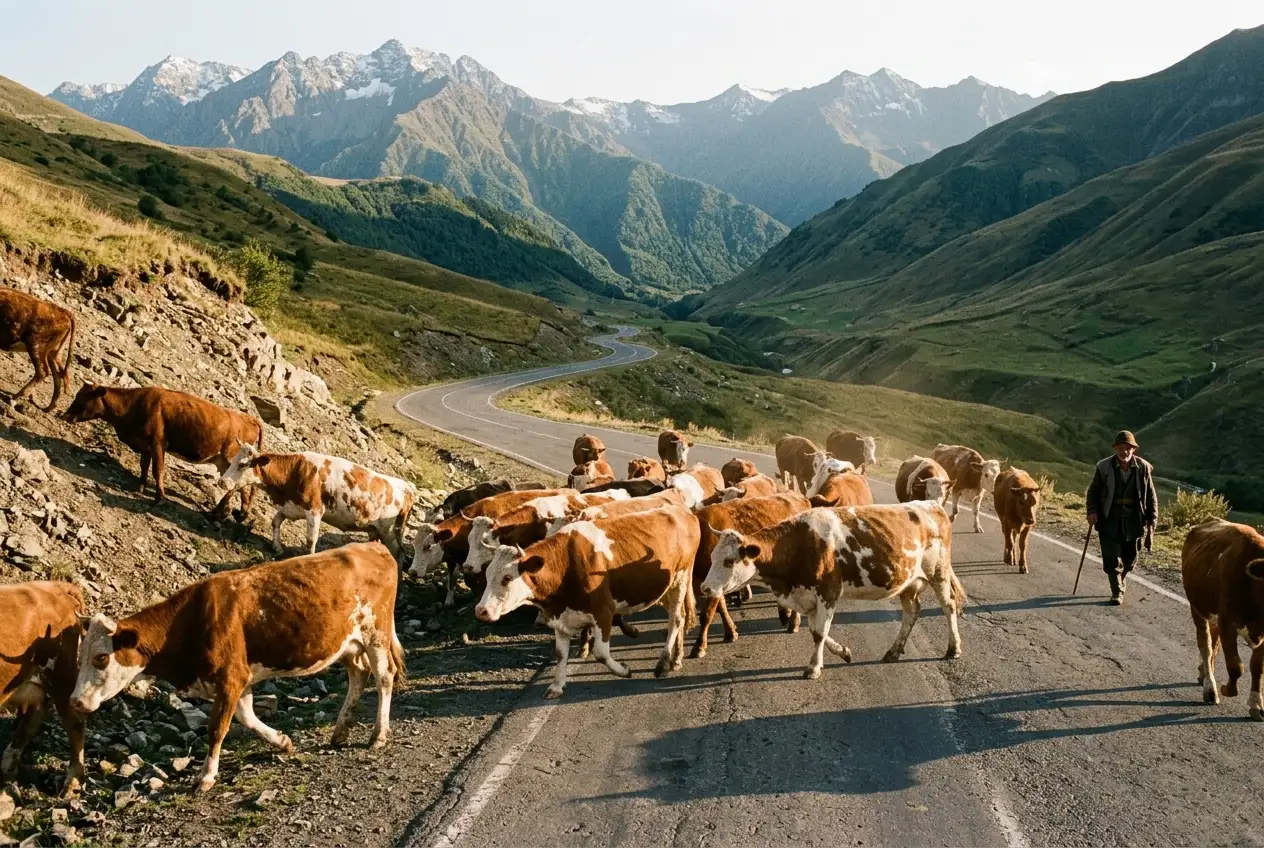
Georgia is creating a dedicated 25-staff service inside its Roads Department to keep livestock off highways and to handle cargo and other hazards that disrupt traffic, under amendments the Government of Georgia put before parliament this week. The new unit is the smaller companion to a two-part restructuring that will also spin road maintenance into a state-owned LLC, a deliberate shift away from the private contractors the prime minister said hadn’t delivered. The two changes move together.
The prevention service will sit inside the Roads Department, which reports to the Ministry of Infrastructure leadership. The Roads Department will employ 25 staff with an average monthly payroll of 120,000 GEL, according to the explanatory note attached to the amendments. The package is being fast-tracked through parliament alongside the larger state-owned maintenance company that will replace private contractors on highway work. Funding runs through 2029.
What the New Service Will Do
The unit’s stated mission is narrow. It will prevent livestock from crossing highways, manage the road safety risk that creates, and respond to related incidents when they happen. The amendments were presented in parliament by Deputy Minister of Infrastructure Mzia Giorgobiani, who said the brief stretches to cargo that falls onto roads, an everyday hazard on routes that carry heavy goods vehicles across mountain passes. Giorgobiani framed the change as a deliberate split inside the Roads Department, with one entity handling maintenance and another handling prevention. That split sits at the heart of the package.
We should actually divide it into two parts. One is an LLC that will ensure road maintenance and the other to be in the form of prevention, which will ensure, among other things, the safety part.
The remark came from Deputy Minister of Infrastructure Mzia Giorgobiani during parliamentary discussion of the amendments. The framing set the pattern for the larger legislative package that followed.
The shift pulls livestock and hazard response out of the maintenance chain. Each line of work now has its own line of accountability. The two structures are linked only by their funder. That funder is the Ministry of Infrastructure in both cases.
The Two-Part Restructuring
The prevention service is being created alongside a separate state-owned LLC that will take over highway maintenance. The Ministry of Infrastructure registered the draft law on June 3, 2026, and is pushing it through parliament in expedited procedure, the same vehicle as the livestock amendments. Together, the two pieces redefine the Roads Department’s remit and move maintenance work that has long been done by private contractors onto the state’s books.
Prime Minister Irakli Kobakhidze presented the maintenance side of the package on June 9, calling it a “stable resource” and a guarantee of quality. He argued previous private contractors hadn’t delivered satisfactory work, an assessment the state-run model is meant to answer. The argument is also why the prevention service sits where it does. Pulling livestock and hazard response out of the maintenance chain turns “who handles the road” into two cleaner questions.
The first question is who maintains the surface. The LLC answers that one. The second is who clears the hazard on top of it. The new 25-staff unit answers that one. The two structures share a funder, the Ministry of Infrastructure, but little else, with the LLC a stand-alone legal entity and the prevention service a unit inside an existing department.
| Category | Maintenance LLC | Prevention Service |
|---|---|---|
| Function | Highway maintenance | Livestock and hazard response |
| Staffing | 163 employees | 25 staff members |
| Initial capital | ~63 million GEL (excl. VAT) | Not stated |
| Annual operating cost | ~30 million GEL total | 300,000 GEL fuel, 350,000 GEL maintenance, 50,000 GEL equipment |
| Salary pool | ~7 million GEL (annual) | 120,000 GEL monthly average |
| Network covered | International and domestic highways | 6,000-km road network |
| Reporting line | State-owned LLC under the Ministry of Infrastructure | Inside the Roads Department |
| Funding | State budget via optimisation and redistribution | 2026-2029 state budget allocations |
Their funding paths also differ. The LLC’s bill is covered through optimisation and redistribution inside the state budget, and the prevention service draws on allocations already set aside for the Ministry and the Roads Department inside the 2026-2029 window.
The Money in Plain Figures
The explanatory note attached to the prevention service breaks its running costs into four line items. The service will carry an average monthly payroll of 120,000 GEL. Annual operating costs include 300,000 GEL for fuel, 350,000 GEL for maintenance, and 50,000 GEL for technical equipment.
The 50,000 GEL equipment line is the unit’s main window onto a 6,000-kilometer road network, the length cited in the explanatory note. The Roads Department says the service will work across that full extent, with patrol, response, and monitoring stretching the length of the national system. The equipment budget covers tools the unit will use to watch the network, not to maintain it. Maintenance of the surface remains the LLC’s job. The East-West and North-South highway corridors the Roads Department already manages will all sit under the new unit’s watch.
The figures sit well below the LLC’s. The maintenance company carries a ~63 million GEL capital bill and an annual operating cost around 30 million GEL, with about 7 million GEL of that going to salaries for 163 staff, while the prevention service fits inside a tight payroll-plus-fuel-plus-maintenance envelope designed to plug one specific gap.
- 25 staff members (unit complement)
- 120,000 GEL average monthly payroll
- 300,000 GEL annual fuel
- 350,000 GEL annual maintenance
- 50,000 GEL annual technical equipment
- 6,000 km road network to monitor
Why the State Is Stepping Back In
Kobakhidze’s framing of the LLC was blunt. “We want to create a stable resource that will also be a guarantee of quality,” he said at a June 9 briefing. He argued the initiative served a “double effect,” pairing stable resources for routine road maintenance with specialised equipment to respond to natural events.
The prevention service is the smaller companion unit, and the reasoning is similar in form. If a state-run LLC can be tuned to one job, a state-run unit can be tuned to another, with the same goal. That goal is cutting out a layer of intermediation the government no longer wants to rely on. The package also brings the two structures under one ministry with one budget window.
The accompanying amendments also tighten rules under the Law on Motorways. They aim to prevent unauthorised construction in roadside zones. They aim to improve protection of road infrastructure. The Ministry says violations of roadside construction rules remain common despite existing restrictions. Those violations, it says, create risks for road safety and infrastructure alike, and the new rules sit alongside the new service and the new LLC as a third piece of the same legislative package.
All three pieces of the package are being processed in the same expedited procedure, with the maintenance LLC draft law registered on June 3, 2026 and set to be considered in expedited manner. The ministry is asking parliament to clear the livestock service and the maintenance LLC in the same window as the separate ADB loan amendment already under committee review.
How It Sits Inside the 2026-2029 Budget
The amendments tie the new service to the existing four-year budget window. Funding runs through 2029, drawn from allocations inside the 2026-2029 state budget for both the Ministry of Infrastructure and the Roads Department, not from a new appropriation. The four-year window runs through 2029.
The service will be set up this year. The trigger is the law entering into force. The parliamentary timetable is tight, with the Budget and Finance Committee having cleared a separate infrastructure amendment on June 8 and Giorgobiani presenting a Letter of Change to a 2017 Asian Development Bank loan for the Batumi Bypass Road Project. The same ministry is now asking parliament to clear the livestock service and the maintenance LLC in the same window.
Frequently Asked Questions
What does the new Georgian Roads Department service actually do?
It will prevent livestock from crossing highways, manage the safety risk when they do, and respond to related incidents. The brief also covers cargo falling onto roads, a hazard Deputy Minister Mzia Giorgobiani flagged in parliamentary discussion.
How many people will it employ, and what is the budget?
The service will have 25 staff. The explanatory note sets an average monthly payroll of 120,000 GEL, with annual operating costs of 300,000 GEL for fuel, 350,000 GEL for maintenance, and 50,000 GEL for technical equipment.
How is this different from the state road maintenance company?
The maintenance LLC is the larger companion piece. It will take over routine highway work from private contractors, with 163 staff, around 63 million GEL in initial capital, and about 30 million GEL in annual operating costs. The prevention service sits inside the Roads Department and focuses on livestock and hazard response.
When will the service start operating?
This year, immediately after the law enters into force. Funding is drawn from the 2026-2029 state budget for the Ministry of Infrastructure and the Roads Department, rather than from a new appropriation.
Why is Georgia making this change?
The official rationale, set out by Prime Minister Irakli Kobakhidze, is that private contractors hadn’t delivered satisfactory quality. The state-run LLC and the prevention service are meant to give the government a “stable resource” and a direct line to road safety incidents.