BP handed operatorship of the Baku-Supsa pipeline to Azerbaijan and Georgia on June 8, 2026, ending a 27-year run running the 837-kilometre crude oil route from Azerbaijan’s Caspian coast to a Georgian Black Sea terminal. Azerbaijan’s state oil company SOCAR, through its subsidiary SOCAR Midstream Operations, took over daily operations of the line and the Supsa terminal after the BP-led operating contract reached its end. The Western Route Export Pipeline, as Baku-Supsa is also known, runs from the Sangachal terminal near Baku to the Supsa terminal in Georgia’s Lanchkhuti district on the Black Sea, where oil is loaded onto tankers for the Bosphorus run to European and global markets.
BP framed the move as a contractual obligation, not a strategic decision. “This is not our choice, this is a contractual obligation,” BP’s Executive Vice President for Production and Operations Gordon Birrell told journalists in Baku on June 2. The same contract cycle is now reshaping the wider Caspian operating map, with Azerbaijani state energy interests taking over daily control of Western-built export routes. BP’s larger Baku-Tbilisi-Ceyhan (BTC) pipeline, the consortium’s other main Caspian-to-export crude line, is also being prepared for a similar handoff to SOCAR under a separate contractual arrangement.
What BP Said in Baku
Birrell confirmed the June 8 date in Baku on June 2, on the sidelines of Baku Energy Week. “On June 8, bp will transfer operatorship of the Azerbaijani and Georgian sections of the Baku-Supsa pipeline to the owners of those sections in Azerbaijan and Georgia,” he told local media, including the Azerbaijani agency Report. Birrell linked the timing to a contract signed a decade ago, when the consortium agreed that operatorship would eventually pass to host governments.
BP’s Regional President for Azerbaijan, Georgia and Türkiye, Giovanni Cristofoli, was more direct the same day. “This step does not constitute a sale of assets or divestment, but merely the fulfillment of previously signed contractual obligations,” Cristofoli said on June 2. BP Azerbaijan’s own statement on June 8 described the pipeline as “returned to the appropriate government entities in Azerbaijan and Georgia” under the relevant contractual framework, and added that facilities inside the Sangachal Terminal were excluded from the transfer.
These are the terms of the contracts. As the previous operator of the oil pipeline, we have contractual obligations. By fulfilling these obligations, we are returning it to its owners.
Gordon Birrell, BP’s Executive Vice President for Production and Operations, in comments to journalists in Baku on June 2, 2026, as reported by Azerbaijani agency Report and carried by Georgia Today.
The Baku-Supsa Pipeline at a Glance
Construction of the Baku-Supsa pipeline began under the April 1996 intergovernmental agreement between Azerbaijan and Georgia, with the line itself completed in November 1998. The first oil was pumped in on December 10, 1998, and reached the Supsa terminal on March 11, 1999. The Supsa terminal was formally inaugurated on April 17, 1999, and has served as the route’s Black Sea outlet ever since. The Western Route Export Pipeline was, per Georgia’s state oil and gas corporation page on the pipeline, the first major investment of the international oil consortium in Georgia.
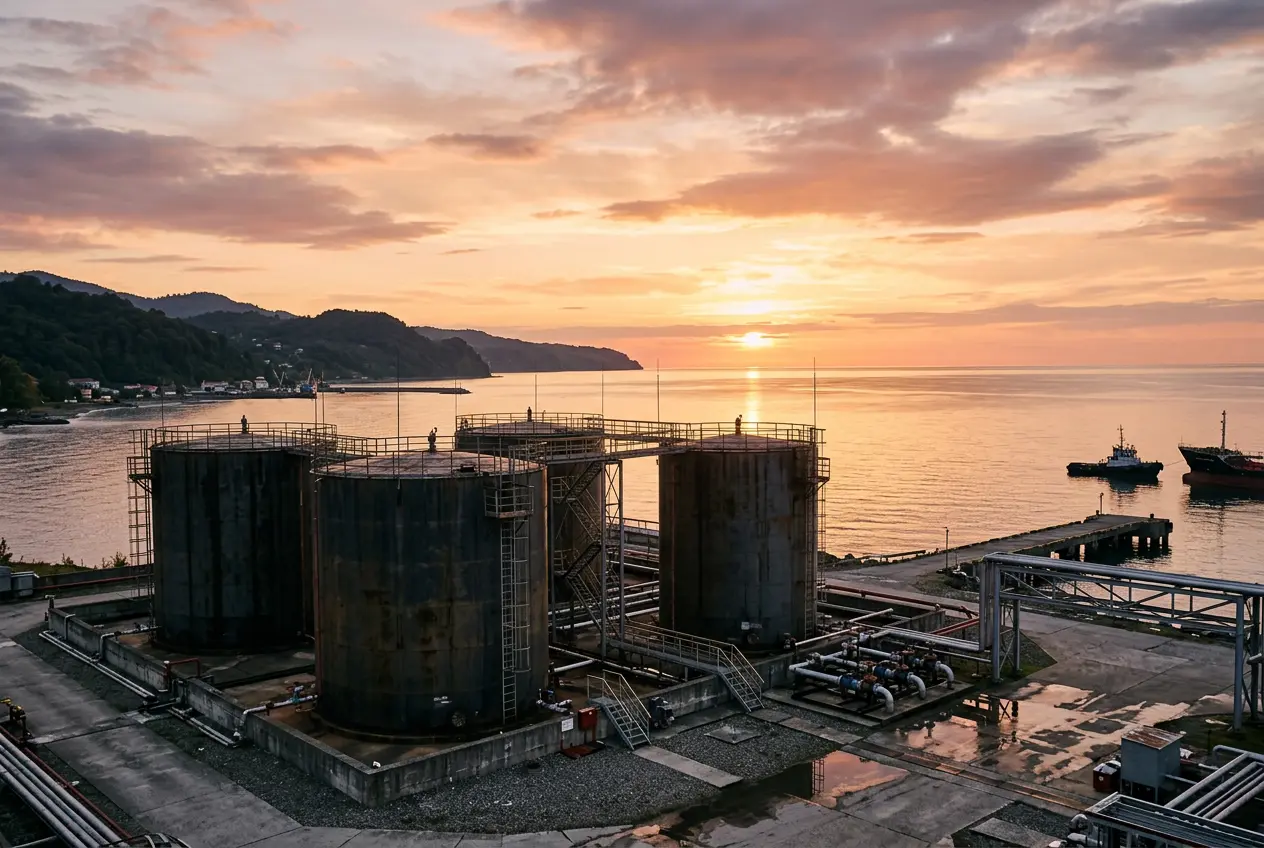
The Supsa terminal sits in Georgia’s Lanchkhuti district and consists of four oil storage tanks, each with a capacity of approximately 40,000 tonnes, where crude is held before being loaded onto tankers. The pipeline system includes six pump stations (three in Azerbaijan, three in Georgia), two pressure reduction stations in Georgia, and 59 block valves along the route. A year-long shutdown in 2007 was followed by a full re-commissioning programme that wrapped up in the first quarter of 2008, leaving the line in continuous service through the early 2020s.
The pipeline’s design capacity and lifetime throughput frame the scale of the asset being transferred:
- Length: 837 km from the Sangachal terminal near Baku to the Supsa terminal on Georgia’s Black Sea coast
- Diameter: 530 mm
- Capacity: 145,000 barrels per day, equivalent to about 7.5 million tonnes of oil per year
- Lifetime volume: nearly 738 million barrels transported from the start of commercial operations to April 1, 2026, per SOCAR data
- Supsa storage: four tanks totalling roughly 160,000 tonnes of crude
The Contract Clause Behind the Handover
Birrell’s framing in Baku pointed to a specific mechanism written into the Baku-Supsa contract. “Under that agreement, operatorship is transferred in each country to the government, as the owner, and the government then determines the operator,” he said, per the report carried by Georgia Today. In practice, that means Azerbaijan’s government and Georgia’s government, not the consortium, now choose who runs the pipeline on their soil.
BP’s exit from operatorship does not mean BP is exiting the asset. The Western Route Export Pipeline is owned and operated by the Azerbaijan International Operating Company on behalf of the ACG PSA Parties, a consortium of which BP is the largest single shareholder. SOCAR Midstream Operations, the SOCAR subsidiary that took over on June 8, was created in early 2015 specifically to manage Azerbaijan’s strategic stakes in onshore export oil and gas pipelines, per the company’s June 9 statement on the transfer. The unit was set up against the backdrop of the same contract cycle that is now triggering the Baku-Supsa handoff.
The Baku-Supsa transfer is part of a wider pattern of Western consortia handing Caspian operating control to Azerbaijani state interests. BP’s larger Baku-Tbilisi-Ceyhan (BTC) pipeline, the consortium’s other main Caspian-to-export crude line, is also being prepared for a similar handoff to SOCAR under a separate contractual schedule. The two pipelines have defined Western-led Caspian export since the late 1990s; both are now passing into Azerbaijani operatorship.
BP’s place in the Baku-Supsa partnership remains significant on paper. The WREP partner roster, as listed on the operator’s project page for the Western Route Export Pipeline, splits ownership across nine companies:
- BP, 35.8%
- SOCAR, 11.6%
- Chevron, 11.3%
- INPEX, 11%
- Statoil, 8.6%
- ExxonMobil, 8%
- TPAO, 6.8%
- Itochu, 4.3%
- ONGC, 2.7%
A Route That Has Been Largely Idle Since 2022
The Baku-Supsa pipeline has carried little oil in recent years. Operations have been largely suspended since 2022 due to increased shipping risks in the Black Sea caused by Russia’s full-scale invasion of Ukraine, with only limited volumes moving through. According to the annual report of the Azerbaijani Energy Ministry, 90,000 tonnes of oil were pumped through the pipeline in 2024, and 150,000 tonnes moved in 2023.
Those volumes are a fraction of the pipeline’s 7.5 million tonne annual capacity, leaving the system at a small fraction of design throughput. The agreement signed in May 2026 between SOCAR Midstream Operations and the Georgian Oil and Gas Corporation, captured in Baku-Supsa’s restart role for Central Asian oil, sets minimum pipeline loading requirements, a signal that Baku and Tbilisi expect commercial flows to rise. Kazakh Energy Minister Yerlan Akkenzhenov told Trend in July 2025 that his country was in “constant contact” with SOCAR about Baku-Supsa as a possible export corridor for Central Asian crude, with Astana weighing the route among its non-Russia options.
The Supsa terminal itself, on the Black Sea coast, is fully ready to resume transportation. The pipeline has not been mothballed, Georgia’s Economy Minister Mariam Kvrivishvili said at the May signing, and the 2008 repairs left the system in working order. Kvrivishvili called the line “strategically important not only for our country and the region as a whole, but also for Europe and international partners,” and Georgian Prime Minister Irakli Kobakhidze signed the operational contract for the Georgian section during a May 2026 visit to Azerbaijan.
The Non-Russia Corridor Stakes
When it opened in 1999, the Baku-Supsa line was the first major non-Russia export route for Caspian oil. Built under the 1996 intergovernmental agreement between Azerbaijan and Georgia, it gave Baku a westward outlet that did not require transit across Russian territory. That bypass function has gained weight since 2022, as European buyers have moved to reduce reliance on Russian crude and on Russian-transit pipelines, a shift documented in US government reference on Azerbaijan’s energy sector.
Kazakhstan’s interest in the route hints at a possible new chapter. Astana is weighing transport corridors that move Kazakh crude to the Black Sea without crossing Russia, and Baku-Supsa is one of the named options. BP’s separate gas pipeline, detailed in the Q1 2026 South Caucasus Pipeline update, is also running near capacity, suggesting the wider Caspian corridor is being rebuilt around non-Russia routes. The Baku-Supsa handoff, in other words, lands at the start of that remaking rather than at the end of the old arrangement.
Frequently Asked Questions
Who now operates the Baku-Supsa pipeline?
SOCAR Midstream Operations, a SOCAR subsidiary created in early 2015 to manage Azerbaijan’s interests in onshore export pipelines, took over daily operations of the Baku-Supsa pipeline and the Supsa terminal on June 8, 2026. The subsidiary’s creation date lines up with the original Baku-Supsa contract timeline. Under the contract BP held, Azerbaijan’s government and Georgia’s government, as owners, have the right to choose who runs the line on their territory.
Does BP still own part of the Baku-Supsa pipeline?
Yes. BP exited operatorship on June 8 but remains a member of the Western Route Export Pipeline consortium with the largest single stake at 35.8 percent. Other partners, per the operator’s WREP project page, include SOCAR at 11.6 percent, Chevron at 11.3 percent, INPEX at 11 percent, Statoil at 8.6 percent, ExxonMobil at 8 percent, TPAO at 6.8 percent, Itochu at 4.3 percent and ONGC at 2.7 percent. The handover moves control of day-to-day operations, not the equity split.
When did the Baku-Supsa pipeline first open?
The pipeline’s roots go back to the April 1996 intergovernmental agreement between Azerbaijan and Georgia that set the route. Construction was completed in November 1998, with first oil pumped in on December 10, 1998, and the first tanker loaded at the Supsa terminal at the end of March 1999. The Supsa terminal itself was formally inaugurated on April 17, 1999.
Why has the Baku-Supsa pipeline been largely idle?
The pipeline has been largely idle since 2022 because of increased shipping risks in the Black Sea tied to Russia’s full-scale invasion of Ukraine. It moved just 90,000 tonnes of oil in 2024 and 150,000 tonnes in 2023, against a nameplate capacity of 7.5 million tonnes a year, leaving the system at a small fraction of capacity. The May 2026 operating agreement between SOCAR Midstream Operations and the Georgian Oil and Gas Corporation sets minimum loading requirements, a signal that Baku and Tbilisi expect flows to rise.
What is the BTC pipeline, and what is happening to it?
The Baku-Tbilisi-Ceyhan pipeline is BP’s other major Caspian export route, running from Baku through Georgia to the Turkish Mediterranean port of Ceyhan. BP is preparing to transfer operatorship of BTC to SOCAR as well, on a separate contractual schedule. Baku-Supsa and BTC together have defined Western-led Caspian export since the late 1990s; both are now passing into Azerbaijani operatorship.