About 82 percent of Georgians identify with the Georgian Orthodox Church, and public trust in the institution still outranks most political bodies even after a long decline from its late-2000s peak. A new Catholicos-Patriarch, Shio III, now leads it after the March 2026 death of Ilia II.
The pattern is older than any recent poll. For centuries the Church functioned as the place that kept the language, the memory and the sense of political continuity alive when foreign powers held the state.
Census Shares and Trust Numbers
The 2024 census records Georgian Orthodox adherence at 82.0 percent. Muslims stand at 11.1 percent, mostly in Adjara and Kvemo Kartli. The Armenian Apostolic Church accounts for 2.59 percent. Smaller Christian groups, those with no religion, and other faiths fill the rest.
| Group | 2024 Share | Notes |
|---|---|---|
| Georgian Orthodox | 82.0% | Dominant national church |
| Islam | 11.1% | Sunni Adjarians, Shia Azerbaijanis |
| Armenian Apostolic | 2.59% | Concentrated in Javakheti |
| Other / none / refused | ~4.3% | Includes Catholics, Protestants, Jews |
Earlier 2014 census figures on religious demography put the Georgian Orthodox share at 83.4 percent and Muslims at 10.7 percent. The op-ed figure of “about 85 percent” sits close to both counts.
An IRI poll in 2023 found 71 percent held a positive view of the Patriarchate, second only to the army at 77 percent. Full trust has fallen sharply since 2008, when three-quarters of Orthodox respondents said they fully trusted the Church; by 2019 that full-trust share sat near one-third while ambivalence rose. Weekly attendance hovers around the European average of 10 to 13 percent. High identification and high institutional trust therefore coexist with modest regular practice.
The Refuge Pattern Across Empires
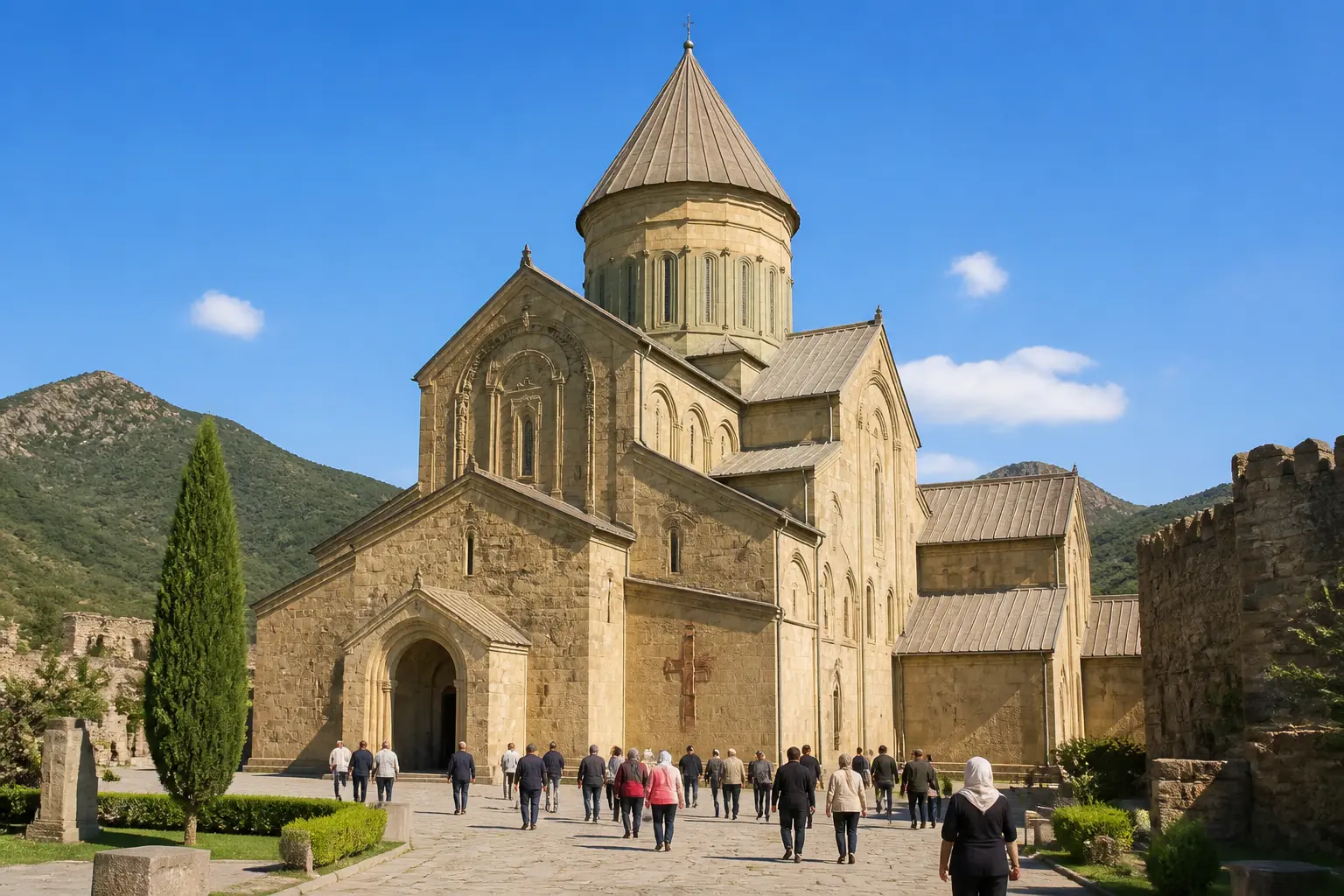
Georgia adopted Christianity as the state religion of Iberia (Kartli) in the first half of the fourth century. Tradition credits St. Nino of Cappadocia and the baptism of King Mirian III around 334-337. The event ranks among the earliest national conversions in Christendom.
- c. 326-337, Iberia adopts Christianity under Mirian III after St. Nino’s preaching; priests arrive from Constantinople.
- 467-491, Autocephaly granted by the Patriarchate of Antioch; the Catholicos of Mtskheta gains local authority.
- 1811, Russian Empire abolishes Georgian autocephaly and folds the Church into the Russian Holy Synod.
- 1917 / 1943, Autocephaly restored de facto then de jure; Soviet rule still closes churches and purges clergy.
- 1990-1991, Ecumenical recognition and post-Soviet independence fuel rapid reopening of parishes and monasteries.
Under Persian, Ottoman and Russian domination the Church became the sanctuary that preserved the Georgian tongue, historical memory and cultural practices. The alphabet itself emerged in the late fourth or early fifth century largely to support evangelization and Scripture. Soviet atheism repeated the pressure: churches were shuttered or secularized, yet the institution survived as a quiet carrier of national continuity. When the Soviet system collapsed, Georgians turned again to the same structure for moral authority and identity after decades of ideological vacuum.
That repeated function explains why the Church still ranks as a national symbol rather than merely a worship body. The same mechanism that kept literacy and liturgy alive under empire now operates under globalization and digitalization.
Right Praise and the Name Itself
The Georgian term მართლმადიდებელი (martlmadidebeli) parses as “the one who rightly praises” or “righteous glory.” Martali means true or correct; dideba means glory or praise. The English “Orthodox” comes from Greek orthos (straight, correct) and doxa (belief, glory, worship). The Georgian form is a calque of the Russian pravoslavnyi and stresses right glorification more than propositional content.
Nugzar B. Ruhadze’s op-ed notes that the English label has long been conventional yet feels less expressive to native ears. The linguistic preference itself mirrors the historical pattern: the Church is valued for the act of right praise that sustains communal identity, not solely for doctrinal precision.
The Georgian Orthodox Church ranks among the oldest continuous Christian bodies, sharing that status with the Ecumenical Patriarchate, Mount Athos and the Greek, Russian, Serbian and Romanian churches. Its international profile stayed modest because of population size, geography and language. Inside Georgia the stature never faded.
Ilia II’s Revival and the Handover to Shio III
Ilia II became patriarch in 1977 when active churches and clergy were few. He reopened parishes as Soviet controls loosened, restored monastic life, and after 1991 oversaw an explosion of baptisms and construction. He introduced large group baptisms in which he personally stood as godfather to every third and subsequent child of married Orthodox couples. Analysts and local tallies credit him with becoming godfather to more than 50,000 children; many saw the policy as a practical response to falling birth rates.
He died on 17 March 2026 at age 93. Crowds reported in the millions filed past during the multi-day farewell in a country of roughly 3.7 to 4 million. The scale itself functioned as public confirmation of the identity bond.
His Holiness and Beatitude Patriarch Ilia, from an atheist communist Georgia to one of the most faithful countries in orthodoxy…
Fr. Daniel wrote that summary on X days after the death; the post drew thousands of likes and framed the arc from near-suffocation to public centrality.
On 11 May 2026 the Holy Synod elected Metropolitan Shio (Mujiri) of Senaki and Chkhorotsku with 22 of 39 votes on the first ballot. He took the name Shio III, becoming the first new patriarch in nearly half a century. Enthronement followed the next day at Svetitskhoveli Cathedral in Mtskheta on the feast of St. Andrew. Shio had served as Locum Tenens since 2017. Some clergy and observers describe him as more hardline than his predecessor on social questions; others expect the Synod to reclaim collegial weight after one dominant figure. The election of Shio III as Catholicos-Patriarch closed an era and opened questions about tone without erasing the underlying historical role.
Identity That Outruns Weekly Practice
Many Georgians who rarely enter a church still tick the Orthodox box. Identifying as Orthodox often functions as a way of identifying as Georgian. The three classic markers-ethnic Georgian, Georgian language, Orthodox affiliation-still shape everyday definitions of belonging for a large share of the population.
- Ethnic and linguistic continuity reinforced by Church schooling and liturgy in Old Georgian
- Historical memory of resistance carried in saints’ lives and feast days
- Moral and family norms treated as national rather than merely confessional
- Public rituals (baptisms, funerals, Easter processions) that draw participants beyond regular worshippers
A 2020 CRRC survey for the Future of Georgia project found the ethno-religious definition still strong even as civic and liberal alternatives gained ground. Orthodoxy ranked as a more important identity marker than ethnicity for many respondents. Urbanization, higher education, migration and digital media have widened the range of views, yet the baseline association persists. Public Easter celebrations amid Tbilisi protests illustrate how the calendar itself can unite people across political lines.
Privileges, Pluralism and the Concordat Frame
The 2002 Constitutional Agreement (Concordat) between the state and the Georgian Orthodox Church grants special rights in education and cultural heritage, tax exemptions, recognition of Church ownership of churches and monasteries, and compensation for losses after the 1811 abolition of autocephaly. The constitution itself notes the Church’s special historical role while affirming independence from the state and religious freedom for all.
Other communities-Muslim, Armenian Apostolic, Catholic, Protestant, Jewish-operate legally. A 2011 law eased registration for groups with historic ties. Discrimination complaints surface, especially against newer or nontraditional groups, and Freedom House-style scores for religious freedom sit at middling levels. In 2024 the ruling Georgian Dream party floated the idea of making Orthodoxy the state religion; senior clergy, including figures later associated with Shio, expressed caution that formal establishment could reduce the Church’s independence under the existing Concordat model.
What we know
- Constitutional special role plus 2002 Concordat privileges remain in force
- Religious freedom is legally protected and multiple faiths maintain communities
- Younger cohorts show more diverse social views than older ones
What remains contested
- Exact degree of political influence versus moral authority
- Whether hardline stances on family and gender slow European integration goals
- How far the new patriarch will shift internal governance toward the Synod
The Church’s contribution to world Orthodoxy has stayed less visible abroad than that of larger centers. Inside Georgia the institution still supplies the continuity that earlier generations sought under occupation. Commemorative coins for 1,700 years of Christianity mark the same long arc the census and the succession now extend.
What the Pattern Suggests for the Next Chapter
Shio III inherits both the trust reservoir and the internal diversity of views. Younger clergy interviewed in earlier studies often support Western education and view Russia primarily as an occupier rather than a spiritual ally; older networks retain warmer memories of the Russian Church. The patriarchate has publicly respected the public’s Euro-Atlantic choice while resisting certain liberal social measures. That dual stance tracks the historical pattern: the Church defends what it sees as the core of Georgian continuity while adapting enough to remain the default identity container.
Urban non-believers and liberal Christians form a growing sector. Their presence does not erase the 82 percent baseline or the habit of treating Orthodoxy as a national rather than purely confessional label. The refuge function that once preserved the language under Persian and Russian rule now operates against cultural homogenization. Whether the new leadership leans harder into conservative social teaching or broadens collegial decision-making, the underlying mechanism that made the Church the nation’s most trusted institution remains the same one that carried it through every prior empire.
Faith here is still bound to survival memory. That is why the numbers and the trust endure even when weekly pews are only partly full.
Frequently Asked Questions
What share of Georgia’s population belongs to the Georgian Orthodox Church?
The 2024 census places the figure at 82.0 percent, down slightly from 83.4 percent in the 2014 census; Muslims form the next largest group at 11.1 percent.
When did Georgia adopt Christianity as a state religion?
Iberia (eastern Georgia) adopted Christianity in the 330s under King Mirian III after the preaching of St. Nino; traditional dates center on 326-337, making it one of the earliest national conversions.
When did the Georgian Orthodox Church gain autocephaly?
Sources place the grant of autocephaly by the Patriarchate of Antioch between 467 and 491; full independence was later interrupted by Russian rule from 1811 until restoration in 1917-1943 and wider recognition in 1990.
What privileges does the 2002 Concordat give the Church?
It recognizes Church ownership of ecclesiastical properties, provides tax exemptions, grants consultative roles in education and cultural heritage, and commits the state to partial compensation for historical losses.
Do most self-identified Orthodox Georgians attend church weekly?
No; weekly attendance runs around 10-13 percent, comparable to many European countries, while a much larger share maintains the Orthodox label as part of national identity.