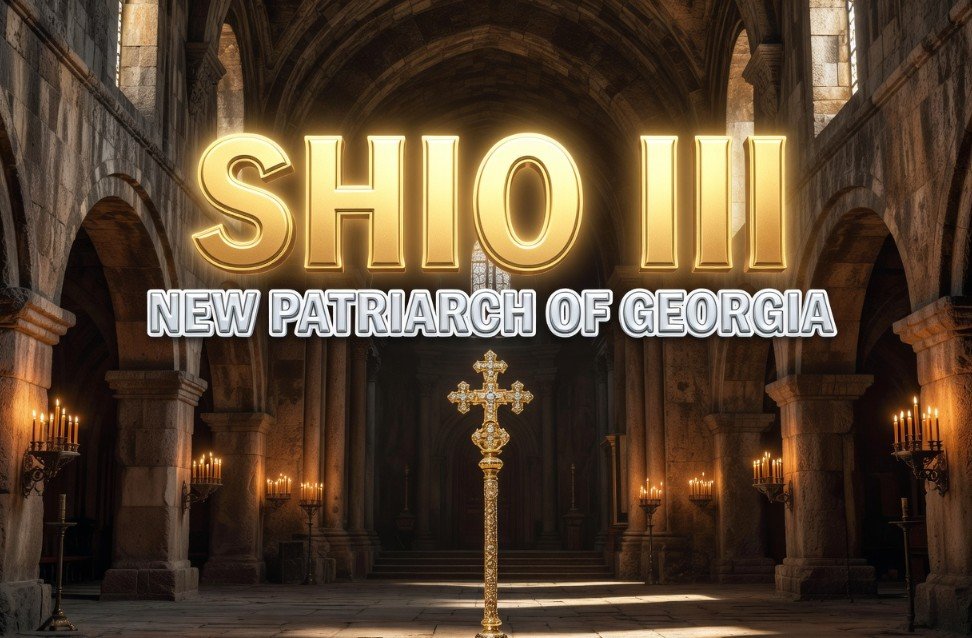
Georgia has a new spiritual leader. The Georgian Orthodox Church elected Metropolitan Shio Mujiri as the country’s 142nd Catholicos-Patriarch on May 11, 2026, less than two months after the death of longtime leader Ilia II. He now carries the name Shio III. But the vote that brought him to power exposed deep divisions inside the church and raised serious questions about faith, politics, and Russia’s reach into the Caucasus.
How Shio III Won the Historic Church Vote
The election took place at Tbilisi’s Holy Trinity Cathedral, known locally as Sameba. Around 1,200 delegates gathered for the expanded church council, but only the 39 members of the Holy Synod held actual voting rights under church law.
Shio Mujiri secured 22 votes, clearing the majority threshold required for election as Catholicos-Patriarch. His two rivals fell well short of the mark.
| Candidate | Votes Received |
|---|---|
| Metropolitan Shio Mujiri | 22 |
| Metropolitan Iob Akiashvili | 9 |
| Metropolitan Grigol Berbichashvili | 7 |
| Annulled | 1 |
The counting took place behind closed doors. Metropolitan Anania Japaridze, chairman of the vote-counting commission, announced the results to the waiting crowd.
This is the first patriarchal election since Georgia regained its independence. The weight of that milestone was felt far beyond the cathedral walls.
The enthronement followed the very next morning, on May 12, at the ancient Svetitskhoveli Cathedral in Mtskheta, just northwest of the capital. Shio III received the symbols of patriarchal governance and officially assumed the titles of Archbishop of Mtskheta-Tbilisi and Metropolitan of Abkhazia and Bichvinta.
The Man Behind the Name Shio III
Born Elizbar Teimuraz Mujiri on February 1, 1969, in Tbilisi, Shio III is 57 years old. His is a life shaped equally by art and devotion.
He earned a diploma in cello performance from the Tbilisi State Conservatory before his calling to religious life. He was ordained as a novice in 1991, tonsured as a monk in 1993, and ordained a priest in 1996.
His climb through the church hierarchy was steady: consecrated as a bishop in 2003, elevated to archbishop in 2009, and appointed metropolitan in 2010.
He completed his theological studies in Moscow, defending his doctoral dissertation at Saint Tikhon’s Orthodox University in 2015. That academic background in Russia would later become a source of lasting controversy.
In 2017, the late Patriarch Ilia II formally designated Mujiri as Locum Tenens, the acting leader responsible for governing the church in the event of the patriarch’s incapacity or death. He held that post until his election this week.
Speaking moments before the vote, Shio III described the Georgian Orthodox Church as “a unifying force for the nation, a defender of the true faith, of the Georgian language, of traditions, and of historical memory.”
A Church Caught Between Faith and Politics
The Georgian Orthodox Church is not simply a spiritual institution. It is one of the most trusted bodies in the entire country, and the choice of its leader carries enormous political weight.
Nearly half of the 39-member Holy Synod did not vote for Shio III, a clear sign that significant internal disagreements remain inside the church.
Critics pointed to his close alignment with the ruling Georgian Dream party. Party founder Bidzina Ivanishvili issued a statement within minutes of the vote, framing the new patriarch’s role in terms that closely matched the government’s own messaging. Georgia’s Prime Minister Irakli Kobakhidze declared, “Today, a historic page has been turned in the life of our nation and Church.”
His ties to Moscow drew equal scrutiny. He completed his doctoral studies in Russia. His appointment as locum tenens in 2017 came shortly after a visit to Tbilisi by a senior Russian Orthodox Church figure, fueling persistent speculation about external influence. Mujiri himself dismissed those allegations in 2017 as “gossip and slander.”
Just days before the election, Holy Synod member Archbishop Zenon Iarajuli went on television and openly called Mujiri the preferred candidate of both Russia and the Georgian government. Two archimandrites who publicly criticized Mujiri were later suspended from clerical duties.
Some observers believe the divided vote could signal a broader shift in church governance. A more assertive Synod may introduce internal checks on patriarchal authority going forward.
The World Reacts to Georgia’s New Patriarch
The election drew immediate responses from governments, religious leaders, and diplomatic missions across the globe. Congratulations came in from every direction.
- The US Embassy called the election “a historic occasion as the first election of a Patriarch since Georgia regained its independence” and voiced hope for deeper engagement with one of the world’s oldest Christian denominations.
- The European Union extended congratulations, expressing confidence in Shio III’s spiritual leadership during a period of global uncertainty.
- Cardinal Kurt Koch of the Vatican’s Dicastery for Promoting Christian Unity sent a warm message, hoping the new patriarch’s ministry would strengthen bonds of friendship and promote fraternal dialogue between the two churches.
- Pope Leo XIV had already written to Mujiri in March, shortly after the death of Ilia II, praying for light, discernment, and strength.
- Patriarch Kirill of Moscow sent congratulations, expressing hope that the traditions of fraternal communion built under Ilia II would continue under the new patriarch.
- Serbian Patriarch Porfirije and Archbishop Ioannis of Albania both offered congratulatory messages.
- Israel’s Ambassador Walid Abu-Haya wished the new patriarch “wisdom, strength, peace, and fruitful service.”
The Vatican connection carries particular significance. Cardinal Koch had attended the funeral of Ilia II in Tbilisi back in March, a ceremony presided over by Ecumenical Patriarch Bartholomew I. The sheer breadth of international reaction reflects just how important the Georgian Orthodox Church is to the wider Christian world.
Georgia’s President Mikheil Kavelashvili also offered his formal congratulations to the new patriarch.
The election of Shio III as Georgia’s 142nd Catholicos-Patriarch closes one historic chapter and opens another that is far from certain. He inherits the mantle of one of the world’s most ancient Christian churches, the trust of millions of faithful Georgians, and a deeply polarized political landscape. Whether he delivers the unity he has promised, or deepens the divisions already visible inside the Synod, is a story that Georgia and the wider world will be watching closely. For the believers who gathered in prayer outside Tbilisi’s Holy Trinity Cathedral and knelt in reverence at Svetitskhoveli, the hope is simply this: a shepherd who protects his flock above all else.
What do you think about the election of Shio III as Georgia’s new Catholicos-Patriarch? Share your thoughts in the comments below.