Georgia’s exports jumped 20% year-on-year in June to $771 million, a Geostat preliminary release showed, with petroleum shipments and metal ores carrying the country’s foreign-trade numbers to their strongest monthly pace of 2026. The $771 million was up $131 million from June 2025, and the same release recorded first-half exports of $3.9 billion at the same 20% annual pace. June imports, by comparison, rose 7% to $1.6 billion. Behind the headline sits a sector shake-up whose biggest mover is a refinery at the Black Sea port of Kulevi that began operations in late 2025.
The same release showed a first-half 2026 import bill of $9 billion, an increase of just 0.7% over the same six months of 2025. Local exports, which strip out re-exports, hit a record share of total exports in the early months of the year, fueled by the start of domestic oil processing. The trade pattern has prompted a former central bank chief to publicly question whether the numbers reflect genuine domestic production.
What the June Number Actually Adds Up To
June exports of $771 million translated to a $131 million increase over June 2025, according to the Geostat preliminary release covered by Georgia Today. Imports rose at a slower 7% pace in the same month to $1.6 billion, up $112 million year-on-year. The country closed the first half of 2026 with $3.9 billion in exports, the same 20% year-on-year growth rate repeated across six months.
The trade gap, by contrast, barely moved: imports over the same six months totaled $9 billion, an increase of just 0.7% versus the first half of 2025. So the headline captures real export momentum, but it does not show the wider gap between what the country ships out and what it buys in shrinking with it.
Geostat’s preliminary release is the survey published for the month of June; final revised figures follow later in the year. Earlier 2026 readings had tracked a similar shape, with January-May total exports rising 19.8% year-on-year to $3.107 billion and the same five-month period logging a $4.224 billion trade deficit. Each month’s headline now borrows momentum from the same underlying shift in the export basket, which leaves a single sector question hanging over the back half of the year.
- June 2026 exports: $771 million (+20% YoY, +$131 million vs June 2025)
- First-half 2026 exports: $3.9 billion (+20% YoY)
- June 2026 imports: $1.6 billion (+7% YoY, +$112 million vs June 2025)
- First-half 2026 imports: $9 billion (+0.7% YoY)
How a 20% Jump Was Built
The sector engine is concentrated in a small number of goods, and the mix looks nothing like the year’s earlier months. Geostat’s full breakdown for January-April 2026, the most recent sector breakdown Georgia released for January-April, shows petroleum and metal ores doing most of the lifting.
Passenger cars, the country’s perennial export leader, fell sharply in the same period, dropping 29% to $537.4 million as the post-2022 re-export boom continued to unwind. Oil and petroleum products, meanwhile, more than decupled: $324.1 million worth of shipments in four months, a 922% year-on-year jump. Precious metal ores and concentrates joined the surge at $225.1 million, up 134%. Ferroalloys and copper ores also climbed into double digits, with copper ores and concentrates up 119% to $80.1 million.
The pivot follows the start of operations at the Black Sea Petroleum refinery in Kulevi, Georgia’s first full-scale oil refinery, which received its first crude cargo in October 2025. Hazelnuts, copper, and precious metal ores expanded into Asian markets, helping carry the export line even as car re-exports fell. Alcoholic beverages were the rare category to print a decline in the four-month list.
Strip out re-exports, goods resold in roughly their original form without substantial transformation, and the picture sharpens. Geostat’s local-export measure, designed to capture domestically produced goods, reached $1.551 billion in January-April 2026, up 73.5% year-on-year, the highest four-month total on record, surpassing the prior $1.2 billion peak set in 2022. The local share of total exports hit 63.6%, the highest level Geostat has recorded for that period. Petroleum products accounted for roughly one-fifth of all local exports across the four months, and the petroleum line now drives the total.
| Commodity | Jan-Apr 2026 | YoY change |
|---|---|---|
| Passenger cars | $537.4 million | -29% |
| Oil and petroleum products | $324.1 million | +922% |
| Precious metal ores and concentrates | $225.1 million | +134% |
| Ferroalloys | $94.6 million | +92% |
| Copper ores and concentrates | $80.1 million | +119% |
| Natural grape wines | $73.5 million | +2% |
| Hazelnuts and other nuts | $59.7 million | +58% |
Where the Goods Are Going
The new commodity mix is shipping to a different set of destinations than the older re-export trade. Geostat’s January-May 2026 ranking, set out in the trading-partner ranking from Geostat, put Kyrgyzstan in the top spot at $355.2 million of Georgian goods, followed by China at $327.5 million and Azerbaijan at $269.3 million. The top ten destinations accounted for 70.3% of all exports across the five-month stretch, a concentration that has held for several reporting periods.
Among local exports, the leading destinations were China, Russia, and Turkey, with copper and precious metal ores heading into the Chinese market as those shipments expanded considerably. The reorientation runs in parallel with Tbilisi’s broader political and economic tilt toward Beijing. The same period saw motor cars fall sharply as a share of the export basket, even as the per-country totals continued to grow across the top destinations.
- Kyrgyzstan — $355.2 million of Georgian exports (January-May 2026)
- China — $327.5 million of Georgian exports (January-May 2026)
- Azerbaijan — $269.3 million of Georgian exports (January-May 2026)
The Refinery at the Center of the Surge
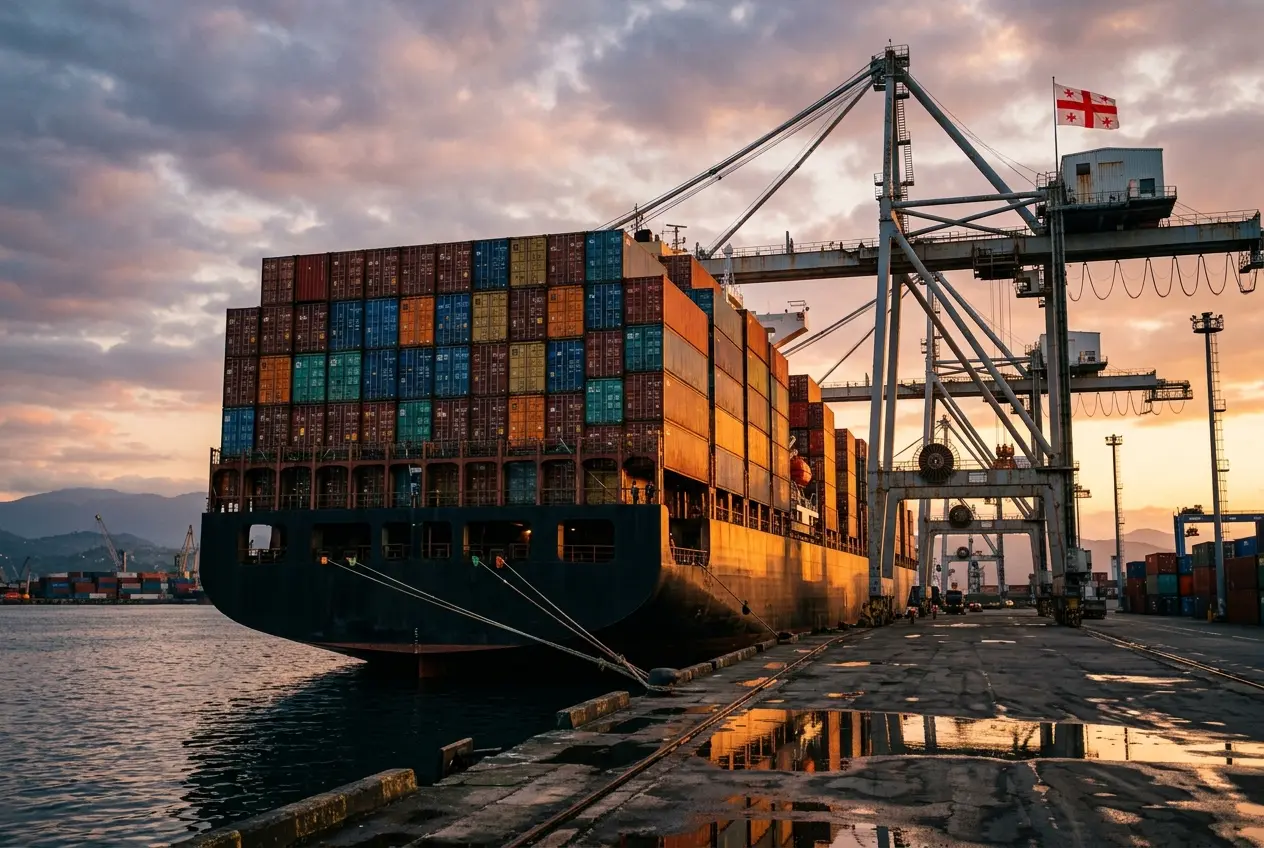
Black Sea Petroleum’s Kulevi refinery, which began receiving Russian crude in October 2025, sits at the heart of the export numbers. The first cargo arrived on the tanker Kayseri from Russneft, and within three weeks the vessel had been added to the EU sanctions list as part of the “shadow fleet,” per an investigation into the Kulevi refinery sanctions question.
The investigation traced the refinery’s ownership and supply chain, finding that in January 2026 alone Georgia exported $56 million worth of petroleum products that it classified as domestically produced, a 3,300% year-on-year jump. The figure, the investigation argued, far outstrips anything Georgia can credibly refine from its own crude inputs, and points toward Russian petroleum being re-labeled as Georgian to reach European markets. Public response from Tbilisi was not reported in the investigation.
Geostat, asked by reporters, attributed the discrepancy to possible three-way trade with resale. Under international trade rules, however, the country of origin is the country where a good is produced or substantially transformed, not the country from which it is shipped.
Geostat’s January-May 2026 release puts petroleum and petroleum oils at $366.6 million, 11.8% of total exports and second only to motor cars. Black Sea Petroleum’s owner, former model Maka Asatiani, acknowledged at the refinery’s October 2024 launch that the project “would have been impossible without effective work and significant support from the government, as well as the participation of state and local institutions,” per The Insider’s reporting. The facility is the only one in Georgia with a full crude oil refining cycle, with phase-one capacity set at 1.2 million tons of crude per year.
There is Togo in the list, which is the African country that does not need unfinished semi-processed diesel products. This means exporting Russian petroleum products by circumventing sanctions.
Roman Gotsiridze, former head of the National Bank of Georgia, raised the point when asked to read the latest trade data.
What the Trade Picture Still Buries
The same January-May release showed a $4.224 billion trade deficit, equal to 40.5% of total external trade turnover. Motor cars remained the country’s biggest single import line at $1.251 billion and 17.1% of all imports, with Turkey ($1.162 billion of imports), Russia ($983.4 million), and China ($849.7 million) the top three sources. June’s 7% rise in the import bill offers an early signal that the gap may begin widening again in the second half of the year.
Georgia’s statistics office has acknowledged that re-exports, goods resold in roughly their original form without significant domestic processing, can muddy the export line. Investigative reporting in early 2025 found discrepancies between Geostat’s data and the trade databases of Spain, Greece, Italy, Belgium, and the Netherlands, with international records showing oil shipments from Georgia that did not appear in the country’s outbound statistics.
The pattern echoes what Gotsiridze called “blurry and unclear” indicators in his reading of the data. Local-export growth, which strips out re-exports, is meant to give a cleaner read on domestic activity, but even that figure is being driven heavily by petroleum products. The Kulevi facility’s entrance has shifted the meaning of the local-export line in the same direction as the headline number. The question that hangs over the data is now embedded in every monthly Geostat release that includes petroleum.
What Changes When Russian Crude Stops
Georgia’s only full-cycle refinery is scheduled to phase out Russian crude by September 2026, the Moscow Times reported, after EU sanctions warnings. Black Sea Petroleum announced the shift to alternative crude sources in early July, marking a reversal of the supply chain that built its initial export surge. For the first time, the petroleum line on Georgia’s trade tables faces a structural pullback, not just the normal monthly wobble. The replacement crude will come from sources other than Russia, the refinery confirmed. Geostat’s own framing of re-exports as a separate line item has not changed.
The trade picture for the rest of 2026 will depend partly on whether the replacement crude produces the same export volume. The Insider investigation warned the port at Kulevi remains at risk of EU sanctions for as long as the origin of those shipments remains in dispute. Tbilisi has not been reported to have publicly responded to the sanctions allegations. Black Sea Petroleum has said only that it is changing its sources, and Geostat has not revised its methodology, leaving the September deadline to phase out Russian crude as the next test for the headline number.