EU foreign ministers approved the bloc’s largest-ever sanctions slate against Russia on Monday, blacklisting 250 individuals and entities in a single batch, even as the wider 21st sanctions package remained unsigned and the oil price cap approached Wednesday’s scheduled adjustment.
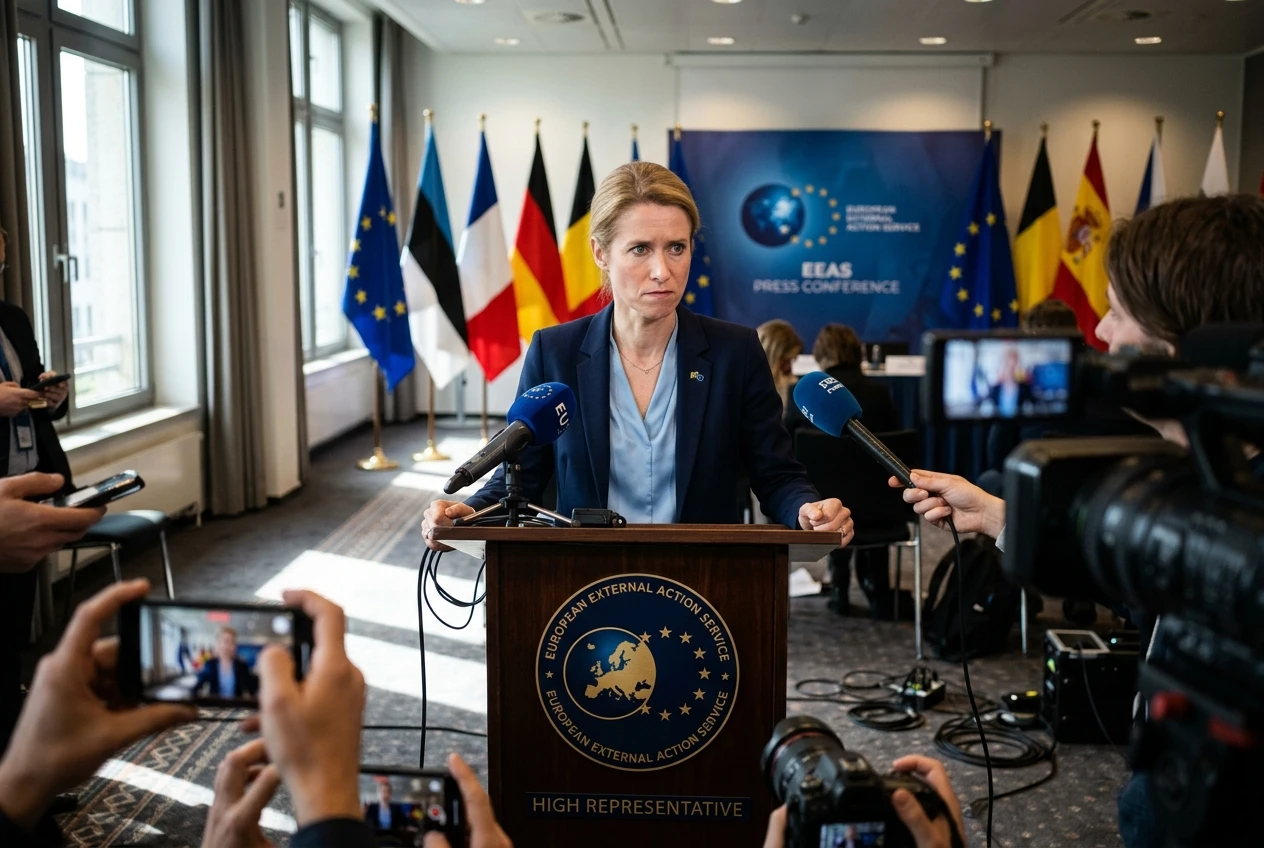
EU foreign policy chief Kaja Kallas told journalists in Brussels ahead of the Foreign Affairs Council meeting that ministers were “hoping that we get 250 listings agreed,” calling it “the biggest number of listings we have done so far.” When it came to the broader package, she was blunt: “When it comes to the 21st package, there are still some open questions.” Lithuanian Foreign Minister Kęstutis Budrys was blunter still, warning that “we cannot put economic interests above security interests … that is a very dangerous trend.”
A Record Slate, Smaller Than It Sounds
The 250 names approved on Monday came straight from Kaja Kallas’s press conference remarks after the Foreign Affairs Council. “I hope that today we will be able to approve 250 new entries on the sanctions list. We will also continue working on the 21st package, on which we have not yet reached unanimity,” she said. The new listings “constitute our biggest round of individual sanctions since Russia’s 2022 invasion,” per her formal remarks. Blacklisting bars the named individuals from entering the EU and freezes their assets, while listed entities are barred from any economic activity within the bloc.
The vote was the ninth time in a row by the Foreign Affairs Council to impose new sanctions on Russia, and Kallas framed the slate as “a reaction to the attacks that Russia has had on the civilians recently.” The new entries specifically target detention facilities holding prisoners of war and Ukrainian civilians, a topic that opened Monday’s ministerial session. Ukrainian human rights defenders Oleksandra Matviichuk and Maksym Butkevych attended that morning’s discussion at Kallas’s invitation.
That record is the upside of the day. The downside is the wider package it was meant to feed.
- 250 names added in a single day, the largest batch since the 2022 invasion
- Ninth consecutive Foreign Affairs Council imposing new Russia sanctions
- Listed individuals barred from EU entry; their assets frozen
- Listed entities barred from any economic activity within the bloc
- Detention facilities holding POWs and Ukrainian civilians now in scope
The 21st Package Keeps Losing Teeth
The 21st package was unveiled by European Commission President Ursula von der Leyen on 9 June 2026 with the line “Our sanctions keep biting hard and cutting deep,” and was originally meant to land by 15 July. EU ambassadors met in Brussels on 12 July and failed to agree. Foreign ministers gathered on 13 July and, as of Kallas’s midday remarks, still had not.
How the 21st package’s oil-cap mechanism follows the 20th helps explain why every cut matters. Items have been dropping off the draft one by one. Kallas acknowledged at the press conference that “fish has been eliminated from the package.” A proposed entry ban on Russian soldiers has been narrowed to short-stay visas and individuals who “took direct part in the full-scale invasion,” per EU diplomats. The visa ban is “not a visa ban for former combatants soldiers, it will be something much softer,” Kallas said. A proposed ban on selling LNG tankers to Russia and on the transit of Russian LNG through EU waters is also unresolved.
Bulgaria secured the most visible concessions. Russian Patriarch Kirill (secular name Vladimir Gundyaev) and Lukoil founder Vagit Alekperov are no longer on the draft list.
Bulgarian Foreign Minister Velislava Petrova told reporters in Brussels that “Bulgarian reservations were taken into account and these two individuals are no longer in the proposed package, so on our part we are ready to support the package.” Prime Minister Rumen Radev had framed the Kirill objection by saying “the time of crusades” is over. On Alekperov, Radev warned that blacklisting him would mean “shooting ourselves in the foot,” because Lukoil has filed a €3 billion compensation claim against the Bulgarian state. Bulgaria also extracted the removal of a Russian citizen linked to spare parts for Sofia’s metro system, according to Petrova.
What Happens If the Cap Lapses on Wednesday
The 21st package was always tied to the oil price cap. Under the rules adopted in the 18th package, the EU’s cap on Russian seaborne oil is currently set at $44.10 per barrel, and must be automatically adjusted every six months to remain at 15% below the average market price. The next review is scheduled for 15 July. Ireland’s Foreign Minister Helen McEntee told journalists in Brussels that the cap is “set to lapse unless action is taken,” per a report from the day’s Brussels quotes on the cap, fish, and Bulgaria.
The mechanism was not designed to handle shocks like the closure of the Strait of Hormuz, which has driven global oil prices higher. The European Commission proposed freezing the cap at $44.10 for another six months, until January. One legal analysis, Foley Hoag’s review of the package, puts the alternative at “up to $70 per barrel” by 15 July if the mechanism runs.
Greece, Cyprus, and Malta have objected to the postponement, citing their shipping sectors that continue to transport Russian oil. A diplomat told Euronews that any adjustment “should therefore be carefully calibrated in coordination with our G7 partners.” Energy Commissioner Dan Jørgensen pushed back: “We are not in a situation where we are stepping down or in any way loosening our pressure on Russia.” That cap sits inside a longer sequence of oil restrictions that includes the EU’s 14th sanctions package on Russian energy, which first locked in oil-sector restrictions.
We cannot put economic interests above security interests. That is a very dangerous trend.
The line belongs to Kęstutis Budrys, Lithuania’s foreign minister, speaking to journalists at the Foreign Affairs Council in Brussels on 13 July.
Five Holdouts and What Each One Wants
Budrys captured the day’s mood in one line. Kallas, asked the same question at her press conference, said simply: “Yes, I also regret that we do not have an agreement on the 21st package. Although, I must say that we are quite close.”
Germany, Denmark, Ireland, and Lithuania are pushing to land the package this week. Germany’s Foreign Minister Johann Wadephul told reporters in Brussels that “the agreement will not happen today, but in the next few days. Europe must show this week that it is capable of acting.” Denmark’s Foreign Minister Lars Løkke Rasmussen said agreement “may not be today, but it should be within a few days.” Ireland’s McEntee added: “I think what’s very clear from the room is that there is a determination from all member states that we would agree the strongest possible package.” Kallas framed the goal more bluntly: “the call was to really focus on ending this war that we are trying to do, with putting more pressure on Russia.”
Five capitals are reshaping the package line by line. Bulgaria’s objection is religious and commercial. The rest stem from oil, cod, and oligarch assets.
Even with Bulgaria’s wins, Petrova warned that without agreement on the package, there could be “consequences for the current oil price ceiling and possible price increases after July 15.” A separate, older dispute is back on the table: Austria has renewed its demand to lift sanctions on Rasperia, the Russian investment company linked to oligarch Oleg Deripaska, last raised publicly during discussions on the 19th package. The Bulgarian foreign minister’s confirmation that Kirill and Alekperov are out came at her doorstep remarks in Brussels on Monday morning.
- Bulgaria: removed Patriarch Kirill and Lukoil founder Vagit Alekperov from the draft after PM Rumen Radev framed the Kirill objection as “the time of crusades” being over and the Alekperov move as “shooting ourselves in the foot” because of a €3 billion compensation claim Lukoil filed against Sofia.
- Greece: leading resistance to freezing the oil price cap, fearing that a low cap pushes ships carrying Russian oil to reflag outside the EU, costing Athens shipping revenue.
- Cyprus and Malta: alongside Greece, object to the cap freeze because their shipping sectors transport Russian oil.
- Portugal: resisting Commission proposals to limit imports of Russian cod and pollack over fears for its fish-finger industry; cod (bacalhau) is the national dish.
- Austria: renewing demands to lift sanctions on Rasperia, the Russian investment company linked to oligarch Oleg Deripaska.
The Other Decisions on Kallas’s Brussels Day
Beyond the 250 listings, the ministers adopted several other Russia-linked measures. “For the first time, the EU and the UK simultaneously sanctioned the broader ecosystem that enables these attacks, including criminals, hacktivists, and companies operating on Moscow’s behest,” Kallas said at the press conference. “This is the largest EU cyber sanctions package ever adopted.” The EU will also summon a Russian representative to Brussels over Moscow’s cyber campaign.
Ministers adopted sanctions targeting Russia’s prison system and agreed to increase support to NGOs helping victims of arbitrary detention. They also launched a new informal group to coordinate international action for the release of Ukrainian civilian detainees, with Kallas calling the evidence of torture and sexual violence “overwhelming.”
Ministers reviewed the EU’s Black Sea strategy. Since launch last year, the bloc has initiated 65 projects worth around €200 million across the region, with Romania and Bulgaria co-leading a new maritime security hub. Aviation-sector measures have their own enforcement line, including the EU’s 16th sanctions package on airlines operating in Russia. Moldova received an additional €120 million under the European Peace Facility to strengthen its air defences, the bloc’s biggest support package to date for Chișinău.
Before I was in this job, I did not know that fish are so geopolitical. Like fish are really, really something that are hindering all important geopolitical processes.
The line came from Kaja Kallas, the EU’s High Representative for Foreign Affairs and Security Policy, at the Foreign Affairs Council press conference in Brussels on 13 July.
Where the Talks Go From Here
The 250 listings are in. The cyber package is in. The prison-system sanctions are in. The oil price cap remains unresolved with two days to go.
One EU official, on condition of anonymity, told reporters in Brussels that “one or two days more or less don’t really matter.” Wadephul and Rasmussen both put the realistic landing window at “the next few days.” If ambassadors split the package, diplomats said, the price cap could move alone as early as 13 or 14 July, with the rest left to later talks.