Samsung’s Galaxy Z Fold8 hit 1.44 million domestic preorders in a week and has already drawn young women and longtime iPhone owners who now call the regular phone a dad device. The thinner passport-shaped foldable is rewriting who wants a Galaxy.
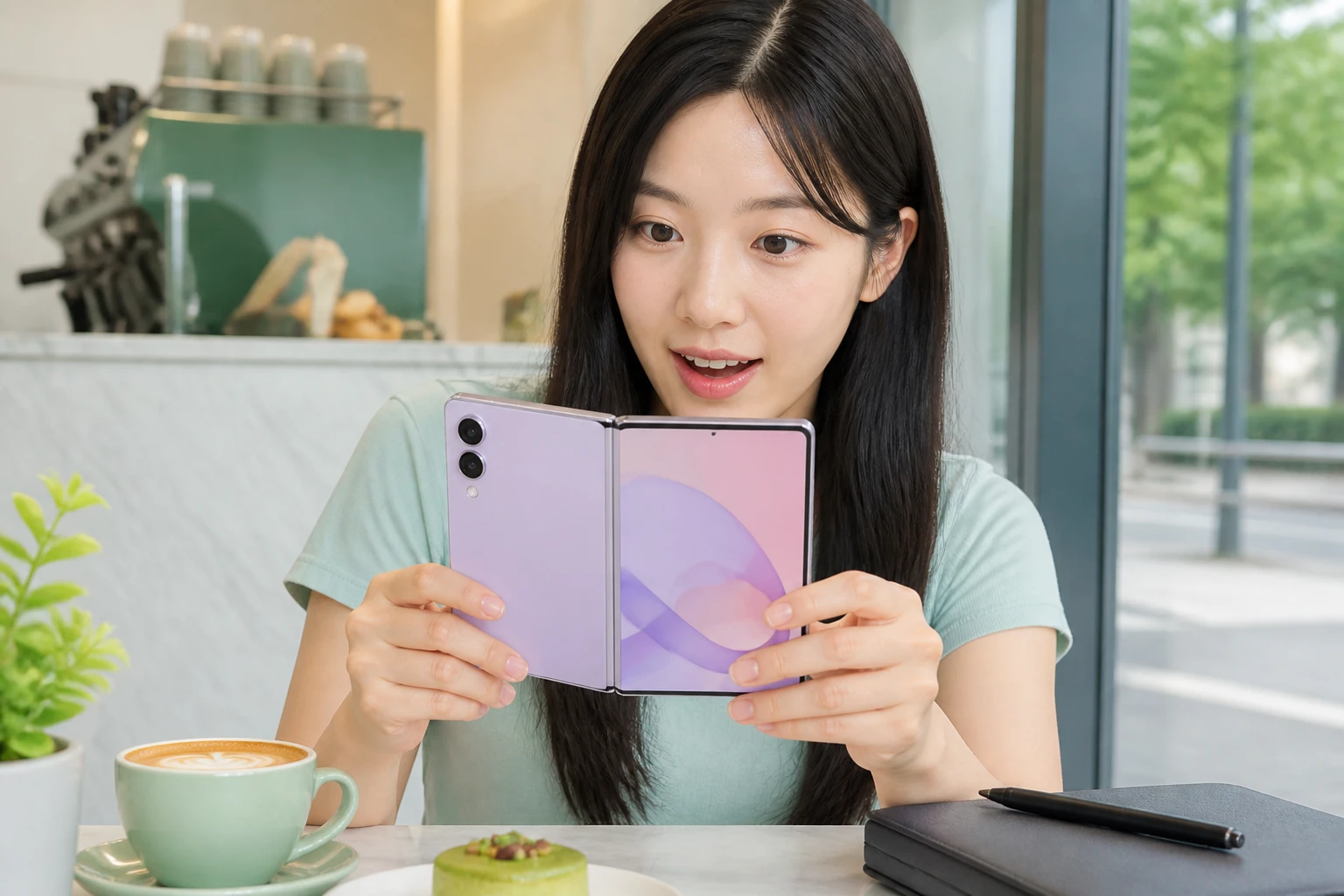
At Samsung Store Hongdae in Seoul, teenage girls headed straight for the Fold8, folding it open for selfies and declaring they really wanted one. The same scene is playing out in Japan and on social feeds where Apple loyalists post tearful goodbyes.
That shift is visible in more than store traffic. Buyers who once treated foldables as niche gadgets now treat the Fold8 as a first-choice phone. The change rests on size, weight and a form that finally feels personal rather than experimental.
Passport Size Finally Fits One Hand
The Fold8 weighs 201 grams, the lightest Samsung Fold ever, and measures 4.5 mm thick when open. Closed it sits at 9.7 mm and roughly the footprint of a passport, short and wide enough for true one-hand use.
Samsung’s own product page calls out the 201 grams lightest Fold yet and the new 4:3 main display paired with a 10:16 cover screen built for social feeds. Earlier Folds felt like tablets that folded. This one feels like a compact phone that opens into a content canvas.
- 201 g total weight, down from prior generations
- 4.5 mm unfolded thickness with Flex Titanium support
- 7.6-inch 4:3 inner screen for video and multitasking
- 5.5-inch cover screen sized for one-thumb scrolling
The short-wide shape matters as much as the grams. Closed, the phone stays pocketable. Open, the 4:3 inner panel gives video and split apps room without the tall stretch of earlier Folds. The cover screen’s 10:16 ratio matches the feeds people already scroll all day.
A 28-year-old office worker surnamed Cho pulled the phone out at a cafe and immediately drew a staff question about the new model. At a company dinner the unfolded screen pulled every eye at the table. “It’s like dating, you have to like it first before you start paying attention to the specs,” Cho said.
That order of attention keeps repeating. People notice the thin body and the passport footprint first. Specs come second, once the device already feels desirable in the hand.
1.44 Million Korea Preorders Break the Note Record
Samsung confirmed the Galaxy Z Fold8, Fold8 Ultra and Flip8 together took 1.44 million preorders in South Korea from late July into early August. That topped the Galaxy Note 10 series record from 2019. The base Fold8 drove most of the volume, with production ramps showing Fold8 production outpacing the Flip.
| Market / Metric | Figure | Note |
|---|---|---|
| Korea series preorders | 1.44 million | 7-day window, all-time Galaxy record |
| Global preorder estimates | ~5 million | Series high, Fold8 largest share |
| US preorders vs prior Z | +30 percent | Fold8 nearly half of total |
| Shipping delays | Late Aug-Oct | Demand outran early stock |
Half of Korea preorder buyers were in their teens, 20s or 30s. Within that group, purchases by women more than doubled versus the previous Fold. Shipping slipped for some configurations as factories chased the surge.
The base model’s lead in volume is a signal. Buyers chased the lighter passport shape more than the Ultra tier. Production followed that demand, pushing Fold8 units ahead of the Flip and leaving some configurations back-ordered into the autumn window.
Global estimates near 5 million preorders put the series at a high-water mark. The U.S. gain of 30 percent against the prior Z generation, with the Fold8 taking nearly half of that total, shows the same pattern outside Korea. Early stock simply could not keep up.
Young Women Doubled Their Buy Rate
Sixty-seven percent of Korean women in their 20s still use iPhones, an industry source noted. The Fold8 spike among teens to 30s therefore lands as a direct dent. At the Hongdae store, 22-year-old Jeong Seo-hee said she had planned an iPhone switch until she tried the Fold8. “I changed my mind because it’s light and the photos have a nice aesthetic.”
Twenty-six-year-old Jeong Da-um moved from an iPhone 17 Pro and posted an unboxing that called the device pretty at first sight. Social posts from former Apple users carried lines such as “The iPhone feels like a dad phone now” and farewell notes from decade-long devotees.
When twenty women in that age band at the store gave first impressions, the words that came first were cute, thin, pretty and interesting. Specs arrived later. Professor Kim Dae-jong of Sejong University said Samsung finally cracked the desirable code it had chased for years: “Stimulating the feeling of ‘I want that’ is the starting point of sales.”
The doubled purchase rate among women in the younger brackets is the clearest demographic break from prior Folds. Those buyers were not waiting for a checklist of camera scores. They responded to how the phone looked closed, how little it weighed, and how the open screen framed photos and feeds.
That path from first glance to preorder also explains the tone of the farewell posts. Decade-long Apple users framed the move as an identity shift, not a minor upgrade. Calling the regular phone a dad device is shorthand for a form factor that suddenly feels older once a thinner foldable is in hand.
Japan Store Reservations Filled Overnight
Japan has long been an Apple stronghold with iPhones holding more than half the market. After the Aug. 7 launch some Fold8 models sold out online and reservations to try the device at Samsung’s Harajuku flagship filled up. IT engineer Leo Yasumura noted a growing view that Samsung holds the edge on foldables even if Galaxy remains a smaller player overall.
The attention is not limited to Asia. US preorders ran 30 percent ahead of the prior Z series. European markets also posted higher early demand. Financing options such as 30-month EMI plans in India have widened the buyer pool further.
In a market where Apple still holds the majority, overnight reservation fills at Harajuku carry extra weight. They show curiosity converting into lined-up demand, not just social noise. Yasumura’s point tracks with that pattern: Galaxy can trail overall and still lead the foldable conversation.
Financing stretches the same effect. Longer EMI terms lower the monthly barrier without changing the sticker price, so more buyers can act on the first-glance reaction before the impulse fades.
Thirteen Years From CES Wallet Vision
The passport idea is not new. At CES 2013 Samsung showed a concept for a 4:3 smartphone that folded like a wallet or passport. Thickness and weight killed it then.
- 2013, CES concept for wallet-style 4:3 foldable revealed
- 2019-2025, successive Galaxy Z Folds refine hinge and crease but stay taller and heavier
- 2026, titanium alloy film 20 times stronger and denser micro-hole plate cut display thickness 12 percent and shrink the crease
- August 2026, Fold8 ships at 201 g with the short-wide form finally practical
Samsung Display’s work on the Flex Titanium layer and reinforced plate turned the old vision into a daily driver. The same display supply chain is already part of the larger rivalry story of Samsung Display panels arming Apple.
This passport design is THE future of foldables. I think Samsung released both as a test. The wide one WINS!
Tech reviewer Vadim Yuryev posted that assessment after weeks with the device, a take that drew strong engagement on X. Other users echoed the compact one-hand feel and the jump in content viewing, while noting that many apps still stretch awkwardly across the new ratios.
The long gap between concept and ship date was mostly materials. Hinges improved year by year, yet the stack stayed too thick and the body too heavy for true one-hand carry. The stronger titanium alloy film and denser micro-hole plate finally cut enough thickness to make the short-wide body practical.
App layout remains unfinished business. The hardware now matches the passport vision; software still has to catch the new proportions so video, chat and multitasking fill the 4:3 canvas cleanly.
Apple’s September Passport Arrives Next
Apple is expected to launch its first foldable, widely called the iPhone Ultra, in September alongside the iPhone 18 series. Leaks point to the same short-wide passport proportions, a roughly 7.8-inch inner display, 5.5-inch cover and a starting price above $2,000. Samsung Device eXperience head Roh Tae-moon said the company welcomes the entry because more players expand a mature market.
Counterpoint Research projects the global foldable market will grow 21 percent in 2026. Samsung is forecast to keep the lead at a projected 32 percent foldable share, down from 40 percent as Apple takes an estimated 25 percent in its debut year and Huawei holds 24 percent. Liz Lee of Counterpoint noted Samsung’s maturity and channel edge still matter even as Apple raises awareness and the premium bar.
| Company | Projected 2026 Share | Context |
|---|---|---|
| Samsung | 32 percent | Lead retained, down from 40 percent |
| Apple | 25 percent | Debut year estimate |
| Huawei | 24 percent | Close third |
Form-factor shifts tend to lock in for years once they stick. Samsung’s immediate task is converting the first-glance “I want that” reaction into daily habit through software, AI features and price discipline. Professor Lee Seong-yeob of Korea University said the device already delivers both design and performance; holding the top spot will require keeping the AI ecosystem strong and the price competitive.
The leaked iPhone Ultra outline mirrors the Fold8’s proportions almost line for line: short-wide body, large inner panel, 5.5-inch cover. That convergence suggests the passport shape is settling as the category default, not a Samsung-only experiment. A debut price above $2,000 also sets a premium ceiling that keeps the Fold8’s own pricing under pressure.
The Passport Shape Resets Buyer Expectations
Earlier Folds asked buyers to accept extra bulk for a bigger open screen. The Fold8 flips that bargain. At 201 grams and 4.5 mm open, it asks less of the pocket and still opens into a 7.6-inch canvas. That trade is what younger shoppers and former iPhone owners are responding to in stores and on social feeds.
The doubled buy rate among women in their teens to 30s, the dad-phone farewell posts, and the overnight Harajuku reservations all point the same way. Desire now starts with how the closed phone feels in one hand. Spec sheets and camera charts arrive only after that first reaction sticks.
- Closed footprint near passport size for true one-hand use
- Open 4:3 panel built for video, feeds and split apps
- Cover screen ratio tuned to social scrolling
- Weight low enough that the foldable no longer feels like a special-occasion device
Professor Kim’s line about stimulating “I want that” maps directly onto those store quotes: cute, thin, pretty, interesting. Cho’s dating comparison makes the same point from the buyer side. Specs still matter for retention, yet they no longer open the sale.
Software and app scaling remain the open risk. Users already praise the compact carry and the jump in content viewing, then note awkward stretches on the new ratios. If daily apps catch up, the first-glance win can harden into habit. If they lag, the passport shape still wins the unboxing and may lose the second month.
Rivals Raise Awareness While Samsung Holds Channels
Roh Tae-moon’s welcome to Apple is more than polite framing. A larger foldable field lifts the whole category, and Counterpoint’s 21 percent growth forecast for 2026 assumes that kind of broad lift. Apple’s entry is projected to take about 25 percent in year one. Huawei holds an estimated 24 percent. Samsung’s share dips from 40 percent to a still-leading 32 percent.
Liz Lee’s note on maturity and channel strength explains how a smaller slice can still be the stronger position. Samsung already has the retail footprint, the production ramp that pushed Fold8 ahead of Flip, and a display stack it also supplies into the wider industry. Those pieces do not vanish when a new premium name arrives.
Price discipline sits beside the product work. Professor Lee Seong-yeob tied the long game to a strong AI ecosystem and competitive pricing once design and performance are already in place. An Apple starting price above $2,000 gives Samsung room to defend value without racing to the bottom. Financing such as India’s 30-month EMI plans extends that room into markets where monthly cost decides the cart.
The strategic test is conversion speed. Preorder records and sold-out configurations prove the first wave. Holding the lead through 2026 means turning that wave into steady replacement cycles while the passport form becomes the shape buyers expect from everyone, not only Galaxy.
For now the passport Fold8 has done what earlier Folds could not. It made a foldable the object younger buyers and Apple refugees reach for first.