Samsung unveils the Galaxy Z Fold8 family on July 22, and it is not the undisputed foldable champion some coverage assumes. Honor’s Magic V6 already set the technical bar this year. Global shipment data puts Huawei, not Samsung, on top of the category. Yet Samsung is positioned to profit from this fight regardless of which phone wins shelf space, because its display division builds the screen going inside Apple’s first foldable iPhone too.
That is the twist sitting underneath the launch. Samsung Display signed an exclusive, multiyear deal to supply the OLED panels for Apple’s rumored foldable iPhone, the same device Samsung’s phone unit is racing to beat. The mobile business and the display business are not rooting for the same outcome, and both belong to Samsung.
Samsung Display Is Quietly Arming Apple’s Foldable Challenger
Samsung Display has reportedly signed a three year exclusive deal with Apple to supply OLED panels for its foldable iPhone, according to Korean trade publication The Elec. Apple’s qualification process is strict. Its minimum yield requirement is reportedly around 70%, and Samsung Display is said to have cleared that bar by hitting yields above 80% during module production testing.
The panels lean on Color Filter on Encapsulation, a process that removes the polarizer layer and applies a color filter directly onto the encapsulation layer instead. That cuts light loss, lifts brightness, and avoids the cracking a polarizer can cause at a fold point. Samsung Display paired the process with M16, its newest OLED material set, built originally for its own flagship phone screens before Apple ever placed an order.
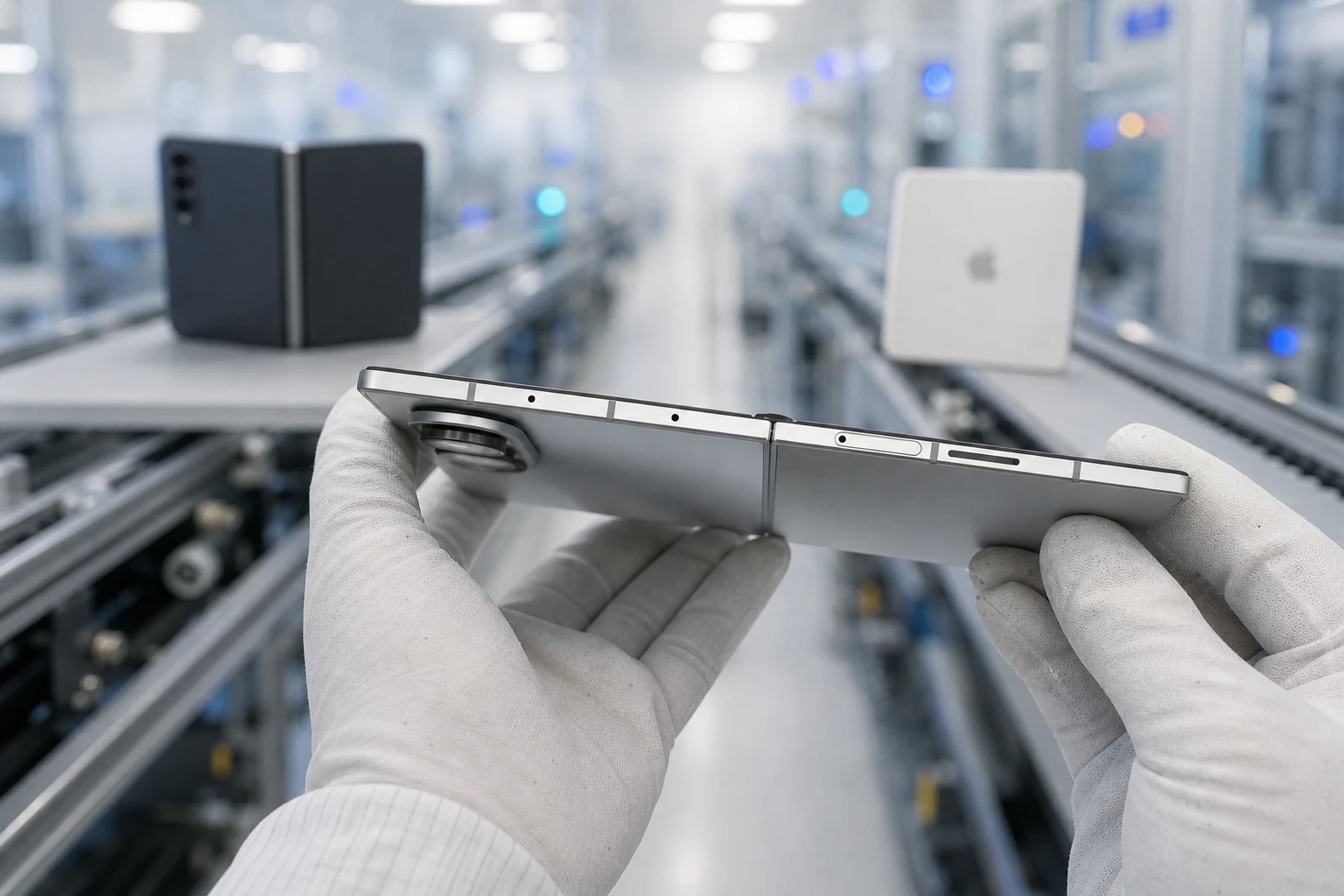
Production is already moving. Samsung Display is preparing an initial shipment of roughly 3 million foldable OLED panels for delivery to Apple this year, running output through its Vietnam facility. The exclusivity cuts deep, too: Apple will not source foldable OLED panels from any other display maker during that three year window.
Why Apple Had Nowhere Else to Go
Apple did not choose Samsung out of loyalty. China’s BOE supplies the foldable panels inside Huawei’s phones, but its panels fall short of Apple’s durability and yield bar, according to industry sources cited by The Elec. LG Display had never built a folding phone screen for a smartphone at all. That left one qualified vendor standing, and it happens to be the same company building Samsung’s own foldable screens.
The arrangement is awkward inside Samsung’s own walls. Samsung’s display division reportedly had to justify the deal internally, since it hands a key component to a direct competitor of Samsung’s mobile business. The math apparently won that argument anyway. Foldables still account for less than 2% of global smartphone shipments, and Apple’s entry is expected to grow that pool and lift Samsung Display’s revenue along with it, whether or not the Galaxy Z Fold8 outsells the iPhone.
Who Actually Leads the Foldable Market
Samsung’s own marketing leans on the idea that it is the foldable category’s top brand. The shipment data is messier than that. Global foldable shipments totaled 3.1 million units in the first quarter of 2026, even as overall smartphone shipments fell 14% year over year.
Huawei’s shipment share fell from 54% to 40% year over year, yet it still topped the category. Samsung’s share nearly doubled in value terms, climbing from 14% to 25% in shipments and from 16% to 31% in revenue, driven by Fold7 and Flip7 promotions in South Korea, Japan, North America and Europe. Honor grew too, from 11% to 19% in shipment share. Huawei’s grip holds mainly in China, where Samsung’s presence is close to nonexistent, while Samsung’s gains are concentrated everywhere else.
Where the trackers disagree:
- Smart Analytics Global’s Q1 2026 report puts Huawei on top globally with 40% shipment share, well ahead of Samsung’s 25%.
- TechInsights forecasts Samsung holding onto the top spot through 2026, even as its lead keeps eroding.
- Older tracking from Electroiq had Samsung’s share climbing to 64% in a prior quarter, a reminder that region and vendor scope shift the ranking depending on whose count you trust.
None of the trackers agree on a single number, but they agree on the shape of the story: Samsung’s grip on premium markets outside China is real, and its claim to the global top spot is not as clean as the Unpacked stage will suggest.
How Does the Z Fold8 Stack Up Against the Magic V6?
Honor’s phone is thinner and carries a much bigger battery. Samsung’s Fold8 Ultra answers with a sharper camera and a titanium build meant to erase the crease almost entirely. Pricing lands close once Honor’s launch discounts are applied, which is exactly the comparison Samsung has to win at Unpacked.
Honor’s own listing puts the Magic V6’s 6,660mAh battery and 8.75mm folded thickness against a Galaxy Z Fold7 battery of just 4,400mAh. Leaked Fold8 specifications suggest Samsung is closing that gap with a titanium display substrate it calls Flex Titanium, aimed at nearly invisible creasing, alongside a jump to a 200MP main camera on the Ultra model.
| Device | Unfolded Thickness | Battery | Chipset | Starting Price |
|---|---|---|---|---|
| Galaxy Z Fold8 | Around 4.5mm (leaked) | Around 4,800mAh, 45W wired | Snapdragon 8 Elite Gen 5 for Galaxy | Around $1,999 / €1,999 (leaked) |
| Galaxy Z Fold8 Ultra | Around 4.1mm (leaked) | Not yet detailed | Snapdragon 8 Elite Gen 5 for Galaxy | Around €2,199 (leaked) |
| Honor Magic V6 | 4.0mm unfolded, 8.75mm folded | 6,660mAh silicon carbon | Snapdragon 8 Elite Gen 5 | €1,699.90 launch price |
| Apple foldable iPhone (“iPhone Ultra”) | Not yet disclosed | Not yet disclosed | A20 chip, C2 modem | Around $2,000 (estimated) |
The industry needs the courage to evolve.
James Li, Honor’s chief executive, said that as the Magic V6’s global rollout began in June. Samsung answers that challenge on July 22, with Apple still waiting in the wings behind both of them.
The Lineup Grows to Three Models
Samsung is not just refreshing the Fold7. Leaks point to a three phone foldable family this year, the widest lineup Samsung’s mobile unit, formally called Device eXperience, has fielded in this category.
- Galaxy Z Fold8, the direct successor to last year’s Fold7, expected to start near $1,999.
- Galaxy Z Fold8 Ultra, a premium tier with the titanium build and 200MP camera, priced near €2,199.
- Galaxy Z Fold Wide, a new and wider body added to the family for the first time this year.
Splitting the range into three tiers spreads Samsung’s bet across more price points at once, covering the ground Honor is attacking from below and the ground Apple is expected to attack from above.
The Value Math Behind the Spec War
Foldables barely register by volume. Omdia’s analysis shows the category makes up only 1.0% to 1.5% of global smartphone shipments, yet one Galaxy Z Fold7 sold at list price generates the revenue of roughly 15 entry-level Galaxy A06 phones. That is why Samsung protects this category so aggressively even though it barely moves the needle on total units sold.
Apple’s arrival is expected to make the category bigger and more lucrative at once. IDC projects Apple will grab over 22% of foldable unit share in its first year, worth 34% of the category’s value, at an average price near $2,400.
By the numbers:
- $38.68 billion is the foldable smartphone market’s projected size in 2026, according to Mordor Intelligence.
- 30% year over year growth is IDC’s forecast for the category in 2026, up from a 6% forecast a year earlier.
- 34% is the share of that market’s total value IDC expects Apple to capture in its debut year alone.
Samsung will find out how this actually breaks within weeks of July 22, as Honor’s discounts keep landing and Apple’s supply chain works toward a contested September target. Samsung Display ships its three million panels to Cupertino regardless of how that race ends.
Frequently Asked Questions
Why isn’t the Honor Magic V6 sold officially in the US?
Honor has not launched the Magic V6 through official US retail channels. Buyers who want one domestically rely on gray market imports of the China or global model, which typically run between $1,900 and $2,300.
What is Color Filter on Encapsulation, or CoE?
CoE is a foldable display process that removes the traditional polarizer layer and applies a color filter directly onto the encapsulation layer instead. That cuts light loss, improves brightness, and avoids the cracking polarizers can cause at a foldable’s bend point.
Is “iPhone Ultra” Apple’s confirmed name for its foldable iPhone?
No. Apple has not confirmed any name. iPhone Ultra is the label that has stuck across leaks and supply chain reports, fitting Apple’s habit of reserving Ultra branding for its highest tier hardware.
What is the Galaxy Z Fold Wide?
It is a third, wider foldable Samsung is reportedly adding to the Z Fold8 family alongside the standard Fold8 and the Fold8 Ultra. Leaks describe passport style proportions closer to the dimensions expected on Apple’s book style foldable iPhone, wider than past Z Fold generations.