Christopher Glass is a production designer whose work has shaped the look of Jon Favreau’s 2016 “The Jungle Book” and Boots Riley’s 2026 absurdist crime comedy “I Love Boosters.” The film school graduate built that career through a route that bypassed the standard climb: storyboards first, pre-visualization second, production design only after he had already worked on films with Ed Zwick and Sam Raimi. In a Q&A with Georgia State University, where he earned his bachelor’s degree in 1996, Glass laid out the path that took him from the back of a commercial-set drawing board to designing the worlds of billion-dollar blockbusters and indie provocations.
The June 15 interview, published by GSU’s School of Film, Media & Theatre, offers one of the more detailed looks at how Glass transitioned from storyboard artist to designer, a move that mirrors the larger trend of filmmakers arriving at production design through the pre-visualization pipeline. It also reads as a quiet counter-argument to the notion that practical filmmaking is finished.
From Storyboards to Production Design
Glass started his career in the early 2000s drawing storyboards for commercials, a job he credits with teaching him the basic grammar of film faster than any film school curriculum could. “Commercials in the early 2000s were a fantastic way to learn basic filmmaking principles,” he said in the original Q&A on Glass’s career path.
The first feature that pushed him toward production design was “The Last Samurai,” where he worked as a storyboard artist alongside director Ed Zwick. “I got to interact with and see what the art, costume, lighting and camera departments were doing. It created a spark in me and led to my desire to create worlds and environments beyond just the drawings on the page,” he said. He moved from storyboarding into pre-visualization supervision on “Spider-Man 3” and “Angels & Demons,” then art-directed VFX for commercials before stepping into production design full-time.
The last feature he storyboarded was “Oz: The Great and Powerful,” which he worked on with director Sam Raimi. By the time Jon Favreau tapped him to design “The Jungle Book,” Glass had spent years working on storyboards, pre-visualization, and VFX art direction, learning how sets, lenses, and light fit together on a working set. “My journey to production designing was unconventional. I knew film language well, but all of the practicalities of designing, budgeting and building sets were things I had to learn on the job,” he said.
The Films That Built His Eye
Glass’s filmography, drawn from his production design portfolio and the full filmography of Christopher Glass, runs from storyboard work in the early 2000s to two of the more visually distinct projects of 2026. The arc, in his own words, was a slow accumulation of “what could actually be shot” through a particular lens. A short list of his feature and television credits:
- “The Last Samurai” (storyboard artist, Ed Zwick)
- “Spider-Man 3” (pre-visualization supervisor)
- “Angels & Demons” (pre-visualization supervisor)
- “Oz: The Great and Powerful” (storyboard artist, Sam Raimi)
- “The Jungle Book” (production designer, 2016)
- “Ms. Marvel” (production designer, 2022 Disney+ series)
- “Kansas City” (production designer, 2018 television movie)
- “I Love Boosters” (production designer, 2026)
The 2016 “Jungle Book” marked a pivotal early production design credit for Glass. It earned him a 2016 Satellite Award nomination for Best Art Direction and Production Design, according to his portfolio page. Since then he has continued to balance big-budget studio work with smaller, more idiosyncratic projects. The through-line is a willingness to follow directors who trust his eye, from Favreau’s hyper-real digital jungle to Riley’s handmade absurdist fashion world.
Designing the World of I Love Boosters
Glass’s latest film is Boots Riley’s “I Love Boosters,” a 2026 absurdist crime comedy that premiered at South by Southwest on March 12, 2026 and opened in U.S. theaters via Neon on May 22, 2026. The film follows a group of shoplifters called the Velvet Gang who take aim at a fashion empire, and the public encyclopedia entry on I Love Boosters lists Glass as production designer alongside costume designer Shirley Kurata and cinematographer Natasha Braier, both of whom he singles out as central collaborators.
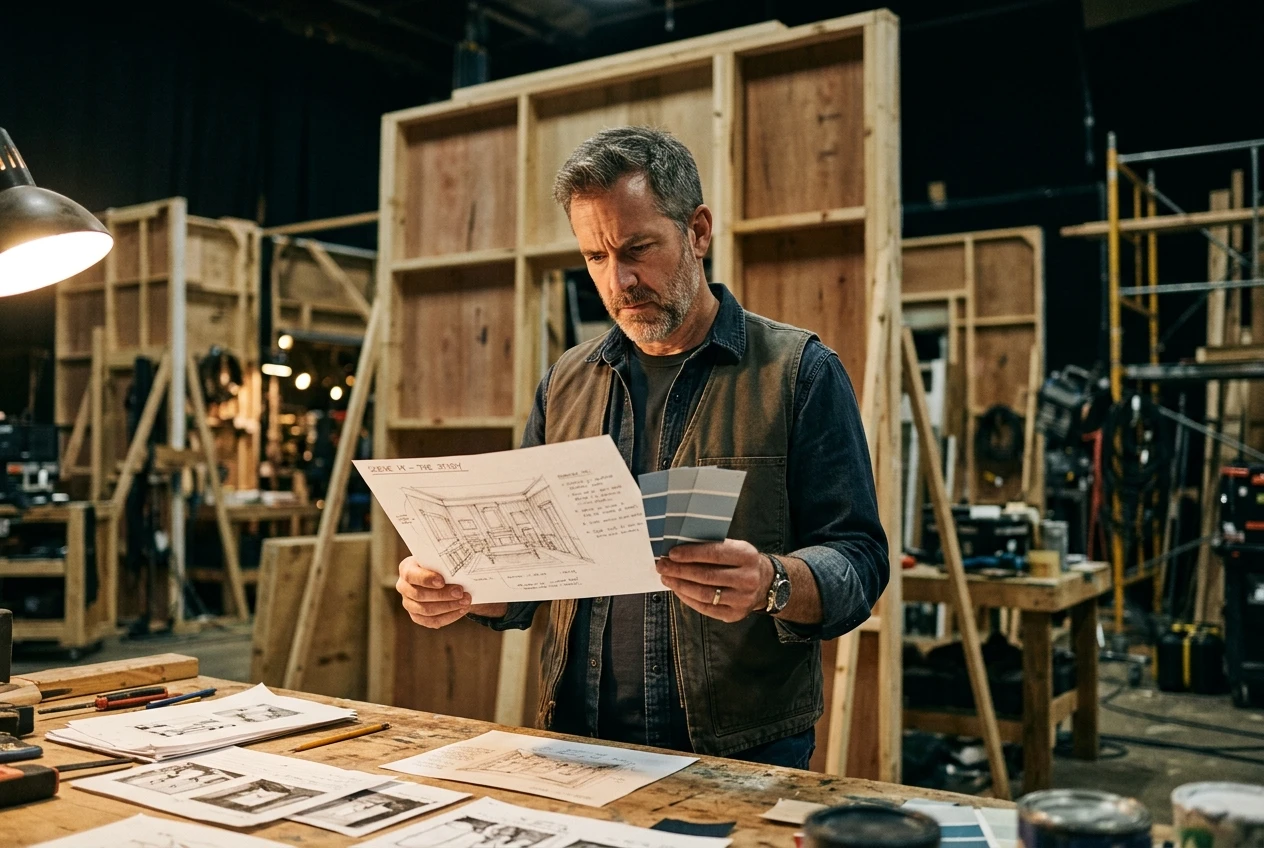
The palette of the film was “a huge collaboration between my department, costumes and camera/lighting,” Glass said. He traded paint chips with Kurata and sent fabric samples and camera tests her way. “I would send them paint samples and they would send me back fabric samples or camera tests,” he said. The whole film, he added, was “a continual collaborative process among all of us working on it.”
Riley’s writing and directing pushed the design into a maximalist register, and Glass matched it by going “straight into set design and pre-vis because we didn’t have much time.” He had to know quickly if the sets would fit the spaces, and he had to know the camera could move the way the script needed. The result is a film “without some ‘magic trick’ we had to pull off correctly” in every scene, he said.
What Georgia State Gave Him
Glass was a film and media major at GSU in the early 1990s and finished his degree in 1996. He credits the program with two things: a film vocabulary he didn’t have, and a senior-year pivot into screenwriting that changed how he thought about design. “The film program introduced me to films I wouldn’t have seen otherwise,” he said.
“I think I knew the language of film inherently from watching movies endlessly as a kid, but GSU helped me put logic and words to what it is,” he added. For his honors thesis, he wrote a screenplay. “Learning the structure of a story and how film writers put ideas on the page is important for understanding any part of filmmaking,” he said. That screenwriting grounding shows up in how he talks about his own work: he calls himself a designer who serves the story and characters.
Sticking With Practical Filmmaking
Glass’s method is built on a stubborn preference for practical effects, even on projects that are mostly digital. In a 2016 interview about The Jungle Book, he described the production’s guiding philosophy: “Jon Favreau, Bill Pope, Rob Legato, me, everyone working on the movie, all of us come from the same philosophy where more practical is better.” The film, he noted, was “98 percent computer generated.”
That approach has earned him industry recognition outside film. His Apple “Welcome Home” commercial won a 2019 Art Directors Guild Excellence in Production Design award, a 2019 D&AD Yellow Pencil, and a 2018 Cannes Lions Bronze Lion in Film Craft, per his portfolio page. His award record, drawn from that page, includes:
| Year | Award | Work | Result |
|---|---|---|---|
| 2019 | Art Directors Guild Excellence in Production Design (Commercial) | “Welcome Home” (Apple) | Winner |
| 2019 | D&D Yellow Pencil, Commercial & Craft | “Welcome Home” (Apple) | Winner |
| 2018 | Cannes Lions Film Craft (Commercial) | “Welcome Home” (Apple) | Bronze Lion |
| 2016 | Satellite Award, Best Art Direction & Production Design | “The Jungle Book” | Nominee |
I love absurdist, surreal, all-handmade and practical movies as he does. We hit it off.
On “I Love Boosters,” production designer Glass said in the June 15 Q&A, the practical impulse showed up in how he approached the look. He went “straight into set design and pre-vis because we didn’t have much time. We needed to know quickly if things would fit into spaces or on stage. We also needed to check if we could move the camera in certain ways through the set.” The film is, by most measures, a digital-effects-heavy production. The sets were still real, and the camera tests were still run on the stages.
The Advice He Tells New Filmmakers
Glass ended the GSU Q&A with a short list of advice for film students. The list is short enough to quote almost in full. “Look at a lot of storyboards. Read many scripts in script format. Make films using your iPhone or whatever you can get. Feed your crew,” he said.
He also pushed back against one of the more common anxieties in 2026 film schools. “Failure is essential to success. Success is fantastic, but I have learned more from failing. Make films for yourself first. There’s plenty of time later to make films for others. If you make something true to yourself, your audience will find you,” he said. His last line is a direct rebuttal to the AI anxiety that has crept into film school hallways. “And don’t give up. Don’t let the tech industry make you think we are going extinct,” he said. For Glass, the lesson of his own career is that the unconventional path is the one most worth defending.
- Study storyboards, regardless of drawing skill.
- Read scripts in script format.
- Make films using whatever you have, including an iPhone.
- Feed your crew.
- Make films for yourself first.
- Don’t give up.
Frequently Asked Questions
Who is Christopher Glass?
Christopher Glass is a Los Angeles-based production designer whose work includes Jon Favreau’s 2016 “The Jungle Book,” the 2022 Disney+ series “Ms. Marvel,” and Boots Riley’s 2026 film “I Love Boosters.” He graduated from Georgia State University in 1996 with a degree from the School of Film, Media & Theatre.
What is Christopher Glass’s role on I Love Boosters?
Glass is the production designer on “I Love Boosters.” He worked alongside costume designer Shirley Kurata and cinematographer Natasha Braier, with the film’s color palette emerging from a back-and-forth of paint samples, fabric swatches, and camera tests between the three departments.
How did Christopher Glass get into production design?
Glass started as a storyboard artist for commercials in the early 2000s, moved into pre-visualization supervision on “Spider-Man 3” and “Angels & Demons,” and transitioned to production design full-time after Jon Favreau asked him to design “The Jungle Book.”
What did Christopher Glass study at Georgia State?
Glass studied film and media at Georgia State University’s School of Film, Media & Theatre, graduating in 1996. He completed an honors thesis in screenwriting during his senior year, which he credits with shaping how he approaches design as storytelling.
Has Christopher Glass won any awards for his work?
Yes. Glass’s commercial work has won a 2019 Art Directors Guild Excellence in Production Design award, a 2019 D&AD Yellow Pencil, and a 2018 Cannes Lions Bronze Lion, all for the Apple “Welcome Home” spot. He was also nominated for a 2016 Satellite Award for Best Art Direction and Production Design for “The Jungle Book.”
What advice does Christopher Glass give to film students?
Glass tells students to study storyboards, read scripts in script format, make films with whatever equipment they have, feed their crew, accept failure as part of the work, and not let the tech industry convince them that film jobs are disappearing.