Maruti Suzuki has launched the Wagon R Flex Fuel in India at Rs 7.24 lakh (ex-showroom), priced as the country's first flex-fuel production car. The single ZXi Plus variant, paired with a 5-speed manual gearbox, is available only to commercial fleet operators at launch.
The flex-fuel version costs Rs 86,000 more than the standard ZXi Plus petrol at Rs 6.38 lakh. The infrastructure that would make the car's E85 capability worth paying for is still being built. India has 50 to 100 ethanol dispensing stations today, against a government target of 5,000 by the end of 2027.
Maruti Puts a Number on the Flex-Fuel Wagon R
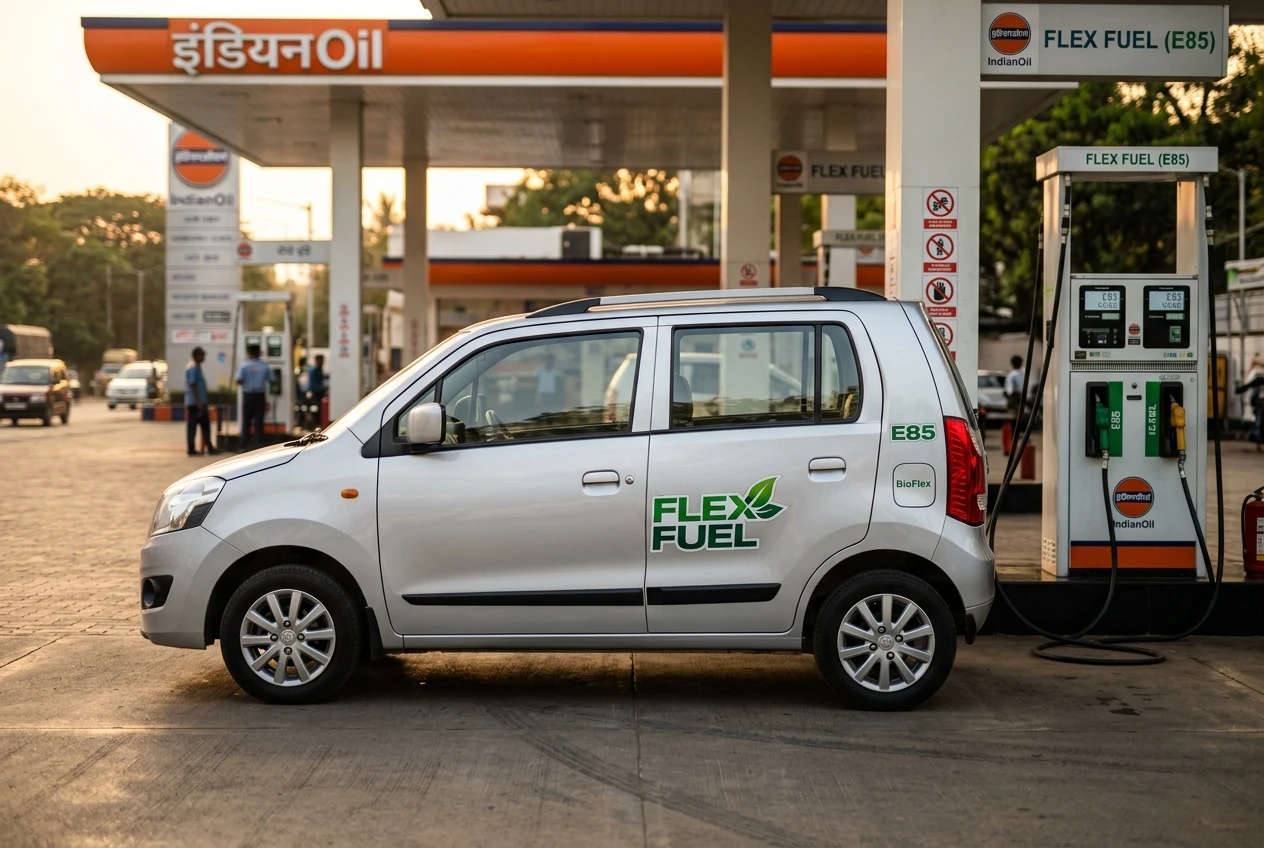
Maruti has launched the Wagon R Flex Fuel in a single ZXi Plus trim, paired with a 5-speed manual gearbox. Per the ZXi Plus Flex Fuel launch and variant details, the car carries a 'Flex Fuel' decal on the side profile, a BioFlex badge on the tailgate, and 14-inch alloy wheels. The interior and exterior follow the standard Wagon R otherwise. The fuel system is the only mechanical change.
Cabin equipment carries over from the regular ZXi Plus: a 7-inch touchscreen with wired Android Auto and Apple CarPlay, four speakers, manual air conditioning with rear vents, and steering-mounted audio controls. On safety, the variant runs to six airbags, electronic stability program, ABS with EBD, hill hold assist, rear parking sensors, and seatbelt reminders for every passenger. The hardware underneath is the engineering delta, with new fuel-system components to handle ethanol.
The fuel system is the engineering delta from the standard petrol K12N. New fuel lines and a recalibrated ECU sit alongside a dedicated ethanol sensor that reads the blend in the tank. The sensor feeds the ECU continuously, letting the engine adapt to whatever mix is in the lines.
The Engineering Behind the E85 Rating
The flex-fuel Wagon R uses Maruti's 1.2-litre four-cylinder K12N petrol engine, paired with a 5-speed manual transmission. The unit develops 91 PS and 114 Nm, the same output as the standard petrol K12N, a deliberate parity Maruti chose to maintain. The fuel system has been reworked from the standard petrol K12N, per the hardware changes on Maruti's 1.2-litre K12N flex-fuel engine.
The flex-fuel version is fitted with upgraded fuel injectors, a sturdier fuel pump, new fuel lines, a recalibrated ECU, and a dedicated ethanol sensor. The sensor reads the blend concentration in the tank and feeds the ECU continuously, letting the engine adapt to whatever mix is in the lines. The mechanical list runs longer than the standard petrol K12N; the sensor and the recalibration are the parts that do the work. The engine is homologated to E85 in India, though it is technically compatible with blends from E20 to E100.
The transmission pairing is a 5-speed manual only. No AMT variant has been confirmed for the flex-fuel model.
Maruti has homologated the car for E85 under the E20-to-E85 range used in Indian certification. The engine is technically capable of running on E100. Maruti has not disclosed fuel-efficiency or E85-specific power figures separately from the petrol unit.
| Spec | Value |
|---|---|
| Engine | 1.2-litre flex-fuel petrol |
| Fuel Rating | Up to E85 Blend |
| Transmission | 5-speed MT |
| Power | 91 PS |
| Torque | 114 Nm |
What the Rs 86,000 Premium Buys
The flex-fuel ZXi Plus carries a Rs 86,000 premium over the standard ZXi Plus petrol, on identical trim and equipment. The standard ZXi Plus petrol starts at Rs 6.38 lakh (ex-showroom). The premium funds the reworked fuel system, the ethanol sensor, and the certification work needed to homologate the car for E85 in India. The result, on the showroom floor, is a single variant with a single transmission and a single engine.
The flex-fuel is the more expensive option in Maruti's commercial-only lineup. The Wagon R Tour H3, sold to commercial buyers in petrol MT and CNG MT forms, is priced from Rs 4.99 lakh to Rs 5.89 lakh, putting the BioFlex Rs 1.35 lakh to Rs 2.25 lakh above it. The Tour H3 is a different vehicle underneath, a 69 hp 1.0-litre naturally aspirated petrol engine, and the gap reflects the larger K12N plus the flex-fuel hardware. Maruti has not released fuel-efficiency figures for the flex-fuel Wagon R. The standard ZXi Plus is rated at 23.56kpl (5-speed MT) and 24.43kpl (5-speed AMT).
| Variant | ZXi Plus Flex Fuel | ZXi Plus Petrol | Difference |
|---|---|---|---|
| Price (ex-showroom) | Rs 7.24 lakh | Rs 6.38 lakh | +Rs 86,000 |
Where the Fuel Comes From (and Doesn't)
The flex-fuel capability is only as useful as the E85 network behind it. Per Union Petroleum Minister Hardeep Singh Puri, India has 50 to 100 ethanol dispensing stations operating nationwide, concentrated in Delhi-NCR and the Mumbai-Pune-Nagpur corridor. Every other petrol pump in the country sells E20, the 20 percent blend that became the national baseline in April 2026.
For a private buyer outside the corridor, the flex-fuel feature is inert: the car runs on E20 at every pump, exactly like a standard Wagon R. The E85 benefit (ethanol's lower price per litre and lower oil-import footprint) only kicks in when the car is filled with E85, which today means a planned route to one of the 50 to 100 stations. Fleet operators with fixed routes and known fuel stops are the ones who can actually use the capability the car was homologated for. That is the calculation behind Maruti's commercial-first launch order.
In the beginning, we will have about 50-100 dispensing stations in the Delhi-NCR and Mumbai-Pune-Nagpur corridor. This will expand to 500 stations by December this year, and god willing, up to approximately 5,000 stations across major Indian cities by the end of next year.
Union Petroleum Minister Hardeep Singh Puri, at the Wagon R Flex Fuel launch, per Business Standard.
The Centre's plan, per Puri's statement at the launch, is to scale the network to 5,000 stations across major Indian cities by the end of 2027. Until then, the flex-fuel Wagon R is a fleet tool more than a family car.
- Today: 50 to 100 dispensing stations in Delhi-NCR and the Mumbai-Pune-Nagpur corridor
- End-2026: 500 stations across major urban corridors
- End-2027: approximately 5,000 stations nationwide
The E20 Mandate That Cleared the Path
Per the Centre's E85 station buildout and E20 mandate details, the Centre notified the E20 rule in February, requiring oil companies to sell petrol blended with up to 20 percent ethanol and a minimum Research Octane Number of 95 across all states and Union Territories. The rule came into effect on April 1, 2026. The flex-fuel Wagon R is the first production-spec flex-fuel passenger car in India. Toyota and Tata Motors have both shown flex-fuel prototypes in the country before, including Toyota's Corolla flex fuel in 2022, the Innova HyCross at the Bharat Mobility Show 2024, and Tata's Punch at the same event, but neither has reached production.
Maruti Suzuki is the first company to take a passenger flex-fuel vehicle into production. The launch is the commercial payoff of an E20 mandate that turned every petrol pump in the country into an E20 outlet. The flex-fuel Wagon R is the first car homologated to use that E20 baseline plus E85, once the E85 stations arrive.
What a Private Buyer Is Waiting On
Maruti has not set a public timeline for retail sales of the Wagon R Flex Fuel. At launch, the variant is sold to commercial fleet operators, including cab aggregators and corporate fleets, with private sales to follow as the E85 network expands.
The first wave of buyers are the ones the E85 network actually serves: fleet operators in ethanol-producing states running fixed routes, who can plan their fuel stops around confirmed E85 stations. A private buyer in a non-corridor city pays the premium for a car whose flex-fuel capability is moot at every local pump. The commercial-first logic is also the only logic the current fuel network supports. Maruti Suzuki Chairman R C Bhargava has separately pitched for stronger policy support for vehicles powered by biogas.
On running cost, two reference points frame the math. Autocar India's E20-versus-E85 fuel-mileage test on a Suzuki Gixxer SF 250 found E85 had 24.40 percent lower fuel efficiency than E20. E85 fuel was 19.58 percent cheaper per litre than E20, in the same test. The Wagon R BioFlex is a different category, so the Gixxer figures don't transfer directly, but the directional tradeoff (pay less per litre, get fewer kilometres per tank) is the same. Puri has said E85 fuel will be priced "significantly lower" than E20 petrol, with no consumer price published.
Until the E85 network scales, the flex-fuel capability is moot for any buyer outside the corridor cities. Maruti has not published a Wagon R BioFlex fuel-efficiency figure for any blend. Private sales are positioned to follow as the E85 network expands, with no public date from Maruti.
- Engine: 1.2L K12N, 91 PS / 114 Nm
- Transmission: 5-speed manual only
- Fuel rating: E85 homologated, E20-E100 compatible
- Price premium: Rs 86,000 over the ZXi Plus petrol
- E85 stations: 50 to 100 today, approximately 5,000 targeted by end-2027
Frequently Asked Questions
How much does the Maruti Wagon R Flex Fuel cost in India?
Maruti has priced the Wagon R Flex Fuel at Rs 7.24 lakh (ex-showroom), in a single ZXi Plus variant with a 5-speed manual gearbox. The standard ZXi Plus petrol is priced at Rs 6.38 lakh, putting the flex-fuel version Rs 86,000 above it.
Is the Wagon R Flex Fuel more powerful than the regular petrol?
No. The flex-fuel 1.2-litre K12N engine produces the same 91 PS and 114 Nm as the standard petrol K12N. The change is in the fuel system hardware, not in output.
When will private buyers be able to buy the Wagon R Flex Fuel?
Maruti has launched the variant for commercial fleet operators only, with no public timeline for retail sales. Private sales are positioned to follow as the E85 station network expands, with the Centre targeting roughly 5,000 ethanol stations nationwide by the end of 2027.
How many E85 fuel stations are there in India today?
Per Union Petroleum Minister Hardeep Singh Puri, India has 50 to 100 ethanol dispensing stations in operation today, concentrated in the Delhi-NCR and Mumbai-Pune-Nagpur corridor. The government's plan is to reach 500 stations by December 2026 and roughly 5,000 by the end of 2027.