Vivo has confirmed the camera and display specs of its next flagship foldable, the X Fold 6, with a 200MP main sensor and the first 200mm teleconverter support on a book-style foldable. The device pairs a Zeiss APO-certified periscope telephoto with the ZEISS 200mm Teleconverter G2, the same accessory that debuted with the Vivo X300 Ultra. The details came from product manager Han Boxiao on Weibo on June 12, 2026, putting the X Fold 6 in line to challenge Samsung’s Galaxy Z Fold 8 Ultra for the most camera-capable foldable of the year.
The X Fold 6 will run on the MediaTek Dimensity 9500 Super Edition chipset and ship with OriginOS 6 Fold, a custom OriginOS build for foldable-specific multitasking. Vivo says the X Fold 6 will launch in China later this month, in June 2026, with pricing yet to be announced. Global release plans have not been discussed. Han Boxiao’s post landed alongside camera samples showing the foldable’s low-light and zoom performance.
A 200MP Main and a Zeiss APO Telephoto
Vivo has confirmed the X Fold 6 will ship with a 200MP primary rear camera, the first foldable from the brand to use one. The sensor is Samsung’s HPB at 1/1.4-inch with an f/1.68 aperture, a meaningful step up from the 50MP main on last year’s X Fold 5. Both the main and telephoto cameras carry CIPA 4.5 image stabilization, a rating Vivo says is essential for the foldable’s handheld shooting modes.
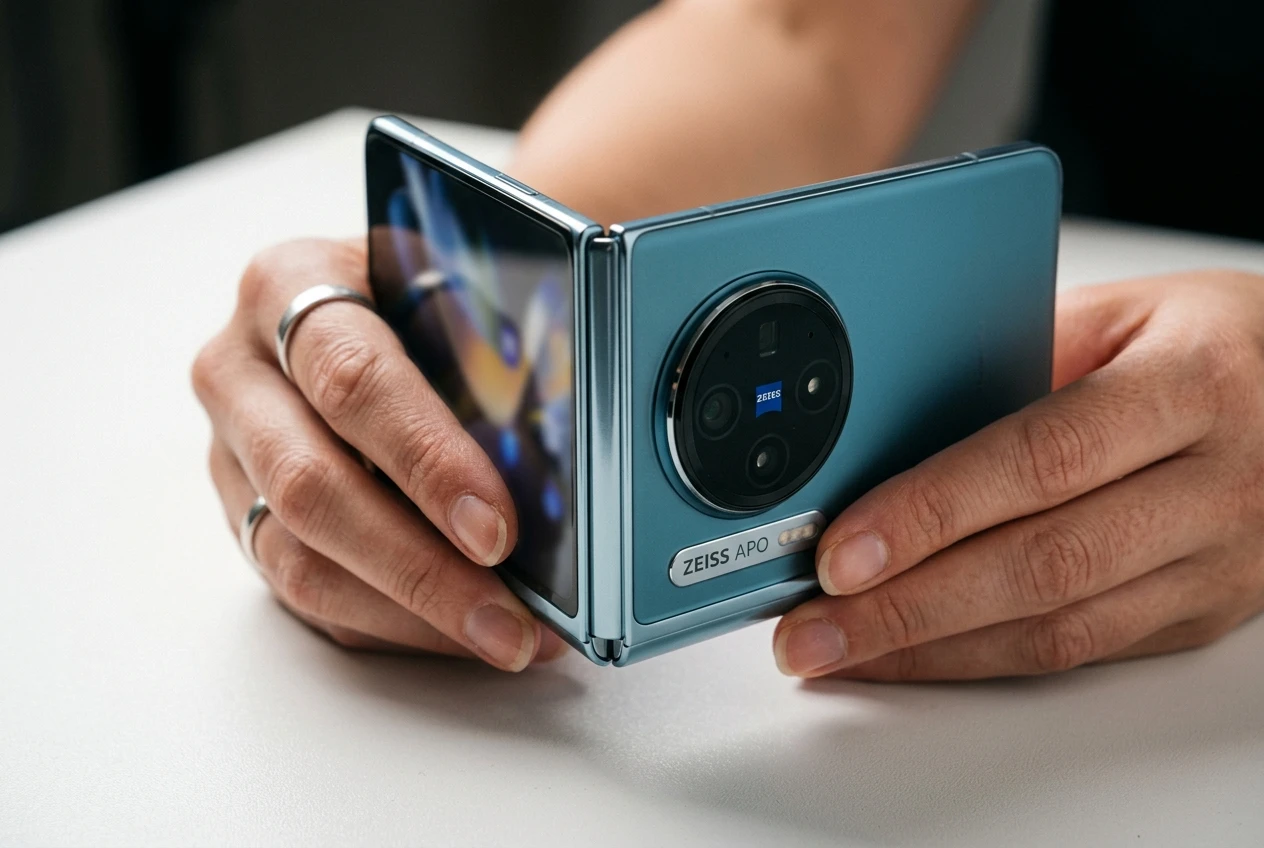
The periscope telephoto is a Zeiss APO-certified unit running Sony’s 50MP LYT-602 sensor, the same 50MP class found on Vivo’s other 2026 flagships. CIPA 4.5 stabilization applies here too, so handheld zoom shots get the same stabilization budget as the main camera. The lens meets ZEISS APO chromatic aberration control standards for long-range image quality. A 50MP ultra-wide rounds out the rear triple, though Vivo has not confirmed its sensor model. The phone supports 50MP output across 23mm to 100mm portrait focal lengths, a wider golden range than most foldables ship with.
The whole imaging system runs on Vivo’s V3+ imaging chip, the same silicon that powers the Vivo X300 Ultra. That ties the X Fold 6’s imaging pipeline to the same hardware shipping in Vivo’s 2026 camera flagship. The V3+ chip also drives the AI Creative Camera features Vivo has rolled out across its 2026 lineup, including Blueprint Natural Colour and Blueprint Palette as the default color profiles.
- 200MP main camera resolution
- 1/1.4-inch Samsung HPB sensor size
- f/1.68 main camera aperture
- 200mm equivalent focal length with ZEISS teleconverter
- 23-100mm portrait focal length range
The First Foldable With a 200mm Teleconverter
The X Fold 6 will be the first foldable phone in the world to support a teleconverter lens, the ZEISS 200mm Teleconverter G2. In practice, the accessory attaches to the rear camera module and extends the periscope telephoto’s reach to a 200mm equivalent, opening up a focal range normally reserved for dedicated cameras. The same accessory debuted alongside the standard Vivo X300 series. The support was confirmed by Han Boxiao in his Weibo post on June 12, 2026.
Vivo has not yet confirmed the foldable will work with the 400mm teleconverter that ships with the X300 Ultra, the larger telephoto kit shown at MWC 2026. For now, the X Fold 6 is locked to the 200mm G2, the same accessory that launched with the standard X300 series. That keeps the foldable’s camera system in the same family as the X300 line, sharing the V3+ imaging chip and Zeiss APO telephoto pipeline. The 200mm range is meant for capturing distant subjects with clarity, including events like concerts and sporting matches, per Vivo’s own positioning.
Vivo is leaning hard into camera credibility for the X Fold 6 launch. Han Boxiao’s Weibo post framed the device in DSLR-like terms, in line with how Vivo positions its X-series flagships. The company’s own product lead, Huang Tao, called the X Fold 6 a “foldable mini-DSLR” in a separate Weibo post about the design.
foldable mini-DSLR
Huang Tao, Vivo’s President of Product, used the phrase in a Weibo post about the X Fold 6’s design. Pricing for the X Fold 6 and the ZEISS 200mm Teleconverter G2, which sells separately, has not been announced.
How Bright the 8.02-inch Display Gets
The X Fold 6 will feature an 8.02-inch inner display built using Samsung’s M14 luminous material, the same panel class used in some of Samsung’s own 2026 flagships. The panel can reach a peak brightness of 5,000 nits and drop to 1 nit for late-night viewing, the widest brightness range Vivo has shipped on a foldable. Both the inner and outer displays hit the same 5,000-nit peak, and both support the 1-nit minimum. The display is also rated for TÜV Rheinland Global Eye Protection 3.0 certification, an eye-comfort standard Vivo has been pushing across its 2026 phones. The M14 material underpins the higher brightness while keeping power draw in check, per Vivo’s claim of 44 percent reduced power consumption versus the previous generation.
The screen is the centerpiece for the phone’s split-view multitasking, with the new OriginOS 6 Fold software built around the larger canvas. The 2K resolution and 120Hz refresh rate make the inner panel well-suited to the foldable’s split-screen mode, where users can run up to five apps side by side with the new Atomic Workbench. The high peak brightness and low minimum brightness make the inner screen usable in both direct sunlight and dark rooms.
The Dimensity Switch and OriginOS 6 Fold
Powering the X Fold 6 is the Dimensity 9500 Super Edition, a chip co-developed with MediaTek over two years. Per Han Boxiao’s Weibo post, the Super Edition tag is new and brings up to a 111% jump in peak NPU performance and a 56% drop in AI power consumption. The standard Dimensity 9500 already powers the X300 series, which Vivo launched in late 2025.
The X Fold 6 marks the first time a Vivo X Fold has shipped without a Qualcomm chipset. The phone runs OriginOS 6 Fold, a custom OriginOS build designed for foldable-specific multitasking. The software adds an upgraded Atomic Workbench with five-app multitasking support, a new AI File Manager, and an AI Voice Engine for on-device commands. These are firsts for the X Fold line, and they go hand in hand with the more demanding NPU work the Dimensity 9500 Super Edition enables.
Battery capacity has not been officially confirmed, though leaks point to a 6,900mAh cell for the X Fold 6. Vivo has also confirmed the X Fold 6 will support a desktop mode with external displays, building on the X Fold 5’s existing PC-style interface. The X300 series, which shipped with the standard Dimensity 9500 and a 200MP Zeiss main in late 2025, gives a sense of where the X Fold 6’s imaging and silicon sit within Vivo’s 2026 lineup.
Vivo’s ‘Blue Hole’ Color and the China Launch
Vivo has officially teased a Blue Hole color option for the X Fold 6, a teal-blue finish that the company has shown off in its own marketing materials. Vivo’s product lead Huang Tao confirmed the design in a Weibo post, showing a more rounded R-corner body with a 2.5D vertical metal frame for better grip. The same color had appeared in earlier real-world leaks ahead of the reveal, and the design is a meaningful departure from the X Fold 5’s flatter frame.
Vivo says the China launch is set for later this month, in June 2026. Pricing for the X Fold 6 and the ZEISS 200mm Teleconverter G2 accessory remain unannounced. Global release plans have not been discussed publicly.
Frequently Asked Questions
When does the Vivo X Fold 6 launch?
Vivo’s own communications point to a China launch in June 2026, though the company has not given a specific date. Pricing for the X Fold 6 and the ZEISS 200mm Teleconverter G2 accessory also remain unannounced. Global release plans have not been discussed.
What makes the X Fold 6’s camera different from other foldables?
The X Fold 6 pairs a 200MP Samsung HPB main sensor with a Zeiss APO periscope telephoto. It is also the first foldable to support the ZEISS 200mm Teleconverter G2, opening up a 200mm equivalent focal length on a book-style foldable.
How big is the X Fold 6’s inner display?
The inner display is 8.02 inches with Samsung’s M14 material, capable of 5,000 nits peak brightness. The same 5,000-nit peak applies to the outer display, and the panel can drop to 1 nit for late-night viewing.
What chipset does the X Fold 6 use?
The MediaTek Dimensity 9500 Super Edition, co-developed with MediaTek over two years. Per Han Boxiao’s Weibo post, the Super Edition brings up to a 111% jump in peak NPU performance and a 56% drop in AI power consumption.
Vivo has not announced pricing for the X Fold 6 or the ZEISS 200mm Teleconverter G2, with both expected to be revealed at the China launch later this month.