Public schools across Georgia will start receiving new textbooks in the coming days, with 1,533,339 copies of 32 titles headed to first-, fifth-, seventh-, ninth- and tenth-grade students for the 2026-2027 year. Educational Resources LLC is running the consolidated tender and says phased delivery to schools and resource centers finishes no later than September 10.
Of those copies, 1,340,044 go straight to public schools. The rest support resource centers and special categories. The books are free.
The Numbers Behind the Delivery
The print run is specific. Thirty-two titles cover the five grades now updating. Public-school students and teachers receive them at no cost. So do certain private-school students: children from socially vulnerable families, children of soldiers killed in the August 2008 war, and all first-graders.
Georgian-language schools in the occupied territories of Akhalgori Municipality and schools in and around the occupied Gali district also get free copies for students and teachers.
| Category | Details |
|---|---|
| Total copies | 1,533,339 |
| Direct to public schools | 1,340,044 |
| Titles | 32 |
| Grades covered | I, V, VII, IX, X |
| Deadline | September 10, 2026 |
Earlier in March the government earmarked GEL 13.4 million for a broader 2026 print run that included more than 1.7 million textbooks and over 2.2 million exercise books under separate tenders. The current consolidated package is the operational follow-through for the grades listed.
- 1.53 million total copies now moving
- Free for public students, teachers and named private groups
- Occupied-territory Georgian schools included
- Phased start this week, finish by mid-September
How the Reform Turned Books Into State Products
This delivery is not a routine restock. It sits inside the National Concept for Reform of the General Education System approved in late January. Prime Minister Irakli Kobakhidze signed the National Concept decree signed in January. The Ministry of Education will move to one state-approved textbook per subject and grade, replacing the old multi-publisher menu.
Full transition is scheduled for completion by September 2028. Until then the state continues printing books from multiple publishers and handing them out free, a practice that began more than a decade ago.
- January 2025: State commission formed to draft the concept, chaired by the prime minister.
- January 27, 2026: Government decree approves the National Concept.
- Early 2026: Parliament amends the Law on General Education, locking in structural changes and the single-textbook path.
- March 2026: Procurement tenders for 2026 print runs announced.
- August 2026: Educational Resources LLC begins delivery of the first updated set for five grades.
The same reform package shortens full general education from 12 to 11 years, makes year 12 optional from 2028-29, sets school start age at six by September 15, requires primary uniforms, and regulates phones in class. The classroom phone storage rules with September deadline belong to the same overhaul.
National Values Move Onto the Covers
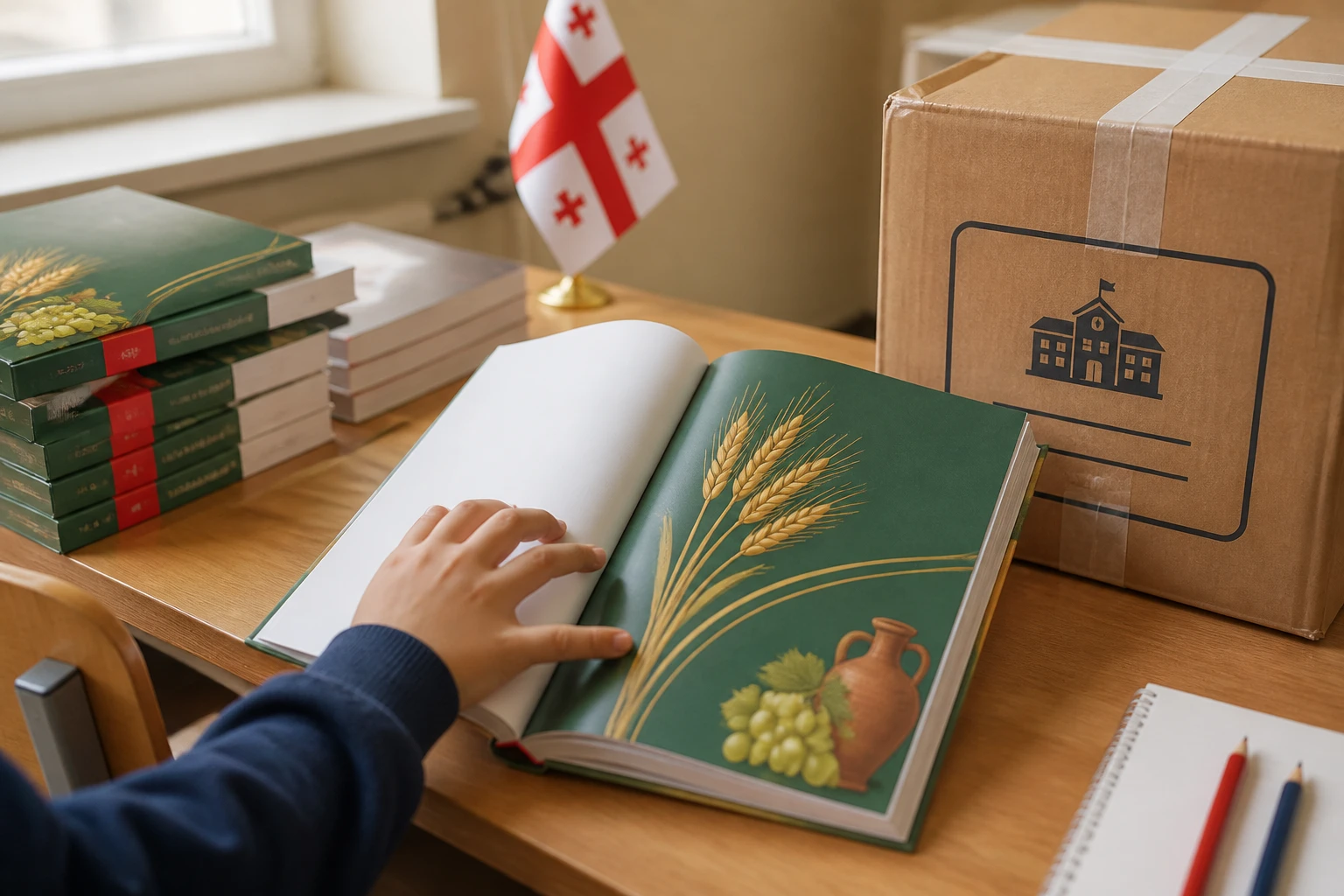
Education Minister Givi Mikanadze has said new covers will feature national achievements and symbols. Chemistry books may show Georgian winemaking. Biology books may carry five ears of Georgian grain. Physics covers could highlight Elguja Medzmariashvili’s satellite work. Georgian-language texts will include quotes and a portrait of the late Patriarch Ilia II, ending one volume with his phrase “Georgia, I love you.”
The state assumes responsibility for producing a single standard textbook per subject for each grade. This process will be completed by September 2028.
Mikanadze made that commitment in late January. He has also paired Ilia II’s “God, Homeland, Human” with Ilia Chavchavadze’s older “Language, Homeland, Faith.” The ministry argues the previous multi-book system left parents dissatisfied and that only publishers object to the change. Critics see content centralization.
Books That Cross the Administrative Line
Free provision extends deliberately beyond government-controlled territory. Students and teachers at Georgian-language schools in occupied Akhalgori Municipality and in and around occupied Gali receive the same free books. The policy treats those classrooms as part of the national system even while the areas remain under de-facto control outside Tbilisi’s reach.
That choice keeps Georgian-language materials circulating where Russian-backed administrations operate. It is a quiet continuity of soft educational presence.
- Public-school students and teachers nationwide
- Socially vulnerable private-school families
- Children of 2008 war fallen soldiers
- All first-graders in eligible private schools
- Georgian-language schools in Akhalgori and Gali-area schools
The 2013 decision that first made textbooks free to public pupils aimed to cut family costs. The current run keeps that promise while folding it into the single-book model.
Publishers Lose the Menu, the State Gains the Pen
Under the old rules, author groups worked with different publishers, submitted books for ministry review, and schools chose among several approved options. The new model has the ministry produce the books through selected experts under a “one book in all schools” rule. Private schools will eventually use the same texts.
Mikanadze has said quality will rise and transfers between schools will become smoother. Publishers lose a commercial channel. Independent authors lose the chance to compete for school adoption. The ministry gains direct control over what every child in the five grades, and later every grade, reads as the official version of each subject.
That concentration is the second-order fact. Equity improves because every public pupil gets the identical free book. Coherence improves because content no longer fragments by publisher. The trade-off is that curriculum power now sits inside one ministry pipeline rather than a competitive market of approved alternatives.
What Changes Inside Classrooms This Autumn
First-graders, fifth-graders, seventh-graders, ninth-graders and tenth-graders open new books. Teachers receive matching free copies. The rest of the grades continue with existing stock until their turn in the multi-year rollout.
Digital supports are promised later: video lessons, simulations, research assignments and virtual platforms meant to reduce pure print dependence. For now the physical books are the tangible piece arriving at school gates.
The broader phased general education reforms from 2026 also tighten school readiness age, embed non-formal clubs and sports inside schools, raise teacher pay pathways, and expand psychologists and social workers. The textbook truck is simply the first vehicle most families will notice.
Families who once bought supplementary books or paid tutors to bridge gaps between school texts and national exams may see less need for that patchwork once single books and in-school exam prep become standard. Whether the single book actually reduces the private-tutoring market remains an open test of the reform’s equity claim.
Educational Resources LLC’s statement is brief and operational: phased delivery begins in the coming days. The larger machinery of the National Concept has been turning since January. The crates now leaving the printers are the first concrete product of that turn.
By September 10 the five grades should hold the new books. By 2028 every grade is supposed to hold only the state’s version. That is the arc this delivery opens.