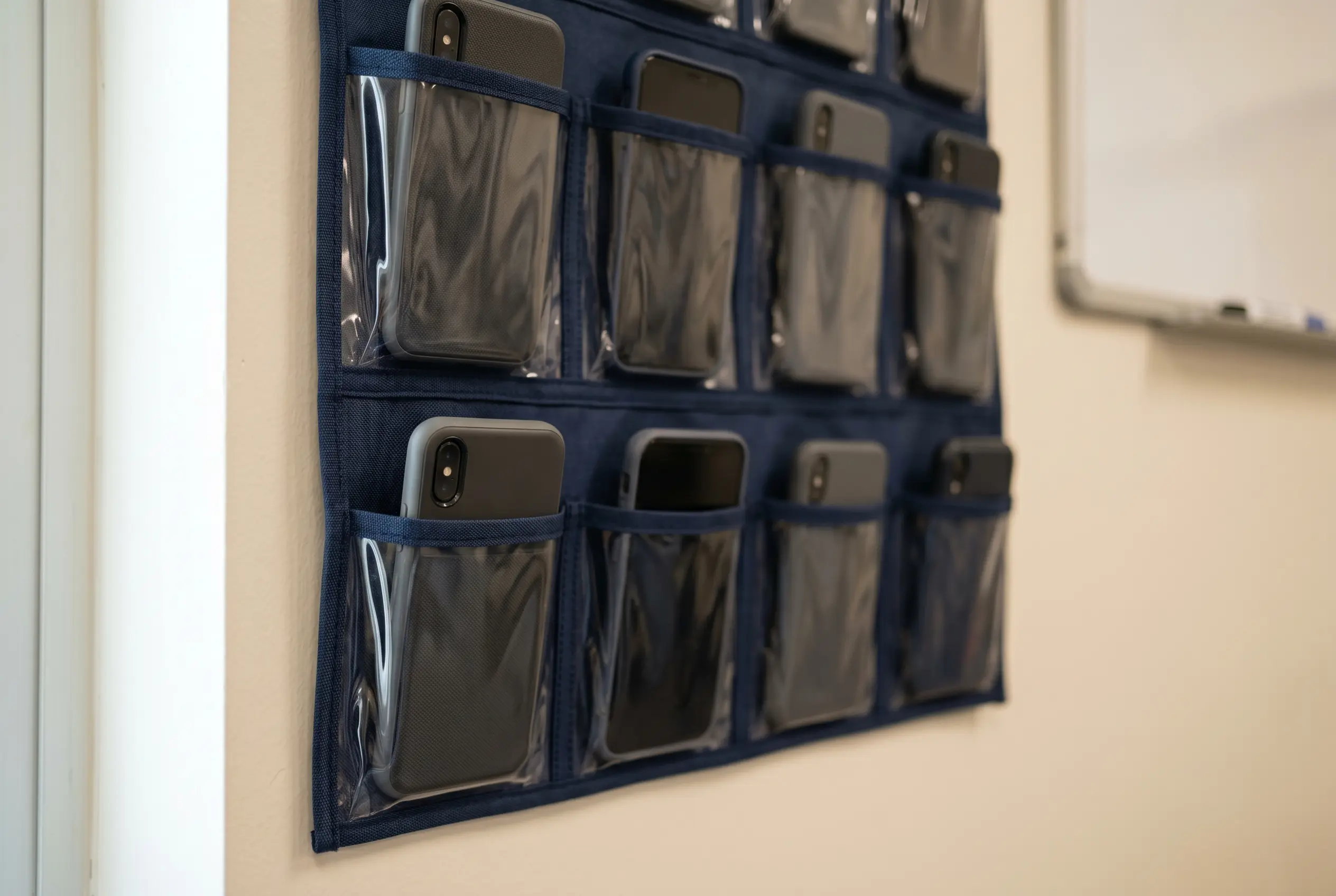
Georgia’s Minister of Education, Science and Youth signed an order on June 5 requiring every school in the country to install dedicated storage units for mobile phones and smartwatches in each classroom before September 1, 2026. The rules, reported by BMG, a Georgian business news outlet, prohibit non-educational use of electronic communication devices during the learning process and require students to deposit their devices before the first lesson of the day. By end of 2024, roughly 40% of education systems worldwide had implemented some form of smartphone restriction, a movement Georgia joined with this June 5 order.
The hardware requirement is specific: storage facilities belong in individual classrooms, not at a central school gate, and schools must purchase and install them before the new academic year. Georgian schools also face a parallel obligation to set up official parent communication channels before September, replacing the direct child-to-parent call that the new rules will cut off during school hours.
Storage in Every Classroom by September 1
The core mechanic of the order is physical. Each classroom must hold enough storage slots for every device students bring, and those slots are tied to that individual room. Students deposit phones and smartwatches before the first lesson and retrieve them at dismissal. The September 1, 2026 deadline is a procurement target as much as a policy date: schools must buy the hardware before anyone can comply with the rule.
Violations are handled as disciplinary matters under school regulations and Georgian law. The order assigns no penalty schedule, leaving each institution to set its own enforcement threshold within those legal bounds. That structure puts meaningful discretion in the hands of individual administrators.
Six circumstances permit a student to keep or use a device during school hours:
- Educational use, with prior authorization from a designated school official
- Health monitoring or other medical needs, backed by documentation submitted by a parent or legal guardian to the school
- Emergencies and urgent situations
- Students with special educational needs or disabilities, on a joint decision by an inclusive education specialist (where available), the class teacher, and the parent or legal guardian
- Individual learning or functional needs confirmed by an appropriate specialist
- Other circumstances specified in a school’s own internal regulations
That final carve-out is the broadest. Schools can draft additional exceptions into their own rules, meaning the policy’s effective reach will differ from institution to institution. Ireland, which similarly mandated lockable storage for a nationwide school phone ban, secured €9 million in dedicated government funding to equip its schools; Georgia’s order leaves procurement costs to each individual school.
A Global Wave That Took Eight Years to Reach Tbilisi
France was the first government to act at national scale, with a law covering students in primary and middle schools through age 15 that took effect in 2018. The stated goals were to reduce distraction, improve academic performance, and rebuild face-to-face interaction among students. Early friction in French schools gave way to what most education observers described as basic compliance by the end of the first academic year. France launched a further pilot in 2024 covering more than 50,000 pupils at 180 middle schools, requiring children to hand in phones as they arrive, testing what nationwide physical collection demands in practice.
A 2025 comparative review of school phone restriction policies across European and Asian systems traced China and Canada following by 2019, and Denmark, Sweden, and England adopting similar measures in subsequent years. Hungary went further in September 2024: Government Decree 245/2024 designated mobile phones, tablets, laptops, and smartwatches as prohibited or restricted items in all Hungarian schools, with use allowed only through explicit authorization from a teacher or principal.
The Czech Republic is currently weighing its own legislation, and South Korea’s National Assembly has a bill under discussion citing declining grades and rising student absenteeism. Georgia’s order fits the established template so closely that it reads as straightforward adoption. The Georgian government announced its intention to regulate classroom devices at the end of 2025; the signed order arrived roughly six months later.
Behind each of those national decisions sat broadly similar concerns: declining international assessment scores in countries with high adolescent smartphone use, rising anxiety and depression rates among young people with heavy screen exposure, and teacher reports of classrooms where attention spans had measurably shortened. An EU analytical report on smartphone policies across member states found that by end of 2024, roughly 40% of education systems worldwide had implemented some form of restriction, driven by those overlapping concerns.
| Country | Effective year | Scope | Enforcement approach |
|---|---|---|---|
| France | 2018 | Primary and middle schools (through age 15) | National law, school-level enforcement |
| China | 2018 | Primary and secondary schools | National directive |
| Canada | 2019 | Province-level policies | Varied by jurisdiction |
| Hungary | September 2024 | All schools (Decree 245/2024) | Prohibited items designation |
| Georgia | September 2026 | All schools | Ministerial order, school-level enforcement |
What the Classroom Data Shows
The academic evidence for phone bans is real, but the range of findings is wide enough that proponents and critics can each cite peer-reviewed research to make their case.
What the Test Score Studies Found
Beland and Murphy’s 2016 research on phone bans and standardized test scores, widely cited in phone policy debates, found an approximately 6% average improvement when phones were removed from classrooms. For low-achieving students, that gain ran above 14%. Students most susceptible to distraction also benefit most when the distractor is physically removed.
Regional data from Spanish schools found PISA (the Programme for International Student Assessment, an OECD benchmark administered to 15-year-olds in more than 80 countries) score improvements of 10.7 to 12.7 points in mathematics and sciences in the year following a ban’s introduction. On PISA’s scale, 10 points corresponds roughly to several months of additional learning.
- 6% average improvement in standardized test scores when phones leave classrooms, per Beland and Murphy’s 2016 data
- 14%+ gain for low-achieving students in the same study
- 10.7 to 12.7 PISA-point gain in mathematics and science the year after a ban in Spanish schools
Where the Evidence Gets Contested
Research from the London School of Economics found that phone bans alone produce no consistent boost to standardized exam performance, a conclusion corroborated by government-funded research reviews in several countries where bans have been running for years. Short-term improvements in classroom focus show up reliably in teacher reports; long-run exam score gains do not.
Compliance adds a separate wrinkle: OECD data found that nearly 30% of students in schools with bans reported using their phones regularly during the school day anyway. An Inter-American Development Bank study on phone restrictions and children’s learning outcomes found that school-wide bans reliably produce calmer classrooms and fewer off-task behaviors even where test-score effects remain ambiguous. Teachers in phone-free schools consistently reported fewer disruptions and more instructional time per lesson.
How Parents Will Reach Their Children During School Hours
Schools must set up official parent communication channels before September, under a requirement that sits alongside the phone ban in the order. Those channels must include the school administration’s contact phone number and the class teacher’s email address and phone number. Schools are also required to use school information systems, social media platforms, and any other tools designated in their own institutional framework.
The system routes parental contact through the school administration during school hours. In ordinary circumstances that is a minor procedural shift. In urgent situations, the speed and reliability of those institutional channels will matter considerably.
In similar debates across Europe and North America, parent communication has been the most persistent source of pushback against classroom phone bans. Parents who relied on direct contact with their children during school emergencies have raised concerns about institutional response delays. The American Academy of Pediatrics’ review of school phone policy research found compliance was reported as moderately high in over half of surveyed schools and that standardized scores showed a small but significant improvement in the years following a ban’s introduction.
Georgia’s approach puts the reliability obligation on schools. How well that system functions in practice will depend on institutional resources and administrative capacity, both of which vary considerably across the country’s regions.
Who Decides When a Phone Stays in a Student’s Pocket
Three of the six exceptions require multi-party decisions. For students with special educational needs or disabilities, the authorization to keep a device requires agreement among an inclusive education specialist (where one is available), the class teacher, and the parent or legal guardian. The qualifier “where available” carries significant weight. Countries across the South Caucasus and broader region face uneven geographic distribution of specialized school personnel, particularly in rural areas. An exception dependent on a specialist’s sign-off at schools without one creates practical ambiguity that each institution must resolve independently before September.
Individual learning or functional needs form a separate category, requiring confirmation from “an appropriate specialist” without specifying which professional credentials qualify. That vagueness probably reflects intent to allow local adaptation. It also means enforcement will differ across schools until internal guidance takes shape ahead of the new year.
Enforcement sits with each school under Georgian law, the same structure used in the 2018 wave of European bans, where national rules set the terms and individual schools handled the consequences. Hungary’s implementation, which began in September 2024, offers the most recent comparable: the Eurydice network’s summary of Hungary’s phone restrictions in schools noted that exceptions apply only when a teacher or school head explicitly authorizes use, a narrow discretion Georgia’s order broadly mirrors. Hungarian schools reported fewer disruptions in the first year, though the head of the teacher union described the decree as outdated.
The academic year begins in September. Schools have the summer to procure classroom hardware, stand up parent communication systems, train staff on the exception framework, and finalize whatever internal rules they choose to add. Georgia’s ministerial order took effect with the signature; the hardware deadline is September 1.